


Executive Summary
business case as tobacco waste processing for nicotine extraction in Gujarat. This comprehensive guide explores
why Gujarat has emerged as the undisputed leader for entrepreneurs looking to establish profitable,
sustainable nicotine manufacturing ventures. With Gujarat accounting for 45% of India’s tobacco
production, world-class infrastructure, and progressive government policies, the state offers an
unmatched ecosystem for this high-growth industry.
Read Our Project Report: Click Here
1. Understanding the Nicotine from Tobacco Waste Industry: A Golden Opportunity
The Business Landscape
The global pure nicotine market presents a remarkable growth trajectory that savvy entrepreneurs
cannot afford to ignore. Valued at USD 624.1 million in 2023, the market is projected to reach USD
1,166.7 million by 2032, growing at a robust CAGR of 7.2%. The Indian market specifically shows even
more promising prospects, with the USP Grade Nicotine Market valued at USD 25.82 million in 2024 and
expected to grow exponentially.
What makes this opportunity truly exceptional is the dual benefit it offers: converting industrial waste
into high-value pharmaceutical and agricultural products while addressing environmental concerns.
Tobacco waste, which was once a disposal challenge for the industry, has now become a valuable raw
material source for nicotine extraction.
Market Dynamics and Growth Drivers
The nicotine extraction industry benefits from multiple demand drivers across diverse sectors.
Pharmaceutical companies require high-purity nicotine for smoking cessation products, including
nicotine patches, gums, lozenges, and nasal sprays. The global nicotine replacement therapy market is
experiencing significant growth, driven by increasing awareness about smoking-related health risks and
government initiatives promoting smoking cessation.
The agricultural sector represents another substantial market segment. Nicotine serves as an effective
natural insecticide and pesticide, offering an environmentally friendly alternative to synthetic chemical
pesticides. With the global shift toward organic farming and sustainable agriculture practices, demand
for natural nicotine-based pesticides continues to rise steadily.
Additionally, the emerging vaping and e-cigarette industry, though controversial, represents a significant
consumption channel for pharmaceutical-grade nicotine. The nicotine pouches market alone is estimated at
USD 5.39 billion in 2024 and projected to reach USD 25.40 billion by 2030, growing at an impressive CAGR
of 29.7%.
Raw Material Advantage
One of the most compelling aspects of nicotine extraction from tobacco waste is the cost-effectiveness
of raw material procurement. Tobacco waste constitutes approximately 51.5% of the production cost,
making access to abundant, affordable raw material a critical success factor. Gujarat’s dominant position
as India’s largest tobacco producer, contributing 350 million kilograms annually (45% of national
production), provides manufacturers with unparalleled raw material access and pricing advantages.
The state specializes in bidi tobacco, chewing tobacco, and rustic tobacco varieties, all of which serve as
excellent feedstock for nicotine extraction. The climate and soil conditions in Gujarat, particularly in
districts like Kheda, Anand, Mehsana, and Ahmedabad, are ideally suited for tobacco cultivation,
ensuring high nicotine content in the crop.
This concentration of tobacco production creates a robust ecosystem of growers, processors, and
traders who understand the industry intimately. For entrepreneurs entering the nicotine extraction
business, this means established supply chains, competitive pricing, and reliable quality standards are
already in place.
Read More: How to Start Manufacturing Business of Nicotine from Tobacco Waste
2. Why Gujarat Reigns Supreme: The Definitive State-Level Advantages
Tobacco Production Powerhouse
Gujarat’s agricultural prowess in tobacco cultivation forms the foundation of its competitive advantage
for nicotine extraction ventures. The state produces approximately 350 million kilograms of tobacco
annually, significantly outpacing other states. This represents 45% of India’s total tobacco production,
creating an abundant, localized supply chain that dramatically reduces transportation costs and ensures
consistent raw material availability.
The state specializes in bidi tobacco, chewing tobacco, and rustic tobacco varieties, all of which serve as
excellent feedstock for nicotine extraction. The climate and soil conditions in Gujarat, particularly in
districts like Kheda, Anand, Mehsana, and Ahmedabad, are ideally suited for tobacco cultivation,
ensuring high nicotine content in the crop.
This concentration of tobacco production creates a robust ecosystem of growers, processors, and
traders who understand the industry intimately. For entrepreneurs entering the nicotine extraction
business, this means established supply chains, competitive pricing, and reliable quality standards are
already in place.
Find the Best Idea for Yourself With our Startup Selector Tool
World-Class Infrastructure: The Gujarat Advantage
Gujarat’s infrastructure development sets it apart as India’s premier manufacturing destination. The
state operates 41 major ports and minor ports, including India’s largest commercial port at Mundra and
the historic Kandla port. This extensive port infrastructure is crucial for nicotine manufacturers, as
approximately 70-80% of pure nicotine production is exported to international markets, particularly the
United States, Europe, and Southeast Asia.
The state boasts over 200 industrial estates and nearly 100 private industrial parks, providing ready-to-
use manufacturing facilities with plug-and-play infrastructure. These industrial zones offer dedicated
utilities, waste treatment facilities, and excellent connectivity to transportation networks.
Gujarat’s road network spans over 200,000 kilometers, including extensive highway connections that
link manufacturing hubs to ports and major cities efficiently. The innovative Ahmedabad-Vadodara
Expressway exemplifies the state’s commitment to world-class infrastructure, facilitating rapid
movement of goods.
The state’s rail connectivity is equally impressive, with dedicated freight corridors ensuring cost-effective
bulk transportation. For nicotine manufacturers dealing with large volumes of tobacco waste as
feedstock, this multimodal connectivity translates directly into operational efficiency and cost savings.
Read Our Book: Click Here
Uninterrupted Power Supply: Critical for Manufacturing Excellence
Manufacturing industries, particularly those involving chemical extraction processes like nicotine
purification, require consistent, uninterrupted power supply. Gujarat stands out with one of India’s most
reliable power infrastructures, offering 24×7 electricity to industrial units. The state has made
substantial investments in both conventional and renewable energy sources.
Gujarat leads India in solar power capacity and has made significant strides in wind energy, making it
attractive for manufacturers seeking to reduce their carbon footprint and energy costs. For energy-
intensive nicotine extraction processes involving distillation, crystallization, and purification, reliable
power at competitive rates provides a significant operational advantage.
Strategic Geographic Location
Gujarat’s location on India’s western coast provides strategic access to both domestic and international
markets. The proximity to major consumption centers in northern and western India reduces
distribution costs for domestic sales. Simultaneously, the coastal location facilitates efficient exports to
key international markets in Europe, America, and the Middle East.
The state’s connectivity to inland container depots and customs clearance facilities streamlines export
procedures, reducing lead times and improving overall supply chain efficiency. For nicotine
manufacturers targeting global markets, these logistical advantages translate into tangible competitive
benefits.
Business-Friendly Ecosystem and Skilled Workforce
Gujarat has cultivated a reputation as India’s most business-friendly state through consistent policy
implementation and investor-focused governance. The state government’s single-window clearance
system significantly reduces bureaucratic delays in obtaining necessary licenses and approvals for
setting up manufacturing units.
The availability of skilled technical workforce is another substantial advantage. Gujarat’s numerous
engineering colleges, chemical engineering institutes, and industrial training centers produce a steady
pipeline of qualified professionals who understand chemical processing, quality control, and
manufacturing operations.
Furthermore, Gujarat’s industrial culture, developed over decades of manufacturing excellence, creates
an ecosystem where ancillary industries, equipment suppliers, and service providers are readily
available. This mature industrial ecosystem reduces the challenges typically faced when establishing
new manufacturing ventures.
Credible External Resources
Internal Links
3. Government Incentives and Policy Support: Financial Catalysts for Success in Tobacco Waste Processing
Capital Investment Subsidies
The Gujarat government demonstrates its commitment to industrial development through generous
capital subsidy schemes. Under the Gujarat Textile Policy 2024 and similar manufacturing incentive
frameworks, new industrial units can access capital subsidies of up to 30% on fixed capital
investment, with caps ranging from INR 12 crore to INR 15 crore depending on the project size
and location.
For micro, small, and medium enterprises (MSMEs), which form the backbone of India’s manufacturing
sector, the capital investment subsidy can reach up to 35% of project costs for manufacturing
units up to INR 50 lakh. These subsidies significantly reduce the initial capital burden on entrepreneurs,
making it easier to establish viable tobacco waste processing and nicotine extraction operations.
The subsidy structure is designed to encourage investment in backward regions and districts, with
higher subsidy percentages available in less industrialized areas. This creates opportunities for
entrepreneurs to achieve financial advantages through strategic plant location.
Interest Subsidy Schemes
Beyond capital subsidies, Gujarat offers attractive interest subsidy schemes that reduce the cost of
borrowed capital. For MSME units, interest subsidies up to 5% are available on term loans used for
fixed capital investment, while larger units can access subsidies up to 3%.
These interest subsidies typically apply for five years from the commencement of commercial
production. For example, a tobacco waste processing unit with a term loan of INR 5 crore could save
INR 25 lakh annually through the interest subsidy.
Power Tariff Concessions and Utility Support
Recognizing that energy costs constitute a significant portion of manufacturing expenses, the Gujarat
government offers power tariff concessions to eligible industrial units. These concessions may include
reduced electricity rates, especially for units located in designated industrial clusters or SEZs.
Stamp Duty Exemptions and Tax Benefits
Gujarat offers stamp duty exemptions or reductions on land purchases for industrial purposes.
Additionally, units in certain industrial parks may qualify for GST benefits, property tax exemptions,
and other fiscal incentives—highly beneficial for tobacco waste processing businesses.
Single-Window Clearance System
Perhaps more valuable than direct subsidies is Gujarat’s single-window clearance system, which
dramatically cuts the time required for obtaining approvals and licenses. Through the Invest India
portal and state-level facilitation mechanisms, entrepreneurs can navigate regulatory processes more
efficiently.
4. Comprehensive Market Analysis: Import-Export Dynamics & Business Opportunities in Tobacco Waste Processing
India’s Global Leadership in Nicotine Exports
India is the world’s leading exporter of nicotine and nicotine-based products. With 3,900 export
shipments, India surpasses China and Switzerland. During FY 2024, India exported tobacco and related
products worth USD 1.4 billion, a 20.8% jump from the previous year.
Key Export Markets
Major international markets for Indian nicotine include:
- The United States
- United Kingdom
- Germany
- France
- Indonesia, Vietnam, Thailand
- Middle East (UAE, Saudi Arabia)
Pharmaceutical-grade nicotine for export often commands premium prices of INR 25,000–40,000 per
kilogram.
Import Substitution Opportunities
Despite being an export leader, India still imports certain specialized nicotine products—especially
synthetic nicotine and ultra-high purity grades. This presents an excellent opportunity for domestic
manufacturers capable of meeting:
- USFDA standards
- European Pharmacopoeia standards
- GMP Certification
Local production can eliminate import duties, reduce logistics costs, and ensure supply chain security
for pharmaceutical companies.
Domestic Market Potential
Domestically, the nicotine replacement therapy (NRT) market is growing at 12.56% CAGR—expected
to reach USD 75.74 million by 2030. The agricultural sector is another major consumer of nicotine-
based natural pesticides, driven by the rise of organic farming.
Emerging Market Segments
Several niche but high-value markets include:
- Research-grade nicotine for R&D
- Nicotine derivatives for veterinary pharma
- Biosafe pesticides for organic agriculture
5. Technical & Economic Feasibility: Understanding the Tobacco Waste Processing Business Model
Manufacturing Process Overview
The extraction of nicotine from tobacco waste follows a precise, multi-step chemical process. It
involves:
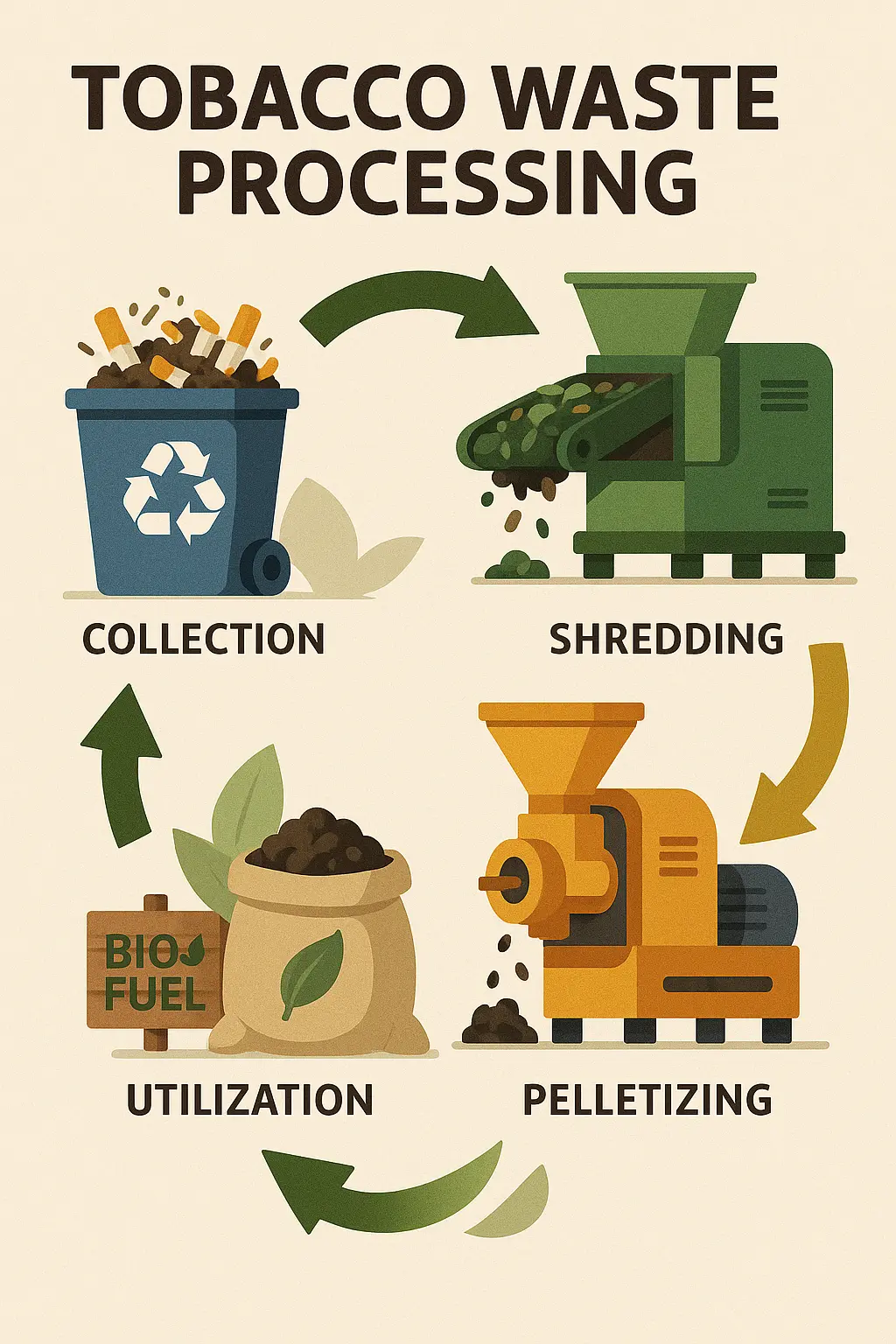
- Collection & preparation of tobacco waste
- Alkaline treatment using sodium/potassium hydroxide
- Solvent extraction using organic solvents
- Acid treatment forming nicotine sulphate
- Neutralization to regenerate nicotine
- Distillation & purification to achieve ≥99% purity
- Testing & packaging using GC and analytical instruments
Project Investment & Capital Requirements
Setting up a small-to-medium scale tobacco waste processing unit (100–200 kg/month) typically
requires INR 1.5 crore – 3 crore. Costs include:
- Land & building: INR 40–60 lakh
- Machinery: INR 50–80 lakh
- Laboratory setup: INR 15–25 lakh
- Utilities & ETP: INR 20–30 lakh
- Working capital: INR 25–40 lakh
- Licensing & contingencies: INR 15–20 lakh
Revenue Model & Profitability Analysis
A unit producing 100 kg of pharmaceutical-grade nicotine per month can generate:
- Monthly revenue: ~ INR 30 lakh
- Annual revenue: ~ INR 3.6 crore
- Margins: 15–25% depending on efficiency
- Payback period: 3–5 years
Scaling Opportunities
The business model scales extremely well. Entrepreneurs can:
- Add extraction vessels to increase output
- Backward integrate with farmers
- Forward integrate into bio-pesticides or NRT products
- Expand into other alkaloid extraction industries
6. Success Stories: Learning from India’s Business Titans for Tobacco Waste Processing Entrepreneurs
Dhirubhai Ambani: From Humble Beginnings to Industrial Empire
The story of Dhirubhai Ambani and the Reliance empire offers profound lessons for entrepreneurs
embarking on manufacturing ventures in Gujarat. Born in a small village in 1932, Dhirubhai began his
career as a gas station attendant in Yemen before returning to India in the 1950s to start Reliance
Commercial Corporation.
What distinguished Dhirubhai was his ability to identify opportunities in manufacturing. His decision in
1966 to establish a textile mill in Naroda, Gujarat, transformed Reliance from a trading company to a
manufacturing giant.
Key lessons for Tobacco Waste Processing entrepreneurs include:
- Prioritize manufacturing over trading to capture more value
- Integrate backward and forward to control quality and margins
- Scale strategically to create long-term competitive advantages
- Adopt innovative financing strategies such as public investment
- Leverage Gujarat’s infrastructure and port access for exports
Dhirubhai’s relentless commitment to scale, quality, and efficiency is directly applicable to establishing
and expanding nicotine extraction or tobacco waste processing units.
Mukesh Ambani: Continuing the Legacy of Manufacturing Excellence
Mukesh Ambani expanded Reliance’s manufacturing vision through world-class assets like the Jamnagar
refinery complex—the world’s largest refining hub.
Applicable lessons include:
- Use scale as a strategic weapon
- Deploy advanced technology to improve efficiency and sustainability
- Diversify but maintain strong operational fundamentals
- Choose geographically strategic locations
For tobacco waste processing ventures in Gujarat, embracing similar principles—especially technology
adoption and environmental compliance—can significantly enhance competitiveness.
Ratan Tata: Ethics, Innovation & People-Centric Leadership
Ratan Tata transformed the Tata Group into a global powerhouse through ethical leadership, innovation,
and strategic acquisitions like Tetley, Jaguar Land Rover, and Corus.
Key lessons for entrepreneurs:
- Think globally while building locally
- Prioritize innovation even if risks exist
- Commit to ethical practices and transparent operations
- Invest in employee well-being and community impact
Tobacco Waste Processing businesses benefit greatly from following Tata’s example—especially by
maintaining ESG (environmental, social, governance) standards.
Key Takeaways for Nicotine & Tobacco Waste Processing Entrepreneurs
- Leverage Gujarat’s strategic advantages
- Focus on quality and certifications
- Implement scalable manufacturing processes
- Prioritize innovation and sustainability
- Maintain long-term ethical and financial discipline
7. Professional Consulting Support: Why NPCS Partnership Matters in Tobacco Waste Processing
The Critical Role of Detailed Project Reports
Establishing a nicotine extraction or tobacco waste processing unit requires detailed planning, technical
expertise, financial modeling, and regulatory knowledge. This is where professional consulting support
becomes essential.
Niir Project Consultancy Services (NPCS) offers expert-backed Market Survey cum Detailed Techno-
Economic Feasibility Reports (DPRs) covering:
- Complete manufacturing process documentation
- Detailed market & demand analysis
- Process flow diagrams
- Capacity planning recommendations
- Raw materials & machinery specifications
- Complete financial projections & profitability analysis
These reports enable informed decision-making and assist with loan applications, regulatory approvals,
and investor discussions.
Market Research & Demand Analysis
NPCS provides comprehensive, data-driven insights into:
- Domestic and global market dynamics
- Emerging export opportunities
- Pharmaceutical, agricultural & research demand
- Price forecasts and competitor benchmarking
Machinery, Raw Materials & Vendor Support
NPCS reports include detailed specifications for:
- Extraction vessels
- Distillation columns
- Filtration units
- Analytical lab equipment
- Quality control systems
- Storage & safety equipment
They also help identify reliable suppliers of:
- Tobacco waste feedstock
- Solvents & chemicals
- Laboratory instruments
- ETP and safety systems
Financial Projections & Project Viability
NPCS provides comprehensive financial projections including:
- Projected P&L statements
- Balance sheets & cash flows
- NPV & IRR calculations
- Sensitivity analysis
- Payback period assessment
Ongoing Support
NPCS also offers post-report support such as:
- Technical clarifications
- Vendor recommendations
- Regulatory guidance
- Troubleshooting during setup
8. Regulatory Framework & Quality Standards for Tobacco Waste Processing Units
Licensing & Regulatory Requirements
Operating a tobacco waste processing or nicotine extraction facility requires compliance with multiple
regulatory frameworks:
- Industrial licensing under state industrial policies
- Registration with District Industries Centre
- Environmental clearances from the State Pollution Control Board
- Compliance with the Factories Act
- Drugs and Cosmetics Act (for pharma-grade nicotine)
- Hazardous Chemicals Rules
- Export license registration with DGFT
Quality Standards & Certifications
Pharmaceutical-grade nicotine must meet stringent purity standards such as:
- United States Pharmacopeia (USP)
- European Pharmacopoeia (EP)
- Indian Pharmacopoeia (IP)
Key certifications include:
- GMP (Good Manufacturing Practice)
- ISO 9001 (Quality Management Systems)
- ISO 14001 (Environmental Management Systems)
Export-oriented units may also require:
- USFDA registration
- European regulatory approvals
Intellectual Property Opportunities
Entrepreneurs can develop and patent innovations such as:
- Improved purification techniques
- Safer extraction solvents
- Eco-friendly process variations
- Nicotine derivatives & formulations
9. Risk Management & Sustainability Considerations in Tobacco Waste Processing
Business Risks & Mitigation Strategies
Like any industrial venture, tobacco waste processing and nicotine extraction carry certain business
risks. Understanding and mitigating these risks is essential for long-term sustainability.
Major risks include:
- Raw material supply risk: dependence on tobacco waste availability and prices
- Regulatory risk: strict compliance requirements for chemical processing
- Market risk: price fluctuations, competition, changes in global demand
- Financial risk: cash flow, debt servicing, capital overruns
- Operational risk: equipment breakdowns, safety hazards, process inefficiencies
Environmental Sustainability & Corporate Responsibility
Sustainability is not just compliance—it’s a competitive advantage. For tobacco waste processing
units, environmental and social responsibility practices include:
- Efficient solvent recovery & recycling systems
- Wastewater treatment & reuse
- Energy-efficient distillation columns
- Conversion of residual biomass into fertilizer or biofuel
- Worker safety programs and training
- Community development initiatives
Demonstrating strong ESG practices helps attract international clients, investors, and supply chain
partners.
Find the Best Idea for Yourself With our Startup Selector Tool
10. Implementation Roadmap: From Concept to Commercial Production
Phase 1: Project Conceptualization & Planning (Months 1–3)
The first phase involves detailed market research, preliminary technical evaluation, financial feasibility
analysis, site shortlisting, and engaging consultants for a DPR. Early conversations with banks begin
here.
Phase 2: Approvals, Financing & Detailed Engineering (Months 4–8)
- Secure industrial licensing
- Obtain environmental clearances
- Finalize land or industrial shed
- Arrange financing & finalize term loans
- Complete detailed engineering & procurement planning
Phase 3: Construction & Equipment Installation (Months 9–14)
- Complete civil construction
- Install extraction vessels, distillation units & utilities
- Set up QC laboratory
- Recruit and train staff
- Implement safety protocols
Phase 4: Trial Production & Optimization (Months 15–17)
- Commission machinery
- Run trial batches
- Optimize yield & purity
- Obtain product certifications
- Begin customer sampling & sales pipeline development
Phase 5: Commercial Production (Month 18 Onwards)
- Start production at controlled capacity
- Gradually scale output
- Expand domestic and export markets
- Monitor financial performance & plan expansion
- Explore forward integration opportunities
Conclusion: Gujarat — Where Opportunity Meets Infrastructure in Tobacco Waste Processing
Gujarat offers a rare combination of abundant raw materials, world-class infrastructure, progressive
government policies, and a mature industrial ecosystem—making it the best destination for establishing
a profitable tobacco waste processing unit.
Key highlights include:
- Massive growth potential in global & domestic nicotine markets
- Unmatched raw material access—45% of India’s tobacco production
- Strong export orientation & premium international pricing
- Attractive subsidies reducing project cost by 25–35%
- High profitability with 15–25% margins
- Rapid payback within 3–5 years
- Robust infrastructure, ports, and reliability in Gujarat
For aspiring entrepreneurs, the time to enter this industry is now. The next decade will see explosive
growth in nicotine demand, eco-friendly pesticides, and global biotechnology applications.
Begin your journey by preparing a detailed feasibility study, exploring Gujarat’s industrial zones,
understanding regulatory requirements, and partnering with experienced consultants like NPCS.
Gujarat is ready. The opportunity is yours.
Read More: From Waste to Wealth: The Profitable Extraction of Nicotine from Tobacco Waste
Key Metrics & Statistics Summary
Market Size Data
- Global Pure Nicotine Market: USD 624.1M (2023) → USD 1,166.7M (2032), CAGR 7.2%
- Indian USP Grade Nicotine Market: USD 25.82M (2024)
- Nicotine Pouches Market: USD 5.39B (2024) → USD 25.40B (2030), CAGR 29.7%
- India Nicotine Replacement Therapy Market: USD 33.09M (2023) → USD 75.74M (2030)
India’s Production & Trade Leadership
- India Tobacco Production: 772,200 metric tons (2022)
- India Tobacco Exports: USD 1.4B (FY24)
- Nicotine Exports: 3,900 shipments (highest globally)
- 45.7 million employed across tobacco value chain
Gujarat’s Dominant Position
- 45% of India’s tobacco production
- 350 million kg annually
- 41 ports including Mundra & Kandla
- 200+ industrial estates & 100+ private parks
- 200,000 km road network
Government Incentives
- Capital Subsidy: 30–35% of project cost
- Interest Subsidy: 5% MSMEs, 3% large units
- Power tariff concessions
Project Economics
- Total Investment: INR 1.5–3 crore
- Monthly Revenue: INR 30 lakh
- Annual Revenue: INR 3.6 crore
- Profit Margin: 15–25%
- Payback Period: 3–5 years
Product Pricing
- Agricultural-grade nicotine: INR 8,000–12,000/kg
- Pharma-grade nicotine: INR 25,000–40,000/kg
- Research-grade nicotine: premium pricing


