



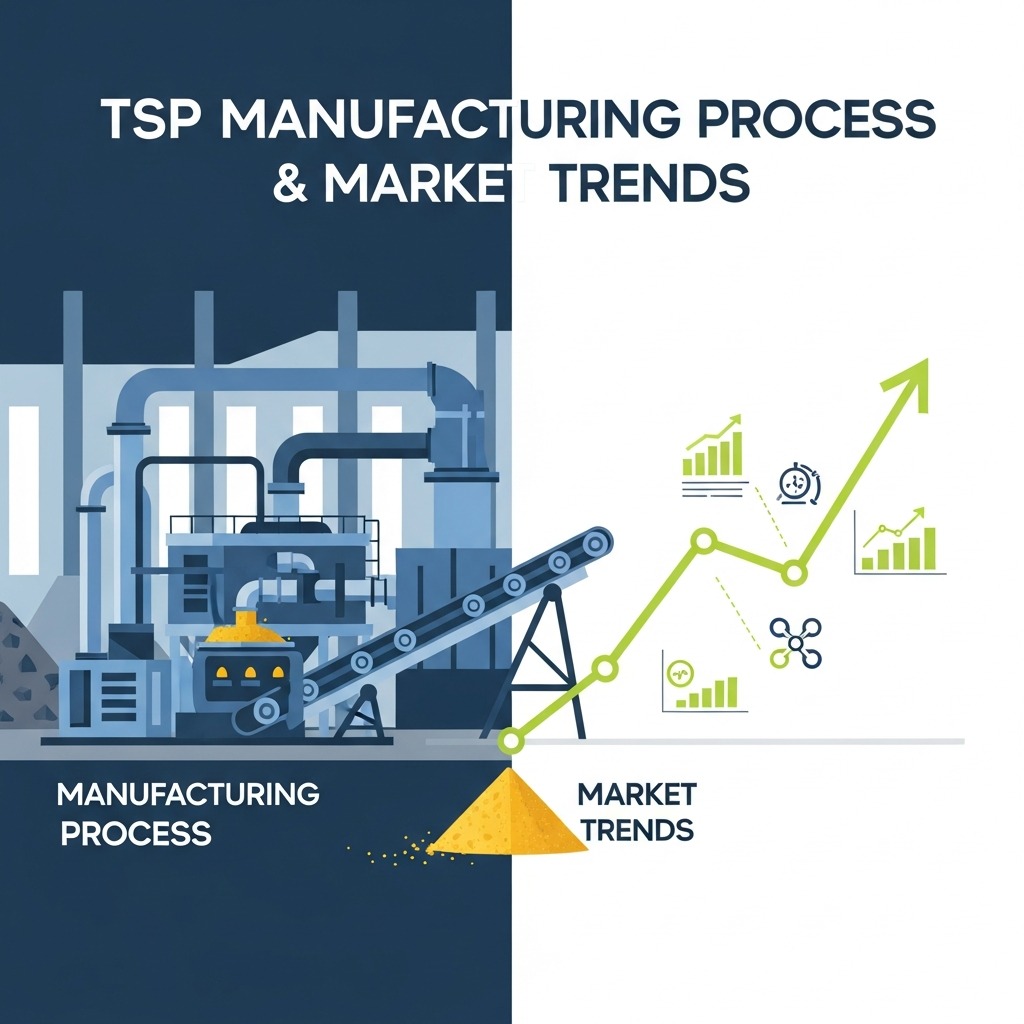
TSP Manufacturing Process: The agricultural sector globally is fast changing as a result of increased demands for food security, population growth, and a push toward more sustainable farming practices.
Phosphate fertilizers, especially, have remained essential for boosting yield and maintaining soil fertility. Triple Super Phosphate (TSP), a very efficient and concentrated phosphorus fertilizer, stands out among them, providing about 46% P₂O₅ in water-soluble form.
Hence, TSP manufacturing is a major potential business opportunity for entrepreneurs. The demand for fertilizers in the world especially in Africa, South Asia, and Latin America is soaring(TSP Manufacturing Process).
India is well-positioned to take the lead in TSP exports. The market has been supported by various factors such as favorable government policies, rising consumption trends, and competitive production costs. Therefore, this is a very good field for a startup and investors.
This article looks at the process of manufacturing TSP, the market outlook, exporting potential, government’s support, and its financial feasibility; it serves as an enlightenment of new-age industrial entrepreneurs that would lead them to success.

What is Triple Superphosphate-TSP Manufacturing Process
Triple Super Phosphate or TSP is a concentrated phosphorus fertilizer prepared by treating the phosphate rock with phosphoric acid.
In water-soluble forms, TSP supplies almost three times as much phosphorus as Single Super Phosphate (SSP), which contains only 16-20% P₂O₅, and therefore tends to be much more effective for crop growth.
Salient Features:
- Phosphorus content: ~46 (as P₂O₅)
- Granular/powder form
- Highly water-soluble and available for plants
- Application: Excellent for cereals, pulses, oilseeds, and cash crops
It is also one of the best and most cost-effective options for long distance transport as a unit of TSP holds a very highly concentrated nutrient per unit of fertilizer and is used very economically to apply to larger farms.
Read More: What Is the Future Outlook for the Indian Speciality Chemical Industry?
How is Triple Super Phosphate (TSP) Made?
The manufacture of Triple Super Phosphate (TSP) is purely a combination of chemical and mechanical processes.
By this phosphate rock is transformed into ultra concentrated phosphorus fertilizer under strictly controlled parameters of each step working toward optimum nutrient efficiency, solubility, and stability of the end product.
1. Raw Material Preparation
For this, the raw materials are rock phosphate (70-75% pure) and phosphoric acid (50-54% concentrated), with an original material testing for impurities and the particle sizes. More fine grinding of rock phosphate gives greater reactivity and more uniform conversion in the chemical process(TSP Manufacturing Process).
2. Reaction Process
In an acid reactor, phosphoric acid reacts with rock phosphate and produces monocalcium phosphate slurry (the active ingredient in TSP). Measurements of temperature, acid ratio, and mixing speed are closely controlled during the reaction to ensure completion with high recovery of phosphorus.
3. Granulation
The slurry is then routed into a granulator where it is mixed with recycled TSP dust and fines. This is where uniform granules (2-4 mm) suitable for field application begin to form. The right granulation imparts high flowability, reduced dust formation, and a good soil distribution.
4. Curing and Drying
Freshly granulated material is dried in rotary dryers at 90-100°C to remove excess moisture, and then72 cured in storage (for 4-6 weeks) to complete further chemical reaction leading to hardness, stabilization, and nutrient availability of the product.
5. Screening and Packaging
After curing, granules are passed over vibrating screens to separate the desired size fraction. Oversized and undersized granules are recycled back into the process. The final product is packed in HDPE/PP bags (usually of 50 kg) or shipped in bulk for export.
This brings automated production, in a controlled and efficient manner, of very high-grade Triple Super Phosphate fertilizer at 46% P₂O₅ having excellent solubility and high field performance for all major crops.
What to Expect from the Global Market for TSP-TSP Manufacturing Process
Global demand for phosphate fertilizers is forecasted with a growth of about 2.5-3% each year during the period from 2025 to 2030-and TSP has become a desired product in emerging agricultural economies since it is high in phosphorus content as well as efficient(TSP Manufacturing Process).
| Year | Global Demand (Million Tonnes) | Market Value (USD Billion) | Growth Rate (%) |
|---|---|---|---|
| 2024 | 22.5 | 9.8 | – |
| 2026 | 24.0 | 11.2 | 3.2 |
| 2030 | 27.5 | 13.9 | 3.5 |
CAGR (2025-2030): 3.2%
Regional Demand Share:
- Africa: 35%
- Asia-Pacific: 30%
- Latin America: 20%
- Others: 15%
Major Importing Regions
- Africa: Ethiopia, Nigeria, Morocco
- Latin America: Brazil, Argentina
- Asia-Pacific: Bangladesh, Vietnam, Myanmar
Phosphate-based fertilizers are considered the best fertilizer for improving soil fertility and thus these regions are viewed as promising export targets.
Read Our Reports: Click Here
Indian Fertilizer Industry Perspective-TSP Manufacturing Process
TSP Fits India-the largest consumer of fertilizers worldwide. Among these, the most crucial is phosphate fertilizers to generate the country’s food output.
Because the volume of TSP consumption in India is significantly lower than with DAP (Diammonium Phosphate), India has considerable potential to export this product to its immediate neighbors in South Asia and Africa.
According to the Ministry of Chemicals and Fertilizers (2023-24):
- Diversifying production of phosphatic fertilizers within the country.
- Encouraging investment in fertilizer plants from the private sector.
- Active support to Export-Oriented Units (EOUs).
All these will tie in with India’s fertilizer diplomacy under South-South cooperation, whereby TSP exports would also enrich the trade relations with developing nations.
Export Capacity: Opportunities Worldwide-TSP Manufacturing Process
TSP fertilizer is identified as a priority export product by India’s CAPEXIL (Chemical and Allied Export Promotion Council), and the reason for the same is a very strong global demand coupled with a favorable cost structure.
Benefits for Export:
- Geographically nearby: Easy logistics to Asia and Africa.
- Cost Competitiveness: Lower labor and energy costs.
- Policy Support: Export incentives and reduced import duties on raw phosphate.
Target Export Markets:
- Bangladesh: High consumption for rice and jute.
- Ethiopia & Nigeria: Expanding fertilizer subsidy programs.
- Vietnam & Myanmar: Growing rice-based agriculture.
These countries exhibit continual and large demand demand creating a great opportunity for Indian exporters(TSP Manufacturing Process).
Read Our Book: Click Here
Investment and Financial Outlook-TSP Manufacturing Process
To set up a TSP unit, one has to invest medium to high capital depending on the capacity of the plant.
| Parameter | Estimate Cost (INR Crores) |
|---|---|
| Land & Site Development | 20–25 |
| Plant & Machinery | 85–100 |
| Utilities & Infrastructure | 15–20 |
| Working Capital | 30–35 |
| Total Investment | 150–180 |
Operating Costs (Annual):
- Raw Materials: 55%
- Power & Utilities: 12%
- Labor & Overheads: 10%
- Packaging & Logistics: 15%
- Miscellaneous: 8%
Profitability Outlook:
- ROI: 15-18%
- Payback Period: 3-4 years
- EBITDA Margins: 12-15%
These factors thus instigate sustainable margins for the entrepreneur against an export-led return(TSP Manufacturing Process).
Challenges and Risks-TSP Manufacturing Process
With bright prospects, preparation by entrepreneurs for the following challenge is a must:
- Raw Material Reliance-India imports 80-85% of rock phosphate.
- Competition in the Market-DAP is a more recognized fertilizer.
- Conformance to Regulation-Plants must conform to environment and safety standards.
Sourcing efficiently as well as compliance take care of these challenges for long-term stability of business.
Read More: Opportunities in Triple Super Phosphate Manufacturing
What NPCS Offers Entrepreneurs to Thrive-TSP Manufacturing Process
Niir Project Consultancy Services (NPCS) provides guidance to entrepreneurs in planning, setting up, and developing of manufacturing enterprises in the fertilizer sector.
NPCS has a wide range of project reports and techno-economic feasibility studies entailing detailed manufacturing process inputs, raw material sourcing, plant layout and equipment selection, and financial projections such as ROI, repayment period, and break-even analysis.
With NPCS’s expert help, an entrepreneur may avoid costly mistakes, legal compliance, and achieve sustainable profitability in TSP production as well as other chemical manufacturing operations(TSP Manufacturing Process).
Find the Best Idea for Yourself With our Startup Selector Tool
Future Forecast-TSP Manufacturing Process
Triple Super Phosphate, with the strong government support for fertilizer exports, is poised to become the fulcrum for agriculture-oriented trade.
The ever-increasing demand for the product in both Africa and Asia would create endless opportunities for exports, while new entrepreneurs can also take advantage of good policy frameworks and ever-increasing international demand.
By investing in and developing efficient and export-oriented production strategies, Indian manufacturers can play a critical role in strengthening the global food security picture and profitable growth.
FAQs-TSP Manufacturing Process
Q1. Difference between TSP and DAP?
While TSP has phosphorus content of 46 percent P₂O₅, DAP fertilizer has N profits that are equal to 18 percent as well as 46 percent P₂O₅.
Q2. What is the minimum investment required to set up a TSP plant?
A small plant may require an investment of ₹50-70 crores and a large integrated plant may consume ₹150 crores and more.
Q3. Main raw materials for TSP production?
Rock phosphate/phosphate rock and phosphoric acid are important inputs.
Q4. Global demand for TSP by 2030 is possible?
It is expected to reach a global demand of 27.5 million tons by 2030, representing a CAGR (Compound Annual Growth Rate) of 3.2 percent.
Q5. NPCS can help new TSP manufacturers in which way?
NPCS has assisted entrepreneurs in confidently establishing profitable TSP plants by offering feasibility reports, process designs, and financial analyses.


