



Turmeric Processing Business India
Turmeric has transcended completely from its role as an Indian kitchen spice. In today’s global economy, it has become a strategic agro-industrial commodity that finds applications across food processing, pharmaceuticals, nutraceuticals, cosmetics and wellness products. This transformation has provided an excellent opportunity for entrepreneurs who wish to develop manufacturing businesses that are agriculture based but geared towards international demand.
For first generation founders and MSME planners, the value addition of turmeric is attractive due to the integration of secured raw material, multi-market demand, and export scalability. The real business opportunity is not on growing turmeric, but on converting it into standardised, certified and market-ready products.
Table of Contents
ToggleRead More: Handbook on Spices, Seasonings and Condiments Processing, Extraction with Kitchen Spices Manufacturing
Why Turmeric Is Strong Industrial Raw Materials
India is the world’s leading producer of turmeric and a leading exporter of turmeric in international markets. This leadership is backed by good climatic conditions, seasoned networks of farmers and existing spice-growing clusters in several states.
From the industrial point of view, turmeric is a pretty incredible base material, because:
- It supports low-risk commodity processing while as well as high-value advanced derivatives
- It has good storability once dried so can be processed all year round
- It provides diversification of food, health and cosmetic industries
This combination mitigates supply-side risk and allows entrepreneurs to have flexibility in their choice of business model.(Turmeric Processing Business India)
Market Demand Logic - Domestic and Global Pull
Domestic Market Momentum
Within India, the demand for turmeric is no longer restricted to the household kitchen. Industrial consumption is growing at an accelerated pace because food processors and pharmaceutical companies and nutraceutical manufacturers and cosmetics producers are increasing their industrial usage. This ensures stable offtake even during fluctuations in the market.
Key drivers of demand domestically are:
- Processed food and spice blending industries
- Health supplements, functional foods
- Ayurvedic formulations, cosmetic, personal care formulations
Because of the diverse sectors turmeric is used in, the demand for it is resilient and predictable.(Turmeric Processing Business India)
Export Demand and Worldwide Opportunity
Globally, turmeric has benefited from the growing awareness of health matters and the natural and plant-based ingredient trend. Buyers in North America, Europe, the Middle East and East Asia are increasingly getting processed and standardized turmeric products from India.
According to India Brand Equity Foundation, the export of turmeric from India keeps rising because of the increasing demand for its use in food, pharmaceutical and wellness industries. International buyers are now demanding consistency in quality, traceability, and compliance instead of high-volume supply of raw materials.
Export markets have great preference for:
- Stable colour and curcumin content turmeric powder
- And, organic and certified turmeric products
- Extracts and oleoresins of curcumin
These segments have higher pricing and long-term contracts.(Turmeric Processing Business India)
Read More: Handbook on Spices
Value Addition: Where the Profitability Lies
The profitability of turmeric business rises significantly in the higher value chain.
Turmeric Powder Processing
Turmeric powder manufacturing is typically the first step for entrepreneurs getting into this sector. The process in itself is fairly simple, but success depends upon maintenance of quality standards and the minimum losses during the drying and grinding processes.
A well managed powder unit has the advantages of:
- Moderate capital investment
- Faster break-even compared to extract plants
- Strong domestic as well as export demand
The consistent, clean and well-packaged supply from processors can earn them a lot more money than the raw turmeric traders can.(Turmeric Processing Business India)
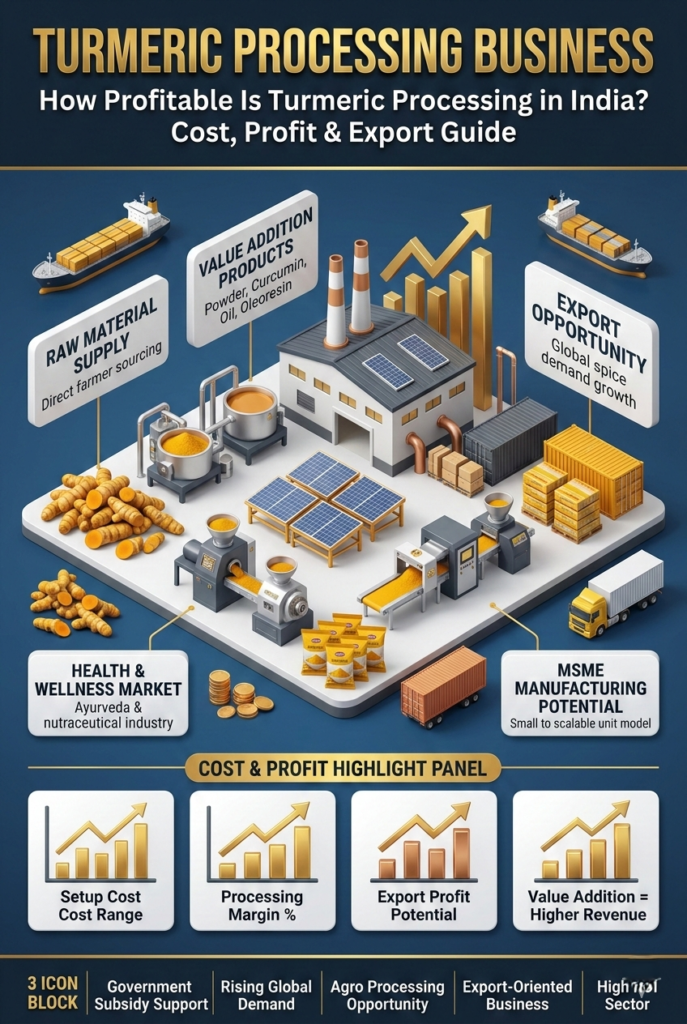
Curcumin Extraction and Sophisticated Processing
Extracting curcumin is a greater level of value addition. Curcumin is the active ingredient that gives turmeric its medicinal properties and is widely used in supplements, pharmaceuticals, cosmetics and functional foods.
While the investment and technical demands are increased, the benefits are clear:
- Very high per-kilogram value
- Strong export orientation
- Long-term agreements with world buyers
A leading example is Arjuna Natural Extracts Ltd which has gained a global reputation by focussing on research backed turmeric extracts. Their success shows how technology and certification can transform turmeric into a high end, global ingredient.(Turmeric Processing Business India)
Branded Turmeric Consumer Products
The branded turmeric consumer products market presents another fast expansion opportunity through its introduction. Consumers now prefer to spend extra money on reputable and high-quality turmeric products because e-commerce platforms and wellness-oriented lifestyles have become popular.(Turmeric Processing Business India)
Popular branded formats include:
- Turmeric health powders and capsules
- Wellness drinks – herbal teas
- Organic spice blends
- Skincare and cosmetic preparations
The business model demands better branding and marketing expertise for successful implementation while it allows business owners to earn retail profits and develop their brands over time.(Turmeric Processing Business India)
Feasibility & Profit Logic
From a financial perspective, turmeric value addition provides flexible points of entry. Powder processing units need relatively lower capital and promise faster returns. Extract and curcumin unit takes more investment but there are better margins. Branded product is a combination of profitability in manufacturing and marketing growth.(Turmeric Processing Business India)
A proper feasibility study should consider:
- Raw materials sourcing and price sensitivity
- Processing yields & wastage
- Here are some of the advantages of CCS: – Cost of certification and compliance
- Target market pricing, margins
Entrepreneurs who make decisions based on structured feasibility analysis and not on assumptions are greatly reducing risk.(Turmeric Processing Business India)
Export Readiness and Compliance
India’s turmeric export ecosystem is backed by policy initiatives and institutional support. According to the Department of Agriculture & Farmers Welfare, Spices continue to be a priority export segment for the country.(Turmeric Processing Business India)
For success in export, processors must concentrate on:
- Current certifications include: – Food safety and quality certification
- Traceability and documentation
- Standardised and consistent batch-level standards
Compliance not only allows for exports but better pricing power.
Final Insight
Turmeric value addition is no longer an activity which is small-scale spice activity. It is an exploitable manufacturing opportunity coupled with global health trends, export growth, and India’s strength in agriculture. Entrepreneurs that invest in processing capability, quality systems and market access can create sustainable, high margin businesses out of this golden spice.(Turmeric Processing Business India)
Frequently Asked Questions (FAQ)
Is processing turmeric for new entrepreneurs?
Yes, particularly when the emphasis is not so much on raw trading, but on value addition.
Which product of turmeric offers the most margin?
Curcumin extracts and branded consumer products generally provide the greatest profitability.
Is it necessary to have certifications to export turmeric?
Most international buyers demand certifications (GMP, HACCP, organic, etc.).
How can the supply of raw material be stabilized?
Contract farming and long-term sourcing agreements with farmer group(s) is effective.
Can turmeric processing be used together with other spices?
Yes, integrated spice units indeed tend to improve capacity utilization and reduce business risk.


