



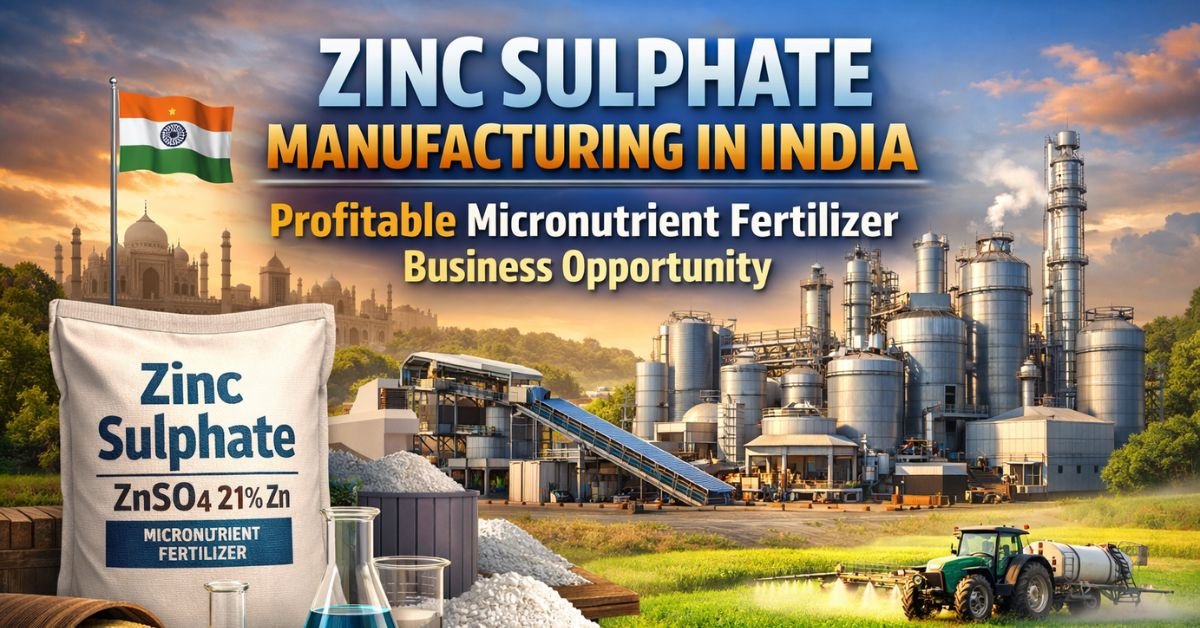
India’s fertilizer industry is slowly moving away from volume-powered production of macronutrients to value-based micronutrients. While nitrogen, phosphorus and potassium fertilizers are still essential, the long-term agricultural productivity is now highly coupled to soil micronutrient balance. Of all the micronutrients, Zinc deficiency has become one of the most serious limitations in crop production in India.
This changing agronomic reality has made constant demand for Zinc Sulphate Heptahydrate and Zinc Sulphate Monohydrate, making Zinc Sulphate manufacturing a strategic business opportunity for MSMEs, Startups, and Agro-Chemical Investors.
Why Zinc Deficiency is a National Agricultural Concern
Zinc is important in the activation of enzymes, formation of chlorophyll, synthesis of protein, and nitrogen in plants. When soil zinc levels are too low, critical, crops cannot absorb nutrients as well as if the macronutrients are applied in adequate amounts.
Soil health studies carried on in different parts of India indicate that almost 45 – 50% of cultivated land is zinc deficient, especially in intensively farmed states. This problem is prevalent among crops like wheat, rice, pulses, oilseeds, sugarcane, cotton, fruits and vegetable.(Zinc Sulphate Manufacturing)
Recognising this challenge, the Government of India has formally incorporated the use of zinc-based micronutrient fertilizers under the framework of Nutrient Based Subsidy administered by the Department of Fertilizers under the Ministry of Chemicals and Fertilizers.
To manufacturers, this policy support ensures:
- Institutional procurement by the State agriculture departments
- Stable long-term demand
- Less market volatility with the purely commercial agro-products
Why Zinc Sulphate Is most widely used Zinc Fertilizer
Among different zinc fertilizers, Zinc sulphate has received universal acceptance because of its agronomic efficiency and cost effectiveness. It dissolves readily in the soil moisture and spray solutions so it can be absorbed faster by plants.
Zinc sulphate is used in large amounts for:
- Soil Application in Field Crops
- Foliar spraying in horticulture
- Fertilizer blending and fertilizer customized nutrient mixtures
Its compatibility with a number of application methods makes it one of the favoured micronutrient fertilizers across India.(Zinc Sulphate Manufacturing)
Heptahydrate vs Monohydrate Market & Business perspective
Zinc sulphate is commercially manufactured in two major forms – heptahydrate or monohydrate. Although both are correct deficiency of zinc, commercial use of these differ.(Zinc Sulphate Manufacturing)
Zinc sulphate heptahydrate is a compound that contains approximately 21% zinc and contains higher levels of moisture. It is used mostly in direct application to the soil, and is widely distributed through government-supported channels for fertilizers.
Zinc sulphate monohydrate contains about 33% zinc concentration and is more concentrated and efficient. Due to reduced moisture, it has advantages in transportation, storage and blending.
In an entrepreneurial perspective:
- Heptahydrate provides volume stability by institutional domestic demand
- Monohydrate has the following benefits: – Higher margins and better export potential
Many successful manufacturers therefore run dual-product plants so as to balance profit and risk.
Overviews: Manufacturing Process
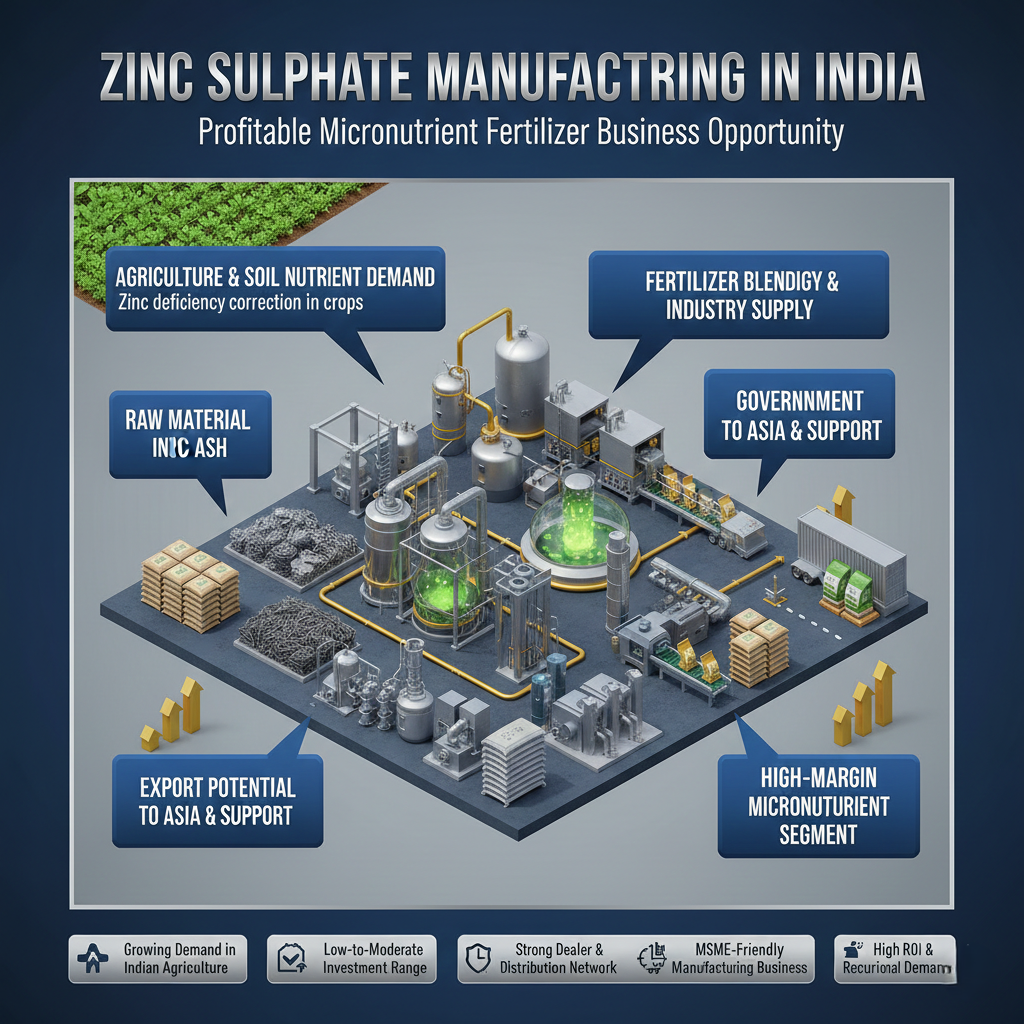
The manufacturing technology for zinc sulphate is well-established and is suitable for the small and medium-scale chemical units. The process involves reacting of zinc-bearing raw materials with sulphuric acid followed by purification and crystallization.
Common raw materials are as follows:
- Zinc ash
- Zinc dross
- Zinc oxide
- Sulphuric acid
After reaction and filtration, the crystallization product is zinc sulphate heptahydrate. Additional dehydration and drying means are employed to create monohydrate. The process does not require highly complex machinery and can be efficiently managed by proper technical supervision.(Zinc Sulphate Manufacturing)
Read More: Project Reports & Profiles
India's Advantage in the Zinc Industry
India has a strong zinc metal production base which gives domestic manufacturers an advantage of natural raw material availability. A major player in this eco-system is that of Hindustan Zinc Ltd. of Vedanta Group, promoted by Anil Agarwal.(Zinc Sulphate Manufacturing)
Large-scale zinc smelters produce by-products including zinc ash and dross that are ideal inputs for the production of zinc sulphate. Converting such industrial residues into micronutrient fertilizers is a cost effective waste-to-value manufacturing model, especially attractive for MSMEs.
Import Substitution, Export Opportunities
Despite being a significant zinc producing power, India still imports some finished micronutrient fertilizer products. Limited domestic processing capacity represents a strong opportunity for import substitution.(Zinc Sulphate Manufacturing)
At the same time there still is a strong export demand for zinc sulphate monohydrate in:
- Southeast Asia
- African agricultural markets
- Middle Eastern countries
These regions are facing similar soil micronutrient deficiencies and therefore zinc-based fertilizer is necessary to enhance the production potential of crops.
From an investment point of view:
- Domestic demand is policy backed
- Export demand is productivity driven
This dual demand structure helps in better long term sustainability of business.
Projecting Opportunities for MSMEs
Zinc sulphate manufacturing plants can be set up at relatively small capacities of 5-10 TDP, which is suitable for MSME entrepreneurs. Such units supply the fertilizer cooperatives, the agro-inputs distributors, and government procurement agencies.
Monohydrate-focused plants from which fertilizer blending units are supplied and export markets are generally able to achieve better realization per ton. Further value addition is possible in the form of downstream integration in micronutrient mixtures, chelated zinc products and crop-specific formulations.(Zinc Sulphate Manufacturing)
Profitability and Sustainability of Business
Compared to the bulk fertilizers, such as urea or DAP, micronutrient fertilizers function at a low volume, but are sold at premium rates. Competition is relatively less and the institutional demand helps in reducing the market uncertainty.(Zinc Sulphate Manufacturing)
As a result, the manufacturing of zinc sulphate usually provides:
- Better EBITDA margins
- Reduced exposure to global fertilizer price cycles
- Stable Long Term Growth Potential
Importance of Detail Feasibility Study
Before establishing a zinc sulphate plant, investors will need to consider sourcing of raw materials, utilities, handling of effluents, regulatory compliance, and market access. A professional techno-economic feasibility report is important to reduce execution risk.
Niir Project Consultancy Services provides a full-fledged Market Survey cum Detailed Project Reports including manufacturing process, machinery, market analysis and financial projections to make an informed investment decision.(Zinc Sulphate Manufacturing)
Conclusion
As Indian agriculture transitions toward balanced fertilization, zinc sulphate manufacturing is emerging as one of the most promising micronutrient fertilizer businesses. The combination of government policies and export demand together with accessible technologies creates growth potential which can be expanded by small and medium enterprises and industrial startups.(Zinc Sulphate Manufacturing)
In today’s fertilizer industry, profitability is driven not by volume, but by nutrient value—and zinc sulphate delivers both value and stability.
Frequently Asked Questions (FAQs)
Zinc sulphate manufacturing in MSMEs: is it suitable?
Yes, because of moderate capital requirements and sound institutional demand.
So, which variant is more profitable?
The greater margins are generally available with zinc sulphate monohydrate.
Can zinc sulphate be exported by startups?
Yes, especially the monohydrate used in fertilizer blends.
What are the main risks?
Raw material price volatility and environmental compliance.
Is there government support available?
Yes, zinc sulphate is under the Nutrient Based Subsidy framework.


