


Introduction: Zinc Sulphate Manufacturing Business
The sector of fertilizer industry in India is in a process of structural transformation. For decades agricultural productivity was based heavily on macronutrients like nitrogen, phosphorus, and potassium (NPK). While these nutrients are still essential, the over-application and the imbalanced use of them has led to a mass depletion of micronutrients in our soils. Of these, zinc deficiency has become the most widespread and costly limitation of crop productivity.
Scientific soil surveys, government data, and field-level yield responses have now proved that for improving agricultural output in India, it is not about increasing the quantity of fertilizers anymore, but about correcting the nutrient balance. This has put zinc sulphate, especially zinc sulphate heptahydrate and Zinc sulphate monohydrate, in high gear.
For entrepreneurs, MSMEs and first-generation industrial investors, the manufacturing of zinc sulphate is a rare confluence of agronomic need, government support, stable demand and export opportunity.
Table of Contents
ToggleRead More: The Complete Technology Book on Chemical Industries
Government Policies Actively Support Zinc Sulphate Consumption
India’s focus on balanced fertilisation is solidly supported by policy frameworks, not short-term initiatives. Nationwide soil testing programmes have been revealing the occurrence of deficiency of zinc throughout the major agricultural belts of the country, namely rice-wheat belt, cotton belt and intensive horticulture belt.
Under Soil Health Card scheme, Zinc is a priority micronutrient. Recommendations issued through government advisories is to routinely recommend application of zinc to restore soil fertility and to improve nutrient use efficiency. Furthermore, zinc enriched fertilizers are given a favourable consideration under the Nutrient Based Subsidy (NBS) system which is encouraging fertilizer companies and blending units to add zinc sulphate in their products.
From the perspective of investors, this policy environment is critical. It ensures that zinc sulphate demand is not speculative or cyclical, but is underpinned by national agricultural strategy – and so the business risk is significantly lowered – compared to a lot of other chemical products.(Zinc Sulphate Manufacturing Business)
Demand-Supply Gap: The Main Business Opportunity
Decades of NPK predominant fertilization have progressively depleted available Z in Indian soils. Today, the deficiency of zinc is seen in over half the cultivated land of the country, having a direct impact on food production and quality of grain and farmers’ income.
This has changed zinc sulphate from an optional micronutrient to a soil corrective needed in the soil. Annual consumption continues to go up as awareness spreads among farmers, extension agencies, and institutional buyers.
There are three obvious benefits for businesses from micronutrient fertilizers:
- Demand is Ag driven and recurring, not trend based
- Supply is backed up by government programs and institutional procurement
- Market competition is much less than bulk fertilizers
The demand/supply gap is persistent in nature and has been growing at a rate higher than the production capacity of the organized manufacturing sector; Zhongke is the main reason why zinc sulphate production has been identified as a high growth MSME manufacturing opportunity.(Zinc Sulphate Manufacturing Business)
Zinc Sulphate Heptahydrate vs Monohydrate: Product Positioning Is Everything
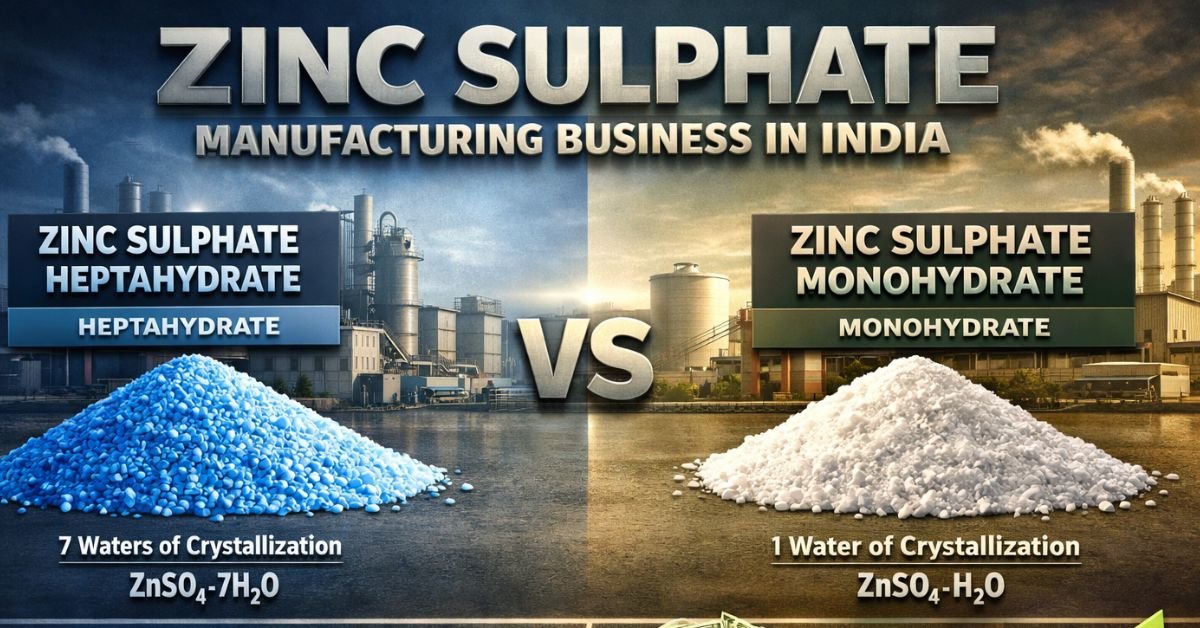
Understanding the difference between zinc sulphate heptahydrate and monohydrate is critical to commercial success.(Zinc Sulphate Manufacturing Business)
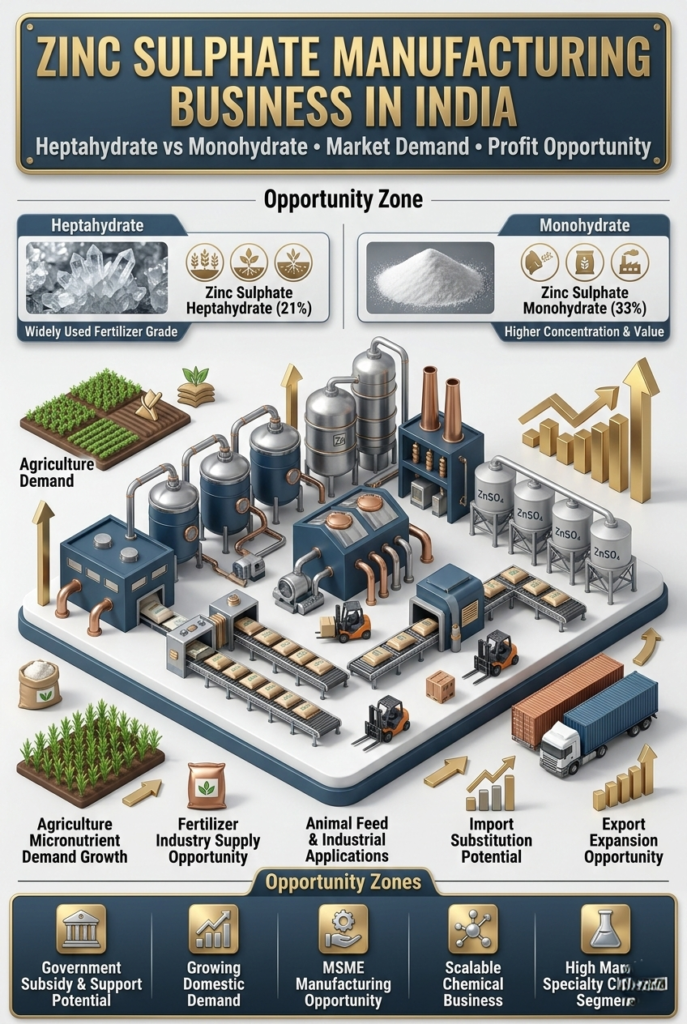
Zinc sulphate heptahydrate contains about 21% zinc. It is the grade used by most people for direct soil application and has long been purchased by state agriculture departments, fertilizer cooperatives and retail agro-input distributors. Its established acceptance creates stable domestic volumes and predictable off-take.
Zinc sulphate monohydrate, on the other hand, has a zinc concentration of about 33%, making it more concentrated and more efficient in terms of logistics. It is preferred by fertilizer blending units, water-soluble fertilizer manufacturers and exporters. Because of higher zinc content, monohydrate permits better formulation accuracy and less transport cost.
Strategic comparison:
- The heptahydrate is dominant in government supply and retail application of soil
- Monohydrate dominates institutional blending and exports
- Monohydrate usually has higher margins because of the concentration advantage
For startups, producing both variants in the same facility offers flexibility, risk diversification and access to multiple buyer segments.
Import Substitution and Export Potential
Despite good domestic demand, India continues to import a percentage of value added micronutrient fertilizer formulations, because of fragmented processing capacity. This leaves a very clear import substitution opportunity for domestic manufacturers.
At the same time, Indian Zinc Sulphate Monohydrate is getting acceptance in the international markets. Countries in the regions of southeast Asia, Africa, and middle east are all actively promoting zinc supplementation to combat declining soil fertility and concerns about food security.
Indian manufacturers enjoy access to competitive raw materials, built-in fertilizer knowledge and advantageous trade relations. This dual market advantage permits domestic sales, which ensures the minimum capacity utilization but exports add considerably to overall profitability.(Zinc Sulphate Manufacturing Business)
Read More: Project Reports & Profiles
Zinc Sulphate Manufacturing Business Opportunities for MSMEs and Startups
Zinc sulphate manufacturing is ideal for MSME scale manufacture. A typical heptahydrate plant in the 5-10 TPD range is capital intensive and requires a proven process technology. The manufacturing process consists of standard chemical unit operations such as reaction, crystallization, filtration, and drying – and therefore, it is accessible even for first-time industrial entrepreneurs.(Zinc Sulphate Manufacturing Business)
Monohydrate production involves more attention to dehydration control and quality consistency than it does, but provides greater realization and access to higher-value institutional buyers.
Beyond simple production, startups may engage in downstream integration into:
- Zinc based micronutrient mixtures
- Chelated zinc fertilizers
- Crop-specific customised nutrient formulations
These value-added products have higher margins and create better long-term relationships with their customers.
Profitability and Scalability Strengths
Unlike bulk fertilizers, the zinc sulphate manufacturing does not rely on the need for enormous volumes in order to be profitable. Smaller plant sizes, premium pricing and policy backed demand make for quicker break even and healthier EBITDA margins.(Zinc Sulphate Manufacturing Business)
As awareness of farmers and monitoring soil health grow, micronutrient consumption is expected to grow in a structural way in the long-term. This allows manufacturers to expand capacity incrementally and not have to contend with aggressive price wars that are common for commodity fertilizer segments.(Zinc Sulphate Manufacturing Business)
Industry Insight: Value Addition is the Key to Sustainable Margins
Large industrial groups have already shown the advantages of moving downstream into fertilizer-grade derivatives. Business leaders like Anil Agarwal had developed zinc metal operations under the aegis of the Vedanta Group into value-added zinc chemicals to enhance margins while mitigating commodity cycle risk.
For the startups, the takeaway is obvious: it is not volume-based manufacturing of commodities that will be profitable over the long haul, it is specialized, application-based manufacturing.(Zinc Sulphate Manufacturing Business)
Importance of a Feasibility Study in Detail
Before setting up a zinc sulphate manufacturing plant, entrepreneurs have to consider a number of technical and commercial parameters. These include sourcing of raw materials, process efficiency, energy usage, compliance to environmental laws, product quality standards and linkage to markets.(Zinc Sulphate Manufacturing Business)
A professionally prepared techno-economic feasibility report not only helps to enhance the viability of the project but also facilitates talks with banks, investors and institutional buyers.(Zinc Sulphate Manufacturing Business)
Conclusion
The agricultural strategy in India focuses on achieving balanced micronutrient levels which makes zinc sulphate manufacturing a top chemical processing opportunity for startups and MSMEs. The business exists as a future-ready enterprise because it has all necessary components including policy-based demand and export capabilities and simple technology and high-value products.(Zinc Sulphate Manufacturing Business)
The present-day fertilizer production process requires manufacturers to achieve success through their ability to create better nutrient value products which allow them to produce fertilizers at a higher rate.(Zinc Sulphate Manufacturing Business)
Frequently Asked Questions (FAQs)
Is zinc sulphate manufacturing suitable for MSMEs?
Yes. The business needs moderate capital together with established technology because it operates within an environment of constant institutional demand.
Which variant offers better profitability?
Zinc sulphate monohydrate generally offers higher margins because of its increased zinc content and its high demand for export.
Can startups export zinc sulphate?
Yes. Fertilizer-grade monohydrate is widely accepted in international fertilizer blends.
What are the major risks?
Raw material price volatility and regulatory compliance are the primary risks.
Is government policy supportive?
Yes. Zinc sulphate monohydrate generally offers higher margins because of its increased zinc content and its high demand for export.


