





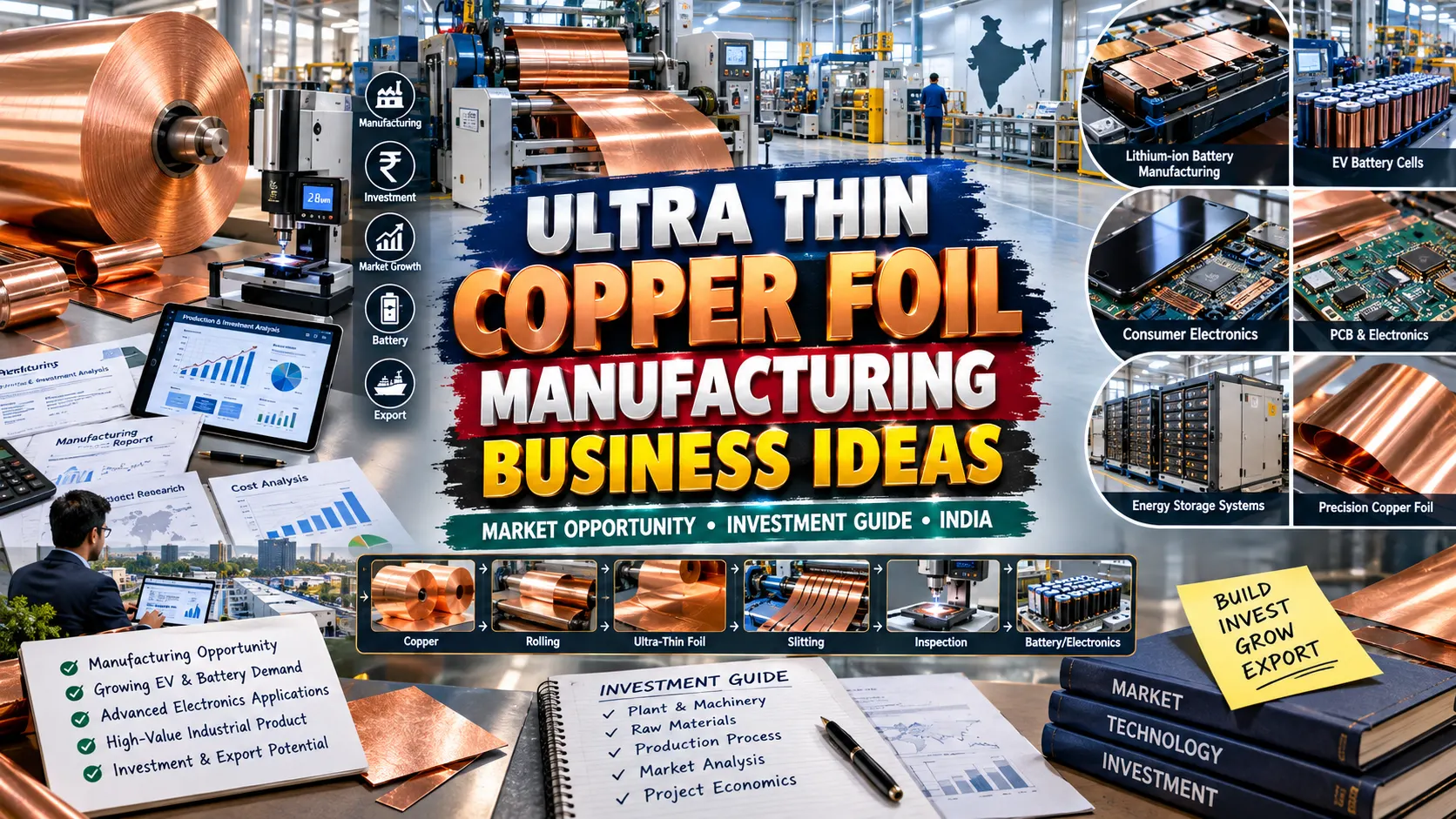
Why Ultra Thin Copper Foil Is One of the Smartest Business Ideas Right Now
India’s electronics manufacturing revolution has created a surge in demand for materials that have not seen the light of day before. Ultra thin copper foil, a high-value, high-precision industrial material used in things like lithium-ion batteries and flexible printed circuit boards can offer tremendous opportunity to startup founders and manufacturing investors looking for business ideas with a solid foundation.
The global push toward electric vehicles, 5G infrastructure, consumer electronics, and renewable energy has made ultra thin copper foil an indispensable raw material. Yet India still imports the vast majority of its requirement. That gap between surging domestic demand and limited local production is precisely where opportunity lives.
This article examines the manufacturing opportunity, government policy support, viable business models for different investor profiles, trade dynamics, and what serious entrepreneurs need to know before entering this sector.
Why Ultra Thin Copper Foil Is a High-Priority Manufacturing Opportunity
The Material Behind Every Modern Electronics Product
Ultra thin copper foil — typically ranging from 6 microns to 35 microns in thickness — is an critical input material in printed circuit boards (PCBs), lithium-ion battery anodes, electromagnetic shielding films, and flexible electronics. Modern smartphones, electric vehicle batteries, laptops, and base stations for 5G cannot exist without this material. The thinner the foil, the higher the technical precision required. This is precisely why global production is concentrated in a handful of specialised manufacturers in Japan, South Korea, Taiwan, and China. India’s domestic production is negligible vis-a-vis actual demand.
Market Demand Drivers Are Exceptionally Strong
Several powerful demand drivers are pushing consumption of ultra thin copper foil upwards simultaneously. Electric vehicle battery production is seeing a steep rise across India, driven by both policy and private investment. The government’s PLI scheme for advanced chemistry cell batteries is pulling demand for copper foil used in battery anodes. Domestic PCB manufacturing is rising too, supported by the PLI scheme for electronics components. 5G rollout across Indian cities requires a massive expansion in base station infrastructure, each of which uses copper foil based PCBs extensively. Flexible electronics, wearables, and IoT add another layer of growth. All of these sectors are rising simultaneously, and they all drive demand for ultra thin copper foil.
Government Policies and Incentives Supporting the Ultra Thin Copper Foil Business
PLI and MSME Schemes Aligned with Electronics Manufacturing
The Indian government has a clear stance in support of electronics manufacturing and battery production, two of the biggest end-use sectors of ultra thin copper foil. The Production Linked Incentive (PLI) Scheme for Advanced Chemistry Cell (ACC) Battery Storage offers financial incentives to manufacturers building domestic battery supply chains — which directly benefits copper foil producers who supply into this ecosystem.
The PLI Scheme for Large Scale Electronics Manufacturing offers strong downstream demand. Companies investing in PCB or electronics assembly under PLI will see their copper foil sourcing requirements rise.
For small and medium manufacturers, the MSME Credit Guarantee Fund Scheme offers collateral-free loans up to ₹2 crore — a practical financing route for setting up a copper foil processing/ rolling unit. The Technology Upgradation Fund Scheme (TUFS) could apply where machinery import or upgradation is involved.
Make in India and Atmanirbhar Bharat Alignment
The copper foil sector fits right into the Make in India electronics initiative, which is aimed at reducing import dependency in critical components. Entrepreneurs entering this space can expect a supportive policy environment and access to export incentives and technology import.
DPIIT’s sector-specific guidelines for electronic components offer clarity on FDI norms and technology tie-up frameworks, relevant for those planning joint ventures with foreign copper foil technology providers.
Business Ideas for Entrepreneurs Entering the Ultra Thin Copper Foil Sector
This section presents six distinct business models, all centred around ultra thin copper foil, which entrepreneurs can consider based on their capital capacity, technical expertise, and market access.
Business Idea 1 — Small-Scale Electrodeposition Copper Foil Manufacturing Unit
The easiest business entry is setting up a small-scale electrodeposition plant for producing ultra thin copper foil. Electrodeposition — or electroforming — is the primary production technique, where copper ions from a copper sulphate solution are deposited onto a rotating titanium drum. The drum surface is peeled continuously to produce foil in the 6–35 micron range. A small unit producing 18–35 micron foil for PCB applications is technically achievable at the micro or small enterprise level.
Such a unit would target domestic PCB manufacturers, electronics component assemblers, and industrial shielding product makers. This business model addresses actual import substitution. Buying foil from China or Japan is the option for buyers in India, which means a locally-produced equivalent at competitive quality can find real commercial interest. Entrepreneurs considering this idea should plan water and chemical management systems, as electrodeposition involves controlled electrolytic baths. However, this is standard industrial chemistry with well-documented process engineering, available through technology consultants.
Business Idea 2 — Contract Manufacturing and Toll Processing for Large Electronics Companies
Not every entrepreneur needs to own the full production line. A contract manufacturing model, also called toll manufacturing, allows an entrepreneur to set up copper foil processing capability and offer it as a service to larger companies. In this structure, the client supplies the raw copper cathode or copper wire, and the contractor performs the rolling, electrodeposition, slitting, and surface treatment operations on a fee basis. This model dramatically reduces working capital requirements, as the contractor does not need to own raw material inventory.
It also reduces sales complexity — instead of chasing hundreds of small buyers, the entrepreneur works under long-term contracts with a handful of anchor clients. Indian electronics groups and PCB manufacturers that currently import finished foil may be interested in toll arrangement if it allows them to have more control over quality and reduce import lead times. The entrepreneur’s revenue model is service-fee based, typically per kilogram of processed foil, with the margin derived from operational efficiency rather than raw material trading.
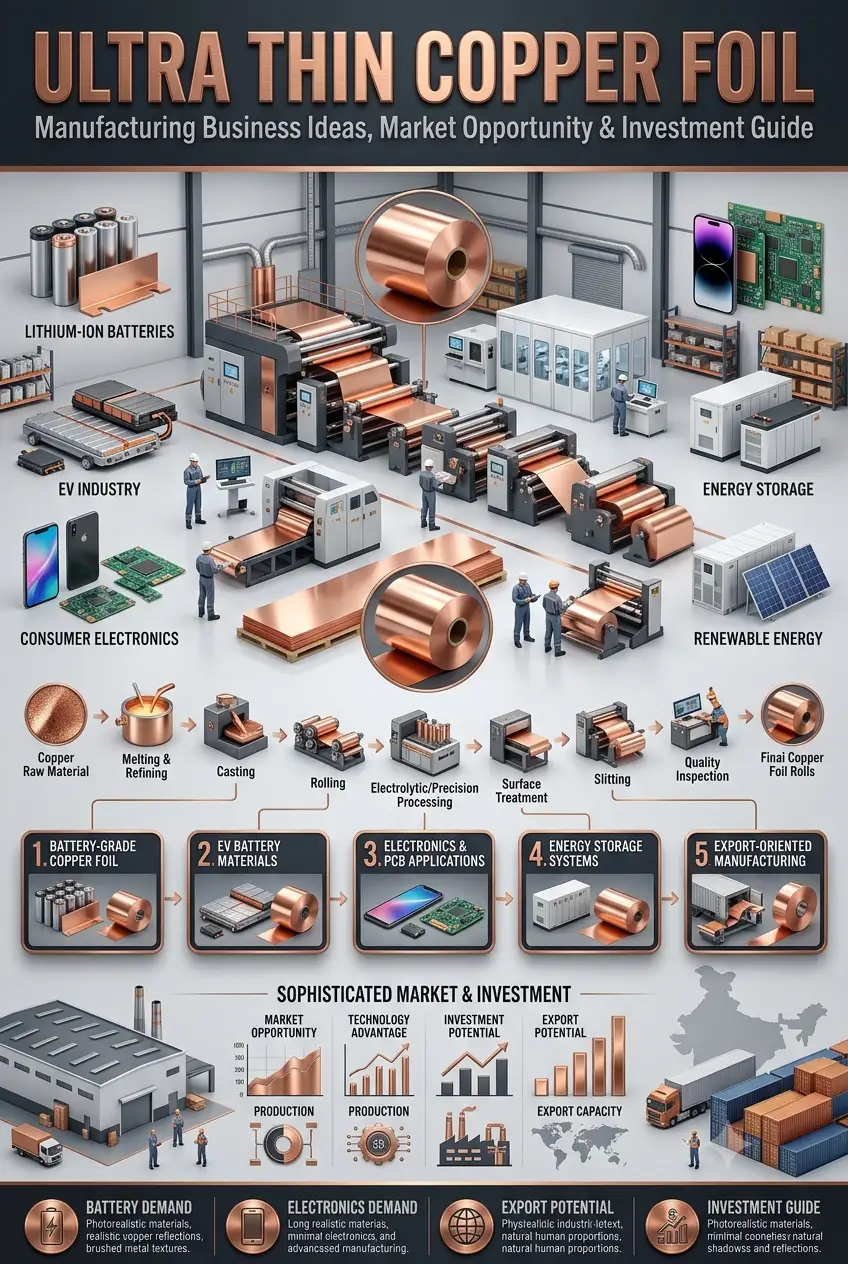
Business Idea 3 — Copper Foil Slitting and Converting Unit for PCB and Battery Makers
Ultra thin copper foil comes from primary producers in large master rolls of specific widths. However, end users — PCB manufacturers, battery cell assemblers, flexible electronics makers — require foil in precise widths, lengths, and wound tensions that match their production equipment. A slitting and converting unit bridges this gap. This business model involves procuring master rolls (domestically or via import), precision-slitting them to customer specifications, and supplying converted rolls with appropriate packaging for sensitive materials.
The investment intensity is lower than a full electrodeposition plant, the skill requirement is more accessible, and the market addressable is broad. For entrepreneurs who want to enter the copper foil value chain with lower capital exposure, while still building genuine sector expertise and customer relationships, slitting and converting is an excellent starting point. Over time, this operation can evolve into upstream production as capital accumulates and market knowledge matures.
Business Idea 4 — Specialty Surface-Treated Copper Foil for High-Frequency PCBs
Standard copper foil works well for basic PCB applications. But high-frequency PCBs — used in 5G equipment, radar systems, automative electronics, and aerospace applications — require copper foil with specially treated surfaces that reduce signal loss at high frequencies. This is called low-profile or very-low-profile (VLP or HVLP) copper foil, which commands a significant price premium over standard grades. Establishing a surface treatment operation — which involves roughening, oxidation-resistance treatment, and adhesion promoter coating on standard electrodeposited or rolled annealed foil — allows a manufacturer to carve into a high-value, lower-volume segment.
Domestic demand for such specialty grades is currently met almost entirely through imports. Entrepreneurs with access to materials science expertise or a technology partnership with an international foil maker can profitably target this segment, taking advantage of 5G infrastructure rollout creating consistent domestic demand. This is a genuinely differentiated manufacturing opportunity.
Business Idea 5 — Rolled Annealed Copper Foil Unit for Flexible Electronics Applications
Electrodeposited copper foil, while dominant, is not the only type. Rolled annealed (RA) copper foil is produced by mechanically rolling copper strip to ultra-thin gauges, then annealing it to restore ductility. RA foil has superior flexibility and bend endurance — making it essential for flexible printed circuits (FPCs) used in foldable smartphones, medical wearables, and portable devices. Setting up a rolled annealed copper foil operation requires a different capital configuration (precision rolling mills, annealing furnaces, cold rolling equipment), but it serves a distinct market segment with different competitive dynamics.
Japan and South Korea currently dominate RA foil globally. India imports essentially all of its RA foil requirement. An entrepreneur who can set up even a small RA copper foil operation aligned with domestic FPC manufacturers would occupy a structurally underserved position in the supply chain. The long-term business case is strong, given the growth of the flexible electronics market in India.
Business Idea 6 — Export-Oriented Ultra Thin Copper Foil Manufacturing Unit
India’s cost structure — particularly in labour, electricity tariffs in certain industrial zones, and government export incentives — can make an export-oriented copper foil manufacturing unit economically viable for targeting markets in South Asia, Southeast Asia, and the Middle East. These regions are expanding their own electronics manufacturing but lack domestic foil production.
An export-oriented unit (EOU) designation brings additional tax benefits, including customs duty exemptions on imported capital goods and raw materials, and simplified compliance through India’s Export Promotion Councils. By focusing on markets where Chinese and Japanese suppliers face longer logistics cycles or geopolitical friction, an Indian copper foil exporter can compete effectively on offer on lead time, price, and supply reliability. Entrepreneurs considering this model should work with international trade consultants and evaluate the specific grade requirements of target markets before finalising product specifications.
Import–Export Opportunity Analysis for Ultra Thin Copper Foil
India’s Current Import Dependence Is a Business Opportunity
India currently imports significant volumes of ultra thin copper foil, primarily from China, Japan, South Korea, and Taiwan. The main import categories include electrodeposited copper foil for PCBs and rolled annealed foil for flexible circuits. This sustained import dependence is an indicator that domestic supply is not meeting industrial demand.
According to Invest India’s electronics sector data, India is targeting a major expansion in electronics manufacturing output, which will proportionally increase copper foil consumption. Entrepreneurs who establish domestic production now are positioning themselves ahead of a demand curve that is only going to steepen.
Export Markets Represent a Parallel Revenue Stream
Beyond import substitution, the export opportunity for Indian copper foil manufacturers is real and growing. Bangladesh, Vietnam, Sri Lanka, and several African nations are expanding electronics assembly capacity but have limited access to quality copper foil from nearby suppliers. An Indian manufacturer that, once production quality is established and certified, can target these markets effectively.
The World Bank’s global value chain reports on electronics consistently highlight the importance of upstream materials in supply chain resilience — a trend that is actively creating opportunities for producers outside the traditional East Asian cluster. Furthermore, the IBEF electronics sector report at ibef.org/industry/electronics.aspx outlines how India’s growing role in global electronics supply chains opens upstream materials export corridors.
Indian MSME Success Stories in the Copper Foil and Advanced Electronics Materials Space
How Indian Entrepreneurs Have Built Niche Materials Businesses
Mitsui Kinzoku India (Indian subsidiary operations): While the parent is Japanese, the establishment of Indian processing and distribution infrastructure by advanced materials companies demonstrates that the Indian market actively supports high-precision copper materials businesses. Indian promoters who partnered with foreign technology providers in copper-based materials have built stable, long-term revenue streams by aligning with domestic electronics OEMs.
Glenmark Electronics (Copper Clad Laminates and PCB Materials): Indian entrepreneurs in the adjacent copper-clad laminate (CCL) space — which uses copper foil as a core input — have demonstrated that domestic value-added processing is commercially viable. Promoters like those behind several Maharashtra-based CCL processors made the strategic decision to localise foil sourcing early, which reduced their raw material costs and gave them supply security during global disruptions. The lesson for new entrants is clear: build supplier-of-choice relationships with downstream buyers early, before full production scale is achieved.
Precision Metals and Foils (Small-Scale RA Foil Processors, Pune Region): A cluster of small-scale precision metals enterprises in western Maharashtra has quietly built capabilities in copper strip slitting and thin-gauge rolling for electrical and electronics applications. These businesses — often promoted by first-generation engineers and entrepreneurs — started with slitting operations and gradually moved into value-added surface treatment. Their success model demonstrates the staircase approach: enter with lower capital, build expertise and customer relationships, then move upstream. This path is accessible to many MSME investors if they approach it methodically.
How NPCS Supports Entrepreneurs Entering the Ultra Thin Copper Foil Sector
We at Niir Project Consultancy Services (NPCS) work with startup founders and industrial investors who want to evaluate new manufacturing opportunities with clarity and confidence. For entrepreneurs considering entry into the ultra thin copper foil space, we prepare detailed Market Survey cum Techno-Economic Feasibility Reports (DPRs) that cover the full picture — from raw material sourcing and manufacturing process engineering to demand analysis, product mix recommendations, capacity planning, machinery specifications, financial projections, and profitability timelines.
Our reports are designed to help you answer the most important questions before committing capital: Is this project viable at your target investment level? What is the realistic demand in your target market? What machinery configuration suits your production goals? What are the key raw material dependencies and supply risks? How long before the project breaks even?
If you are a first-generation entrepreneur evaluating the copper foil space, or an investor looking to diversify into advanced materials manufacturing, our feasibility reports give you the analytical foundation to proceed with confidence — or to course-correct early.
Data Table — Ultra Thin Copper Foil Market and Production Overview
| Parameter | Detail |
| Product | Ultra Thin Copper Foil |
| Thickness Range | 6 microns to 35 microns (industrial grades) |
| Primary Types | Electrodeposited (ED) Foil, Rolled Annealed (RA) Foil |
| Key End-Use Sectors | PCB manufacturing, Li-ion batteries, 5G equipment, flexible electronics, EMI shielding |
| Key Import Countries (India) | China, Japan, South Korea, Taiwan |
| Domestic Demand Growth Driver | EV battery PLI, Electronics PLI, 5G infrastructure rollout |
| Primary Production Method | Electrodeposition (ED); Cold Rolling + Annealing (RA) |
| Key Raw Material | Electrolytic Tough Pitch (ETP) Copper Cathode / Copper Wire |
| Surface Treatments Available | Roughening, Oxidation-resistance coating, Adhesion promoter, VLP/HVLP treatment |
| Relevant Indian Policy Support | PLI ACC Battery, PLI Electronics, MSME Credit Guarantee, Make in India |
| Export Market Potential | Bangladesh, Vietnam, Sri Lanka, Middle East, Africa |
| Typical Buyer Profile | PCB manufacturers, battery cell makers, flexible circuit assemblers, EMI shielding converters |
| Competitive Gap in India | No large-scale domestic ED or RA foil producer; market substantially import-dependent |
| Quality Certification Required | IPC-4562 (PCB foil), IEC standards for battery foil; ISO 9001 for manufacturing systems |
Conclusion — Ultra Thin Copper Foil Is a Strategic Manufacturing Opportunity for India’s Next Industrial Wave
The case for entering the ultra thin copper foil sector is built on structural fundamentals, not speculation. India’s electronics manufacturing ambitions, its accelerating EV adoption, its 5G infrastructure buildout, and its broad import dependence for this specific material all point in the same direction. Demand is real, growing, and not adequately met by domestic supply.
For startup founders and MSME investors, the good news is that the sector offers multiple entry points. You do not need to begin with a full electrodeposition plant. A slitting and converting unit, a contract manufacturing arrangement, or a specialty surface treatment operation can all provide meaningful early revenue while you build expertise and customer relationships. The staircase approach — starting accessible, building capability, moving upstream — is well demonstrated by successful Indian entrepreneurs in adjacent materials sectors.
Government support, while not a substitute for sound business planning, is meaningfully aligned with this sector through PLI schemes, MSME credit access, and export promotion frameworks. Additionally, ILO’s global employment and manufacturing reports consistently highlight that advanced materials manufacturing generates quality, stable employment — a consideration that resonates with state governments when evaluating industrial project applications.
The window of opportunity in ultra thin copper foil is open. Large players have not yet moved aggressively into domestic production. Import-dependent buyers are actively looking for reliable Indian alternatives. The technology is accessible through licensing and partnerships. And the policy environment is supportive.
Entrepreneurs who conduct rigorous feasibility analysis, align their entry model with realistic capital and capability levels, and build customer relationships early will find this to be a rewarding manufacturing business for years to come.
If you are evaluating this opportunity seriously, speak with an experienced industrial consultant before finalising your project approach. A professionally prepared feasibility report can save you years of trial and error — and potentially crores of capital from avoidable missteps.
References: Ministry of Electronics and IT — PLI for Electronics | PIB — PLI ACC Battery Press Release | Make in India — Electronic Systems | DPIIT Policies and Schemes | IBEF Electronics Sector Report | World Bank — Global Value Chains and Competitiveness


