





The food processing industry in India is one of the best hidden growth stories and meat; poultry and fish processing is at its heart. The segment is worth considering for entrepreneurs looking for a manufacturing opportunity that has real and persistent demand, and not a fad.
A Market Built on Scale and Consumption
India is home to the world’s highest livestock population which determines everything downstream! Cattle, buffaloes, goats, sheep, and pigs and poultry provide a raw material base which is matched in few countries. It is seen that among all the livestock in India, the poultry sector is one of the fastest growing, with increased demand for protein, urbanisation, and convenience foods. Fish and seafood also have a similar trajectory with inland aquaculture and coastal production.
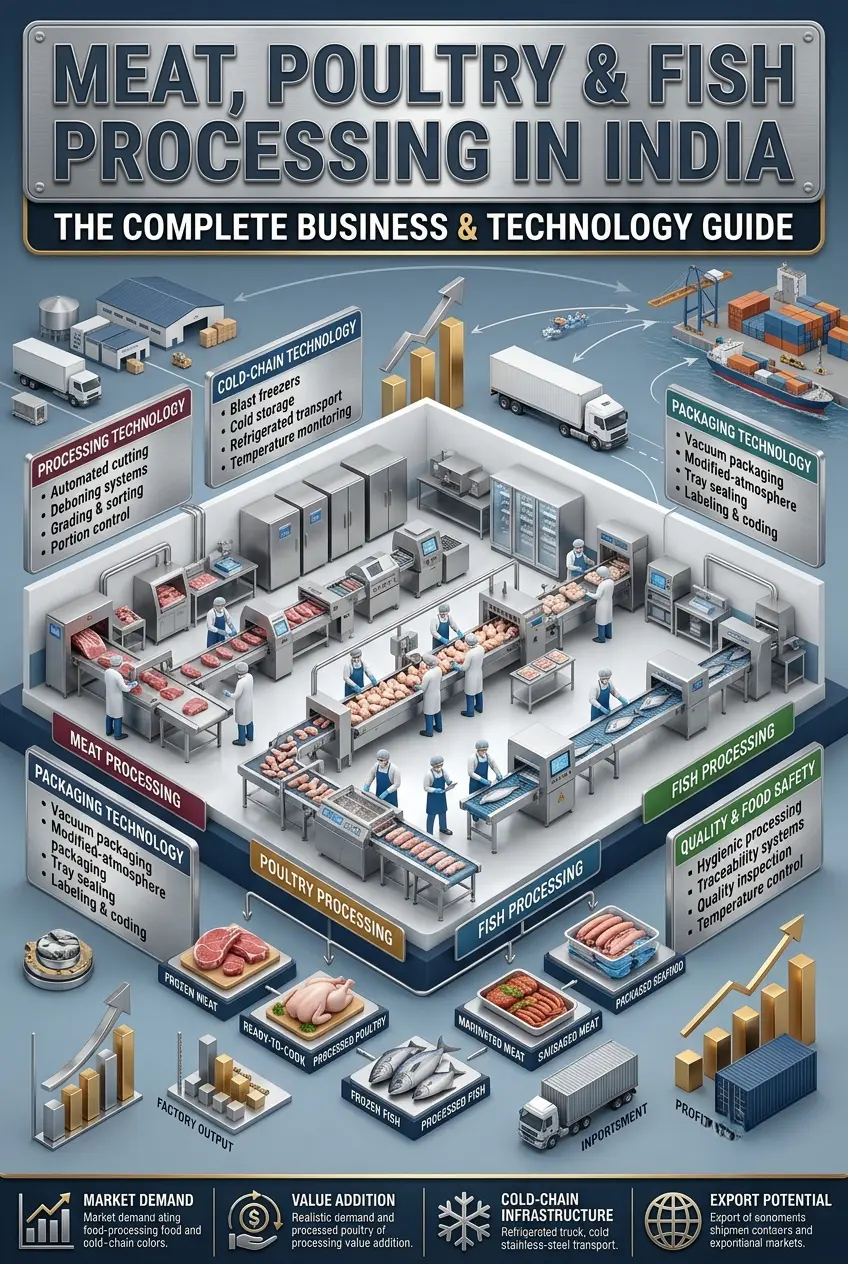
The market is interesting for a new entrant because there is an unmet demand for the rig between raw production and organised processing. Much of the Indian meat industry remains unorganised, comprising service abattoirs, local butchers and small-scale operators lacking access to modern processing, chilling or packaging facilities. That’s where opportunity resides. Businesses that modernise first seem to grab the lion’s share as consumers’ demand for hygienically processed, correctly packaged and traceable meat and fish products increase.
Why Processed Meat, Poultry and Fish Products Are Gaining Ground
Health consciousness is as important as taste to consumers today. Consumers demand meat and fish products that are lower in fat, salt and cholesterol and retain good flavour and shelf life. This has forced processors to come to a better grasp of formulation science – curing, fermentation, smoking and cooking techniques are not only a tradition, but can be controlled and repeated and satisfy today’s quality criteria.
Meanwhile, ready-to-eat and ready-to-cook meat and poultry products – such as sausages, kababs, patties, marinated products, and frozen fish fillets – have made their way from the niche food markets of urban areas to the mainstream food chains of quick-service and retail outlets. This change provides small and medium manufacturers an opportunity to cater to their retail and institutional customers ranging from local supermarkets to hotels, caterers and export houses.
Business Potential for Entrepreneurs, MSMEs and Investors
The draw of this area for a person considering a manufacturing job application is because of a couple sensible elements:
- More diverse product line: Production of cured meats, sausages, smoked products, frozen fillets, canned products, and value-added convenience foods at a single facility, which is considered to be more diversified than relying on a single product line.
- Relevance to export: Buffalo meat, poultry and processed seafood already have export demand, mainly from the Gulf countries and other Asian countries, owing to Indian geographical location and competitive input cost.
- Scalable entry points: A processor can begin with a relatively small, relatively modern unit (such as mechanical hoist facilities, simple chilling, rudimentary packaging) and expand to a full modern, export plant as volume increases.
- The recurring themes in Indian food processing have been the abattoir modernisation and development of cold-chain systems, which are conducive to easier access to institutional finance and infrastructure for organised processors.
- MSME friendly project size: Meat poultry and fish processing units can be planned at MSME level with the capital investment, choice of machines and manpower being feasible for the first-generation entrepreneurs.
All of this potential, however, is not readily realised without technical skills. The processing of meat and fish takes no shortcuts, as wrong curing temperatures, dirty processing facilities or a poorly formulated product can ruin an entire batch or lead to a food-safety problem. That’s where the technical knowledge that has been organized is crucial to differentiate between a hobbyist and a business that can make money.
Where Most First-Time Entrepreneurs Get Stuck
Speak to anyone who has attempted to enter into this industry without having any experience in the food technology industry, and you will find that there is a common theme here. They know what the opportunity is in the marketplace, but have a problem with the operational detail: What the strength of pickle to use on hams versus bacon? What happens to make a good meat emulsion for sausage? Which is the best way to chill and freeze fish fillets to reduce drip loss? What is the best way to make convenient products such as chicken tikka, kofta or seekh kabab, in terms of uniformity, at commercial scale?
These aren’t questions that a standard business plan can answer. They need process level detail like that captured over many years in the manufacturing process within each meat, poultry and fish category.
Introducing The Complete Technology Book on Meat, Poultry and Fish Processing
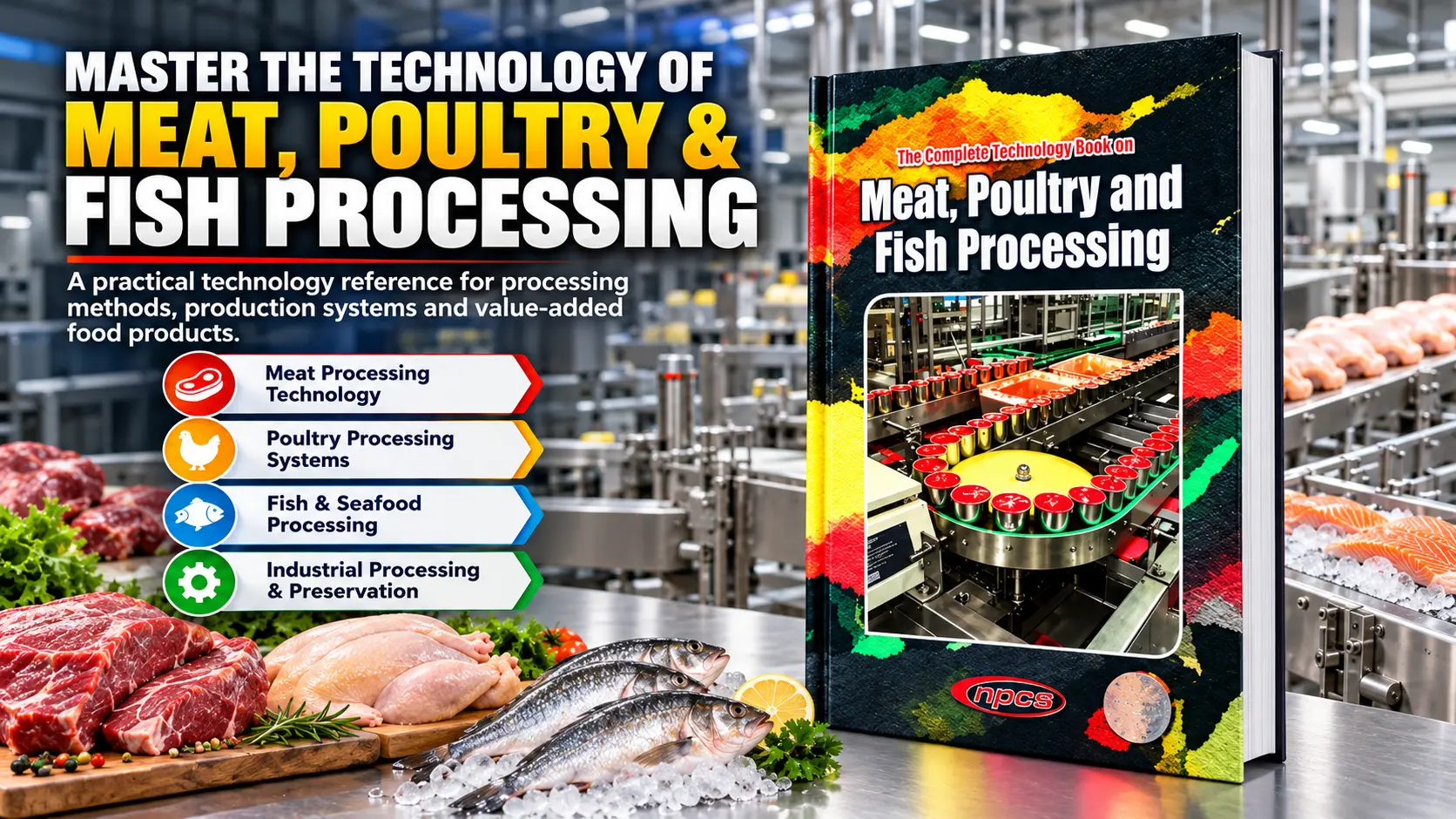
That’s the space that The Complete Technology Book on Meat, Poultry and Fish Processing (2nd Revised Edition) fills. This 488-page reference was compiled specifically for entrepreneurs, technocrats, food technologists and processing industry professionals who seek knowledge on the subjects for their practical and production needs rather than academic theories. Authored by the NPCS Board of Consultants & Engineers, the book has been published by NIIR Project Consultancy Services (NPCS).
The book begins with a basic overview of the Indian meat industry, its livestock resources, production trends and the structural aspects of the industry, followed by the science behind each of the meat processing decisions: the structure and composition of meat tissue, the changes that occur after death, the colour of meat, and the water-holding capacity of meat. From there, it goes into practical territory.
Readers get complete, illustrated coverage of:
- Meat cutting, packaging and preservations methods such as vacuum and modified atmosphere packaging.
- Cured, smoking, and commercial processing of ham, bacon, and cured beef products, using formulation that takes regulations into account
- Detailed formulas for sausage, including salami, frankfurters, bologna, liver sausage and more, as well as fresh, dry, and semi-dry sausage manufacturing methods and formulas, and cooked-smoked sausage.
- From pre-slaughter handling to dressing to popular convenience products such as tandoori chicken, chicken barbecue, kofta and sausages, all the way through to the final processing stage.
- Fish and seafood processing, including salting, pickling, canning, freezing and smoking of various fish and seafoods and in various formats
- Fish processing, including shrimp, crab, oyster, lobster and scallop processing
- Adulteration and spoilage of meat (physical, chemical and laboratory method of identification)
- Machinery and equipment references including references of suppliers for sourcing purpose
What sets this book apart is its format. Rather than reading like a textbook, it functions closer to a technical manual — step-by-step processing procedures, formulation ratios, temperature and timing specifications, and troubleshooting notes drawn from real manufacturing practice. For someone preparing to set up a unit, write a project report, or simply understand what a viable product line looks like, this level of detail is difficult to find condensed into a single reference.
Who Should Read This Book
This book is built for:
- First-generation entrepreneurs evaluating a meat, poultry, or fish processing business and needing a realistic picture of processes and product options
- MSME owners looking to diversify an existing food business into meat or fish-based product lines
- Food technologists and quality professionals who need a consolidated process reference
- Investors and consultants assessing project feasibility in the meat and seafood processing space
- Export-oriented businesses exploring value-added meat and fish products for international markets
Why This Book, Why Now
The organised meat, poultry and fish processing segment in India is still young enough that a well-prepared entrant can build a genuine competitive position. But “well-prepared” is the operative phrase — this is not an industry that rewards guesswork. A resource that lays out formulations, processing sequences, and product categories in one place removes a significant chunk of the trial-and-error that typically eats into a new processor’s time and capital.
For entrepreneurs serious about this sector, this book is less a reference to browse and more a working manual to return to at every stage — from initial product planning through to scaling a processing line.
Purchase the Book
The Complete Technology Book on Meat, Poultry and Fish Processing (2nd Revised Edition) is available now.
Author: NPCS Board of Consultants & Engineers
Publisher: NIIR Project Consultancy Services (NPCS)
Price: $150 (Offer Price: $39.86)
You can purchase the book through the following channels:
- NIIR / NPCS Website: Buy on niir.org
- Amazon: Buy on Amazon.in
- Flipkart / Entrepreneur India: Buy on entrepreneurindia.co
If you’re planning a meat, poultry, or fish processing venture — or already running one and looking to expand your product range — this book belongs on your shelf. It’s not a light read; it’s a working reference built to save you the cost of learning by mistake.
Your Investment Deserves the Right Opportunity
Every serious investment begins with choosing the right sector and the right business model. With hundreds of industrial opportunities available across India’s manufacturing and clean-energy landscape, making the most informed choice is crucial. Niir’s Startup Selector tool helps entrepreneurs, MSMEs and investors identify the most suitable business opportunities based on their investment capacity, location and interests, ensuring their capital is directed toward the venture with the best fit.


