





Pine Chemicals and Oleoresin
Before petrochemicals transformed the chemical industry, trees were the source of raw materials, including rosin, turpentine and a variety of resins and acids that form an important part of the chemical industry. What has changed in recent times is the relevance of such a business and the urgency to explore it.
Governments in Europe, North America and Asia are actively pursuing an industrial shift to wean industries away from petrochemicals. The business case for shifting to oleoresins from petrochemicals is now recognized as vital to meet regulatory, ESG and supply chain compliance requirements. Chemicals derived from pine, including oleoresins, rosin, terpene derivatives, tall oil and dimer acids have found their way into adhesives, inks, coatings, personal care, flavors, biofuels and other applications.
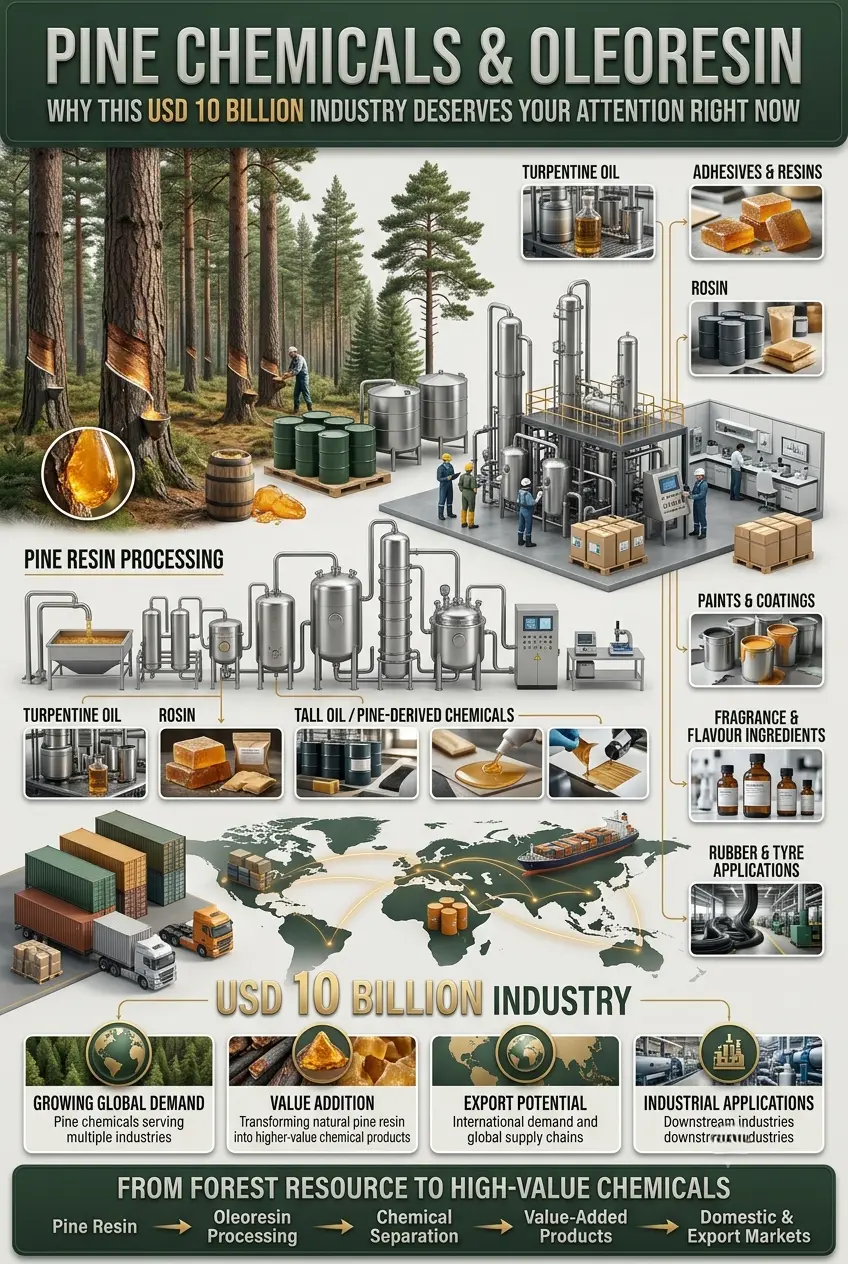
The world pine chemicals market was valued at USD 6.5 billion in 2025 and is projected to surpass USD 10 billion by 2034, registering a CAGR of around 5.5%. As the fastest growing region, Asia-Pacific is set to play a much larger role as a producer than it is at present. India has the potential to become a major player as compared to its current status as a supplier of raw materials because of the forest cover in Himalayan states. But this is a business that is more rewarding to the early entrant and requires a certain amount of knowledge of how to get from the pine tree raw materials to value-added end-products.
The Pine Chemicals Industry: Bigger Than Most People Realize
Pine chemicals are broadly categorized into three, depending upon their sources. These are gum oleoresins, wood chemicals and tall oil chemicals. Gum oleoresin is obtained by tapping the trunk of a pine tree and yields, upon distillation, gum turpentine and gum rosin. Wood chemicals are obtained from stumps and processing waste from the pine trees. The third, and possibly the most commercially rewarding category, is that of tall oil chemicals. These are byproducts of the Kraft process of wood pulp manufacturing and include tall oil fatty acids (TOFA), tall oil rosin (TOR) and sterols.
Each of the three categories represents a different supply chain as well as a separate set of applications and end-markets. That is what makes this industry so fascinating as well as commercially viable.
Where the Demand Is Coming From
The demand for these products is coming from a broad spectrum of industries. Here is a snapshot of the drivers for each category:
- Adhesives & Coatings – The main application for rosin esters is in hot melt pressure sensitive adhesives and road marking paints. There is high consumption in the packaging, construction and automotive industries.
- Printing Inks – Rosin-based resins are an important component of printing inks. The commercial print and packaging inks markets are major consumers.
- Flavor & Fragrances – The demand for terpene-derived aroma chemicals, such as linalool, geraniol, nerol and others, is high and offers the best value per kg for the processor.
- Biofuels & Renewable Chemistry – These are areas that are witnessing increased attention, as governments in the EU, the US and elsewhere promote bio-based chemicals as replacements for petrochemicals.
- Rubber – Dimer acids derived from tall oil are key intermediates for polyamide resins and specialty polyurethanes.
- Paper Sizing – Rosin soap size has been used in the paper industry for over a century and remains in demand.
- Solvents & Disinfectants – Pine oils distilled from turpentine have found their way into industry as solvents and germicides and remain in demand for institutional cleaning.
India’s role in this market has so far been that of a supplier of raw materials. However, with the government promoting chemical sector development and increased domestic demand from the ink and adhesive industries, it is time to look at setting up a integrated processing unit to add value to these raw materials, rather than selling them in their crude form.
India’s Forest Wealth: An Underutilised Industrial Asset
India has about 2.8 million hectares of pine forests, concentrated mainly in the Himalayan belt. Chir pine and other species in this belt have been tapped for their oleoresin content for decades but there is very little downstream processing. Local resin tapping co-operatives and small processors are the norm, but there is clearly room for organized downstream processing and value addition.
A well-capitalized venture with the right knowledge of the market and of the technical aspects of processing could build a profitable business that would make good use of local forest wealth and be competitive in international markets. Organized downstream processing is the norm in countries such as China, Brazil and Indonesia and India has the opportunity to learn from their experience. It is not only rosin and turpentine that could be processed but also crude tall oil, a byproduct of the kraft process of making paper.
Key Products, Applications & Manufacturing Opportunities
To understand the different business opportunities, one needs to know the different products and their applications. Here is a birds-eye view:
Oleoresin
This is the starting point of the value chain. Extraction from living pine trees by tapping is followed by filtration and straining. Further processing includes distillation and the production of rosin and turpentine. Even at the level of oleoresin, there are different grades and value levels, such as that of pharmaceutical grade oleoresin.
Rosin (Gum Rosin, Tall Oil Rosin, Wood Rosin)
Rosin is the solid residue obtained when turpentine is distilled off from oleoresin. Rosin has broad applications in the preparation of adhesives, printing inks, chewing gum, soldering fluxes and tablet coatings. Modified rosins (hydrogenated rosin, disproportionated rosin, polymerized rosin and rosin esters) offer higher value.
Turpentine & Terpene Derivatives
This volatile liquid is distilled off from oleoresin and finds applications as a solvent and thinners for paint. However, the value addition opportunities lie in the production of alpha and beta pinene derivatives such as synthetic camphor, linalool (a fragrance ingredient), terpineol (used in perfumery and disinfectants) and many other aroma chemicals. Turpentine derivatives offer the maximum value addition opportunity.
Tall Oil and Tall Oil Fatty Acids (TOFA)
Crude tall oil, a byproduct of kraft wood pulp manufacturing, is subjected to fractional distillation to yield TOFA, tall oil rosin and distilled tall oil. TOFA finds extensive application in alkyd resins, corrosion inhibitors, emulsifiers and metal working fluids.
Dimer Acids
These are produced by dimerization of unsaturated fatty acids, such as those obtained from TOFA. Dimer acids are important in the production of polyamide resins (used in printing inks, hot melt adhesives and coatings), polyester polyols for polyurethane systems and fuel additives.
Business Potential for Entrepreneurs, MSMEs & Investors
This is a business that could be ventured into by entrepreneurs, MSMEs and investors, from different levels of capitalization:
- Small-scale resin tapping and processing – Low capital, fits in well with MSME schemes and backward linkage with forest communities.
- Turpentine distillation and crude rosin processing – Medium-scale plants with appropriate distillation infrastructure can be set up in pine-belt states with backward linkage with resin tapping and downstream processing.
- Value addition – Offers highest value and scope for higher capitalization with appropriate technical expertise. Establishing plants for production of rosin esters, terpene derivatives and dimer acids would need technical expertise in the field.
- Tall oil processing – Fits in well with downstream processing in paper mills with tall oil as a byproduct.
Each layer in the value addition chain requires different levels of capitalization, different raw material linkages and different end-markets. But none of them require proprietary technology as the technology is well established. What is needed is a comprehensive technical reference that can be relied upon for the setting up of a processing plant.
About the Book: Handbook on Oleoresin and Pine Chemicals
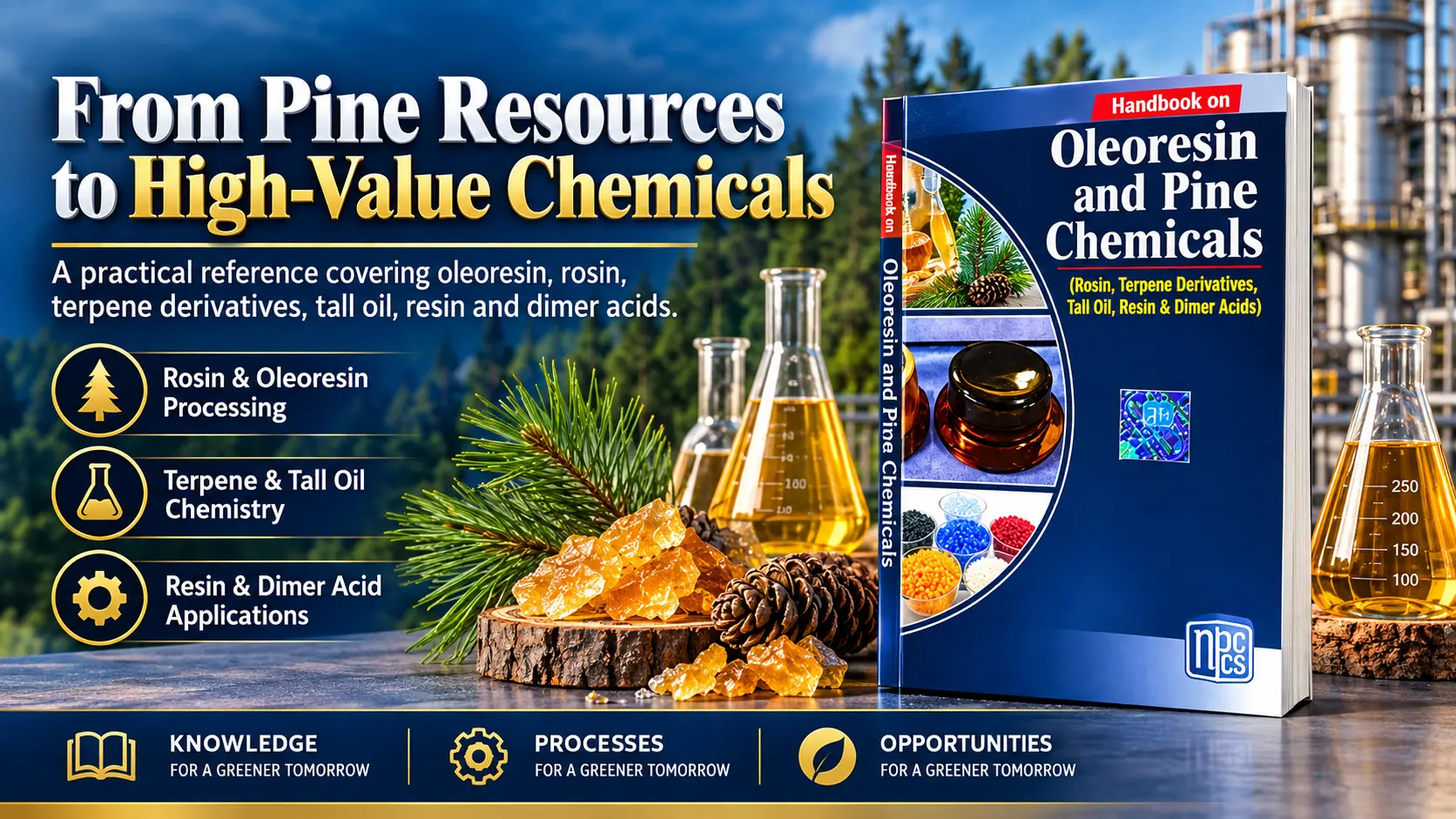
Handbook on Oleoresin and Pine Chemicals: Rosin, Terpene Derivatives, Tall Oil, Resin & Dimer Acids
Authored by H. Panda, published by Asia Pacific Business Press Inc., the publishing house of NPCS, this 594-page book covers all practical aspects of the pine chemicals value chain from the formation of oleoresin in the pine trees to the processing of final derivatives. The book covers all practical aspects of the subject and is aimed at people who are not familiar with this field but are interested in exploring the business opportunities.
This book covers a lot more than just the chemistry of oleoresin. It is written with the intention of serving a wide audience ranging from a chemical engineer who is looking to understand the process technology involved, to an entrepreneur who wants to set up a small-scale plant for processing oleoresin, to an investor who is looking at techno-commercial due diligence of such a venture, and to a business professional who wants to understand what the end-user markets are looking for in terms of specifications.
What the Book Covers
- Formation and exudation of oleoresin in pines – how and why resin is formed and what this implies on tapping yields and quality.
- Oleoresin extraction – processes and techniques of tapping and processing.
- Processing of oleoresin – distillation to rosin and turpentine – batch and continuous processes.
- Rosin derivatives and their potential – hydrogenated, disproportionated, polymerized and esterified rosins – specialty applications.
- New developments in rosin ester and dimer chemistry – recent developments in high-performance adhesive resins.
- Terpene-based adhesives – formulation principles and commercial applications.
- Sylvestrene and its derivatives – niche but commercially interesting terpene compounds.
- Homopolymers and copolymers of acrylates derived from terpene feedstocks.
- Polymers and copolymers of vinyl pinolate.
- Base-catalysed isomerisations of terpenes – important for aroma chemical synthesis.
- Components of pine roots – industrial relevance.
- Insecticides based on turpentine – a growing segment given the push towards bio-based pest control.
- Tall oil chemistry – production, fractionation and applications of crude tall oil, TOFA, tall oil rosin and distilled tall oil.
- Dimer acids – structure, properties, production and applications.
- Industrial applications – adhesives, inks, coatings, paper, detergents, lubricants, flavors, fragrances and rubber.
Pine species from other countries that are tapped for oleoresin are also covered in this book and the coverage goes beyond the scope of any standard chemistry text books.
Who Should Read This Book
The wide audience coverage is reflected in the scope and depth of the book. This book can be read by:
- Chemical engineers and technologists working in the area of oleoresin processing or tall oil refining.
- Entrepreneurs looking at opportunities in the pine-belt states of India.
- MSMEs in the forest or chemical sectors looking at diversification or upgradation.
- Investors and project developers undertaking techno-commercial due diligence of chemical plants for processing pine chemicals.
- Researchers and academics in natural products chemistry or bio-based materials.
- Export-oriented businesses sourcing rosin, turpentine or tall oil derivatives for international buyers.
- Purchasing and sourcing professionals in the adhesives, inks, coatings, Flavors and fragrance industries.
The objective of this book is to collate a huge volume of information that is otherwise difficult to come by in one book. The advantages of doing so cannot be underestimated, even for the person who has the time to read through the book. The sheer volume of information that has been compiled by the author, which goes much deeper than any other single book on the topic, is worth the effort for the reader looking to build a good technical foundation of the subject.
Why This Handbook Stands Apart
There are many chemistry books but few go into such depth on a particular topic, exploring not only the basic chemistry but also the industrial applications and market requirements as well. The approach of H. Panda in this book is to explain the fundamentals of chemistry while emphasizing what can be manufactured and what the market demands. The treatment of the chemistry of terpenes reflects a close examination of a subject that has so far seen very little commercial attention in India but has great potential for expansion.
The fragrance and flavor industry uses terpene chemistry to create aroma chemicals (linalool, geraniol, citronellol, terpineol and many others) that are in great demand. The majority of the world’s supply comes from turpentine distilled from pine oleoresin. India, despite being a producer of raw material, has not been able to capitalize on this opportunity. The technical know-how to unlock this potential is contained in this book.
Similarly, the section on dimeric acids is also of interest to manufacturers of polyamide resins and polyurethanes that are in demand in the global market.
GET YOUR COPY
Handbook on Oleoresin and Pine Chemicals: Rosin, Terpene Derivatives, Tall Oil, Resin & Dimer Acids
Author: H. Panda | Publisher: Asia Pacific Business Press Inc. | Pages: xiv + 594 | ISBN: 8178330199
This handbook is the definitive technical and commercial reference for anyone serious about the pine chemicals sector. Whether you are planning to set up a processing unit, evaluating investment in a pine chemicals plant, sourcing for an existing adhesive or ink operation, or simply building your domain expertise in bio-based industrial chemistry — 594 pages of detailed, organized, practice-oriented information is exactly what you need on your shelf.
Price: INR 1,475 | USD 138 (International)
Purchase Online:
Niir.org (Official): https://www.niir.org/books/book/handbook-on-oleoresin-pine-chemicals-rosin-terpene-derivatives-tall-oil-resin-dimer-acids/isbn-8178330199/zb,,142,a,0,0,a/index.html
Amazon India: https://www.amazon.in/dp/8178330199
Published by Niir Project Consultancy Services (NPCS) / Asia Pacific Business Press Inc. | niir.org | entrepreneurindia.co
Your Investment Deserves the Right Opportunity
Every serious investment begins with choosing the right sector and the right business model. With hundreds of industrial opportunities available across India’s manufacturing and clean-energy landscape, making the most informed choice is crucial. Niir’s Startup Selector tool helps entrepreneurs, MSMEs and investors identify the most suitable business opportunities based on their investment capacity, location and interests, ensuring their capital is directed toward the venture with the best fit.


