





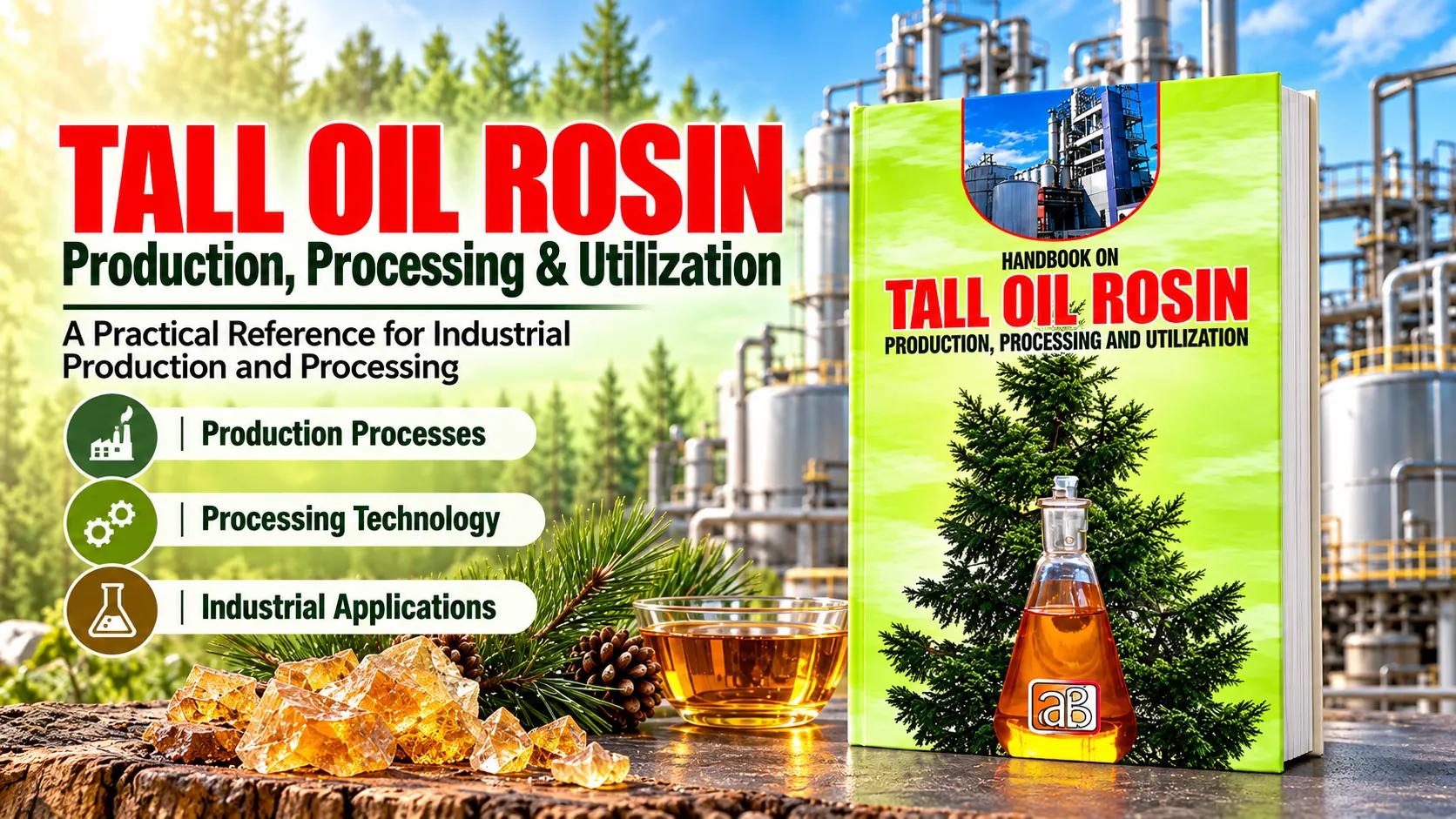
Tall Oil Rosin Production, Processing | Handbook
A Chemical Most People Have Never Heard Of — That Is Everywhere
Most people working with paints, rubber, adhesives, printing inks, paper, lubricants or detergents have never heard of tall oil. Their procurement managers have. Their process chemists have. And the manufacturers who supply those industries take a close eye on it as it quietly underlies a surprising number of everyday industrial products.
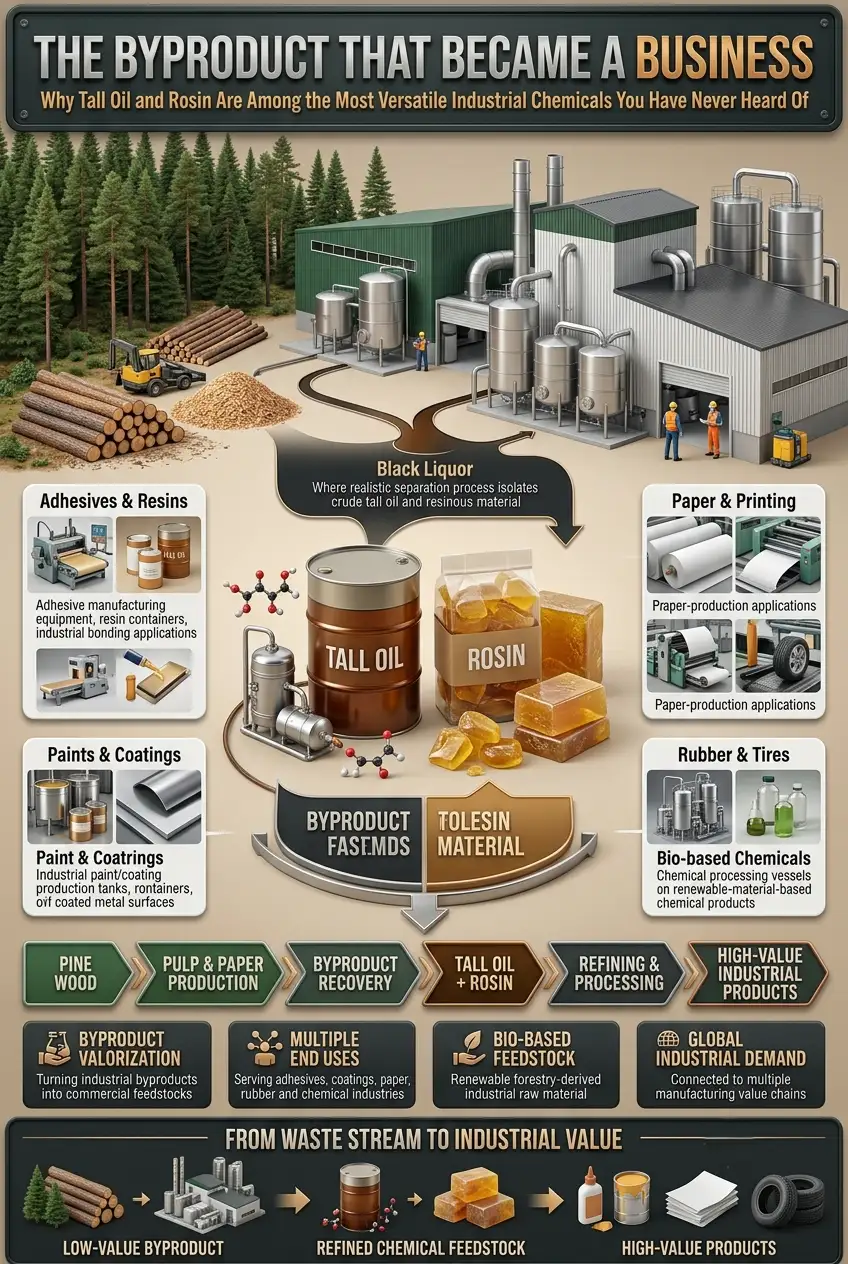
Tall oil is the byproduct of the kraft pulping process used to make paper and paperboard from wood. When pine wood is processed in the kraft process, resins, fatty acids, and other organic compounds are released and concentrated in the black liquor. This soap fraction, skimmed off and acidified, results in a crude tall oil which is a complex mixture of resin acids (rosin), fatty acids, and neutral compounds — one of the most chemically versatile bio-based industrial raw materials available at commercial scale.
In a world seeking to invest in renewable feedstocks, lower dependence on petrochemicals, and embrace circular economy models, tall oil occupies a uniquely advantageous position. It is renewable (from wood), is a byproduct of an existing process (no raw material cost for the upstream supply), and has a chemical composition (oleic and linoleic fatty acids and resin acids) that opens up a large number of industrial applications.
The Industrial Chemistry of Tall Oil: What It Is and What It Produces
Crude tall oil (CTO) recovered from kraft mill black liquor consists primarily of three components: resin acids (abietic acid and its isomers, collectively known as rosin), fatty acids (oleic, linoleic acids in roughly equal proportion, plus smaller quantities of saturated and polyunsaturated acids), and neutral compounds (sterols, wax alcohols, hydrocarbons, and esters).
By vacuum fractional distillation, CTO is separated into the various components. The fatty acid fraction (TOFA) is used in a wide range of industrial applications. The rosin fraction has applications in paper sizing, rubber compounding, adhesives and printing inks. The pitch fraction has applications in asphalt products and as a defoamer base. From TOFA, an entire family of derivative chemicals can be produced: dimer acids, azelaic acid, pelargonic acid, polyamides, amines, esters, etc.
The depth of its derivative chain is the reason why tall oil is an unusually attractive industrial raw material. A kraft pulp mill operator who recovers and processes tall oil is not just selling a byproduct, but is in fact a chemical platform that feeds into paint, rubber, paper, adhesives, detergents, textiles, petroleum processing, mining flotation, pharmaceutical applications — at the same time.
Market Demand and Business Potential: Where the Opportunity Lies
Tall Oil in Paper Sizing
One of the largest single applications for rosin (the resin acid fraction of tall oil) is as a paper sizing agent. Internal sizing with rosin imparts water resistance to paper and paperboard, which is critical for packaging, printing and writing paper grades. India’s paper and paperboard industry has been growing steadily, driven by e-commerce packaging demand, food service packaging, and the overall shift from plastic to paper-based materials. All of these are drivers of demand for rosin-based sizing materials.
Rosin sizing remains relevant and commercially important, despite the availability of synthetic sizing agents. It has its own performance characteristics, cost profile, and compatibility with recycled fibre systems, making it competitive across a wide range of paper grades. For manufacturers looking to supply rosin sizing materials (paste size, dry size or emulsion size), the Indian paper sector represents a stable and growing customer base.
Tall Oil in Alkyd Resins and Surface Coatings
Tall oil fatty acids are a feedstock for alkyd resin production. Alkyd resins are the backbone of oil-based paints, primers and industrial coatings — markets that continue to grow in India alongside the construction, infrastructure and automotive sectors. The versatility of TOFA in alkyd formulations (short-oil baking alkyds, medium-oil alkyds, long-oil alkyds, rosin-modified alkyds for specific applications) makes them a preferred raw material for resin manufacturers.
India’s coatings industry has been growing at a healthy clip, with both organised sector players and large unorganised decorative paint segment driving consumption. Manufacturers with access to TOFA and technical knowledge of alkyd formulation would find themselves well positioned in this market.
Dimer Acids and Polyamide Resins
The dimerisation of TOFA produces dimer acids (C36 dibasic acids) for polyamide resin production. These polyamides serve as hot-melt adhesives, printing ink vehicles, epoxy curing agents, can-seam sealants, etc. The global polyamide resin market is substantial and growing, with applications in packaging, printing and specialty adhesive. TOFA is the preferred and most economical feedstock for dimer acid production — manufacturers who can process TOFA to dimer acids would access a high-value chemical segment.
Azelaic and Pelargonic Acids
The ozonolysis of oleic acid in TOFA produces azelaic acid (C9 dibasic acid) and pelargonic acid (C9 monobasic acid). Azelaic acid has significant pharmaceutical applications (acne treatment formulations) and serves as a polymer building block for plasticizers and lubricant esters. Pelargonic acid finds use in lubricants, plasticizers, perfume bases, fungistats, etc. Both are commercially valuable specialty chemicals produced from a renewable, bio-based feedstock — a positioning that aligns well with the direction of global markets.
Tall Oil in Mining, Petroleum, and Flotation
Tall oil’s use as a flotation collector in mineral processing (recovering copper, lead, zinc from low-grade ores) gives it a relevance in the mining chemicals segment. Its applications in petroleum processing (oil well fracturing fluids, drilling muds, demulsifiers, corrosion inhibitors, lubricating oil additives) add another distinct customer segment. Its use as a defoamer in fermentation, paper-making, phosphoric acid production gives it industrial process chemistry applications.
This breadth of application across industries makes tall oil processing not hostage to any single sector’s cyclicality. Demand for tall oil derivatives tends to be diversified across construction, mining, paper, rubber, paints and agriculture — a portfolio of demand which is inherently more stable than reliance on a single end-use sector.
Handbook on Tall Oil Rosin Production, Processing and Utilization: What This Book Contains
Written by Dr. H. Panda and published by Asia Pacific Business Press Inc. (an associate of NIIR Project Consultancy Services), this 480-page handbook is the most comprehensive English technical reference on the subject of tall oil and rosin — from production, analysis, chemistry, processing to cover the full range of industrial applications.
For a subject that is genuinely specialised and in which reliable technical literature is scarce, this coverage in a single volume is unusual and commercially significant — drawing on primary research, industrial process data, and production experience at kraft mills. The book covers the subject from the chemistry of tall oil fatty and resin acids through to specific application formulations and end-use performance data for each major product category.
Coverage Across the Full Tall Oil Value Chain
The handbook systematically covers:
- History and introduction of tall oil — from early discovery to modern kraft integration
- Production process and recovery — black liquor soap recovery methods, soap skimmer design (including Stokes’ Law analysis of separation), air injection effects, heavy liquor recovery, monitoring of recovery efficiency
- Composition and properties of crude tall oil — complete characterisation of fatty acids (saturated, monoenoic, dienoic, trienoic, tetraenoic, conjugated, esterified), resin acids and neutral components across 13 fraction groups
- Studies on Indian tall oil — dedicated chapter on the composition and characteristic properties of tall oil derived from Indian pine, including factors influencing composition (wood species, geography, chip storage)
- Analytical methods — Gas Chromatography (GC), GC-MS, Thin-Layer Chromatography (TLC), preparative argentation TLC, methylation, silylation, Soxhlet extraction, TAPPI standard testing
- Soap acidulation chemistry — sulfuric acid process, carbon dioxide process (economics), spent acid disposal, sulfur balance, soda losses, pilot plant results by Technical Research Centre of Finland
- CTO distillation processes — Luwa CTO distillation process, effluent minimisation, reboiler design, tower internals, corrosion and materials of construction, Sorbex simulated moving bed process
- Dimer acids manufacture — feedstock specifications, clay-catalysed thermal condensation, effect of reaction variables, TOFA as principal feedstock, commercial production process\
- Azelaic and pelargonic acid production — ozonolysis process, industrial utility, feedstock considerations
- Tall oil in alkyd resins — short oil, medium oil, long oil and rosin-modified alkyd formulations; solvent and fusion processes; distilled tall oil epoxy ester
- Rosin sizing for paper — paste size, dry size, liquid size preparation (cooking, emulsion, Bewoid, Delthirna processes), internal and external sizing, effect of wet strength resins, sizing test methods (Cobb test, water absorption, ink penetration)
- Tall oil in printing inks — typographic, heat-set, steam-set, newsprint, lithographic, gravure, silk-screen inks, overprint varnishes
- Tall oil in rubber — SBR formulations (hot and cold rubber, latex types), foam rubber
- Tall oil in adhesives — rubber based adhesives, hot-melt adhesives, linoleum cements
- Tall oil in petroleum applications — oil well fracturing, drilling muds, demulsifiers, corrosion inhibitors, lubricating oil additives
- Tall oil in flotation — collectors and flotation applications
- Tall oil fatty acids as chemical intermediates — amides, nitriles, amines, quaternary ammonium compounds, polyethoxylated fatty acids, cationic flotation agents
- Tall oil in defoamers — antifoam formulations for fermentation, papermaking, phosphoric acid production; tall oil pitch-derived defoamers
- Tall oil in disinfectants, synthetic detergents, biodegradable detergents, wetting agents, plasticizers
- Tall oil in coprecipitated barium salts — pigment treatment, rosinated lithols for printing inks
- Tall oil pitch as renewable resource — asphalt and pavement applications, wear test results, field experiment data
Who This Book Is Written For
The handbook is essential reading for:
- Chemical manufacturers and process engineers in tall oil, rosin, dimer acid or TOFA processing
- Paint and coatings manufacturers using TOFA as an alkyd resin feedstock
- Paper industry technologists responsible for internal sizing and coating operations
- Adhesive, sealant, printing ink manufacturers using rosin or polyamide resins
- Rubber compounders using rosin as an emulsifying and processing aid
- Project consultants and investment analysts evaluating tall oil or rosin processing projects
- Mining chemicals manufacturers using tall oil in flotation collector formulations
- Research institutions and universities with programmes in forest products chemistry, oleo chemistry or specialty chemicals
- Entrepreneurs evaluating tall oil derivative chemicals as a business entry point
Why This Is the Reference You Need
Technical literature on tall oil and rosin is genuinely hard to find in consolidated, accessible form. Much of what exists is fragmented across journal papers, mill-specific reports and patents. The NPCS handbook brings it all together in a structured, commercially-oriented reference, covering everything from the kraft mill soap skimmer to the final product formulation. At 480 pages and dedicated chapters on Indian tall oil, it is one the few references to address the composition and properties of tall oil derived from Indian pine specifically — a gap that matters enormously to any manufacturer or researcher working with domestically sourced raw material.
Book Details at a Glance
| Book Title | Handbook on Tall Oil Rosin Production, Processing and Utilization |
| Author | Dr. H. Panda |
| Publisher | Asia Pacific Business Press Inc. (NPCS) |
| ISBN | 9788178331515 |
| Pages | 480 |
| Format | Paperback |
| Price | ₹1,575 (India) | US$ 150 (International) |
Get Your Copy Today
Handbook on Tall Oil Rosin Production, Processing and Utilization
If you work in specialty chemicals, paints and coatings, paper, adhesives, rubber, mining chemicals, or petroleum processing — or if you are evaluating any of these sectors as a business opportunity — this handbook gives you the technical foundation that most other available resources simply do not provide on this subject. At 480 pages with coverage ranging from kraft mill soap skimmer engineering to final product formulation chemistry, it is a reference that earns its shelf space many times over.
Dr. H. Panda’s systematic, process-oriented approach across the full tall oil value chain — production, analysis, fractional distillation, derivative chemistry, and application formulations — makes this one of the most practically useful specialty chemical handbooks NPCS has published. If tall oil, rosin, or TOFA is part of your business or your research, this is the book you should have read before you started — and it is not too late to have it on your desk now.
Price: ₹1,575 (India) | US$ 150 (International)
Your Investment Deserves the Right Opportunity
Every serious investment begins with choosing the right sector and the right business model. With hundreds of industrial opportunities available across India’s manufacturing and clean-energy landscape, making the most informed choice is crucial. Niir’s Startup Selector tool helps entrepreneurs, MSMEs and investors identify the most suitable business opportunities based on their investment capacity, location and interests, ensuring their capital is directed toward the venture with the best fit.


