






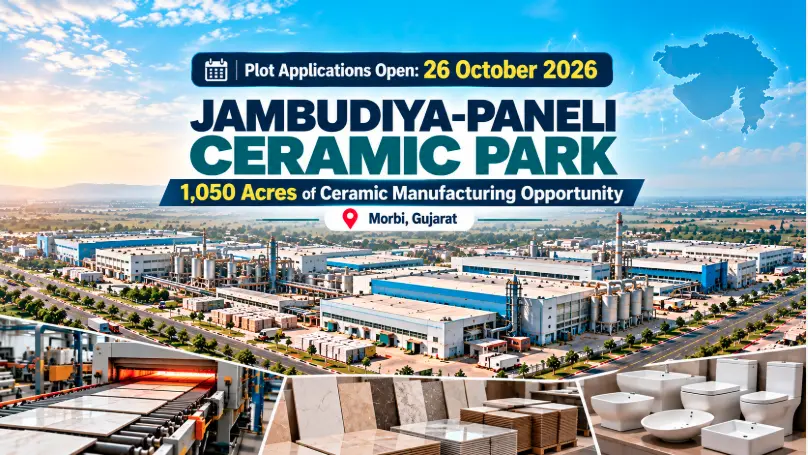
GIDC will be taking online applications for industrial plots at the Jambudiya-Paneli Ceramic Park (near Morbi) from 26th October 2026. The park is earmarked for ceramic industries and falls under GIDC’s “General (Industrial – Non-Chemical)” scheme which is administered via the Rajkot regional office.
Formally the Integrated Ceramic Park, it’s approximately 425 hectares (c. 1,050 acres). At launch in December 2025 most of the facilities were described as planned rather than completed. For anyone considering a tile, sanitaryware or advanced ceramics unit the key questions are what is confirmed, what is still to be built and what to check before you apply. One caveat: as of 20 October 2026 no closure date had been published so you’ll need to check the GIDC ad page for this.
Park location and manufacturing advantages
The park lies at Jambudiya-Paneli village, Morbi taluka, Morbi district. GIDC’s published park profile gives these distances:
- National Highway 27: 1.5km, a short feeder haul for the raw materials and the finished tiles.
- Railway: Morbi 12 km; Rajkot 70 km.
- Airport: Hirasar, Rajkot (70 km), useful for buyers and technicians.
- Ports: Navlakhi 48 km, Kandla 139 km, Mundra 195 km.
- Ceramic clusters: Thangadh 49km, Surendranagar 119km.
Launch coverage also mentions an inland container depot at Makansar (5km away) whilst GIDC’s own profile states that Kandla is the nearest container freight station. Need to confirm which of these facilities is used by the exporters.
The major advantage is the cluster. Morbi is the second largest ceramic cluster in the world, and according to the Gujarat government, it accounts for 80 to 90% of India’s ceramic exports. The unit numbers vary from source to source and from date to date (approximately 750 to 1,800). GIDC lists the installed tile capacity at 4 million sq metres per day. For a new entrant, that means the machinery suppliers, the skilled kiln and press operators, the dealers and the transporters are all in the vicinity. GIDC also states that its estates are free of encumbrance and so there is no need for NA/NOC. The park has arrangements in place for the supply of raw materials (this has not been published).
What the Jambudiya-Paneli Ceramic Park offers: infrastructure and plots
Planned or under development. GIDC has a 30 MLD water supply, three substations (two 66kV and one 220kV), solid waste management and an on-site sewage treatment plant. Shared facilities are a Common Display Centre, a Centre of Excellence (with an NABL-accredited lab), and a Skill Development Centre. The plan also includes roads, gas pipeline, telecom and street lighting. Public tenders are currently out for the widening of the 4.4 km road link to the estate and for the Centre of Excellence buildings (consultancy). Construction appears to be well underway.
Operational (no official statement was available at the time of writing as to which utilities are actually live). You can go to the site and ask the GIDC Rajkot office for a written status.
Focus on segments. Tiles and sanitaryware are the core, with industrial and advanced ceramics the areas of targeted growth. Tableware is not mentioned.
Plot sizes and price (plot sizes and a park-specific price have not been published). GIDC’s FY 2026-27 allotment price list has ₹2,990 per sq. metre for its Morbi estate, though it’s not clear if that price is applicable here.
Application basics. Under the general terms of GIDC (which may be different in the case of this park) applicants will be required to submit a detailed project report covering raw materials, machinery, process, products, investment and financing. A non-refundable scrutiny fee (₹1,240 for plots up to 10,000 sq m) is payable, along with identity proof and an undertaking, and hard copies are to be submitted within 30 days. In normal estates 50% is payable within 60 days of the allotment letter, and the balance in 12 quarterly instalments with interest. Production is to start within 24 months for plots up to 20,000 sq m, and there is a 2% per annum penalty for non-utilisation.
Government incentives and benefits
Shared infrastructure is of course distinct from financial subsidies and no incentive specific to this park could be established. The schemes listed below are more general in nature, and eligibility is by no means automatic.
Scheme and authority | Assistance | Main conditions | Verified amount and validity |
Aatmanirbhar Gujarat Scheme for MSMEs, Industries and Mines Department, Gujarat | Net SGST reimbursement | Manufacturing MSME; commercial production must start within the scheme period; based on the lower of fixed capital investment or bank-appraised cost | 80–100% of net SGST for 10 years, capped at 5–7.5% of eligible investment a year by taluka category; 5 Oct 2022 to 4 Oct 2027 |
Same scheme, as reported at launch | Capital subsidy, interest subsidy, EPF reimbursement | Enterprise category and registration rules apply | Capital subsidy up to ₹35 lakh (micro units); interest subsidy up to ₹35 lakh a year for up to 7 years; EPF for 10 years |
Aatmanirbhar Gujarat Scheme for large industries and thrust sectors, same department | Interest subsidy on term loans | Ceramics is identified as a thrust sector; investment thresholds apply | Up to 12% of fixed capital investment as reported at launch; to 4 Oct 2027 |
PMEGP, Ministry of MSME via KVIC and District Industries Centres | Credit-linked capital subsidy | New micro enterprises; bank-financed | Project cost up to ₹50 lakh; subsidy 15–35% by category and location; confirm current approval period |
CGTMSE, Ministry of MSME and SIDBI | Collateral-free credit guarantee | Micro and small enterprises, via lending institutions | Cover up to ₹10 crore |
One timing issue: the SGST component of the scheme requires production to commence prior to 4th October 2027 whereas GIDC allows up to 24 months for smaller plots. Check with the Industries Commissionerate whether the scheme will be extended. Most of the park scale units will also be above the PMEGP ceiling.
Market demand and sector growth
Treat the tiles, sanitaryware and industrial ceramics as separate markets.
- Morbi exports: the Gujarat government has an estimate of around ₹15,000 crore for 2024-25. This comes from around 1,200 units which are said to be producing around 60 lakh tonnes a year (state estimate, Morbi district, ceramic products).
- Domestic versus export: ICRA’s September 2024 report had the domestic market at around 64% of Indian ceramic tile revenue and a forecast of 7-9% revenue growth for FY2025. Forecasts are not results though. Kajaria’s June 2025 investor presentation had tile exports down by approximately 20% in FY2025.
- Wider market: IMARC estimate the Indian tiles, sanitaryware and bathroom fittings market at USD 9.94 billion in 2025 (combined category) as a result of housing and renovation.
- US exports: Commerce found no dumping in 2025, there was a countervailing duty order in June 2025. GIDC’s main markets are East Asia, the US, Europe, Africa and the Middle East.
- Energy shock: a gas supply disruption in March-April 2026 brought hundreds of factories in Morbi to a standstill. Gujarat Gas spoke of a phased restart and cost estimates are all over the place.
Demand is real, costs are real and so are the trade risks.
What entrepreneurs should assess
- Product and capacity: wall and floor tiles (vitrified or large format slabs), sanitaryware and technical ceramics all require different presses, different kilns and different skill sets. You need to match capacity to a defined customer base.
- Raw materials: confirm clay, feldspar, quartz and glaze input suppliers, quality consistency and transport cost.
- Energy: kilns are gas or propane based. Model price spikes and supply interruptions and ask when the substations and gas connections are due to be ready.
- Machinery: compare the press, dryer, kiln, glazing and printing lines on output, fuel consumption and service support.
- Quality and compliance: check BIS requirements, buyer certifications and pollution control consents.
- Demand and feasibility: test the dealer, test the project and test the export demand, then model the capital cost, working capital and incentive timing.
How NPCS can help you
Applying for a plot you need a full project report and the investor needs numbers they can stand by. NIIR Project Consultancy Services (NPCS) can assist with the project planning in a number of areas.
- Product and capacity selection.
- Market research and demand assessment.
- Detailed Project Reports and techno-economic feasibility studies.
- Raw material, machinery and utility planning.
- Project cost estimates, working capital and financial projections.
NPCS cannot guarantee approvals, subsidies, finance or indeed profitability as all of that is down to the authorities, the lenders and your own execution. Have a look at the range of ceramic manufacturing project reports available from NPCS.
Next step
Applications open on 26 October 2026, and details can change. Confirm the closing date, plot sizes, price and park-specific terms with GIDC, then test the project’s feasibility before you apply. NPCS is available to help you plan that assessment.


