





A pharma factory requires more than just land and a production plant. Water, steam, power, solvent recovery, and effluent treatment all have a bearing on how the plant operates and how much it costs to run.
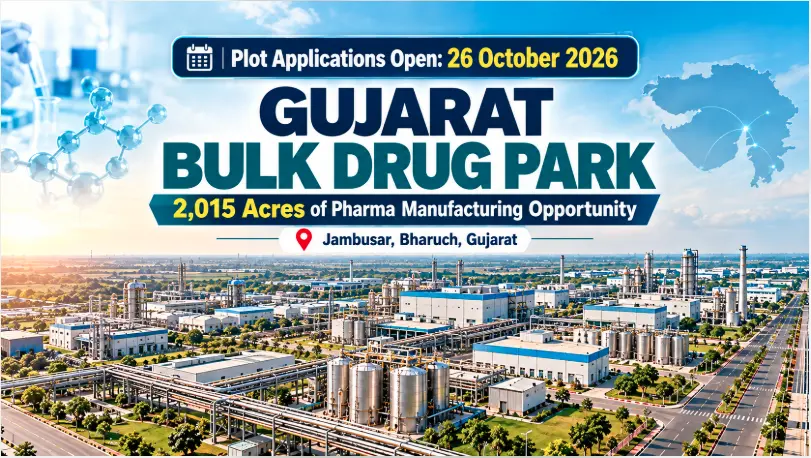
The Gujarat Bulk Drug Park at Jambusar in the Bharuch district is being developed to meet these requirements. It is a 2,015 acre project which brings together industrial plots and planned common facilities for bulk drug, API, drug intermediate and key starting material (KSM) manufacturers.
GIDC has announced that online applications for industrial plots will be open from 26th October 2026 to 25th November 2026. The application period is advertised on the GIDC website.
For an entrepreneur looking at setting up a new pharma manufacturing unit, the announcement gives you a clear place to start: look at the product in question, look at the park and then put together a project plan that is appropriate for that location.
Gujarat Bulk Drug Park at a Glance
Particular | Details |
| Location | Jambusar, Bharuch district, Gujarat |
| Developing agency | Gujarat Industrial Development Corporation |
| Park area | 2,015.02 acres |
| Target manufacturers | Bulk drugs, APIs, drug intermediates and KSMs |
| Application opening date | October 26, 2026 |
| Application closing date | November 25, 2026 |
| Application information | GIDC’s official advertisement page |
The park is being developed with common infrastructure for pharma manufacturing. The plot application period is announced as 26th October to 25th November 2026.
What the Park Offers Pharmaceutical Manufacturers
The key feature of the Jambusar Bulk Drug Park is its planned common infrastructure. Rather than just looking at the land, the manufacturers can look at how the shared services would suit their own production needs.
Water, power and gas
The park infrastructure is planned to include a water supply of 40 million litres per day (MLD), gas supply and a power supply via one 66kV/11kV substation and one 220kV/66kV substation.
These are park-level provisions. Each manufacturing unit will still have to establish its own water quality requirements, its own connected electrical load, its own internal distribution systems and its own process utility requirements.
The availability of industrial water in itself doesn’t dictate whether a given process will require additional purification. That’s part of the plant’s technical assessment.
Shared treatment and recovery facilities
The planned specialised infrastructure includes:
- Effluent treatment and sewage treatment works.
- An integrated treatment, storage and disposal facility for hazardous waste.
- A marine discharge facility.
- Common steam supply.
- A common solvent recovery system.
- Research and development facilities.
- Laboratory testing facilities.
- A common facility/centre and admin complex.
The newspaper allocation announcement also notes the common warehousing between the facilities available.
For the manufacturer the real value is in matching the services to the process in question. The steam requirements, solvent usage, effluent profile and storage requirements will all be different for different products. The project report should therefore state clearly which of the requirements will be met via the common services and which will require investment at the individual plant.
Location Map of Gujarat Bulk Drug Park
Gujarat Bulk Drug Park at Jambusar, Bharuch: location and access via nearby transport. Map credit: GIDC. Distances are indicative.
The Gujarat Bulk Drug Park is located right near road, port and airport connectivity.
Connection | Approximate distance |
| NH228 | 4 km |
| Dahej Port | 65 km |
| Vadodara Airport | 65 km |
| Surat Airport | 151 km |
| Deep-sea discharge location | 11 km |
These distances are a useful baseline for logistics planning. They allow the manufacturer to assess the volume of incoming raw materials, the volume of finished product being dispatched and the access required for equipment suppliers and technical teams.
Port access may also be relevant to projects which are using imported inputs or supplying overseas customers. The actual logistics plan will be dictated by the cargo requirements, the transport routes and the ports the business uses.
Government Incentives and Benefits for Manufacturers
Pharma and API manufacturing is one of the thrust areas under the Aatmanirbhar Gujarat schemes. For the entrepreneur the upside is support on investment, borrowing, employment, and technology costs. The package that applies will be dependent on the type of enterprise and project eligibility.
Investment and borrowing support: eligible businesses can be entitled to capital or interest support under the relevant State scheme. Capital investment support is available to eligible micro enterprises under the relevant provisions (it is not a blanket entitlement to all pharma plants). Interest support is subject to the relevant scheme and loan terms.
Tax and employment support: possible benefits would be net SGST reimbursement and EPF reimbursement. Support in respect of SGST on capital goods, stamp duty and registration fees and electricity duty exemption would be subject to the relevant provisions. Each of the benefits would be scheme-specific and would depend on the unit’s eligibility.
Technology and quality support: relevant support areas include technology acquisition, patenting, quality certification, implementation of ICT and power connection charges.
What it means for a new plant is that eligible assistance can be used to reduce specified project and operating costs. In addition, common steam, solvent recovery, treatment and testing facilities can reduce the need to duplicate some of the infrastructure in each plant. The actual savings will of course depend on the service tariffs, available capacity and process compatibility.
Prior to including any incentives in the DPR, you must confirm with the Industries Commissionerate the appropriate enterprise classification, taluka category, eligible investment, production commencement date, application process and benefit ceilings. The benefits will be subject to approval under the relevant scheme.
Gujarat’s Existing Pharmaceutical Base
The park is being developed in a state which already has a significant pharmaceutical manufacturing base.
GIDC’s 2024 data has 37 pharma clusters, 3,415 allopathic drug manufacturing units and 1,567 bulk drug manufacturing units in Gujarat. Pharma manufacturing employment is at around 1.26 lakh.
These are historical figures relating to the manufacturing network around the park. They are not the 2026 industry figures.
For a new business, an existing industrial base can provide access to suppliers, maintenance and skilled personnel. The next stage is to work out which of those resources are available for the particular product and process in question.
Market Demand for Pharmaceuticals and Bulk Drugs
India’s pharma exports came in at $30.47 billion in FY2024-25 (up 9.4% on the prior year) according to the Ministry of Commerce and Industry’s February 2026 release. That’s a clear indicator of overseas demand for Indian pharma products. The figure is for the pharma sector as a whole and not just the API market.
The same release names the US and Europe as the key export markets. For a bulk drug manufacturer the commercial opportunity is to supply the active ingredient and/or intermediates to the pharma companies who in turn serve the domestic and international markets. Access to those customers is obviously going to be molecule specific and will be dictated by the quality specs and the supplier qualification.
Domestic demand is a second route to customers. Manufacturers of tablets, capsules, syrups and the like will buy APIs as their inputs. The intermediate producers will in turn supply the companies who make the APIs. That creates a whole chain of B2B demand with different customers and different specifications at each stage.
For a unit at Jambusar product selection should start with the identifiable buyer. A useful market study would look at the annual consumption of the molecule, domestic production, imports, competing suppliers and selling price history. It would also establish the required purity, the typical order size and the time taken for customer approval.
Gujarat’s existing pharma base is the obvious place to start with this. The GIDC 2024 info has 1,567 bulk drug units in the state. That’s a very real base to work from, though it doesn’t in itself tell you the level of demand that would be available to a new plant.
The best opportunity is when a proposed product corresponds to a stated customer requirement and there is a technically viable route to production. NPCS can then use product-specific market research to link that opportunity to plant capacity, investment and working capital in the DPR.
Choosing a Product Before Planning the Factory
The allocation announcement covers bulk drugs, APIs, drug intermediates and KSMs. That’s a very broad category and will encompass a huge number of products which will have very different manufacturing routes and different levels of investment.
A useful project assessment starts with a defined product or a product group which is technically compatible. It should be able to answer the practical questions:
- Who is the customer?
- What specs will they be looking for?
- Which manufacturing technology will be employed?
- What market capacity can we actually support?
- What raw materials and utilities will be required?
- How much investment and working capital will the project require?
Entrepreneurs looking at potential products can have a browse through NPCS’s pharmaceutical, fine chemical and bulk drug intermediate project reports.
For a more targeted look at active ingredients NPCS also has a separate category for Active Pharmaceutical Ingredient (API) products and bulk API manufacturing project reports.
These can be used to support initial product research prior to the development of a location specific feasibility study.
NPCS’s Role in Planning a Manufacturing Unit
Niir Project Consultancy Services (NPCS), New Delhi, provide support to entrepreneurs in the form of industrial project identification, market studies, pre-feasibility studies and preparation of Detailed Project Reports.
For the proposed unit at the Gujarat Bulk Drug Park the project planning should be such that the product selected is linked to the land, the plant, the utilities and the capital required to produce it.
The scope can include:
Market assessment: potential customers, competing suppliers, product applications and demand.
Technical planning: the manufacture of the product, the production capacity, the machinery, the raw materials, the utilities and the manpower.
Project costing: the cost of the buildings, the equipment, the installation, the internal infrastructure and all the other things that the project will require.
Operating economics: working out raw material consumption, utility costs, staffing, maintenance and working capital.
Financial projections: assessing revenue, operating margins and break even performance on the basis of clearly stated assumptions.
A location specific DPR should also take into account the park’s common infrastructure. That way you don’t end up budgeting for the same facility twice and you don’t forget about the equipment that will need to be installed in the unit.
NPCS provide the consultancy support and GIDC handle the industrial plot allotment.
How to Access the Application Details
Manufacturers should go to the GIDC’s own advertisement page and open the notice for the Bulk Drug Park at Jambusar, Bharuch.
Application period is announced as 26th October to 25th November 2026. Applicants are advised to go through the full set of conditions prior to applying which cover eligibility, plots available, prices, documents required and payment requirements.
The ad itself gives no individual plot prices or sizes (those are in the GIDC allotment documents). You need to check the allotment documents for that. You also need to check the infrastructure readiness and service connection schedules when you’re putting together your project implementation schedule.
For any business looking at this opportunity the first thing to do is take the broad manufacturing concept and turn it into a proper proposal i.e. what product, what capacity, what land, what utilities and what the investment is going to be.
Frequently Asked Questions
What is the Gujarat Bulk Drug Park?
The Gujarat Bulk Drug Park (GBDP) is a dedicated industrial development at Jambusar in the Bharuch district. It is being developed by the GIDC for bulk drug (including API, drug intermediates and key starting materials) manufacturers with common infrastructure planned.
How big is the Jambusar Bulk Drug Park?
The Jambusar Bulk Drug Park is 2,015.02 acres (approx 2,015 acres).
When do the online applications open and close?
Online applications open on 26th October 2026 and close on 25th November 2026 as per the GIDC official advertisement. Applicants are advised to check the website for any further updates.
Which manufacturers could potentially apply?
The notice is for manufacturers of bulk drugs, APIs, drug intermediates and KSMs. Applicants should refer to the detailed allotment notice for the eligibility criteria that apply to their particular proposal.
What water supply capacity is envisaged for the park?
The proposed park level water supply capacity is 40 MLD (40 million litres per day). Each individual unit will be required to confirm their allocation, connection arrangements and any additional water treatment requirements.
What common facilities are envisaged?
The facilities on the list are effluent and sewage treatment, hazardous waste, steam, solvent recovery, marine discharge, laboratory testing, R&D and a common facility centre. The paper also lists warehousing.
How far is the park from Dahej Port and Vadodara Airport?
Dahej Port and Vadodara Airport are each around 65km from the park. NH228 is about 4km away and Surat Airport is around 151km away.
What is the cost of an industrial plot?
Applicants should refer to GIDC's current allotment terms for plot prices, plot sizes, payment terms and the applicable charges.
Why prepare a DPR for a bulk drug or API manufacturing unit?
A DPR brings the product, market, manufacturing process, and financial requirements into one assessment. It helps establish production capacity, machinery needs, utility consumption, capital expenditure, and working capital before implementation.
How can NPCS assist an entrepreneur considering the park?
NPCS can support product identification, market research, technical and commercial feasibility assessment, and DPR preparation. A project-specific study can examine how the proposed unit would use the park’s common facilities and what additional investment it would require.


