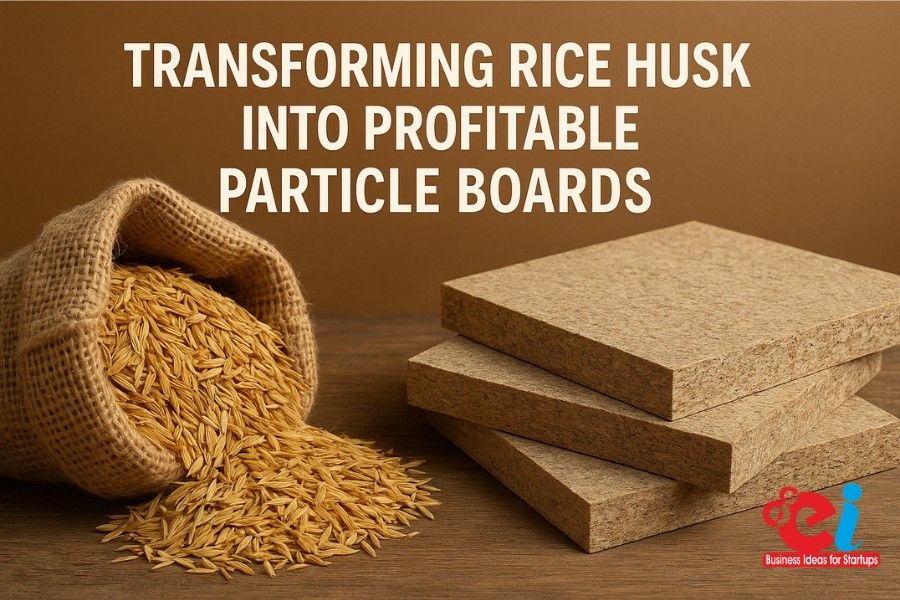





With global focus shifting towards sustainable building materials, Particle board manufacturing derived from rice husks offers a cheaper and greener option compared to other wood-based boards. The apprehensions pertaining to the deforestation problems, increasing costs of timber, and the emerging markets for eco-friendly products allude to the fact that this new area of development is highly fruitful in terms of investment.
India, being one of the largest producers of rice, contributes over 40 million tonnes of rice husk annually, which is a commercially viable byproduct. This post is aimed to provide a comprehensive set of insights on the developments, projections and the most important issues that investors need to consider for the business of Particle board manufacturing from rice husk.
1. Why Choose Rice Husk for the Particle board manufacturing?
Rice husk is an agro-waste material generated in huge quantities during rice processing. However, its features also make it an exceptional candidate for producing particle boards:
Benefits of Rice Husk Based Particle Boards
- Plentiful Supply: Readily available in rice cultivating states of India such as Punjab, Uttar Pradesh, Tamil Nadu, West Bengal, and Andhra Pradesh.
- High Silica Content: Provides greater fire and termite resistance to the boards.
- Light Weight and Durable: Outperforms wood in strength and weight ratio.
- Eco-Friendly: Efficiently utilizes agro-waste to reduce deforestation.
- Moisture Resistant: Perfect for humid and tropical weather conditions.
The usage of rice husk in construction and furniture helps to mitigate their carbon footprint and also reduces the cost of the materials used.
2. Worldwide Market Trends and Predictions
Overview of Global Particle Board Market
- Market Size: Estimated $23.8 billion in 2024
- Projected Growth: Reaching $31.7 billion by 2033
- CAGR: 3.2% (2024 – 2033)
- Main Consumers: Furniture market, modular kitchens, floor and wall panelling
Advancements in Eco-Friendly Materials
- Demand for sustainable furniture and bio-based panels from agrowaste is innovative
- Purchasers are choosing green certified materials more often
- Global government policies motivate industries to incorporate renewable and biodegradable materials
Market for Products Derived from Rice Husks
- Global Market Value (2020): USD 2.5 billion
- Expected Market Value (2025): USD 3.5 billion
- CAGR: 6.5% fueled by the green building revolution
Related: Profitable Plywood Production from Rice Husk
3. The Case for Investment in the Manufacturing of Rice Husk Particle Boards
A. Starter Modular Plants
- Produce 5 – 10 tonnes/day particle boards
- Ideal for local MSMEs in rice-growing areas
- Aimed at local furniture producers and plywood sellers
B. Integrated Particle board manufacturing Plants
- High capacity (25-50 TPD) with fully automated pressing and finishing lines
- Serves B2B sectors (furniture, export)
- Plants designed for export with CE/ISO belongings
C. Value-Added Product Lines
- Laminated particle boards
- Fire-retardant or waterproof boards
- Acoustic panels for soundproofing
These will enable you to charge premium prices and expand the scope of product diversification.
4. Raw Material Procurement Strategy
- Source: Enter into partnership with local rice mills to guarantee blender access to rice husk
- Moisture Control: Husk must be dried to less than 10% moisture content for optimal pressing
- Storage: Build silos or covered sheds to control moisture exposure
Rice husk is typically less expensive than wood chips and is accessible all year.
5. Manufacturing Process Overview
The overall process flow of converting rice husk into Particle board manufacturing includes:
- Collection and Drying: Rice husk is washed and dried to the required moisture level
- Size Reduction: Ground finely into smaller, more homogenous particles using pulveriser machines
- Adhesive Mixing: Particles are blended with resins such as urea-formaldehyde or phenol-formaldehyde
- Mat Formation: A multi-layered mat is constructed on a conveyor belt
- Hot Pressing: The mat is pressed at high temperatures and high pressures (150–180°C)
- Cooling and Finishing: Boards are cut into size, cooled, sanded, and then undergo lamination or direct application
6. Machinery and Equipment
| Machine | Function | Cost Range (INR) |
| Husk Pulverizer | Converts husk into particles | ₹5–10 Lakhs |
| Resin Mixing Blender | Mixes husk with binder | ₹4–6 Lakhs |
| Mat Former | Uniform layer formation | ₹6–8 Lakhs |
| Hot Press (Hydraulic) | Bonds particles under heat/pressure | ₹15–25 Lakhs |
| Trimming and Sanding Machine | Final finishing | ₹6–10 Lakhs |
| (Optional) Lamination Unit | Adds decorative layer | ₹10–15 Lakhs |
Estimated Total Setup Cost for a Small-Scale Unit: ₹60 Lakhs – ₹1.5 Crores- Large Units: May cost approximately ₹3–5 Crores based on automation features
7. Licensing and Regulatory Approvals
For setting up a rice husk particle board unit, one needs to secure the following licenses:
- Factory License
- Udyam/MSME Registration
- Pollution NOC (Air & Dust Emissions)
- GST Registration
- Certification of compliance (BIS: IS 3087:2005)
- Fire Safety Certificate
- Eco-friendly certifications such as FSC and Ecomark, along with ISO 14001, support B2B exports
Related: Particle Board Manufacturing
8. Focused Markets and Uses
| Sector | Applications |
| Furniture Industry | Cabinets, modular furniture, beds |
| Construction Sector | Interior walls, false ceilings |
| Office Furniture | Tables, chairs, partitions |
| Retail and Exhibition | POP Displays, Kiosks |
| Export Markets | Africa, Middle East, Southeast Asia |
9. Marketing and Branding Strategy
B2B Strategy
- Target and promote sales to plywood dealers, architects, and brands specializing in modular furniture
- Partake in exhibitions and trade fairs like IndiaWood, ACETECH
B2C Strategy
- Develop a brand focused on building these unique DIY furniture pieces or eco-friendly furniture design building panels
- Utilize specialized e-commerce platforms for wider distribution, like Amazon and Flipkart
Brand Differentiators
- “Eco-friendly Particle Boards from 100% Agricultural Waste”
- Market features such as termite resistance, low emission formaldehyde, expense efficiency
10. Financial Forecast and ROI
Cost Breakdown for 10 TPD Plant
Earnings Estimate (Annual):
- Output: 3,000 tonnes/year
- Selling Price: ₹22,000 – ₹28,000/tonne
- Revenue: ₹6.5 – ₹8.5 Crores
- Net Profit Margin: 18 – 25%
- Break-even: 2 – 2.5 years
📊 NIIR Project Consultancy Services (NPCS) provides comprehensive project-reporting encompassing intricate financial metrics like IRR and ROI alongside other modeling services.
11. Government Incentives and Support
- Provided under the PMEGP and MSME schemes
- Offering an Interest Subsidy for Term Loans, along with a Pollution Control Subsidy geared towards eco-friendly units
- Export Incentives (RoDTEP, MEIS) for international sales
📑 NPCS aids in application processes for governmental schemes, grants, and environmental scrutiny requisite permits.
Final Note
The conclusion text provided highlights the importance of investing in building materials that are eco-friendly, affordable, and of superior quality. Additionally, it underscores the significance of utilizing rice husk within particleboard manufacturing. It ultimately demonstrates the economical reasons to invest in the sector as business opportunities while keeping in mind sustainable practices.
This opportunity is its best at the moment, both catering to novice investors and to furniture businesses looking to expand.
Support from NIIR Project Consultancy Services (NPCS)
In case of needing assistance for such a project, NPCS offers:
- Free Enterprise Setup Consultancy
- Comprehensive Feasibility Studies
- Full Legitimacy and Compliance with Company Laws
- Project Timeline and Milestones Setup
- Protection deposed by Limited Liability Structures
Providing NPCS an edge over other competitors.
To get further information add us on LinkedIn or visit the NPCS webpage.