



• Latest
  • Trending
  • All
Natural Dyes and Pigments: Business Opportunities in India

Natural Dyes and Pigments: A Booming Industry That Entrepreneurs Can No Longer Afford to Ignore

September 23, 2026
Building Materials Business Ideas in India: 5 Manufacturing

Building Materials Business Ideas: 5 Profitable Manufacturing Units in India

September 23, 2026
Home Business Ideas: Low-Cost Ways to Start From Home

Home Business Ideas That Actually Work: Low-Cost Ways to Earn Extra Income

September 23, 2026
Project & Profile
These Companies Are Setting New Sustainability Standards in 2026

These Companies Are Setting New Sustainability Standards in 2026

September 23, 2026
Precipitated Silica Plant from Rice Husk Ash – Consultancy

Design, Engineering Support, Technology Transfer & Commissioning Precipitated Silica Plant | Green Silica from Rice Husk Ash

September 23, 2026
Aloe Vera Business in India: Cultivation, Processing

Aloe Vera: India’s Most Underutilised Medicinal Plant Is Becoming a Billion-Dollar Business Opportunity

September 22, 2026
Compressed Bio Gas Plant in India: Cost, Business Guide

Compressed Bio Gas Plant in India: A High-Potential Clean Energy Business

September 22, 2026
5 Cosmetics and Personal Care Business Ideas in India

Cosmetics and Personal Care Business Ideas: 5 Profitable Units in India

September 22, 2026
Gypsum Board and Plaster of Paris Manufacturing in India

Gypsum Board and Plaster of Paris Manufacturing in India:

September 21, 2026
Biodegradable bag manufacturing using corn and cassava starch

How to Start Biodegradable Bag Manufacturing Business Using Corn & Cassava Starch

September 21, 2026
Jatropha Biodiesel and Medicinal Herbs Business in India

Jatropha Biodiesel, Ashwagandha, Stevia and Medicinal Herbs: India’s Most Untapped Agri-Business Opportunity

September 21, 2026
Paper Water Bottle Manufacturing: Cost, Machinery & Business

Paper Water Bottle Manufacturing: A Sustainable Business Opportunity Explore Manufacturing Technology, Machinery, Investment and Market Potential

September 20, 2026
Maize Starch Manufacturing: Business, Plant Cost

Why Maize Starch Is Becoming a High-Potential Manufacturing Business

September 20, 2026
  • About
  • Advertise
  • Privacy & Policy
  • Contact
Wednesday, September 23, 2026
  • Login
Entrepreneur India Blog
  • Home
  • About
  • Books
  • Business Ideas
  • Contact
No Result
View All Result
Entrepreneur India Blog
No Result
View All Result
Home Chemical Industry Business Opportunities

Natural Dyes and Pigments: A Booming Industry That Entrepreneurs Can No Longer Afford to Ignore

by Diksha Garg
September 23, 2026
in Chemical Industry Business Opportunities, Textile Industry Business
0
Natural Dyes and Pigments: Business Opportunities in India

Natural dyes and pigments offer growing business opportunities across textiles, food, cosmetics and industrial applications.

491
SHARES
1.4k
VIEWS
Share on FacebookShare on Twitter

The global textile and colorant industry are undergoing a quiet but powerful transformation. Driven by rising environmental awareness, stricter regulations on synthetic chemical use, and a consumer base that increasingly demands transparency about what goes into the products they buy, natural dyes and pigments have moved from niche craft applications into mainstream industrial relevance. What was once considered a craft-era holdover is now the subject of serious R&D investment, government policy support, and significant commercial opportunity — particularly in a country like India, which has one of the richest traditions of plant-based dyeing in the world.

Table of Contents

Toggle
  • A Market Whose Time Has Come
  • Why the Synthetic Dye Industry’s Dominance Is Fading
  • Opportunities Across Multiple Sectors
  • What This Means for Indian Entrepreneurs and MSMEs
  • Introducing the Complete Book on Natural Dyes & Pigments
  • What Makes This Book Different
  • Who Will Benefit from This Book
  • About the Publisher: NIIR Project Consultancy Services
  • Get Your Copy Today
  • Order your copy from your preferred platform below:
  • Your Investment Deserves the Right Opportunity
    • Frequently Asked Questions

A Market Whose Time Has Come

The global natural dyes market has been expanding steadily, with demand originating from textiles and apparel, food and beverages, cosmetics and personal care, and even packaging. Industry analysts have consistently pointed to a compound annual growth rate in the high single digits for natural colorants, with the food colorant sub-segment growing particularly fast as major FMCG brands remove artificial dyes from their product formulations under regulatory and consumer pressure.

India stands at a unique intersection of this global trend. As both a heritage producer and an emerging industrial manufacturer of natural dyes, the country has the raw material base, the agricultural depth, and increasingly the process knowledge to capture a significant share of global supply. Crops like indigo, turmeric, marigold, henna, pomegranate rind, and madder have been cultivated across Indian states for centuries. What is changing now is the application of modern extraction, standardisation, and formulation technology to translate that heritage into export-quality, consistent products that global buyers will pay a premium for.

Why the Synthetic Dye Industry’s Dominance Is Fading

Synthetic dyes have been the backbone of the global textile industry for well over a century. They offered uniformity, stability, wide colour range, and low cost at scale — advantages that natural alternatives genuinely could not match in earlier decades. But that landscape is changing in ways that are structural, not merely cyclical.

Environmental regulations in the European Union, the United States, and increasingly in Southeast Asian manufacturing hubs are tightening restrictions on azo dyes, carcinogenic colorants, and heavy metal-based pigments. The textile industry, already under intense scrutiny from environmental NGOs and sustainable fashion movements, is actively looking for compliant alternatives. Meanwhile, the food industry faces a different but parallel pressure — synthetic food colours such as tartrazine, brilliant blue, and allura red are on the watchlist of health regulators in multiple jurisdictions, nudging food companies toward natural colourants derived from beet, turmeric, paprika, and annatto.

Pollution problems in the synthetic dye sector are well documented. Effluent discharge from synthetic dye plants has been cited as one of the most damaging contributors to water pollution in regions like Surat, Tirupur, and Ludhiana. The compliance cost of treating synthetic dye effluent has been rising, gradually eroding the cost advantage that made synthetic dyes so attractive in the first place.

Opportunities Across Multiple Sectors

Textiles and Apparel

There is a growing segment in the premium and sustainable apparel market that has considerable purchasing power. This segment is willing to pay a premium for naturally dyed fabrics. There is an export market as well, with European and US buyers seeking naturally dyed fabrics. This opportunity is ripe for capture by India’s handloom and natural dyeing industry.

Food and Beverages

Natural colorants are one of the high-growth areas in the food ingredients market. A large number of natural food colorants are plant-derived – some of them are carotenoids (like beta-carotene, lycopene, etc.), anthocyanins, chlorophylls and flavonoids. The Indian industry has a tremendous opportunity to capture the market for natural food colorants. However, it will require a focused effort to raise the quality and standardization of the product.

Cosmetics and Personal Care

Natural colorants find use in a variety of personal care products such as lipsticks, eye shadows, blushes, etc. There is a growing demand for ‘clean beauty’ and natural colorants are in demand among users. The production process for personal care colorants is more involved and requires a good understanding of the chemistry of pigments. That is why your opportunity lies in the technical know-how to produce cosmetics-grade natural colorants.

Plastics, Rubber, and Industrial Applications

Pigments find their way into a variety of industrial applications, such as coloring plastics, rubber, paints, varnishes and printing inks. There is a demand for natural colorants in these end-uses as well and the opportunity is waiting for someone to fill it.
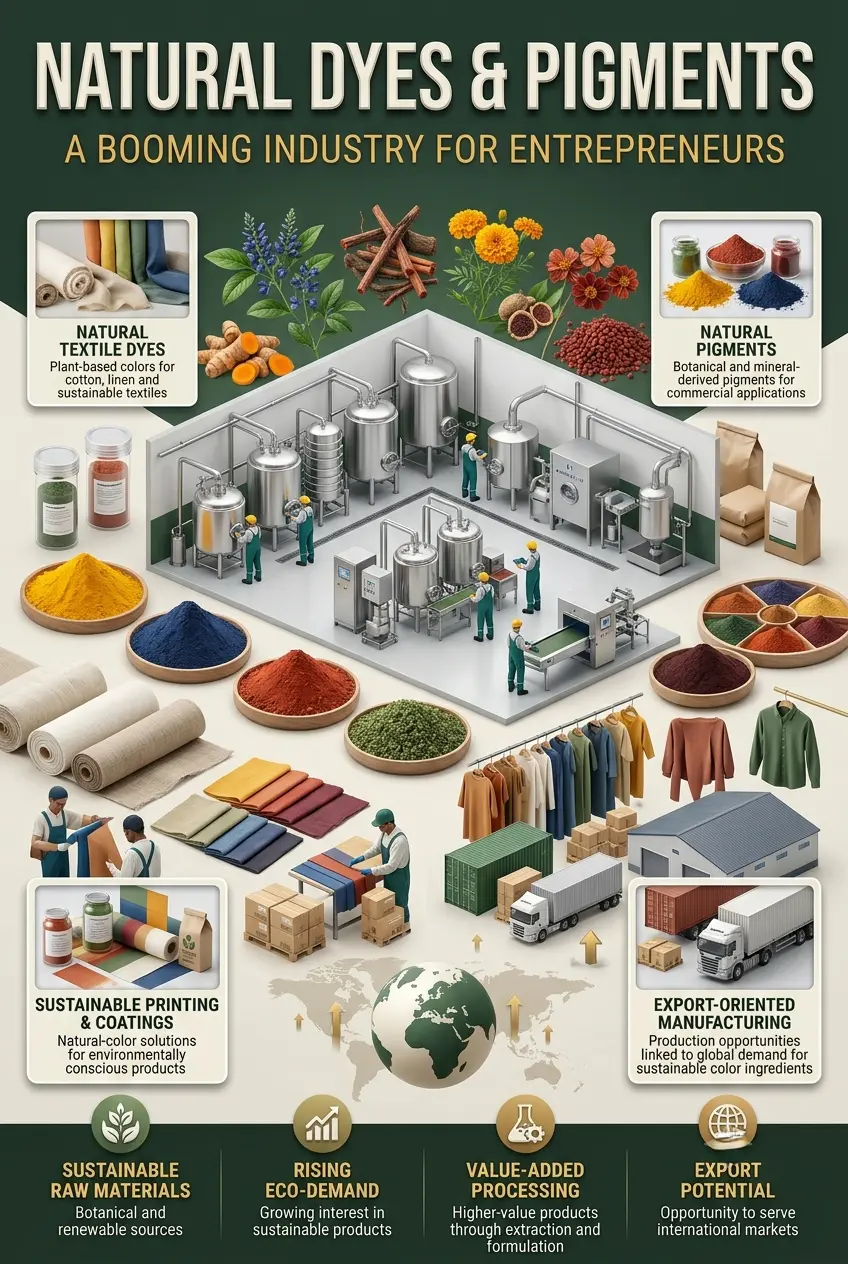
Natural Dyes and Pigments Manufacturing Business Opportunities in India
Natural dyes and pigments offer growing business opportunities across textiles, food, cosmetics and industrial applications.

What This Means for Indian Entrepreneurs and MSMEs

Natural dye manufacturing is a small-scale sector. The raw material needed is available in plenty in India. Setting up a small-scale extraction plant is simple enough and the capital required for such a venture would be easily available under MSME schemes. Moreover, the natural dyes and pigments produced fall mostly under zero or low GST categories. There are also government grants available to support this sector – SFURTI grants and Textile Ministry grants are worth exploring. The technical difficulty involved is moderate but sufficient to require proper training and guidance. So, it is imperative for you, as an aspiring entrepreneur in this space, to equip yourself with the essential technical know-how to make the venture viable.

Introducing the Complete Book on Natural Dyes & Pigments

Authored by the NIIR Board of Consultants & Engineers and published by Asia Pacific Business Press Inc., this book is one of the most comprehensive technical guides to the natural dyes & pigments sector in India. At 448 pages, it goes into great detail to explain everything that you need to know to get started in this field.

Author: NIIR Board of Consultants & Engineers

Publisher: Asia Pacific Business Press Inc. (APBP)

ISBN: 8178330326

Pages: 448

Price: USD 125 (International) / USD 29.73 (Discounted)

What Makes This Book Different

Most books on natural dyes and pigments are either superficial or delve too deep into the subject, making them inaccessible to the average reader. This book manages to avoid both these pitfalls and provides a solid technical foundation without getting bogged down in excessive theoretical detail.

The book covers a huge amount of ground – from the chemistry of various types of natural colorants to the intricate details of their extraction. For instance, the book provides a detailed discussion of the various constituents of natural colorants ranging from the ommochromes found in crustaceans to the carotenoids, anthraquinones and anthocyanins found in vegetables and fruits. It provides a comprehensive overview of the different types of quinonoid dyes and explains the chemistry of quinone reductase. Similarly, the book delves into the chemistry of various types of synthetic dyes – cyanine dyes, disperse dyes, fluorescent brightening agents and more.

Particularly valuable is the book’s treatment of natural colorants for food. The stability of natural colourants — their susceptibility to light, heat, pH, and metal ions — is a core technical challenge for food ingredient manufacturers. The chapters covering the effect of ascorbic acid, metal ions, and organic acids on colourant stability provide practical data that product developers and food technologists can directly use. The discussion of microbial, animal, and plant sources of natural food colourants, along with the feasibility analysis of novel sources, gives manufacturers a clear picture of where the industry is heading.

Two chapters stand out for their practical specificity. The section on anthocyanins from Indian varieties of grapes — covering extraction methodology, partial hydrolysis, pigment separation, and spectral analysis — is directly applicable to producers working with domestically grown fruit varieties. The chapter on red pigment from geniposidic acid and amino compounds, with detailed discussion of HPLC monitoring and NMR structural analysis, is the kind of process-level technical content that entrepreneurs setting up extraction operations will find genuinely useful.

Who Will Benefit from This Book

This book has been written for a broad audience. If you’re an entrepreneur looking to get into the natural dye business, this book will provide you with the technical know-how to get started. Technicians working in the dyeing or pigment industry will also find this book to be a valuable resource. Similarly, libraries – especially college and university libraries – will find this book to be a worthwhile addition to their collection.

If you’re an investor looking to explore investment opportunities in the natural dyes and pigments space, this book will provide you with the technical details that will help you identify viable opportunities.

About the Publisher: NIIR Project Consultancy Services

Niir Project Consultancy Services (NPCS) is one of India’s premier project consultancy firms with more than three decades of experience. The company boasts of having served clients from 85+ countries and completed more than 150,000 successful project reports. The company has a staff of experienced engineers, economists, financial analysts and domain experts who provide technically proficient and commercially viable solutions.

When it comes to publications, the consultants at NIIR bring their vast experience to bear on every project, resulting in high-quality research reports on diverse topics. The Complete Book on Natural Dyes & Pigments is yet another excellent publication from this renowned firm.

Get Your Copy Today

The Complete Book on Natural Dyes & Pigments is a serious, professionally compiled technical reference — the kind of resource that earns its shelf space by being consulted repeatedly, not just read once. Whether you are an entrepreneur scoping a new manufacturing venture, a textile professional looking to deepen your understanding of colorant chemistry, a food technologist working with natural ingredients, or an investor evaluating opportunities in the green chemicals space, this book will pay for itself many times over in the quality of the decisions it helps you make.

Order your copy from your preferred platform below:

Official Website (Niir): https://www.niir.org/books/book/complete-book-on-natural-dyes-pigments/isbn-8178330326/zb,,ee,a,0,0,a/index.html

Amazon India: https://www.amazon.in/dp/8178330326

Flipkart: https://www.flipkart.com/complete-book-natural-dyes-pigments/p/itmdyugj6shzaa6e

For media enquiries, bulk orders, or consultancy services:

Niir Project Consultancy Services (NPCS)

106-E, Kamla Nagar, New Delhi — 110 007, India

www.niir.org | www.entrepreneurindia.co

Your Investment Deserves the Right Opportunity

Every serious investment begins with choosing the right sector and the right business model. With hundreds of industrial opportunities available across India’s manufacturing and clean-energy landscape, making the most informed choice is critical. NPCS Startup Selector tool helps entrepreneurs, MSMEs, and investors identify the most suitable business opportunities based on their investment capacity, location, and interests — so your capital is directed toward a venture with the strongest fit and potential.

Frequently Asked Questions

What are natural dyes and how are they different from synthetic dyes? +
Natural dyes are colorants derived from plant, animal, or mineral sources — such as indigo from the Indigofera plant, madder from Rubia roots, or kermes from insects. Unlike synthetic dyes, which are petroleum-derived and manufactured through chemical synthesis, natural dyes are biodegradable and generally have a lower ecological footprint in terms of production. However, they typically require mordanting to achieve acceptable wash and light fastness, and their colour range and concentration are more limited than synthetics.
Is natural dye manufacturing commercially viable in India? +
Yes, particularly at the MSME level and in clusters with strong agricultural raw material supply. The premium textile, food ingredient, and cosmetics segments offer attractive margins for quality-standardised natural dye products. Government support through schemes like SFURTI and textile cluster development initiatives further improves commercial viability.
What raw materials are used in natural dye production? +
Common plant-based raw materials include turmeric (curcumin), marigold (lutein), indigo plant, pomegranate rind, madder root, henna, and red sandalwood. Animal sources include lac (shellac-based lac dye) and cochineal. Mineral-based pigments include ochre and ultramarine. India has domestic availability of most major plant-based dye crops.
What types of dyes and pigments are covered in this book? +
The Complete Book on Natural Dyes & Pigments covers ommochromes, carotenoids, anthraquinones, biflavonyl pigments, azo dyes, quinonoid dyes, cyanine dyes, disperse dyes, fluorescent brightening agents, optical whitening agents, anthocyanins, pyran pigments, pyrrole pigments (including chlorophylls), pyrimidine pigments, and polyene pigments — among others. It is one of the most comprehensive single-volume treatments of natural pigment chemistry available.
Can natural dyes be used in food products? +
Yes. Natural food colourants are an established and growing segment. Carotenoids (beta-carotene, lycopene), anthocyanins, chlorophylls, and curcumin are already widely used in food and beverage formulation globally. The book dedicates significant coverage to natural colourants for food, including stability behaviour and the effects of additives, acids, metal ions, and other variables.
What investment is needed to set up a small natural dye manufacturing unit? +
A basic extraction and processing unit for plant-based natural dyes can typically be established at the small-scale level under MSME financing thresholds, potentially qualifying for PMEGP or other government scheme support. The exact investment depends on capacity, product range, and automation level. NPCS Detailed Project Reports for specific natural dye products can provide detailed cost estimates.
Are there export opportunities for natural dyes from India? +
Significant export opportunities exist, particularly to Europe and North America where demand for sustainably produced, certified natural colorants is growing. Indian manufacturers have a natural advantage in raw material access and lower labour costs. However, export requires meeting international quality standards for colour consistency, purity, and — for food applications — regulatory compliance in the destination market.
What is mordanting and why is it important in natural dyeing? +
Mordanting is the process of treating a textile fibre with a metallic salt (the mordant) before or after dyeing, to help the dye molecule bond permanently to the fibre. Common mordants include alum (potassium aluminium sulphate), iron, copper, and tannin. The choice of mordant significantly affects the final colour and the fastness properties of the dyed fabric. The book covers mordanting chemistry as part of its dyeing process discussion.
How does this book help entrepreneurs set up a production facility? +
The book provides technical process descriptions for producing various natural dye and pigment types, including raw material selection, extraction methodology, and analysis of final colour properties. This technical grounding helps entrepreneurs understand process requirements, equipment needs, and quality parameters — an essential foundation before preparing project reports or seeking funding.
Is the book relevant for textile professionals as well as food manufacturers? +
Yes. The book's coverage is genuinely cross-sectoral. Textile professionals will find the chapters on mordant dyes, disperse dyes, fluorescent brightening agents, and fastness properties directly relevant. Food manufacturers will benefit from the chapters on natural food colourants, stability behaviour, and novel colourant sources. Cosmetic formulators will find the pigment chemistry sections applicable to their work.
Where can this book be purchased? +
The Complete Book on Natural Dyes & Pigments is available through the NIIR website (niir.org), Amazon India, and Flipkart. International buyers can order through the NIIR website. Purchase links are provided in the section below.
What other resources does NPCS offer for entrepreneurs in the natural dye industry? +
Beyond this book, NPCS offers Detailed Project Reports (DPRs) for specific natural dye manufacturing projects, techno-economic feasibility studies, and business plans tailored to the investor's capacity and market. These services are available through niir.org and cover project cost, machinery, raw material, manpower, profitability, and financial projections.
Tags: Natural ColorantsNatural Dye BusinessNatural Dye ManufacturingNatural DyesNatural Dyes and PigmentsNatural Dyes in IndiaNatural Food Colourants
Share196Tweet123
Previous Post

Building Materials Business Ideas: 5 Profitable Manufacturing Units in India

Diksha Garg

Diksha Garg

Diksha Garg is a marketing strategist and business growth enthusiast with over 7 years of experience driving impact through data-driven insights and strategic storytelling. She writes for entrepreneurs and startups, breaking down complex business challenges into actionable ideas that help founders scale smarter, market better, and build sustainable growth.

Leave a Reply Cancel reply

Your email address will not be published. Required fields are marked *

Contact Us

    Categories

    • Agri Business Opportunities
    • Business Ideas
    • Chemical Industry Business Opportunities
    • Cosmetics and Personal Care Business
    • Eco Friendly Sustainable Business
    • Entrepreneurship Leadership and Startup Growth
    • FMCG Consumer Products Business
    • Food Processing Business Industry
    • Future & Emerging Industries
    • Government Schemes Policies for Business
    • Import Export Business Opportunities
    • Industrial Project Reports Business Guide
    • Investment Funding for Startups
    • Manufacturing Business Ideas for Startups
    • Market Research Trends for Business
    • MSME & Small-Scale Industries
    • Paper Pulp Industry Business
    • Pharmaceutical Industry Business
    • Plastic & Packaging Business
    • Renewable Energy Startups
    • Startup Business Opportunities
    • Startup Business Planning and Strategy
    • Technology & Automation Business
    • Textile Industry Business
    • Uncategorized
    • Waste Management & Recycling Business
    • Water & Environmental Business
    Entrepreneur India Blog

    Copyright © 2026 Entrepreneur India

    Navigate Site

    • About
    • Advertise
    • Privacy & Policy
    • Contact

    Follow Us

    Welcome Back!

    Login to your account below

    Forgotten Password?

    Retrieve your password

    Please enter your username or email address to reset your password.

    Log In
    No Result
    View All Result
    • Home

    Copyright © 2026 Entrepreneur India

    Not enough quota to unlock this post
    Unlock left : 0
    Are you sure want to cancel subscription?