





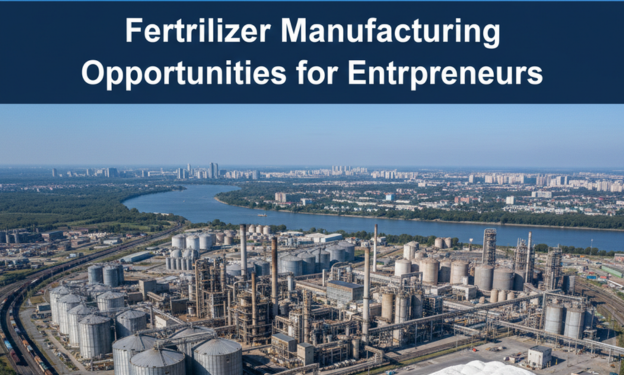
Fertilizer Manufacturing Opportunities for Entrepreneurs: Agriculture remains one of the most essential support systems of the world economy, which directly underlies food security, rural communities, and supply chains of industries. With the ever-growing world population and a decrease in arable land, the agricultural usefulness of fertilizers has never been felt as significant today. Fertilizers assist in replenishing the soil with the necessary nutrients, enhance crop production; and maintain intensive farming systems to satisfy food demand in the world.
Fertilizer manufacturing is an attractive business compromise to entrepreneurs and startups who have long-term and demand-driven industrial opportunities. The fertilizers have stable consumption, policy backing and a close association with food production unlike many cyclical industries. The industry has also developed over the years to commodity products that are more efficient and application-specific to more value adding and better margins.
Among the multitude of products that make up the modern day fertilizer products, Sulphur Water Dispersible Granules (Sulphur WDG) and Ammonium Bicarbonate and Triple Super Phosphate (TSP) are especially promising products both agronomically and in commercial terms. These products meet the major deficiencies in nutrition, target a wide range of crop segments, and have a stable demand in both domestic and export.
This article includes a detailed description of the three above fertilisers in terms of their agronomic values, manufacturing techniques, demand, cost profiles and prospects of growth in the near future. It is also aimed to assist entrepreneurs, investors and industrial planners in considering fertilizer manufacturing as a business opportunity that is viable and can be scaled.
Overview of the Global Fertilizer Industry
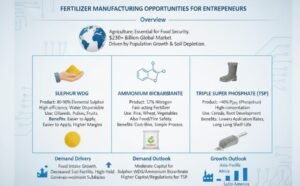
The fertilizer industry is the key to modern farming and providing sustainable food production. As farming areas have been sparsely expanded on and the demand to improve crop yields has risen, there is reduced dependence on fertilizers as a supplement to crop production, and fertilizers have become indispensable inputs. The fertilizer market has been estimated to be over USD 230 billion today and it is projected to continue increasing throughout the next decade.
Various factors are promoting growth in fertilizer usage such as the rise in food intake, the decreasing soil fertility, the increased use of high yield varieties of crops and growing awareness of the balanced use of nutrients. The industry is further promoted by government subsidy programs, soil health programs, and domestic manufacturing incentives in most of the countries.
The place of new economies in Asia, Africa and Latin America is likely to contribute a substantial portion of the future growth. These areas are undergoing intense agricultural modernisation, increased availability of inputs and increased production of nutrient-rich crops. Consequently, the future of the demand for nitrogen, phosphorus, and sulphur containing fertilizers is expected to be robust and steady.
Get more details from our project report
Sulphur WDG: A High-Efficiency Sulphur Fertilizer
Sulphur Water Dispersible Granules (Sulphur WDG), is a new and efficient agricultural solution to the prevalent sulphur deficiency in agricultural soils. Sulphur is an essential secondary nutrient that is needed in protein synthesis, enzyme functions, chlorophyll synthesis, and in crop oil production. The combination of intensive farming methods, less use of organic manure and the extensive use of high-analysis fertilizers have led to an increase in the loss of sulphur in soils in most of the regions.
Sulphur WDG normally includes 80 to 90 per cent elemental sulphur and is composed to scatter even in water. Sulphur WDG compared to the traditional sulphur powder, which is dusty and hard to apply, is safer, easier to apply, and rich in nutrients. The granular form can be easily applied in drip irrigation, foliar sprays and in the soil, and it is especially prevalent in the horticulture and high-value crop segments.
Manufacturing wise, the production of Sulphur WDG requires melting of elemental sulphur in the process of producing the product, the elemental sulphur is mixed with dispersing and binding agents, the mixture is granulated, dried and packaged. Although a special formulation mastery and quality control is needed in the process, the total capital investment is moderate and affordable to small and medium business owners.
Sulphur WDG market is increasing with a steady demand particularly in the oilseed crops, pulses, fruits, vegetables and plantation crops. The largest consumer market is Asia-Pacific, and Africa and Latin America are the emerging high growth markets. Since Sulphur WDG is value added and agronomic, it has better margins than conventional sulphur fertilizers and this is a good opportunity to manufacturers of speciality fertilisers.
Ammonium Bicarbonate: A Cost-Effective Nitrogen Fertilizer
One such common fertilizer is ammonium bicarbonate which is a cheap and fast acting nitrogen fertilizer. It has about 17 percent nitrogen and is therefore very appropriate in crops that demand immediate nutrient absorption like rice, wheat, vegetables, fodder crops, and those ones with short duration. This is because it rapidly decomposes in soil and plants can acquire nitrogen shortly after the application.
Ammonium Bicarbonate is also used in food processing, chemical manufacturing and fire safety products in addition to its agricultural use. These end uses are diversified which contributes to stabilising the aggregate demand and decreasing reliance on agricultural cycles.
The basic chemistry of the manufacturing process of Ammonium Bicarbonate is not quite difficult and requires the reaction of ammonia and carbon dioxide in controlled conditions, crystallisation, drying, and packaging. Raw materials are easily available, power consumption is relatively low and the activities of the plant are very simple. This will result in Ammonium Bicarbonate being a good entry level product when a first time entrepreneur ventures into the manufacture of fertilizers.
Agriculture takes close to two-thirds of the world wide Ammonium Bicarbonate use, and industrial uses have a secondary large portion. Its growth rate is average in comparison with specialty fertilizers; however, its demand is consistent and predictable. Ammonium Bicarbonate is a low-risk and dependable opportunity in front of entrepreneurs that aim at large-volume production, rapid market entry, and shorter break-even timeframes.
Biofertilizer Manufacturing Business
Triple Super Phosphate: Phosphatic Fertilizer of High Concentration.
TSP (Triple Super Phosphate) is a commercial grade of phosphorus fertilizer, and also one of the greatest concentrations of phosphorus. It contains approximately 46 percent of phosphorus in the shape of P 2 O 5 and is therefore very useful in remediating the phosphorus deficiency in the soil.
Phosphorus is vital in the development of roots, translocation of energy, flowering and general vigour of plants, TSP is of high importance as the input in staple and high-value crops.
TSP is extensively applied on cereals, pulses, oilseeds, fruits, vegetables and plantation crops. It has a high concentration of nutrients that lowers the application rates, transportation costs, and storage that provide economic benefits to both farmers and distributors. The shelf life of the product is also long and contributes to the efficient inventory and export logistics.
TSP is manufactured by the reaction of phosphate rock, which has been finely ground, with phosphoric acid, then it is granulated, cured, dried and then screened. TSP production is more capital-intensive than nitrogen or sulphur fertilizers and has stringent environmental regulations especially in emission and effluents treatment. Consequently, this makes medium- and large-scale plants more appropriate to TSP manufacturing.
The need for TSP in the global market is quite high and this is based on its use in balanced fertilization programs and soil health management programs. The awareness of phosphorus deficiency and sustainable use of nutrients will likely help the gradual growth in the future.
Comparative Market and Cost Structure Analysis Related to Fertilizer Manufacturing Opportunities for Entrepreneurs
Ammonium Bicarbonate represents the highest market share as compared to the uses of the other two products given its wide usage and low cost. In its wake comes Triple Super Phosphate, aided by the fact that it is an imperative nutrient of phosphorus. Sulphur WDG is lower in quantity and is a large share in terms of value, as it is a speciality product.
The structures of costs differ in such products. Raw materials are the biggest cost constituent, which is approximately 45 per cent of Sulphur WDG to over 55 per cent of TSP. The rest of the costs are the utilities, labour, packaging and overheads and these can vary depending on the size and technology of the plant.
Sulphur WDG is more profitable as it has more formulations with value added and Ammonium bicarbonate is more profitable because of less complex production and quicker capital recovery. TSP benefits from economies of scale, and long-term stability of demand, despite being a capital-intensive one.
Fertilizer Manufacturing Business Opportunities: 25 Winning Ideas for Growth
Industry Growth Outlook and Future Trends
It is projected that the demand index of fertilizers globally will continue to increase within the coming decade owing to the population growth, shifting eating habits, and on-going soil nutrient depletion. The growing focus on balanced fertilizing, managing of micronutrients and sustainable farming is creating demand on conventional and specialty fertilizers.
The main trends that are defining the industry are that there is a growing demand to use water soluble and high efficiency formulations, fertilizer application has become more mechanized and governments are encouraging domestic production. The factors that are also becoming critical in the design of the plants and the choice of technology are environmental compliance and resource efficiency.
Role of Niir Project Consultancy Services
Niir Project Consultancy Services has a significant role in providing services to entrepreneurs and investors joining the industry of fertilizer and chemical manufacturing. The organisation makes comprehensive market surveys and techno-economic feasibility reports that address the selection of the products, manufacturing processes, raw materials, plant layout, machinery and financial analysis. Through such studies, the entrepreneur can be able to determine precisely the risk, investment and profit potential before establishing new manufacturing units.
Conclusion
Fertilizer production is one of the most reliable and prospective industrial sectors to venture in and start up by any entrepreneur. Sulphur WDG, Ammonium Bicarbonate and Triple Super Phosphate are useful in meeting basic agricultural requirements and enjoy a stable demand, policy backing, and long growth drivers.
The products have unique benefits in terms of capacity to invest, technical knowledge and target markets. Sulphur WDG has high profits due to value addition, Ammonium Bicarbonate is easy and volume based stable, and Triple Super Phosphate is volume based and adequate in nutrient provision.
Sustainable and profitable fertilizer manufacturing enterprises can be established by entrepreneurs with proper planning, technology choice, and alignment with market needs to facilitate the growth of the economy besides helping in securing food in the world.
ent


