





Manufacturing Segments for MSMEs and Investors in EVs: The manufacturing economy of India is at a stage where there is no longer sufficient capacity addition based on incremental capacities. The next ten years will be influenced by regulation-driven demand, import substitution and structural changes in the consumption of energy, chemicals, and mobility solutions as far as industries are concerned. This shift is providing avenues between the traditional heavy manufacturing and technology-based ventures that are appealing to people in the entrepreneurial and investment arena.
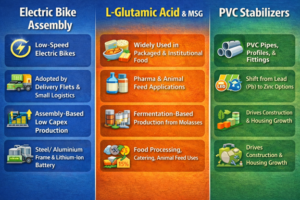
This paper will discuss three of these segments as separate and yet scalable manufacturing firms, which consist of electric bike assembly, L-Glutamic Acid and Monosodium Glutamate, and PVC stabilizers. All of these products cater to a separate industrial ecosystem, yet are united by a single factor: they are both supported by policy, consumption patterns and high downstream connectivity.
Electric Bike Assembly (2-Wheeler, 250W Motor, Speed < 25 km/h)
Product Overview and Real-World Applications
The low-speed electric bikes (250W) and maximum speed of less than 25 km/h have a distinct niche in the Indian mobility ecosystem. They do not need vehicle registration or driving license, which makes them especially appealing to the students, last-mile delivery employees, the elderly, and those who have to travel a short distance and commute to the city.
Economic delivery fleets and e-commerce mobility vendors, small logistics operators are increasingly adopting these electric bikes as a way to minimize fuel expenses without going through the complicated compliance frameworks.
Find Out More in our project reports
Manufacturing and Production Insights
The majority of the successful players in this segment follow an assembly-based model of manufacturing and not full-scale component manufacturing. Frames, motors, controllers, batteries, chargers, and braking are also imported and then a combination of local and overseas suppliers supplies these components, then assembly, testing and quality control are performed locally.
These processes are usually frame mounting, fitting of a motor, integrating a battery, wiring harness, controller programming, road testing and completion of final inspection. Capital intensity is relatively low as compared to more traditional automotive manufacturing, and scalability is ensured through the addition of parallel assembly lines instead of increasing heavy infrastructure.
Raw Materials and Processing Considerations
It consists of a mild steel or aluminium frame, hub motors, lithium ion or lead acid batteries, electronic controllers, tyres, and brakes. The point at which the decision to source batteries holds the highest criticality because the cost of the vehicle directly influences its performance, and the risk associated with warranties.
Non-electronic sourcing gives higher margins through localisation, whereas electronics sourcing has contractual relations with suppliers over the long term to deal with price fluctuations.
Demand Drivers and End-Use Industries
Demand is being spurred by overcrowding in cities, the increased cost of fuel, and the blistering growth of delivery based business models. Electric mobility efforts by governments and acquisitions by government agencies are also bringing exposure to the segment. The highest demand is in the tier-1 and tier-2 cities where short-commuting is the main mode of transportation.
Market Size, Growth Outlook, and Profitability
The low-speed electric two-wheeler market in India has been developing in a high growth of a double-digit rate, beating the conventional scooter in particular urban micro-markets. Assembly units with a range of 8,000 -10,000 units/year usually have EBITDA margins between 12-18 percent, based on the battery chemistry and sourcing strategy.
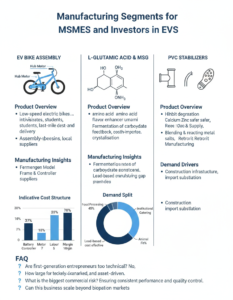
Indicative Cost Structure – Electric Bike Assembly
| Cost Component | Share (%) |
| Battery Pack | 38 |
| Motor & Controller | 22 |
| Frame & Mechanical Parts | 18 |
| Labour & Assembly | 7 |
| Overheads & Testing | 5 |
| Operating Margin | 10 |
L-Glutamic Acid and Monosodium Glutamate (MSG)
Product Overview and Applications
L-Glutamic Acid is an amino acid that is common in food, drugs, animal drugs and nutraceuticals. The most commercially influential derivative of it is Monosodium Glutamate (MSG), a flavour enhancer that is consumed worldwide, as well as an additive that provides umami.
In India, the consumption of MSG goes beyond packaged foods to institutional catering, snacks, seasoning mixtures, and ready-to-eat products. Pharma and feed formulations that are based on fermentation are also sources of L-Glutamic Acid in the industrial market.
Manufacturing and Production Insights
It is produced industrially by fermentation of carbohydrate feedstock (molasses or starch hydrolysate) by microbes. It is done by controlling fermentation, adjusting the pH, separation, crystallisation, drying and packaging.
The production of MSG proceeds to include a neutralisation process with sodium salts after the recovery of glutamic acid. It is a capital-intensive manufacturing process that has to be controlled by biochemical processes and that has a much higher level of economies of scale.
Raw Materials and Processing Considerations
The major raw materials will be molasses or glucose syrup, ammonia, microbe cultures, processing chemicals, and energy. Reliable quality of the feedstock and efficiency of fermentation have direct effects on the yield and cost competitiveness.
The management of the effluents is also a significant factor to be taken into account and adherence to the rules of pollution management is the operational aspect of the planned business but not a set aside factor to be addressed at a later stage.
Demand Drivers and End-Use Industries
The increase in the consumption of processed food, the use of food in cities, and institutional food preparation is driving up the demand for MSG. Simultaneously, the nutritional needs of animals and pharmaceutical uses are also forming a consistent baseline demand of L-Glutamic Acid.
Domestics are still substituting imports, especially in industrial applications.
Market Size, Growth, and Profitability
The MSG market of India has been recording a steady mid-to-high single-digit growth whereas the demand of glutamic acid has been increasing steadily in the pharma and feed markets. Plants have operating margins of 1825 percent and smaller units have niche grades or captive consumption.
Demand Split – Glutamic Acid & MSG
- Food Processing: ██████████ 45%
- Institutional Catering: ██████ 25%
- Pharma & Nutraceuticals: ████ 15%
- Animal Feed: ████ 15%
Calcium Zinc PVC Stabilizer and Lead-Based PVC Stabilizer
Product Overview and Applications
PVC stabilizers are important additives in order to inhibit the degradation of polyvinyl chloride during processing and end service. The Indian market has always been dominated by lead based stabilizers because of its cost effectiveness whereas calcium zinc stabilizers are increasingly getting popular as safer and eco compliant.
Its use is found in pipes, fittings, cables, profiles, footwear, films, and sheets – industries that support the main construction and infrastructure.
Manufacturing and Production Insights
Stabilizer production entails blending and reacting metal salts, lubricants and organic compounds under heat. Minimally, plants are operated as batches; they can be flexible across products grades.
Calcium Zinc stabilizers demand more formulation control and technical support to customers and lead stabilizers are less complex but demand more and more regulation.
Grab more business knowledge from these books
Raw Materials and Processing Considerations
The traditional stabilizers contain lead oxide or lead salts, whereas non-lead stabilizers contain calcium and zinc salts. Performance characteristics are obtained through the addition of fatty acids, waxes and phosphites.
Safety of the workers, dust management and waste management is also essential, especially in lead based units.
Demand Drivers and End-Use Industries
Infrastructure growth, housing demand, and irrigation projects drive PVC consumption. Export-oriented manufacturers are accelerating the shift toward calcium zinc stabilizers due to regulatory pressure in overseas markets.
Market Size, Growth Outlook, and Profitability
PVC is consumed in infrastructure development, housing needs and irrigation projects. Export-focused manufacturers are hastening the transition to calcium zinc stabilizers because of the pressure in foreign markets.
Growth Outlook Comparison
| Segment | Growth Trend | Long-Term Outlook |
| Lead-Based Stabilizers | Stable | Gradual Decline |
| Calcium Zinc Stabilizers | High | Strong Expansion |
Insights from India’s Proven Industrial Leaders
Ather Energy is an Indian company advertised by Tarun Mehta, which proved that a defensible business in electric mobility could be established using disciplined localisation and in-house engineering. The company concentrated on scale at the end rather than at the beginning as far as product reliability was concerned.
In the case of specialty chemicals, Atul Ltd founded by Kasturbhai Lalbhai developed success by means of backward integration and product differentiation which minimized reliance on any one market. The teaching to new entrepreneurs is obvious: it is technical depth and control over the process rather than rapid addition of capacities.
Role of Niir Project Consultancy Services (NPCS) in Industrial Planning
Niir Project Consultancy Services (NPCS) assists business people in the preparation of the Market Survey cum Detailed Techno-Economic Feasibility Reports. These reports include manufacturing etc, raw materials needed, layout planning of the plant, cost estimation of the project and projected financials. NPCS can make promoters analyze the viability of establishing new industries or businesses prior to capital investment by providing structured analysis, thereby lowering the risk associated with the execution of such undertakings and enhancing decision transparency.
Policy and Regulatory Environment
The adoption of electric mobility has been affected by policy support by such bodies as the Ministry of Heavy Industries (https://heavyindustries.gov.in) and the usage of chemical manufacturing advantages through domestic capacity-building and infrastructure-prone PVC demand.
Frequently Asked Questions
Would first generation entrepreneurs be able to assemble electric bikes?
Yes, because of reduced capex and scalability in modules, when supplier selection and after sales planning are good.
Is there regulatory issue in MSG manufacturing?
It is well-established and as such the environmental compliance and treatment of effluents should be incorporated in the project design.
Will the lead-based PVC stabilizers be phased?
Gradually. There is still domestic demand, but those units that are based on exports are converting to calcium zinc formulations.
What segment has got the quickest breakeven?
The electric bike assembly would normally hit breakeven sooner as it is not capital intensive.
Conclusion: Strategic Learners to Manufacturers and Investors.
The three manufacturing opportunities are examples of how to achieve industrial success. The assembly of the electric bikes recognizes responsiveness in the market and discipline in the supply chain. The production of glutamic acid and MSG requires process knowledge and size. PVC stabilizers are at the crossroads between regulation and infrastructure development.
To entrepreneurs, it is not the technology, but knowledgeable decision-making, the realization of demand realism, regulatory direction, and the complexity of operations. The companies that match manufacturing strategy to these underpinnings will discover that the coming wave of India is a wave of resilience and growth of the Indian industry.


