






Introduction
Growth Manufacturing Business: Venturing into manufacturing is also one of the surest methods of scalable business ventures that can be established using assets by entrepreneurs. Although manufacturing, unlike trading or services, may require more start-up capital and organization, it also provides stability in the long run, predictable demand and high value generation. The trick is to find products that will match the market trends, enjoy the increasing demand, and have the possibility to become innovative and differentiated.
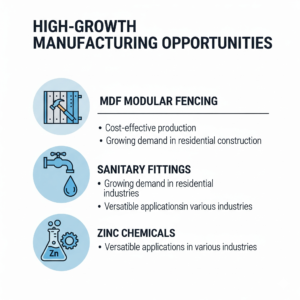
This paper will discuss three manufacturing opportunities that are high growth opportunities that have good market fundamentals, growing demand and promising returns on investment. They are MDF modular fencing systems, sanitary fittings, including faucets, sinks, and showers, as well as zinc oxide and zinc carbonate manufactured by using zinc ingots. Combining these opportunities, the home infrastructure, construction materials, and specialty chemicals are three sectors that are fundamental to contemporary economies and not sensitive to the cycles of demand in the long term.
All the sections give a concise summary of the product, the forces behind its growth, growth prospects, capitalization needs and the potential to make profits, giving would-be entrepreneurs an opportunity to gain a viable idea of where the manufacturing growth will take off to.
MDF Modular Fence Manufacturing: A Modern Construction Solution
Industry Overview
A modern development in the solutions of fencing is Medium Density Fibreboard (MDF) modular fences. MDF is made of fabricated wood fibre of wood bonded to form panels under pressure and heat, making it smooth, uniform, and custom-cut. These panels have pre-fabricated standardized pieces when installed in modular fencing systems that may be easily assembled on-site.
Compared to conventional types of fences, which are made of brick, metal or wood and demand labour and are time consuming to put up, MDF modular fences have speed, uniformity and aesthetic versatility. They are usually installed in residential homes, commercial centers, institutions, and offices, and in gated communities. MDF fences are privacy, sound insulating, and attractive and at a competitive price with proper surface treatment and weather-resistant coating.
To manufacturers, MDF fencing is an avenue of combining construction materials and design oriented products so as to satisfy the demands of customers who are keen to both functionality and design.
Market Demand and Growth Trends
The increased use of MDF modular fences is directly connected with the process of the rapid urbanization and the growth of the real estate sphere. With more compact city development, property owners are becoming more interested in finding a fast and effective way to enforce boundary demarcation, privacy, and noise control. Modular fencing is ideal in this requirement.
The MDF modular fencing market in India is estimated to be worth USD 1.2 billion and is projected to decrease by an average annual growth rate of almost 9 percent. MDF in its raw form is enjoying a well-developed supply chain across the world, as it is enabled by the significantly larger MDF board business which has a value of over USD 50 billion. This guarantees the availability of raw materials and stability in the cost of the raw materials to the manufacturers.
The other significant demand driver is replacement. Classical fences wear out and property owners are more and more using the modern low maintenance fences. MDF modular fences are also made to suit individual designs, wood-grain finishes and modern patterns, which make them more attractive.
Why MDF Modular Fences Are a Strong Investment
MDF fencing is one of the largest opportunities because it aligns with the thriving construction industry. The emerging residential designs, commercial structures, and institutional campuses need a rapid perimeter solution and a modular fencing drastically shortens the construction projects.
Production wise, MDF panels are light and standardized thus making it easy to manufacture and transport. The product is also contractor and developer-friendly because it is easier to install and less labor-intensive. Moreover, the manufacturers have the potential to distinguish by surface finishes, designs CNC-cut, and customized dimensions, which permit premium prices.
Another significant factor is cost efficiency. MDF is not as costly as solid wood or metal and can typically be made of recycled wood fibers, which makes it comparatively eco-friendly. Manufacturing is a process that consists of panel cutting, routing, sanding, and finishing and does not need very intricate machinery.
Investment and Profitability Outlook
The initial investment needed to set up an MDF modular fence manufacturing unit has varied between 55 and 25 lakh. This comprises machinery, factory establishment, and the start up capital. The capital requirement is moderate, whereas the expected returns are favorable, and the estimates of ROI are 20-30%.
Having an efficient operation and a steady demand by the construction industry the business within this segment could gradually scale up, raise capacity and better margins using volume production.
Sanitary Fittings Manufacturing: A Core Segment of Modern Infrastructure
Industry Overview
Sanitary fittings contain major plumbing fittings whose use is in bathrooms and kitchens, like faucets, taps, sinks, showerheads, and other accessories. These are essential products both at homes, offices and institutions and thus are a central product in the development of infrastructure.
The materials that are used in the manufacturing of sanitary fittings include brass, stainless steel, engineered plastics and surface finishes, like chrome plating. Its products are of basic fittings that are cost effective to use in mass houses, to luxury homes and hotels that require high end fixtures.
This business will integrate functionality with design and will be more technologically integrated (water-saving mechanisms and touch-free use).
Market Demand and Growth Drivers
The sanitary fittings business is a booming industry with real estate, and the increase in living standard being the major contributor. In India, the market is estimated to be USD 2.1 billion with an estimated growth rate of 9.5% CAGR thus it is one of the fastest developing manufacturing segments.
Urbanization is also essential and the apartments, offices, malls and hotels that are being new demand many bathrooms and kitchens. Concurrently, the trend of renovation and remodelling can be used as an influential factor in demand because modern efficient designs are being installed by homeowners to replace old outdated designs.
A major boost has also been given through government programs on sanitation and hygiene. Big projects such as toilet construction, government buildings and low-cost housing projects consist of mass acquisition of sanitary fittings.
Consumers all over the world are changing their taste towards water efficiency, hygiene and aesthetics. Low flow faucets, sensor taps and contemporary finishes are no longer considered luxuries, but the norm.
Key Advantages of Entering This Sector
Sanitary fittings have repeat business. The plumbing fixtures wear or become outdated unlike most consumer goods, which means there will be a constant replacement cycle. This causes the business not to be affected much by slowdowns in the economy.
Branding and innovations have a significant role in this industry. Manufacturers that target the aspects of durability, leak-proof functionality, and appealing design may establish a well-developed brand image. Niche positioning (e.g. environmentally friendly fixtures, mid-end products that provide high-end looks at reasonable prices) is also possible.
Scalability is another benefit. Manufacturers will have the opportunity to begin with a small variety of products and slowly diversify into kitchen fittings, accessories or even ceramic sanitary wares.
Capital Investment and Returns
Profitability is also high despite the cost of set up. Return on investment between 22 and 32 is normal especially with manufacturers who have well developed distribution channels and are quality oriented. Healthy margins are associated with premium products and businesses will recover their investment in a couple of years.
Read This Report: Wood and Wood Products
Zinc Oxide and Zinc Carbonate Manufacturing: A High-Value Chemical Opportunity
Industry Overview
Inorganic chemical compounds that are commonly used in industries are zinc oxide (ZnO) and zinc carbonate (ZnCO 3 ). Zinc oxide is a fine white powder, which is found in rubber, ceramics, paints, cosmetics and pharmaceuticals. Zinc carbonate is a white powder and is also utilized in the same industries and also in agriculture and specialty chemical use.
By producing such compounds using ingots of zinc, highly purified forms can be obtained by the producers; these are crucial in the pharmaceutical, cosmetic, and high-performance industrial applications.
This segment will be most suitable to all entrepreneurs who have technical or chemical engineering backgrounds and those who are interested in venturing into value-added chemical production.
Industrial Applications and Demand Base
The rubber and tire industry is the most significant consumer of zinc oxide which occupies a high percentage of the worldwide demand. Zinc oxide is essential in the vulcanization process of rubber, it cannot be done away with in the production of tires. Due to the growth of vehicle ownership in the world, the market of tires and consequently, zinc oxide keeps rising.
Other applications of zinc oxide include ceramics and glass making, paints and coatings as well as personal care products like sunscreens and ointments among many more. Zinc carbonate has been used in the pharmaceuticals, animal feeds, fertilizers and in oil and gas drilling fluids.
Such a diversified demand base is stable. Although one of the sectors might slacken, others tend to be expanding thus minimizing the risk of conducting business.
Market Outlook
The world market of zinc oxide is estimated to be more than USD 5 billion and is expected to increase at a rate of approximately 5 per cent CAGR within the next 5 years. Expanding production of automotive production in Asia, increasing usage of zinc oxide in cosmetics, and thus growing demand in the electronics industry drive growth.
Although Zinc carbonate is smaller in volume, it is also growing steadily especially in agriculture and pharmaceuticals. In certain countries, domestic production is also promoted by restrictions on imports and local policies of industrial supply chains.
Set Up Requirements and Profitability
Indeed, a plant of zinc oxide and zinc carbonate production needs special equipment including furnaces or reactors, a precipitation unit, filtration, quality control laboratory. Zinc ingots or second-hand sources of zinc are the raw materials.
The availability of export opportunities also increases profitability since a large number of countries rely on imports of zinc compounds.
Comparative Perspective and Final Thoughts
All three manufacturing opportunities addressed have their own benefits. MDF modular fencing and sanitary fittings are most closely related to construction and urban development, having good domestic demand and quick development. On the other hand, zinc oxide and zinc carbonate production access world’s industrial supply chains and receive high margins due to chemical value addition.
The correct opportunity rests on capital availability, technical skills and the future vision of an entrepreneur. The only similarity between the three opportunities is that they are applicable to the important industries and contribute to sustainable growth.
These manufacturing undertakings, through proper planning, market research and effective implementation, can be the basis of profitable and future oriented business.


