




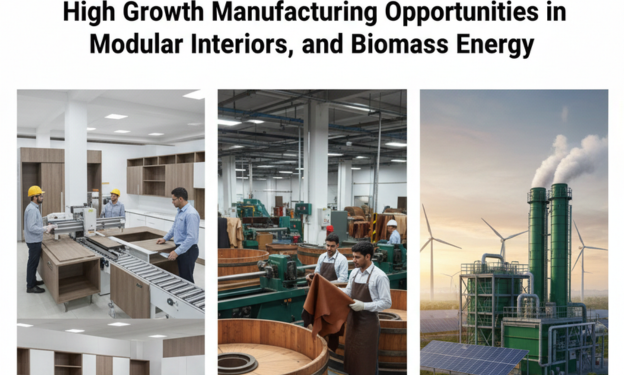
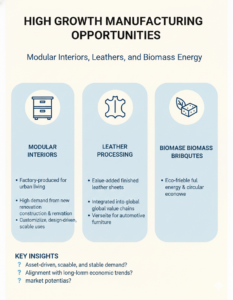
The High Growth Manufacturing Opportunities environment of India is slowly transforming to be more of a value-added, demand-driven production as opposed to a commodity-driven manufacturing environment. The entrepreneurs are not just seeking scale, they are seeking stability, defensible margins and alignment with long term economic and social trends. Three of these manufacturing segments include modular kitchens and wardrobes, finished leather sheets, and bio-waste biomass briquettes, which are unique because, in terms of demand, they are easy to grow, and each is applicable in the domestic and export markets.
All of these industries can be seen as a variant of industrial logic. Modular interiors are urban-consumption and design-driven, finished leather sheets are a part of a globally integrated materials value chain, biomass briquettes occupy a renewable energy and the circular economy niche squarely. The combination of the two offers a handy spectacle of the possible coexistence of multiple manufacturing opportunities within the changing Indian industrial environment.
Modular Kitchens and Wardrobes: Manufacturing for Modern Urban Living
24-19 Built-in wardrobes and modular kitchens have now been part of the modern home and office interior. In contrast to the old fashioned carpentry that was all site-built, the modular systems are based on factory-produced parts that are put together and installed at the location of the customer. This has been brought about by the rapid urbanisation process, the reduction of living space, and increased demands in terms of design consistency as well as speed of installations.
On the product level, the modular kitchens and wardrobes are a collection of standardized boxes in cabinets, shutters, drawers and inside warehouse systems. These elements are made of engineered wood i.e. plywood, MDF, or particle board, covered with a laminate, veneers, acrylic sheets or membrane foils. Even the hardware fittings, such as hinges, soft-close channels, sliders, handles, and locking systems are really vital in functionality as well as perceived quality.
The process of manufacturing is generally created by cutting the panel with CNC machines or panel saw machines and it will be followed by edge banding, drilling and assembling the cabinet. Surface finishing is being outsourced or in-sourced depending on the scale. The manufacture of the core cabinetry is mostly done by the majority of manufacturers, and the local teams carry out installations and final fitting. This mixed system will enable business owners to regulate the quality of the manufacturing but will be flexible in implementation.
Demand of modular interiors is in close connection with the construction of houses, renovation and lifestyle upgrades. The flow of orders is guaranteed by new apartments, government building renovations, office redesigns, stores, and hospitality areas. There is also an increased market impact because of the increasing role of interior designers and turnkey contractors, who take more comfortable modular solutions of predictable timelines and cost management.
The modular kitchen/ wardrobe sector has become a multi-billion industry globally; one with an average annual growth. The market in India is still growing with the shift of modular interiors among the high end urban houses to mid-income housing. The typical entry of entrepreneurs into this space is a handful of small workshops serving local builders and growing by investing in automation, increasing design services, and creating brand awareness.
The efficiency of sourcing of materials, minimization of wastage and discipline of installations are key factors towards profitability in the manufacture of modular furniture. Companies that incorporate both the production capacity and the powerful design and after sales services are likely to achieve better margins and re-orders.
Finished Leather Sheets: A Core Material in a Global Value Chain
There is a highly important place in the leather products ecosystem occupied by finished leather sheets. These sheets are processed animal hides that are then tanned, dyed and surface finished to produce finished sheets that are ready to be used directly in a product making process. They are distributed to footwear companies, bag and accessory manufacturers, furniture manufacturers, and suppliers of automotive interiors.
The process of making finished leather starts with the raw hides that are obtained at the slaughterhouses or of the traders. To produce these hides, a series of chemical and mechanical treatments are undertaken and they include soaking, liming, dehairing, tanning, retanning, dyeing and finishing. The most widely used is still the chrome tan because it is efficient, leather soft yet vegetable tanning is increasingly used in high-quality and eco-friendly applications.
The last properties of the leather sheet are determined by finishing operations. The control of thickness, surface texture, colour uniformity and durability is all affected at this stage. The finished sheets usually have a thickness of between 0.5mm and 2mm depending on the purpose they are intended to serve.
The various end-use industries require varying leather properties. In footwear production, it is necessary to have supple leather of uniform grain and colour, whereas in furniture and car usage it is the abrasion resistance, thickness and life of the product that is required. Clothes and accessories require finishes and beauty.
Read Our Book: Leather Processing & Tanning Technology Handbook
The leather goods business is enormous in the world and is highly intertwined. Manufactured leather sheets are traded across borders and manufacturing centres are usually positioned near the source of the raw hides. India has been a major player as it has a base of raw materials and also a skilled work force. To the business people, there are prospects in the processing of the local hides and also in importing semi-finished crust leather to be finished on value-added.
The production of leather is also capital-intensive and it has stringent environmental guidelines especially in the treatment of effluents. Effective units make initial investments in pollution control systems and qualified technical personnel. A large number of contemporary tanneries distinguish themselves through specialised finishes, personalised colours, or environmentally friendly leather versions.
Although the demand and supply of finished leather tend to have high and low periods in accordance to fashion cycles, finished leather is still a reliable industrial material that has long-term applicability. Manufacturers that concentrate on the consistency of quality and niche positioning tend to have sustainable margins and export competitiveness.
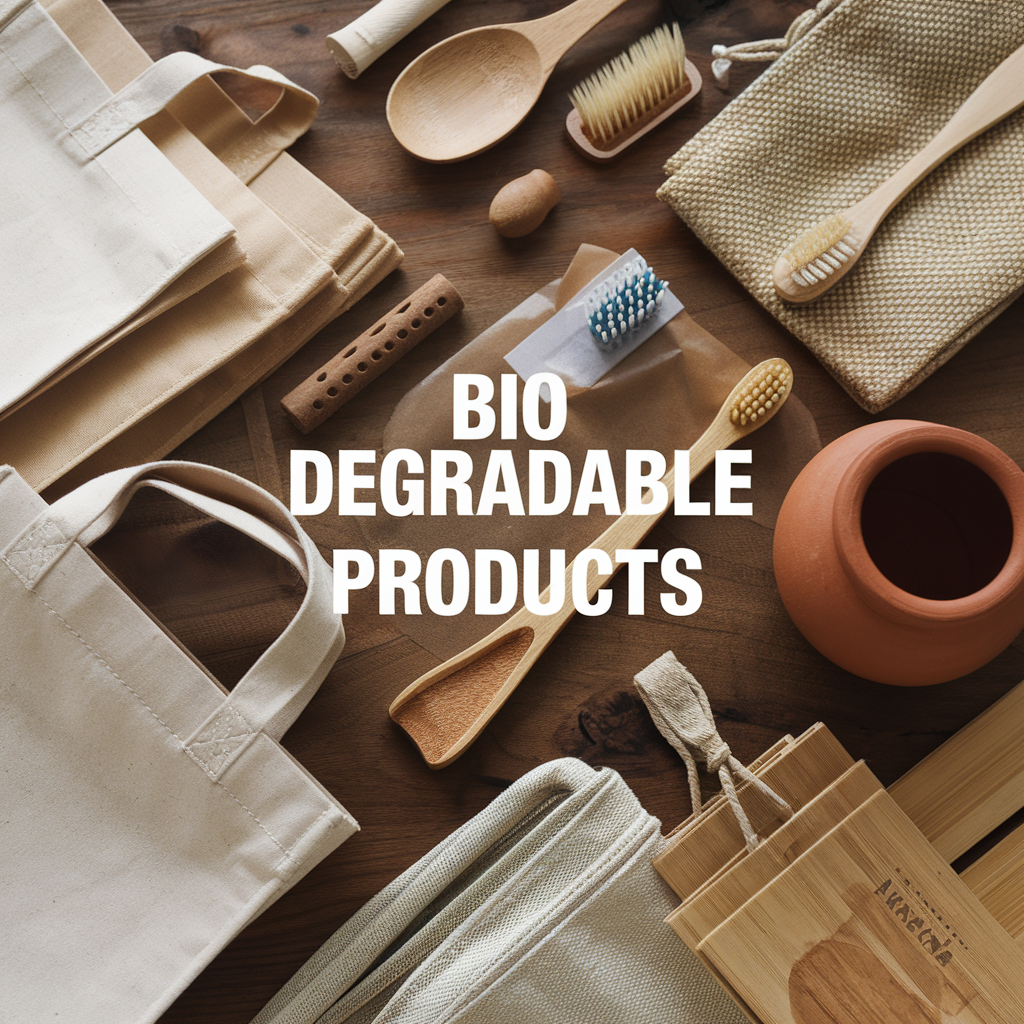
Biomass Briquettes from Bio-Waste: Turning Waste into Energy
A viable example of the implementation of the principles of the circular economy is biomass briquettes. The agricultural and forestry waste materials are compacted into solid fuel blocks composed of sawdust, rice husk, crop residues, and wood chips in densities and energy-efficient forms. They can be used as an alternative to coal and firewood in the heating of industries and homes, as they are clean.
The production is quite simple and needs strict management of raw materials. The gathered biomass is dried to get the rough content of moisture and it is processed to briquetting machines that compact the material under high pressure. No chemical binders are normally necessary in most of the cases since the biomass contains lignin which forms a natural adhesive during heating.
The briquettes formed are of higher calorific value than the loose biomass and burn more productively with less smoke and ash. They have extensive applications in industrial boilers, brick kilns, food processing units and thermal processing where constant heat is needed. Briquettes can also be used as the other option of cooking and heating fuel in the countryside.
The growth of the biomass briquettes is due to the increasing cost of fossil fuel, environmental policies, and corporate responsibility policies. The replacement of coal with biomass based fuels, partially or entirely is an effort many industries are undertaking in an attempt to minimize their carbon footprint. Co-firing in the power plants is also being considered as a way of reducing emissions.
The market of the biomass briquette, although the absolute volume of this market is smaller than that of furniture or leather, is increasing more rapidly. Asia is the leader in production as there is a lot of agricultural waste, the developed markets are based on biomass heating systems and renewable energy targets.
The most important problems facing entrepreneurs are to ensure the availability of biomass throughout the year and conclude long-term contracts with industrial consumers. The scale, efficient logistics, and the closeness to the sources of waste and end users enhance profitability. Policies of renewable energy and government subsidies also increase the appeal of this industry.
Comparative Market Outlook and Growth Dynamics
| Sector | Demand Stability | Capital Intensity | Growth Outlook |
| Modular Kitchens & Wardrobes | High | Medium | Steady |
| Finished Leather Sheets | High | High | Steady |
| Biomass Briquettes | Medium-High | Low-Medium | Fast |
All these industries are enjoying various macroeconomic trends, such as urban housing expansion, lifestyle products consumption around the world, and cleaner energy. Entrepreneurs are supposed to make their decision in correlation with the availability of capital, technical ability, and risk-taking.
How NPCS Supports Industrial Entrepreneurs
Niir Project Consultancy Services (NPCS) is significant in the process of mentoring the entrepreneur in the initial phases of industrial planning. NPCS drafts the Market Survey cum Detailed Techno Economic Feasibility Reports, which is a systematic analysis of manufacturing project proposals.
They usually include the manufacturing process, raw material requirements, plan at plant layout, machinery choice, and the projections of finances. Combining the market demand analysis with the technical feasibility, NPCS allows the entrepreneur to determine whether a certain business concept can be viable and realized commercially and on a large scale, before investing huge amounts of capital into the business.
This kind of planning assistance is particularly helpful when a first-generation manufacturer or investor enters into new industrial sectors.
Frequently Asked Questions
Which of them is the least entry barrier business?
The initial requirements for the manufacturing of biomass briquettes are the least and can be expanded gradually.
Can small entrepreneurs make use of modular furniture manufacturing?
Yes. Some of the successful players started with small workshops and expanded with an increase in demand.
Does the processing of leather have regulatory issues?
Yes. Environmental compliance is essential and should be considered at the initial stages.
What would be the quicker break even sector?
Biomass briquettes and modular interiors should normally have a short break-even compared to leather processing.
Do the three sectors have export opportunities?
Yes, but the most established export is in the leather and modular furniture component.
Conclusion: Choosing the Right Manufacturing Path
Modular interiors, finished leather sheets, and biomass briquettes are all unique manufacturing opportunities that were influenced by varying demand forces. What has been common about them is that they are applicable to the long-term trends, namely urbanisation, global consumption and sustainability.
Those entrepreneurs who look realistically into these areas, keep order in their operations and a clear view of the market processes have the chances to create strong manufacturing companies. In the current industrial world, it is no longer about the pursuit of volume in success but in aligning ability with long-term demand.


