





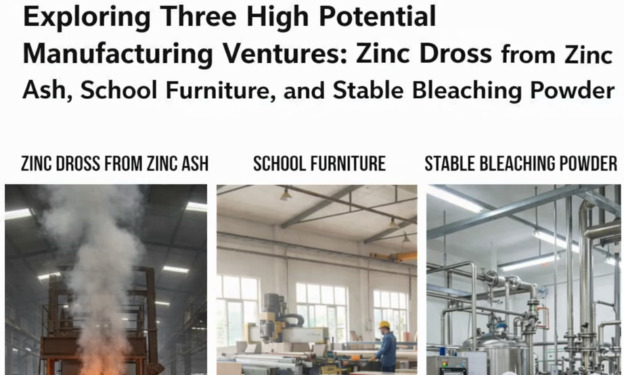
The High Potential Manufacturing Ventures ecosystem in India is changing at a rapid rate and is driven by the growth of industries, infrastructural development as well as the Make in India campaign. Business owners with the aim of increasing their profitability can consider exploring industries that possess a growth potential, export and sustainable profitability. Among them, Zinc Dress of Zinc Ash recovery, School Furniture manufacturing and Stable Bleaching Powder production are the most prominent as they have high domestic market, environmental applicability and broad industrial application.
In this article, the author has extensively analysed all these industries, their market dynamics, manufacturing process, investment outlook among others to enable a startup and MSME to know the profitable business to venture into in 2025 and beyond.
Zinc Dross from Zinc Ash
Overview
Zinc Dross recovery of Zinc Ash is a profitable recycling industry that is environmentally friendly. Zinc Ash the by-product of galvanizing and processing industries of zinc has metallic zinc that can be easily recovered. Zinc Dross that is extracted is in great demand in the market in galvanizing, die casting, and alloy manufacture.
Manufacturing Process
The process involves:
- Preparation of the raw material- Zinc ash is obtained at the galvanizing plants.
- Sieving and Sorting – This is done by sieving of the ash to eliminate impurities and coarse grain.
- Smelting and Reduction- The ash is heated in a furnace to extract the metallic zinc and Zinc oxide.
- Cooling and Casting- The molten zinc is cast in moulds to produce the zinc dross ingots.
- Refining- Any impurities such as iron and aluminum are cleared to enhance quality.
With feed purity, furnace capacity and size, a medium sized unit could generate 5-10 tonnes of zinc dross daily.
Market Demand and Growth
| Parameters | Details |
| Global Zinc Market Size (2024) | USD 40 billion |
| Expected CAGR (2025–2030) | 5.1% |
| India’s Zinc Recycling Market Share | Over 20% of domestic zinc demand |
| Primary Consumers | Galvanizing, alloy, and die-casting industries |
Zinc recovery is consistent with the worldwide trend of the pursuit of the circular economy practices, providing sustainability and profitability. India is also a large steel galvanization center, and thus generates high volumes of zinc ash meaning that there is a constant supply of raw materials.
Investment and Profitability
A small to medium sized plant (5 TPD) cost around 1.5-2.5 crore to invest in furnace, machinery, and work capital. Gross profit margins may be between 25 and 30 percent as per the purity of the extracted zinc and prices in the market.
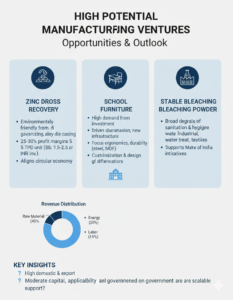
Pie Chart: Zinc Dross Industry Revenue Distribution
Zinc Dross Industry Revenue Distribution
—————————————-
Raw Material Cost – 45%
Energy & Utilities – 20%
Labour & Overheads – 15%
Profit Margin – 20%
Why Start This Business
- Recycling incorporating eco-friendliness and minimizing waste.
- Regular steel and galvanizing industries.
- MSME/CPCB Government support in metal recovery and waste management.
Read also: Cost Optimization Strategy in Zinc Bromide Production: Energy, Waste & Yield Management
School Furniture Manufacturing
Overview
School furniture manufacturing industry is also experiencing high demand as more investments are made in education and school infrastructure. Starting with the simple classroom bench to the ergonomic chairs and laboratory workstations, the industry presents huge opportunities to the entrepreneur.
Manufacturing Process
- Design and Planning – Dimensions of the products are completed according to ergonomics and standards.
- Material Preparation Steel pipes, plywood, MDF and plastic are cut into the necessary size.
- Fabrication- Frames are welded, sanded and applied with anti-rust coatings.
- Painting and Finishing- Powder coating or spray painting is more aesthetically pleasing and more durable.
- Assembly and Packaging- Finished products are assembled, checked and packed to be shipped.
Market Demand and Growth
| Segment | Growth Rate | Key Drivers |
| Government Schools | 6.5% CAGR | PM SHRI, Samagra Shiksha Abhiyan |
| Private Institutions | 8.2% CAGR | Expansion of private education |
| Export Market | 4.8% CAGR | Demand in Africa, Gulf, and Asia-Pacific |
The education industry in India is estimated to grow to USD 225 billion by 2026, which will directly increase the furniture industry. The growing attention to digital and smart classrooms advances the innovative designs even more.
Infographic: Materials Used in School Furniture Manufacturing
| Material Type | Percentage Share |
| Steel Frames | 40% |
| Wood & Plywood | 35% |
| Plastic Components | 15% |
| Others (Paints, Fasteners, etc.) | 10% |
Investment and Profitability
A medium size factory with CNC fabrication will demand 1.21.8 crore. Profit margins are 20-25 cents and the business has a stable annual round-the-year demand particularly on the part of the learning institutions and government tenders.
Why Start This Business
- High demand in the education and institutional sector.
- Possibility to be innovative in ergonomic and modular designs.
- Export opportunities into the third world.
Stable Bleaching Powder (Calcium Hypochlorite)
Overview
Stable Bleaching Powder (SBP) or calcium oxychloride is a white, dry compound that is commonly used to disinfect water, bleach textiles, and disinfect. The increase in the need to cleanse, particularly after the pandemic has caused a considerable growth in its demand around the world.
Manufacturing Process
The process involves:
- Raw Material Input- Hydrated lime of high grade and chlorine gas.
- Reaction Process- Chlorine is sprayed over the hydrated lime under controlled conditions.
- Drying and Cooling- The mass that has been reacted is dried to produce stable bleaching powder.
- Sieving and Packaging The last is the sieving and packing of the product into moisture-proof containers.
The reaction: [2Cl_2 + 2Ca(OH)_2 → Ca(OCl)_2 + CaCl_2 + 2H_2O]
Market Demand and Growth
| Parameter | Details |
| Global Market Size (2024) | USD 1.6 billion |
| CAGR (2025–2030) | 4.3% |
| Major Consumers | Water treatment plants, textile units, paper mills, and municipalities |
One of the highest-growing markets of SBP is India where the emphasis on Swachh Bharat Mission and water sanitation initiatives is observed. The domestic consumption will grow by 8-10 percent a year.
Investment and Profitability
The average cost of a 5 TPD Stable Bleaching Powder plant is ₹80 lakh to 1 crore and the returns are 25-30. It is easy and manpower required is low with a high automation possibility.
Chart: End-Use Sectoral Distribution
| Sector | Usage (%) |
| Water Treatment | 45% |
| Textile and Pulp | 30% |
| Disinfection & Cleaning | 20% |
| Others | 5% |
Why Start This Business
- Stable demand in sanitation, medical services, and municipal services.
- Cheap raw materials and easy process of production.
- Good export potential to Africa, Asia and Middle East.
Comparative Snapshot: Investment vs. Profitability
| Product | Investment (₹) | Gross Margin | Market Growth | Skill Level |
| Zinc Dross from Zinc Ash | 1.5–2.5 crore | 25–30% | 5% CAGR | Medium |
| School Furniture | 1.2–1.8 crore | 20–25% | 7–8% CAGR | Medium |
| Stable Bleaching Powder | 0.8–1 crore | 25–30% | 4–5% CAGR | Low |
Future Market Trends
- Zinc Dress- The expansion of zinc is due to sustainable recycling and steel galvanization.
- School Furniture – Digitization and smart classroom models are driving the need to use modular furniture.
- Stable Bleaching Powder -The increased consciousness of sanitation and safe drinking water in the world.
About Niir Project Consultancy Services (NPCS)
Niir Project Consultancy Services (NPCS) makes Market Survey cum Detailed Techno Economic Feasibility Reports on behalf of the entrepreneurs. Their reports contain manufacturing process, raw material, plant layout and finances giving a blue print of the whole project. NPCS assists new business and MSMEs to evaluate the viability of locating new industries or developing a business by using knowledge and experience in going through the industry analysis and understanding.
Conclusion
All these three manufacturing enterprises Zinc Dross recovery, School Furniture and Stable Bleaching Powder present different benefits in the areas of sustainability, cost-effectiveness, and market scalability. Entrepreneurs have the option of selection on the basis of investment ability, technical proficiency and target market. As the ecosystem of Indian industry is flourishing with the incentives given by the government to encourage manufacturing, the prospects of such ventures are high in a future-ready startup.


