





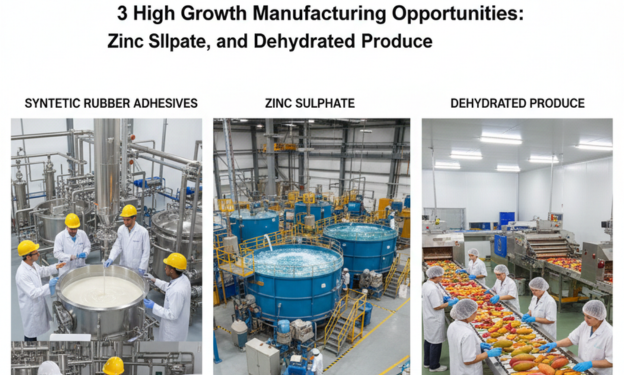
The High Growth Manufacturing Opportunities of specialty chemicals and food processing are promising prospects to entrepreneurs venturing into new industrial ventures. This paper discusses three of these products including synthetic rubber adhesive, zinc sulphate and dehydrated fruits and vegetables, identifying the applications, market prospects and the growth forces. The sections include information about the uses of the products, the manufacturing process, the demand in the market, and the future perspectives as well as the charts and tables to demonstrate the important information. The content is specific to the startups with plans to manufacture in such industries.
Synthetic Rubber Adhesives
Synthetic rubber adhesives are high performance bonding materials produced by properties of synthets elastomers (e.g. styrene-butadiene rubber, nitrile or neoprene) and resins, tackifier, solvents, and additives. These adhesives are highly flexible and adhesive to most of the surfaces such as metals, plastics, rubber, leather and wood and also resistant to heat, moisture and chemical environment. Synthetic rubber-based adhesives can be used as an example in industries such as automotive and footwear to bond together components such as soles made out of rubber, gaskets and trim parts. They are employed in construction to seal building material joints and cement building materials, in packaging and furniture assembly as universal glue. Their fast drying, hard wearing quality makes them suitable in the industrial assembly lines as well as in consumer products.
The production of a synthetic rubber adhesive plant is done through the process of compounding and mixing of synthetic rubber with tackifying resins and solvents. The most important equipment will be mixers, reactors and blending tanks to guarantee homogeneous compound, filtration and packaging equipment. The accuracy of temperature regulation is needed to work with the solvents safely and provide a consistent quality of products. Raw materials and materials normally used are synthetic rubber (e.g. styrene-butadiene rubber), polymer resins, plasticizers and solvents. An example of a process flow is: prepare the rubber-resin mixture, adding of additives, homogenization of the mixture, filtering away impurities, and packaging the completed adhesive. Right plant layout incorporates special spaces in the form of compounding, solvent handling, packaging and quality control laboratories.
Market Forecast and Demand
The market of adhesives in the world market based on rubber, both natural and synthetic rubber adhesives, is solid and expanding. Approximately USD 26 billion was estimated to be in the market in 2024 and it is projected that in 2035, the market will be around USD 34 billion (at a 2.533% CAGR). A very big portion of this market is occupied by the use of synthetic rubber adhesives because of its versatility. The sector is being propelled by increasing automotive and construction industries, increased electronics production, and increased growth in packaging. An example is the packaging adhesives (to be used in consumer goods and e-commerce packaging) demand that is expected to rise to USD 8.5B in 2032 out of an approximate of USD 7.0B in 2023 as illustrated below. In the same fashion, building and infrastructure construction adhesives can increase to USD 5.0B up to 6.2B and automotive adhesives to 4.5B up to 5.8B (all in 2032).
| Application | 2023 (USD Billion) | 2032 (USD Billion) |
| Packaging | 7.0 | 8.5 |
| Construction | 5.0 | 6.2 |
| Automotive | 4.5 | 5.8 |
Table: Global rubber-based adhesives market by application (2023 vs. 2032 projections).
Read Our Books: The Complete Book on Rubber Processing and Compounding Technology (4th Revised Edition)
In Asia-Pacific, consumption of synthetic adhesives is dominated by the region which is experiencing high rates of industrialization especially in China, India, Southeast Asia and export-oriented manufacturing. North America and Europe also have a high demand which is backed by the automotive and construction sectors there. The market trends are low-VOC (no solvents) and environmentally friendly formulations to comply with environmental regulations and the development of adhesives that can unite new materials (lightweight and composite) that are less heavy.
In general, the demand of synthetic rubber adhesives is constant and long term. New entrants in this industry have the opportunity to exploit the market by specialty formulations (e.g. heat free or water based adhesives) and cater to the automotive, footwear, electronics or packaging markets. A business person would design a plant depending on the market projections, the sourcing of raw materials (e.g. bulk SBR rubber), plant layout, and the projected cost of operation. Feasibility can be evaluated with the help of Niir Project Consultancy Services (NPCS) and other companies that would assist in the assessment in the form of techno-economic reports where raw materials, manufacturing process, plant layout and the financial projections are provided in details in relation to such a project.
Zinc Sulphate (Zinc Sulfate)
Zinc sulphate (ZnSO 4 ) is an inorganic compound that is extensively employed in the form of zinc. It is available in different types such as monohydrate and heptahydrate crystals. Its primary application lies in the farming sector as a micronutrient fertilizer: addition of zinc sulphate to soil or crops treats zinc deficiency, improving the condition and crop production of plants. Zinc shortage in soils causes low yields in most of the countries, and therefore, the demand in the fertilizer blends is increasing. Other applications of zinc sulphate are in animal feed to supplement their nutritional requirements, pharmaceuticals and supplements (to treat zinc deficiency in humans), and industry (to produce rayon fiber, cure rubber, treat water, and tan leather).
Zinc sulphate is not particularly hard to produce: most frequently it is produced by reacting sulfuric acid with zinc metal or oxide and crystallizing the product. The acid-leaching step also requires reactors in the facilities and crystallizers or evaporators in order to achieve the desired form of hydrate. Core inputs include the raw materials ( zinc by-product of smelting, sulfuric acid ) and the utilities. The purity of chemicals and control of the stage of hydration are important. Since it is used in agriculture and chemicals, quality regulations (e.g. of impurities) and proper packaging (usually in bags or bulk) is significant to comply with.
Market Outlook
The world market of zinc sulphate has been enjoying good growth, which is an indication of its wide application. It is estimated that in 2024 the market size will be approximately USD 2.1 billion, and it is projected to increase to approximately USD 3.538 billion by the early 2030s, which means that the growth will be approximately 68 percent/year. An overview of forecast will be as below:
| Year | Market Size (USD Billion) | CAGR |
| 2024 | 2.12 | – |
| 2032 | 3.79 | ~7.5% |
Table: Global zinc sulphate market size and forecast (2024-2032).
This expansion is primarily due to the agrochemical application, which is the biggest application. The use of zinc sulphate increases as the farmers around the globe use fortified fertilizers and soil conditioners. Demand is also increased by an increasing world population and focus on agricultural output. The healthcare sector is also expanding, because zinc supplements (in sulfate form) are major components of vitamins and therapeutics. Textile, rubber, battery, and poly-silicon to solar panels are used industrially and steady demand increases, new applications in water treatment add to the growth under environmental regulations.
The Asia-Pacific region (particularly in India and China) is the geographical region that controls the greatest share (typically of approximately 45-50 percent of total world consumption) owing to enormous farming and large-scale pharmaceutical sectors. Europe will experience rapid growth because of clean-energy efforts (need to use zinc chemicals in the production of solar-grade polysilicon) and robust water treatment requirements. The North American market is a fully developed and stable market in terms of farm products and animal feed.
In the case of a manufacturing start up, zinc sulphate business has recognizable market drivers and a large market. Businessmen would consider the supply of raw zinc (waste of metallurgy), the price of sulfuric acid, and its users (fertilizer manufacturers, pharmaceutical, fodder manufacturers). An analysis of production costs, plant layout, equipment (reactor, crystallizer, dryer), and profitability of the project considering commodity price trends would be conducted by a feasibility study (e.g. by NPCS). It offers the opportunity to new ventures aiming at the production of chemicals as it has a rather high growth rate and established distribution channels.
Dehydrated Fruits and Vegetables
Food products that have moisture removed in order to increase the shelf life, decrease the weight and maintain the nutrients are dehydrated fruits and vegetables. The most common ways of dehydrating entail air drying, sun drying, freeze drying or vacuum drying. The products that are produced (dried mango, banana chips, potato flakes, dried tomatoes, etc.) are dehydrated products that are sold as snacks, cooking products, and raw materials of processed foods. They target the health conscious customers because most of the vitamins, minerals and fiber in the fresh produce are usually retained (excluding water weight). They are also appreciated on the basis of convenience (lightweight, portable, ready-to-use), and long shelf-life, thus they suit well retail supermarkets, convenience stores and online grocery.
Read Project Detail: Dehydrated Fruits
Most production processes are sorting and washing of fresh fruits/ vegetables, pre-treatment (such as blanching to retain color and nutrients) followed by drying in dehydrators or ovens, followed by cooling and packaging. The equipment entails the washers, cutters/slicers, drying tunnels or trays and packaging machines on vacuum sealed packs. Quality control provides uniformity in moisture and food safety. Fresh produce or concentrate is used during off season to control seasonality. A large number of manufacturers are also transforming surplus or cosmetically defective produce into dried products and this is a green solution to food wastage.
Read Also: Dehydrated fruits and vegetables Market Research Report (Forecast till 2032)
Market Growth and Trends
The dehydrated fruits and vegetables market is large and continuously increasing in size. The global market size is projected to consist of approximately USD 2730 billion and the CAGR is expected to be approximately 45 percent through the year 2030. As an illustration, one of the analyses foresees the growth of approximately to USD 27.1B in 2024, up to approximately USD 44.2B in 2035 (c. 4.5% CAGR). Another shows that it may get to 94.97B by the year 2033 (probably with allied dehydrated foods). Anyway, year-to-year increase of some regions to a double digit is reported. The critical drivers of demand are escalating preference of consumers towards healthy snacks, convenience foods and longer-lasting ingredients. The city lifestyle and high activity increases the pressure of the prepared and ready-to-eat products.
Moreover, this can be promoted by food industry trends. Dried food substances are highly common in baked goods, prepared foods, rice and snack bars. They are popular because of the natural and clean-label movement: they seem to be wholesome foods compared to fried or sweet snacks. The growth of online sales and the development of modern store also contributes to it since a significant portion of the dried products is sold online or in forms of added value (smoothie packs, blended powders).
| Year | Market Size (USD Billion) | CAGR |
| 2024 | 27.08 | – |
| 2035 | 44.23 | ~4.6% |
Table: Global dehydrated fruits & vegetables market size and forecast (2024-2035).
This market will have an enormous portion in Asia-Pacific due to the high population and the rising disposable income of countries such as China and India. The strong trend of snacking and health-food is making North America and Europe grow. The new markets in Latin America and Africa are also emerging with increasing interest with the growth of urban retail.
As a startup or an investor, there are various benefits of a dehydrated fruit and vegetable plant. The crude products (fruits, vegetables) are usually easily supplied by the local farms or imports. Processing and packaging can add a lot of value. The scale of production can be achieved by modular dryers. The main factors to consider are the choice of high demand products (i.e. dried mango or potato flakes), the acquisition of reliable source of fresh produce, and investment in quality control. Through adequate branding, emphasis on organic or special products can also increase the margins. The mix of products (e.g. types of dried items) and regional demand shares might be presented in the form of infographic or pie charts, however in a narrative form, it is obvious that this is one huge and developing market.

Technical & Financial Considerations
In all the three products, there are some shared manufacturing and business considerations that are used when venturing:
- Infrastructure and Equipment: Plants need special equipment (e.g. mixers and reactors that are used in adhesives and zinc compounds; dryers and packers that are used in dehydrated foods). Effective flow of the material and safety (particularly of solvents in the adhesives or dust in the powders) can be achieved only through proper planning of the plant layout.
- Raw Material Sourcing: It is essential to obtain a consistent supply of raw materials at a reasonable price. Plants based on synthetic rubber require polymer feedstocks, a zinc sulphate plant requires zinc byproducts and acid, and dehydrated food plants require regular supply of fruit/vegetables. Location might be selected close to the sources of raw materials or target markets..
- Regulatory Compliance: The production of chemicals should be in line with environmental and safety laws (emissions to the air, waste disposal, labels). The processing facilities need hygiene certification, food safety measures (e.g. HACCP), and in some cases organic or fair-trade certification in order to gain an advantage in the market.
- Capital and Economics: Capital investment (land, buildings, machines) is dispersed. A feasibility study would be done to outline the CapEx (machinery, land, construction) and OpEx (raw materials, utilities, labor). As an example, a high initial equipment adhesive plant may have a high initial equipment cost and a relatively high product value; a dehydrated vegetable plant may have a moderate equipment cost and can only achieve volume throughput margins. These costs are broken down in many consulting reports (such as the ones by NPCS). An entrepreneur is supposed to figure out likely payback durability, ROI, and scaling up prospects.
Niir Project Consultancy Services (NPCS) and others are experts in the field of techno-economic feasibility surveys in precisely this type of situation. They prepare elaborate market survey and feasibility reports which contain manufacturing process, raw material requirements, plant layout, and financial model. These reports can enable the entrepreneur to determine the feasibility of establishing a synthetic rubber adhesive plant or a zinc sulphate unit or a dehydrated foods unit, based on a review of the market demand, the competitor, and the cost base.
FAQ
Q: What are the primary applications of synthetic rubber adhesives?
A: synthetic rubber adhesives are applied everywhere there is a need of strong and flexible bonds. Major applications are bonding of shoe soles in footwear, joining parts and gaskets in automotive assembly, sealing and laminating in construction, and other packaging and woodworking. They are resistant to heat and moisture and therefore can be used in harsh conditions (outdoor construction, automotive engines, etc.).
Q: Why is zinc sulphate a good product to a new chemical plant?
A: Zinc sulphate has a market of increasing world consumption (several billion USD per year) with predictable demand drivers. The main application of it as a micronutrient fertilizer is growing in the agricultural sector where farmers strive to increase crop production and soil conditions. Also, healthcare (zinc supplements), water treatment, and industrial applications provide additional diversification. The market will increase at an average rate of about 6-8 percent per annum and hence the production of zinc sulphate is economically viable to the entrepreneurs having access to raw zinc.
Q: What are the market trends that are driving the dehydrated fruits and vegetables market?
A: This market is driven by a number of trends: the need by consumers to have convenient and healthy food, bigger application of dehydrated food in convenience food, and improved preservation methods. Due to the necessity to follow the busy lifestyle and search of the healthy ready-to-eat products, dehydrated fruits/vegetables are becoming popular. The tendency towards clean-label (not using preservatives) and exotic fruits also compel manufacturers to develop new dried snacks. In general, the shelf life and nutritional quality of dehydrated products make it continue to demand at an annual rate of 45 per cent in all regions of the world.
Q: How is the dehydrated vegetables production process carried out?
A: The process begins with cleaning and picking fresh produce, after the selection is finished, it would be sliced into similar sized chunks. The articles are usually blanched (quickly heated) to inactivate enzymes, and then run through drying equipment (e.g. tunnel dryers, dehydrator ovens, or freeze dryers). Once the appropriate level of moisture is attained, the dried pieces are cooled, checked and finally packed into airtight, moisture sealed bags or containers. Drying makes it crisp or chewy without being spoilt.
Q: How do I estimate the market prospect and viability of a new plant?
A: It is important to carry out market research. Find reports and data on the industry, current market size and growth rates, and regional demand of your selected product. As an example, forecasts of adhesives, zinc sulphate and dehydrated foods have been summarized in tables above. The second step is to evaluate local variables: access to raw materials, energy prices, labor, and distance to customers. To make sure you have correct information, consulting firms such as NPCS can offer customized feasibility reports, which include market survey details, technological choices, plant designs, and financial estimates.
Q: What is Niir Project Consultancy Services (NPCS)?
A: NPCS is a company that composed Market Survey cum Detailed Techno-Economic Feasibility Reports. Their research involves detailed data on process of manufacturing, raw materials needed, layout of the plant as well as financials of different industries. NPCS is a financial institution that assists business people to determine the viability of establishing new industries or businesses through offering practical project reports and advice.


