




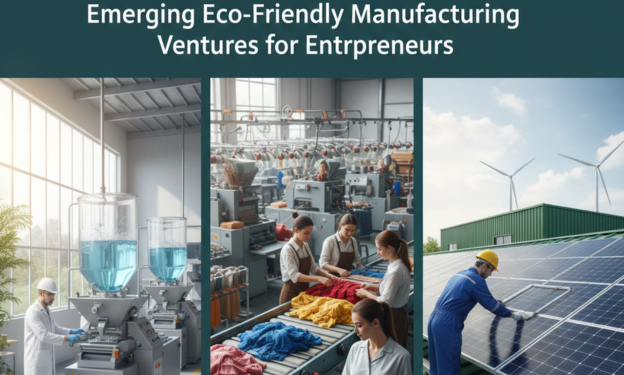
4 Emerging Eco Friendly Manufacturing Ventures for Entrepreneurs. Consumer cleaning products have a steadily expanding market in the world. Detergent powders and soaps will always be necessities. New entrants have a chance of finding a niche due to the developments in formulation and marketing. The low-cost raw materials (such as fats, oils and alkalis to produce soap) can be utilized in the production of detergents and soaps by the startup.
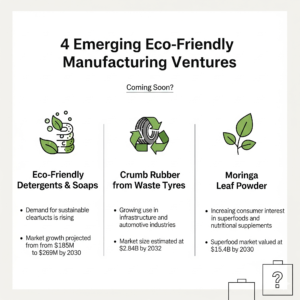
In 2023 alone the market of laundry detergents was approximately 185M and is projected to grow to 269M by 2030 (CAGR of about 5.5). Manufacturers work on environmentally friendly recipes and easy-to-use packages (such as pre-measured packets) and a new product that is differentiated on green ingredients or a brand can win the market share.
The primary factors to be taken into consideration are the sourcing of raw materials (e.g. vegetable oils to make soap, surfactants to make detergents etc.), and the effective plant design. This is the area of NPCS (Niir Project Consultancy Services) they do all the feasibility reports and include manufacturing processes, raw materials, plant layouts and financials in order to help determine the viability of new ventures.
Trade opportunities– New businesses can consider niche markets such as organic soap bars, or herbal powdered detergents. These products attract health and environmentally conscious consumers. Another high-demand segment is bulk detergent in case of laundry or hospitals. It is possible to begin small, even a small scale factory (with cheap mixers and driers) can work out on the right strategy on the market.
Crumb Rubber Powder from Waste Tyres
A good example of a cyclical-economy project is to convert waste tyres into crumb rubber powder. Old tyres are shredded in to small granules with industrial shredders. An additional refinery (removal of steel, magnetic separation, grinding mills) produces fine crumb rubber powder. Several applications are in demand of this recycled rubber: infill on artificial turf, playgrounds, rubberized asphalt and molded rubber products.
Environmental regulations and the increasing cost of raw materials are driving growth in the recycling industry of rubber. The tire and rubber recycling market in the U.S. consists of a value of 2.06 billion in 2024 and may be up to 2.84 billion in 2032 (CAGR ~ 4.2). The world market is pushing towards environmentally friendly infrastructures and construction materials. The startups can take advantage of this by collaborating with tyre collection centres to get free or cheap raw tyres. The secret lies in the appropriate crushing and grinding technology in order to get uniform powder.
Read Our Books: Handbook on Rubber and Allied Products (with Project Profiles)
Benefits and Uses of Crumb Rubber:
- Sports and play surfaces: give cushioning and strength to tracks, fields, pand layground flooring.
- Road paving: As an asphalt additive to make the road quieter and prolong its life.
- Construction materials: Blended into concrete blocks or mats to use in an industrial environment.
- Molded products: Replaced with creating new products out of rubber (mats, gaskets, soles).
Business people have to maneuver through compliance (local recycling regulations) and may frequently receive support in the form of incentives for recycling businesses. A feasibility study (such as those of NPCS) would detail the crushing process, plant layout and economics. In general, tyre-to-crumb has the potential to be a lucrative niche in the waste management sector as it has a steady demand and growth (a medium of 5-10 percent CAGR).
Moringa Leaf Powder – The “Miracle” Herb Business
Moringa oleifera is a superfood with the name of the drumstick or horseradish tree. Its powdered leaf is a good source of vitamins, proteins and antioxidants. This is a natural additive that is used in health food, drinks, cosmetics and animal feed. The moringa market all over the world is on fire: in 2023, it is estimated to be worth 8.15 billion dollars, and it is expected to be approximately 15.4 billion dollars in 2030 (CAGR ~9.5%). This is propelled by increasing the consumer awareness of natural remedies and plant based nutrition.
To entrepreneurs, the moringa powder production is appealing since the cost of growing moringa trees is cheap and sustainable (they grow in diverse climates and do not require much water). It is processed by drying leaves (which is solar drying) and fine powdering. A small farm has an opportunity to feed a local packer or export to the health-food markets. Moringa tea blends, capsules or skincare are all niche products.
Why Moringa Leaf Powder is In Demand:
- Nutrition- Iron and protein are high. Sold as an immune and nutritional supplement.
- Versatility- Applicable in smoothies, soups and fortifying flours. It is also naturally found in cosmetics (lotions, soaps).
- Sustainability- The Moringa trees are fast-growing plants that enhance soil, and this is why they will be very attractive to eco-conscious consumers.
The company can start by planting moringa or hiring local farmers. Grinders, sieves, dryers, and other processing equipment are relatively expensive. Quality is important: high-end consumers desire organic power that is free of pesticides. The distribution can be direct online to the consumers, via health stores or packaged food producers. The most common type of product (reports indicate that leaf powder is the most common product segment (33 percent of moringa market revenue) and is the most in demand) has the most significant demand growth. All in all, moringa powder presents good margins and a rapidly expanding market thus is a good business venture for agripreneurs.
Biomass Briquettes from Bio-Waste
Biomass briquettes are fuel blocks that are environmentally friendly and were produced by compressing agricultural or forest biomass (sawdust, rice husk, straw, etc.). Dried biomass is pressed into thick pellets through the use of briquetting machines, and it is less polluting to burn compared to coal or firewood. Demand- In the developing markets and rural markets, there is increasing demand in clean-burning solid fuels. In 2023, the biomass briquette market of the whole world amounted to approximately $0.9 billion, which is projected to increase to approximately 1.9 billion by 2033 (CAGR of approximately 7.9%). Briquettes are used in industries, power plants and households in heating and co-firing of electricity.
Beginning with a briquette production facility may become appealing to a start-up. Waste products (sawdust, husks) are also inexpensive sources of raw materials, they can be obtained freely on farms, or even at mills or urban green waste. Reduction of waste is done through shredding or milling followed by drying and finally, a mechanical press is used to shape the waste into briquettes. The blocks that are obtained can be sold locally or regionally.
Read Project Details: BIOMASS BRIQUETTES FROM BIO WASTE
Applications of Biomass Briquettes:
- Cooking and Heating: They substitute wood or charcoal in stoves thereby preventing deforestation.
- Industrial Fuel:Briquettes are a regular type of fuel used by factories and in brick kilns.
- Power Generation: There are power generation plants that burn briquettes along with coal in order to reduce emissions.
The major forces are the government policies towards renewable energy and taxes on carbon. The model of doing business is simple to entrepreneurs: invest in a briquetting machine (which is usually produced by the Chinese or European manufacturers), be able to obtain waste biomass, and sell the fuel blocks. A prepared feasibility study (such as the ones prepared by NPCS) would include plant design, power consumption, and budget estimates, assist in raising funds. In general, the market growth (c.g.a. 8% CAGR) signals growth prospects. Green branding and possible carbon credits are also advantages to Briquette ventures
Read Also: How to Start a Biomass Briquettes Business in India
Market Forecast and Trends (Quick Facts)
| Product | 2023 Market Size | Projected 2030 Market | Approx. CAGR |
| Laundry Detergent & Soap | $185 million (2023) | $269 million (2030) | ~5.5% |
| Moringa Products (Leaf Powder) | $8.15 billion (2023) | $15.4 billion (2030) | ~9.5% |
| Biomass Briquettes | $0.9 billion (2023) | $1.44 billion (2030)† | ~7–8% |
| Tire/Rubber Recycling (USA) | $2.06 billion (2024) | $2.84 billion (2032) | ~4.2% |
† Mordor Intelligence projects ~1.44B by 2030 (vs $0.96B in 2025), reflecting 8–9% CAGR.
The figures demonstrate a high demand in every sphere. The common growth factors include environmental concerns and an incentive for green technology. Government requirements in Europe and Asia are promoting biomass fuels as well as rubber recycling, which is increasing these markets. In the meantime, the soap and moringa industries are pushed by consumer trends. Some of the regulations, certifications (organic/natural labels), and distribution (online retail, exports) are some of the areas that entrepreneurs should consider in their strategy.
Niir Project Consultancy Services (NPCS) provides professional services to every one of these projects. NPCS produces comprehensive Market Survey cum Techno-Economic Feasibility Reports of manufacturing processes, raw materials, plant layouts and financial projections. Such detailed reports enable businesspersons to assess the feasibility and design how new industries or projects will be established in every sector.
FAQ
Q1- What are the raw materials required to open a facility that produces detergent powder or soap?
A1- The typical raw materials are the following- caustic soda or soda ash (alkalis), perfume and additives (colorants, bleach). Surfactants and solvents are used in the case of liquid detergents. A feasibility report will indicate specific ratios of ingredients and other sources.
Q2- What is the way of obtaining crumb rubber powder using old tyres?
A2- Waste tyres are shredded at the beginning with the help of a tire chopping machine. Steel wires are extracted and the rubber is crushed into fine granules. Additional milling and particle separation result in the required crumb rubber powder (usually 30 60 mesh). It is done through crushers and vibratory separators.
Q3- What is the reason why Moringa leaf powder is a good business product?
A3- Moringa has outstanding nutritional value (vitamins and minerals) and medicinal value so it is used in health food and cosmetics. Moringa powder has good margins with the increasing demand in the superfoods and herbal remedies. Growing needs little water and land and processing is low hence the costs to start up are not high.
Q4- What machines are required in the production of biomass briquettes?
A4- The main equipment is a briquetting press (screw or piston type) which is used to squeeze biomass (dried sawdust, husk, etc.) into briquettes. Such auxiliary equipment as shredders to reduce the size of raw waste and dryers to reduce moisture is used. Others include cooling and packaging machines. NPCS reports describe layout and options of machineries.
Q5- What are the ways of assessing the viability of these ventures by the entrepreneurs?
A5- It is important to carry out a techno economic feasibility study. These entail market analysis (demand, and pricing) process design and financial projections. There are consulting firms such as NPCS that specialize in such reports. They examine market predictions, availability of raw materials and financial returns and enable the entrepreneurs to make proper decisions prior to investing.
Q6- Do these industries have any environmental regulations?
A6- Yes, there are applicable regulations in the four sectors. The manufacturers of detergents/soaps are required to adhere to the wastewater treatment regulations and chemical handling regulations. Tyre recyclers need to adhere to waste disposal standards. Moringa farmers might want to be organic to attract markets. Renewable energy policies typically work to the advantage of briquette manufacturers, but the companies must regulate emissions throughout processing. These regulatory aspects and available subsidies or incentives will be covered in a feasibility report.


