





Why Indian Railways MSME opportunities
Most new manufacturing startups fail because they misjudge the demand. They assume a market size, copy competitors or follow short term buzz in an industry. Verified and repeated consumption, however, are the basis of sustainable manufacturing businesses.
One of the most powerful institutional buyers in India is Indian Railways. It operates one of the largest rail networks in the world, and consumes industrial materials in massive scale every year. Steel structures, electrical panels, cables, track hardware, rubber components, signalling equipment, wagon parts and passenger amenities are continuously procured.
Annual Report 2023-24 brought out under the aegis of the Ministry of Railways is not only an administrative data. It is a detailed map of where real money is already getting spent.
Unlike consumer markets, railway demand is:
- Budget-backed
- Asset-linked
- Replacement-driven
- Long-term and predictable
For MSMEs and first-generation entrepreneurs, this helps in reducing business risk to a significant extent.
Table of Contents
ToggleRead More: Construction & Building Materials Projects
Understanding the Magnitude of Opportunity
The 2023-24 performance information highlights the magnitude of the industrial consumption behind railway operations. Indian Railways carried 1588 million tonnes of freight and earned freight revenue of Rs. 165880 crores. Passenger earnings was crossed by 70,693 crore. Nearly 5950 kilometres of track was renewed and 4644 kilometres were electrified in one year. The system operates over 2.13 lakh freight wagons and over 72,000 passenger coaches.
These numbers are translated directly into physical product demand. Every kilometre of renewed track needs fasteners, fish plates, clips and steel fittings. Electrification projects are extremely material-intensive, with kilometres of cables, junction boxes and control systems. Wagons and coaches need constant maintenance components.
This is not speculative demand. It is operational consumption.(Indian Railways MSME opportunities)
High Potential Manufacturing Opportunities with Indian Railways
Below are some manufacturing segments where MSMEs can really do business and scale.
1. Steel Fabrication and Manufacturing Structured Steel
Railway modernization needs the continuous construction and upgradation of stations. Platform sheds, foot over bridges, safety railings, cable trays and structural supports are commonly used over and over again in railway zones.
Track renewals of almost 6000 kilometres per year also provide structural demand for brackets, supports and reinforcement assemblies.
This segment is attractive as:
- Fabrication technology well developed
- Raw materials are easily available
- Designs are standardized
- Capacity is expandable with time
For entrepreneurs with an engineering background, it is a viable way to get into railway-linked manufacturing.(Indian Railways MSME opportunities)
2. Railway Application Fasteners and Track Hardware
Track infrastructure consumes monstrous quantities of small but important components. Elastic rail clips, high tensile bolts, nuts, washers and fish plates are used by the thousands per kilometre.
Since track renewal is continuous in nature, demand is recurring rather than project-based. Many precision fasteners are still imported or come from limited suppliers; creating an opportunity for import substitution.
Some of the main benefits of this segment are as follows:
- Capital requirement (moderate)
- High repeat purchase rate
- Strong margins in specialized parts
This is one of the most scalable MSME level railway business opportunities.
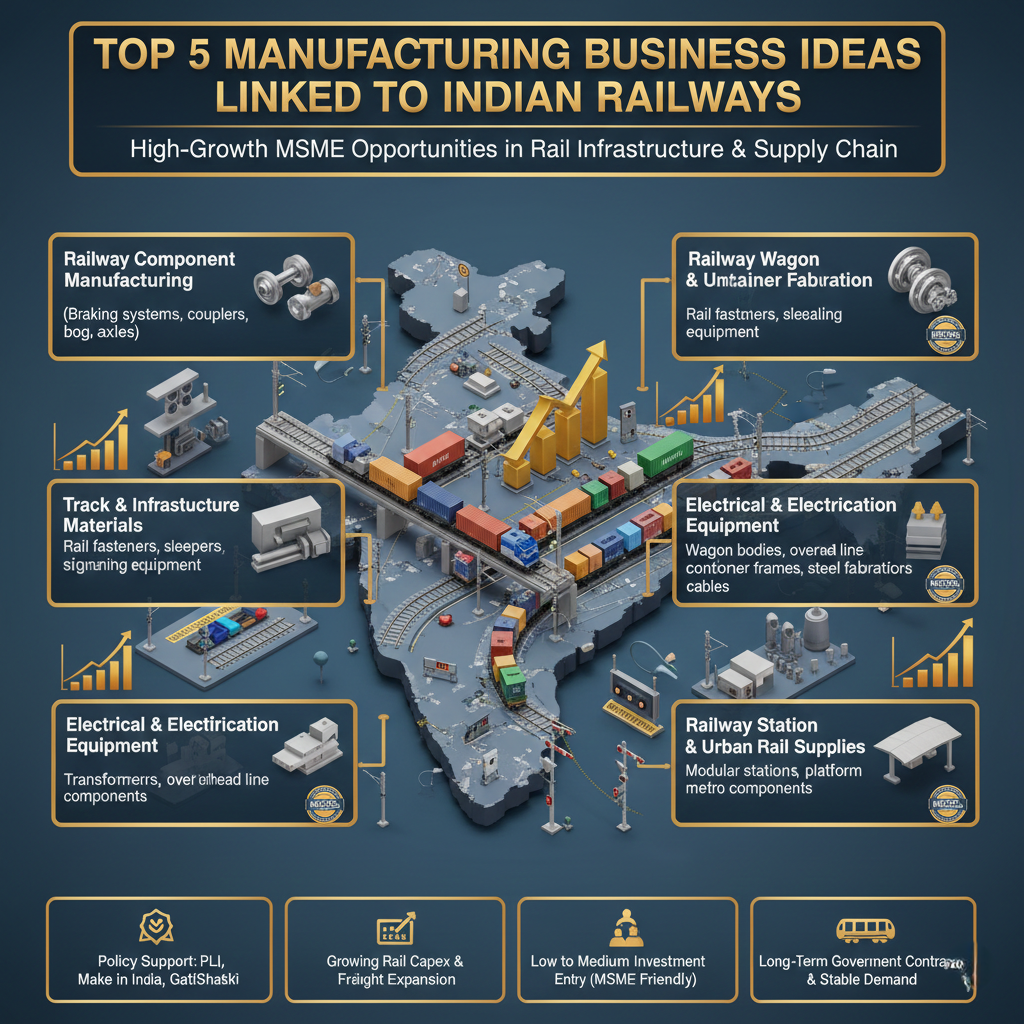
3. Electrical Panels and Signalling Cabinets
Electrification is a key area for focus for Indian Railways. Thousands of kilometres are electrified every year based on traction control panels, relay cabinets, junction boxes or signalling enclosures.
Electrical panel manufacturing is already a domain that is strong in the MSME in India. The railway demand provides long-term stability. After installation, there are maintenance and upgrades which create more orders.
Entrepreneurs entering into this segment must focus on quality compliance and test standards, since the safety certification is a crucial factor in approvals.(Indian Railways MSME opportunities)
4. Railway cables and Conductors
Electrified routes and signalling systems require large amounts of power and control cables. These projects are distributed throughout the country, which will result in geographically diversified demand.
Indian infrastructure focused companies like KEI Industries and Apar Industries grew by riding on the power and railway infrastructure growth.
For smaller manufacturers, accessories such as cable glands, trays, connexons and distribution assemblies are practical entry points with manageable investment.(Indian Railways MSME opportunities)
5. Rubber Components, Polymer Components, and Composite Components
Railway operations heavily rely on rubber pads, bushings, anti vibration mounts and insulation elements. These things have a finite service life and have to be replaced from time to time.
This is the attractive segment because:
- Capital requirement is at a moderate level
- Replacement demand is uniform
- Products are of high value in relation to weight
For startups that want to have a stable cash flow, replacement-driven components provide less volatility than project-based supplies.(Indian Railways MSME opportunities)
The Silent Strength: The Maintenance-Driven Demand
Even if new construction slows, maintenance does not. With over two lakh freight wagons and over seventy thousand coaches on the road, brake systems, suspension components, underframe brackets and interior fittings are changed on a regular basis.
Maintenance industries usually have more predictable revenue cycles than expansion-driven industries. This makes railway maintenance components especially interesting for long-term industrial planning.(Indian Railways MSME opportunities)
Why Manufacturing Is Considered Low Risk With Railway-Linked Manufacturing
Rail way procurement is structured and transparent. Budgets are allocated each year, specifications are standardized and the vendor registration systems are formalized. Financial institutions often look to such projects as relatively secure because the demand is institutional rather than speculative.
Once a manufacturer becomes a recognized supplier, they are then greatly improved in terms of credibility which opens doors to export markets and international railway tenders.(Indian Railways MSME opportunities)
Converting Demand To A Profitable Industrial Project
Identifying opportunity is just a first step. Successful execution requires:
- Market feasibility assessment
- Technical process planning
- Machinery selection
- Strategy of sourcing raw materials
- Financial projections and ROI analysis
Niir Project Consultancy Services (NPCS) assists entrepreneurs in preparing techno-economic feasibility reports in detail for railway-linked manufacturing ventures. Structured planning enables better bankability and lower operational risk.(Indian Railways MSME opportunities)
Final Insight
The most successful manufacturing businesses are built where real spending already exists. Indian Railways represents one of the largest industrial procurement ecosystems in the country.
The statement Enterprise businesses create sustainable growth through their factory operations when railway demand patterns match their production activities. Businesses that depend on unpredictable consumer behavior are unable to build their companies as successful enterprises.
The railway industry shows permanent growth potential through its actual operational data which manufacturing businesses use to create machine learning models.(Indian Railways MSME opportunities)
Frequently Asked Questions (FAQ)
Q1. Is railway manufacturing a suitable business for first time entrepreneurs?
Yes. But due to standardization of the products and institutional demand that is there, there is less risk of entering compared to consumer markets.
Q2. What investment does it require to start up?
Most projects that are of MSME scale range between 1.5 crores to 10 crores depending on the type of products and capacity.
Q3. Is railway demand seasonal?
No. maintenance, renewal and electrification to ensure activity in procurement year round.
Q4. Can MSMEs export railway components?
Yes. Approved suppliers often get involved in international railway and EPC projects.
Q5. Where is official railway data available?
Through publications of Indian Railways, ministry of railways.


