






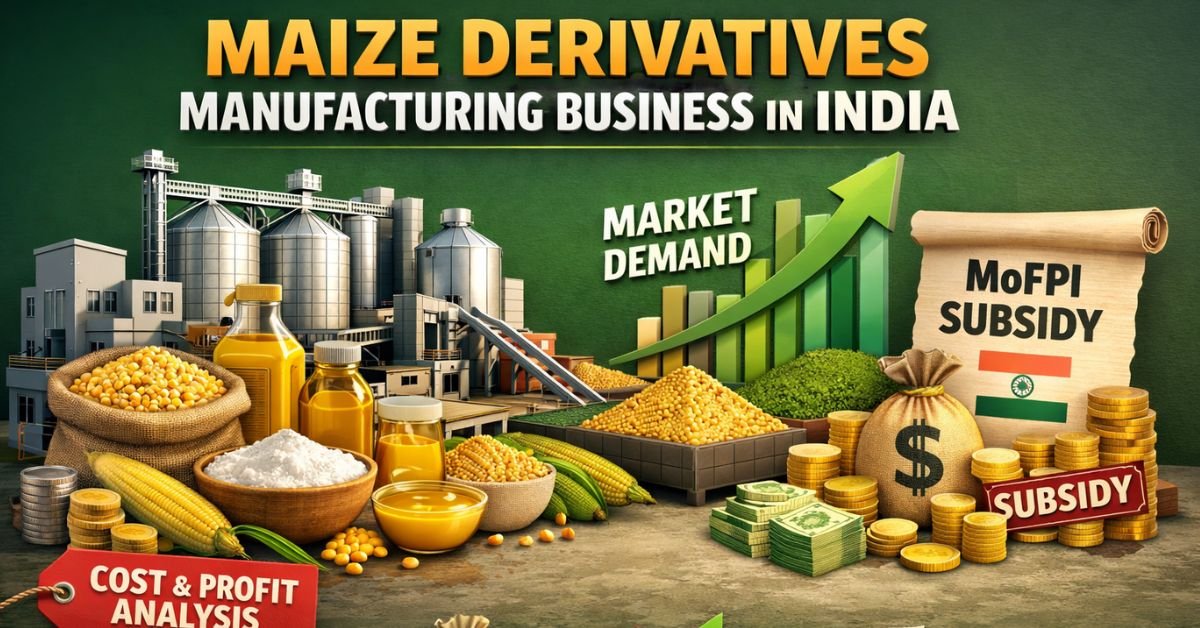
Maize Processing Business India is an emerging high potential manufacturing niche for startups and MSMEs with strong domestic demand, increasing imports of specialty products, and generous government incentives. Products such as maize starch, liquid glucose, dextrose and sorbitol are no longer the products of niche industries – they are now key inputs for the food processing, pharmaceutical, paper, textiles and personal care industries.
This blog explains the business opportunity in simple terms and shows where the bullet points actually help in clarity and how the support from the Ministry of Food Processing Industries (MoFPI) and professional feasibility studies by Niir Project Consultancy Services (NPCS) make these projects financially viable.
Why Maize Derivatives Make Business Sense
India is one of the biggest producers of maize in the world, but still much of it is sold as a low margin raw commodity. Wet milling offers a way for entrepreneurs to process maize into multiple higher-value products to enhance profitability and alleviate dependence on a single market.(Maize Processing Business India)
One of the main benefits of maize processing is the integrated value chain where by-products also generate revenue. Instead of waste, gluten, germ and fiber are sold to feed and industrial markets, leading to improved plant economics overall.
At a glance, maize derivatives stand out from the fact that:
- Availability of raw material is stable in different states of India
- Demand is from essential industries (food and pharma)
- Value addition – increase margins during each processing stage
Where the Demand Comes From
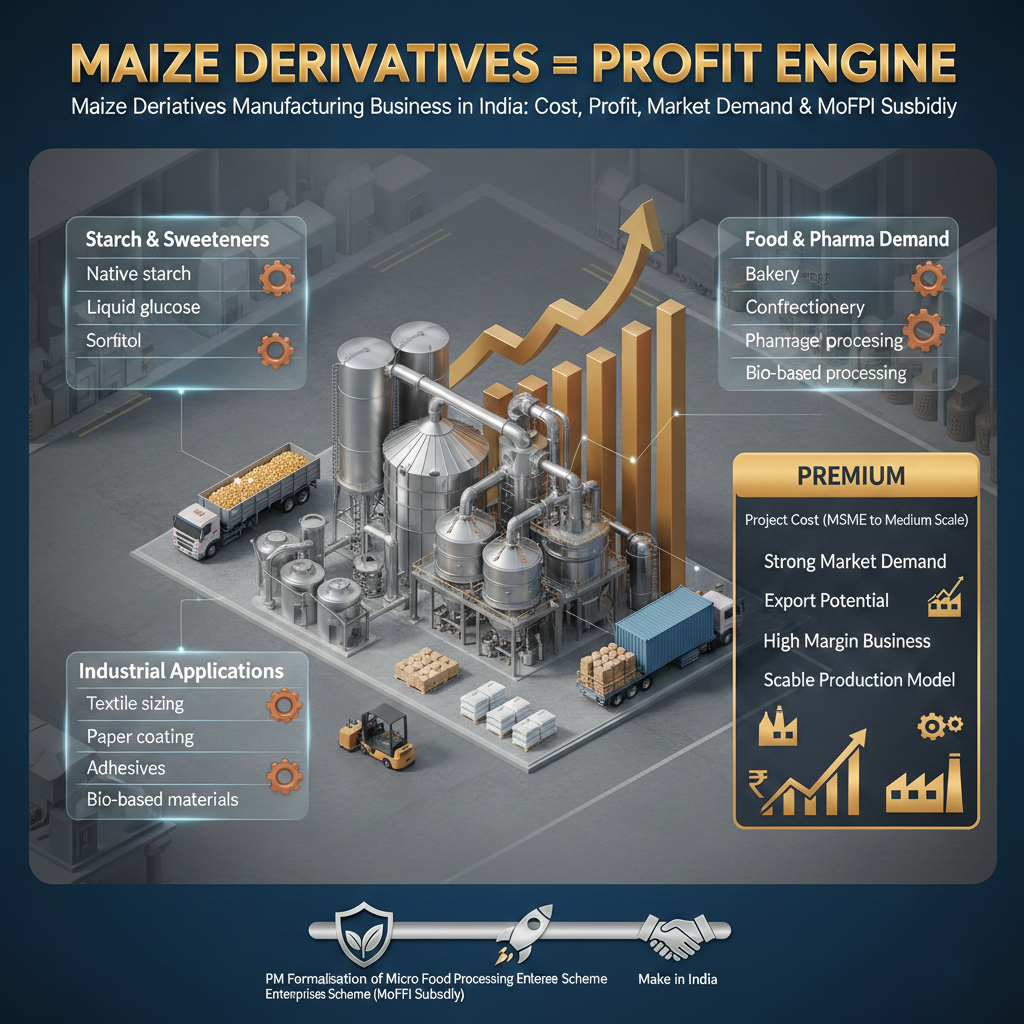
Maize starch is popular in the paper industry, to size textiles, as an adhesive, and to be used in the formulation of food products. Liquid glucose and dextrose are essential for confectionery, bakery, beverages and fermentation industries. Sorbitol demand is increasing steadily because of its use in toothpaste, cosmetics, sugar-free foods and pharmaceutical formulations.
Major application segments are:
- Paper, textile and adhesive industries (starch)
- Confectionery, bakery, beverages, fermentation, glucose
- Oral care, pharma and cosmetics for sorbitol
Due to the steady growth of these industries, demand for maize derivatives does not easily dorm during economic slowdowns.(Maize Processing Business India)
Market Size and Outlook For Growth
India produced approximately 2.6 million tonnes of maize starch in 2024 while the domestic consumption was close to 2.0 million tonnes. The overall market of starch and its derivatives is exceeding USD 3.7 billion and is contributing a growth rate of more than 7% CAGR due to food processing, pharmaceutical, and industrial applications.(Maize Processing Business India)
Sorbitol consumption was about 185 kilo tonnes in 2024 and it is expected to increase slowly over the next decade. The demand for liquid glucose is experiencing its most rapid growth because of the expanding Indian confectionery and beverage markets. The demand for liquid glucose is currently growing its fastest rate because the Indian confectionery and beverage markets are growing.
The market trend demonstrates a shift from bulk commodity starch toward specialized starches which provide better financial returns through their specific use cases.
Demand- Supply Gap and Opportunity to Import
India depends on imported specialty starches and high-grade derivatives because the country has enough maize supply to meet its requirements. The country spent USD 4.7 million on maize starch imports during 2023 which included mostly premium and pharmaceutical grade products.
Key gaps new units can target:
- Modified and pharmaceutical grade starches
- Sorbitol for pharmaceutical and oral care
- Regionally limited supplies of liquid glucose near food clusters
The existing product gaps create strong potential for import replacement because domestic manufacturers achieve better financial results through product sales.(Maize Processing Business India)
Government Support That Enhances Profitability
The MoFPI actively facilitates maize value addition schemes such as PM FME, PLISFPI and ODOP. The programs provide financial assistance through capital subsidies whereas they deliver infrastructure assistance and simplified credit access specifically for MSMEs.(Maize Processing Business India)
Benefits of MoFPI support include:
- Reduction in start-up capital burden
- Faster break-even and pay-back periods
- Improved bankability of projects
In many instances, subsidies and incentives make effective project cost 20-40% less, making returns substantially better.(Maize Processing Business India)
Why NPCS Is Important to This Business
Maize derivatives manufacturing involves capital-intensive and technical operations. A professional feasibility study is essential so as not to make costly mistakes. NPCS prepares the market survey – cum – techno economic feasibility reports (DPRs) which are widely accepted by the banks and the government agencies.(Maize Processing Business India)
NPCS reports generally include:
- That of manufacturing process and technology selection
- Machinery, utilities, and raw material requirement
- Market demand, pricing, and competition analysis”
- Financial projections, IRR and Payback
For an integrated 100 TDP maize starch – glucose – sorbitol plant, NPCS benchmarks generally indicate IRR of 22 – 28% with payback period of 4-5 years which makes the business attractive for long-term investors.(Maize Processing Business India)
Competitive Landscape and Scope for MSMEs
Large players like Gulshan Polyols Ltd., Sukhjit Starch & Chemicals, Riddhi Siddhi Gluco Biols and Sanstar Bio-Polymers and multinationals like Cargill and Roquette are dominating the large-scale production.
However, high capacity utilisation and emphasis on bulk volumes leaves scope for region focused MSMEs producing specialty and certified grades for customers in the region.(Maize Processing Business India)
Economics in Simple Terms
Stand-alone starch plants are moderately profitable, but profitability is greatly enhanced by the addition of glucose and sorbitol. The highest profit margins in sorbitol production come from its use in pharmaceutical and dental care products. Additional income from by-products like gluten feed further increases project viability.(Maize Processing Business India)
Conclusion
Maize derivatives manufacturing in India marries the strength of agriculture, the needs of the industry and the policy support of the government into one opportunity. With the right location, professional feasibility planning and phased capacity expansion, MSMEs can develop scalable and profitable businesses with good domestic and export potential.(Maize Processing Business India)
FAQ
Is maize derivatives manufacturing in India profitable?
Yes. Well-planned integrated plants are usually able to achieve 22-28% IRR (especially when MoFPI subsidies are available).
What is the most attractive maize derivative for new units?
Sorbitol and specialist glucose products tend to have better margins than simple starch.
Do banks need a DPR for financing?
Yes. A detailed DPR such as prepared by NPCS is very important for loans and subsidies.
What is the greatest risk involved in this business?
Raw material price fluctuation which can be controlled by sourcing strategy and product diversification.
Is export possible for MSMEs?
Yes. Many MSMEs have successfully exported starch derivatives and sorbitol after getting necessary certifications of quality.


