





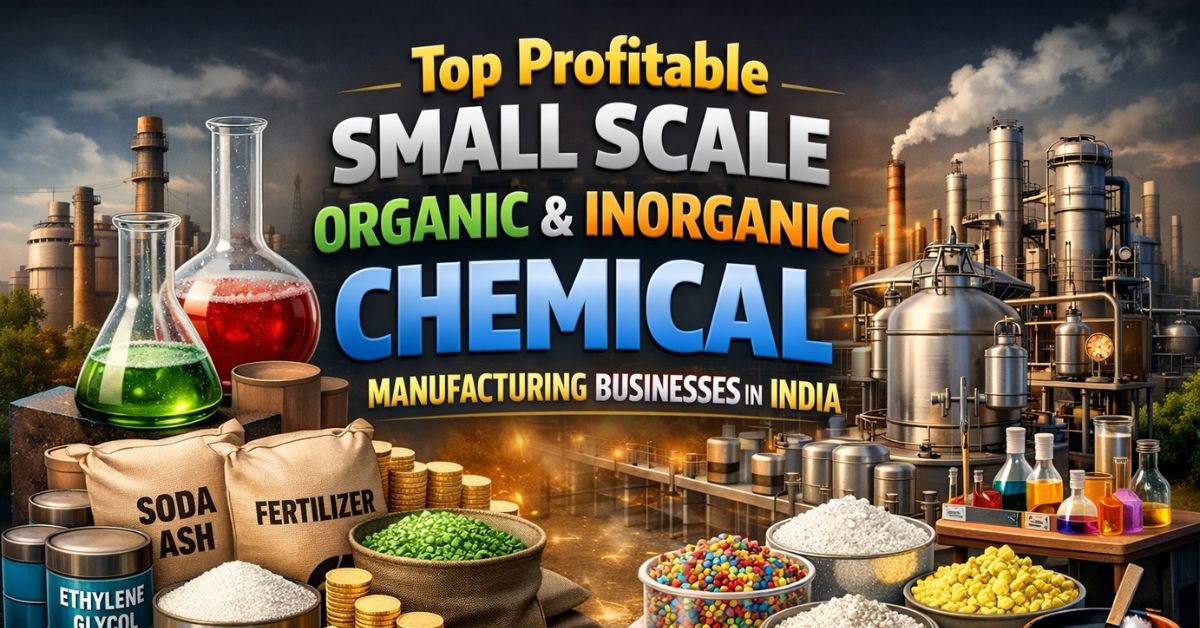
India’s Chemical Manufacturing Business industry is typically synonymous with large petrochemical plants and multinational companies. While these players lead in bulk volumes, a significant and economically important segment of the industry is led by small and medium scale manufacturers of organic and inorganic chemicals. These chemicals are the backbone of industries such as pharmaceuticals, agriculture, textiles, construction, water treatment, paints and healthcare.
According to data published by the Department of Chemicals and Petrochemicals, India’s chemical industry produces over 80,000 commercial products, and ranges from organic chemicals, inorganic chemicals, specialty chemicals to petrochemicals. Among all the different categories, organic and inorganic chemicals are the most widely consumed because of their indispensable role in multiple industrial supply chains.
For first-generation entrepreneurs and MSME investors, this layered structure of industries offers a very interesting opportunity: to enter at the intermediate and manufacturing level downstream, where capital needs are not too high and where demand is structurally embedded.
Table of Contents
ToggleRead More: Handbook On Chemical Industries (Alcohol Based)
Understanding the Demand Base for Organic & Inorganic Chemicals
Unlike consumer driven markets, industrial chemical demand is non-discretionary. Consumption is dictated by operational need, regulatory compliance, and process continuity and not trends or branding.
- Water treatment plants need coagulants and disinfectants on a regular basis to meet the quality norms
- Textile processors rely on inorganic salts, dyes and processing chemicals
- Organic solvents and pigments are used in: – Paints and coatings – Adhesives and sealants
- Agrochemical formulators constantly go for organic intermediates
- Construction chemicals use inorganic compounds as basic raw materials
Production statistics continuously reveal that while alkali chemicals are dominating the total volume, organic and inorganic chemicals have a steady demand in pharma, agro, textiles, infrastructure, and utilities.
Key insight:
Organic and inorganic chemicals are not always going to have the highest volumes but are mission-critical inputs, with stable, repeat procurement cycles.(Chemical Manufacturing Business)
Why The Small Scale Chemical Manufacturing Is Startup Friendly
From the viewpoints of feasibility and risk management, organic and inorganic chemical manufacturing is one of the most accessible chemical industry segments. Unlike petrochemical projects, most of the MSME units are based on batch-processing or modular systems.(Chemical Manufacturing Business)
Key advantages include:
- Low capital investment compared to petrochemical plants
- Batch based production enabling phased capacity expansion
- Strong local demand from industrial clusters
- High customer retention, once quality consistency is acquired
- Simpler customization for specific industrial requirements
Installed capacity utilisation for basic and intermediate chemicals in India has been healthy with predictable demand and not much growth by speculating. This makes small-scale chemical manufacturing appropriate for entrepreneurs who want stability and scalability.(Chemical Manufacturing Business)
Read More: Modern Technology of Industrial Chemicals
High Potential Small Scale Chemical Manufacturing Opportunities
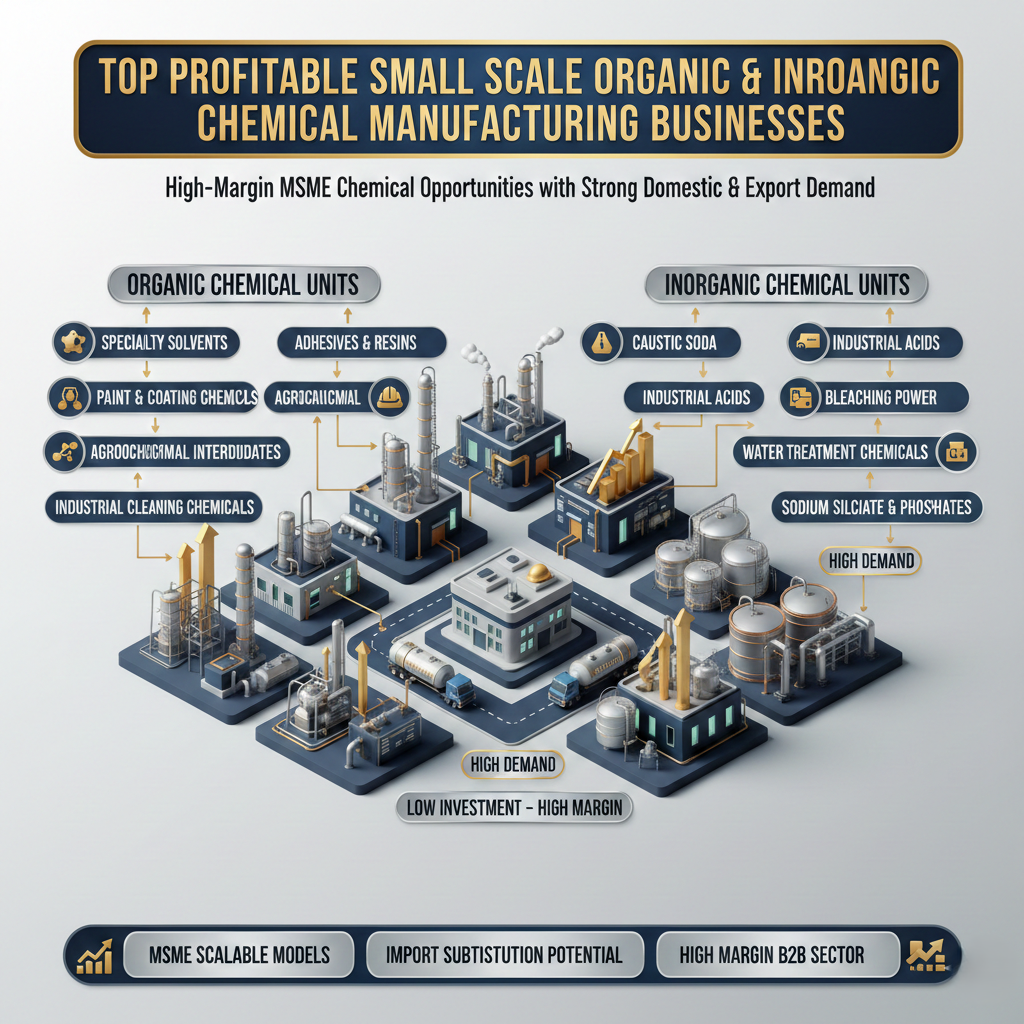
1. Water Treatment Chemicals (Organic)
Urbanization, industrial growth and increasing environmental standards have made water treatment chemicals a non-bargaining item. MSMEs of manufacturing alum, ferric chloride, poly-aluminium chloride (PAC) and specialty coagulant blends provide supplies to municipal water bodies and industrial effluent treatment plants.
Why this segment is good for MSMEs:
- Demand categories are: – Regulation-driven demand (recession-resistant)
- Long-term supply contracts
- Simple and proven manufacturing processes
Profitability is not related to branding, but instead to the sourcing of raw materials, to energy efficiency, and to logistics optimization.(Chemical Manufacturing Business)
2. Organic Solvents Mixture for Industrial Use
Organic solvent blends are widely applied in paints, pharmaceuticals, inks, adhesives and coatings. These products are formulation driven and can be produced using fairly simple blending systems.
Key advantages:
- Moderate technology requirements
- Customization according to client processes
- Buyers are more concerned with consistency than they are with brand name
India has witnessed a number of entrepreneurs build solvent and formulation businesses by emphasizing on quality discipline and customer retention over aggressive capacity expansion.(Chemical Manufacturing Business)
3. Specialty Salts and Inorganic Compounds - Industrial Grade
Specialty salts, like sodium sulphate, magnesium sulphate and calcium chloride as well as potassium salts are among the most stable chemical products for small scale manufacturing. These are used in a wide range of applications from detergents, construction chemicals, pharmaceuticals, food processing and water treatment.
Why MSMEs succeed here:
- Program Objectives: -Diversified end-use industries
- Established production technology
- Predictable demand cycles
Purity control, moisture management, uniform packaging and reliable logistics are key to success.(Chemical Manufacturing Business)
Read More: Project Reports & Profiles
4. Dye Intermediate and Organic Processing Chemicals
India’s textile centres are dependent on dye intermediates and organic processing chemicals for dyeing, printing, and finishing operations. MSMEs manufacturing intermediates for dyes manufacture both for the domestic textile units and export oriented units.
This segment has better margins as compared to bulk chemicals but at the cost of:
- Strong process control
- Compliance with the environmental norms
- Constant R&D for Customer Specific Requirements
Moving up the value chain from the commodity chemicals to the intermediates is a significant step for improving long term profitability.(Chemical Manufacturing Business)
5. Industrial Cleaning and Sanitation Chemicals
Industrial cleaning and sanitation chemicals are in routine use in hospitals, factories, warehouses, food processing units and logistics facilities. Products include degreasers, disinfectants, descalers and surface treatment chemicals.
Business advantages:
- Contract-based recurring revenue
- Predictable consumption patterns
- Easy scalability through more blending units
This segment has received additional impetus because of an enhanced level of hygiene standards across industries.
Export Potential for Chemical Manufacturers (MSME)
India’s chemical exports are still on the rise in Asia, Africa and the Middle East. Small-scale manufacturers can gain access into export markets by meeting standardized specifications and acquiring required certifications.
Products that have a high export demand are:
- Industrial salts
- Water treatment chemicals
- Organic solvent blends
- Textile processing chemicals
Participation in chemical clusters in the vicinity of ports and cooperation with merchant exporters is a vital contribution to the feasibility of exports.(Chemical Manufacturing Business)
Regulatory and Feasibility Issues
Chemical manufacturing needs careful techno-economic evaluation before investment. Key factors include:
- Batch yield efficiency
- Energy consumption per unit
- Waste treatment and effluent handling.
- Regulatory approvals and the cost of compliance
- Working capital cycles
Professional feasibility studies determine execution risks through their assessment of technology requirements and market demand and financial resources of projects. Organizations like Niir Project Consultancy Services prepare Market Survey-cum-Detailed Techno-Economic Feasibility Reports etc. covering design of the plant, machinery selection, cost structure etc. and profitability projections.(Chemical Manufacturing Business)
Final Perspective
Small-scale manufacture of chemicals – organic and inorganic – is low hanging fruit to industrial economy of India. MSMEs can create sustainable and profitable chemical businesses on account of structurally embedded demand, manageable capital requirements and scalable production models without incurring risks associated with large petrochemical complexes.(Chemical Manufacturing Business)
The Indian chemical manufacturing sector will benefit most from entrepreneurs who assess the viability of a business while satisfying regulatory compliance requirements, allowing for predictable product quality and constant demand from customers.(Chemical Manufacturing Business)
Frequently Asked Questions (FAQ)
Is Small Scale Production of Organic Chemicals a Good Start?
Yes. Batch process units with standardized formulations and stable demand are appropriate for first-time entrepreneurs.
What might be the range of investment?
Most of the projects would need a commission of between Rs 1 crores to Rs 8 crores, based on the type of product and installed capacity.
Is there a demand for inorganic chemicals to export?
Yes. Industrial salts and water treatment chemicals are regularly exported from India.
What are the major risks of chemical MSMEs?
Raw material price volatility, energy prices and regulatory compliance are the main risks.
Is it easy to increase capacity?
Yes. Batch-processing plants provide for modular expansion by adding reactors or blending units.


