






Rice Husk Silica for Green Tyres
The global tyre industry has entered a new stage which requires companies to balance their environmental responsibilities with their production capabilities. The industry has dedicated its resources to developing materials which enhance tyre performance while minimizing their environmental effects. Rice husk silica serves as one of those materials which producers create from rice husk ash, which constitutes agricultural waste that arises from rice milling and biomass energy production.
Rice husk ash contains exceedingly high silica levels that can reach between 90 and 95 percent when the proper combustion parameters are maintained. Via chemical processing, this silica can be extracted and turned into precipitated silica to be used in the widely used rubber and tyre manufacturing. Over the past decade, the demand for this material has increased rapidly with the tyre companies moving toward the production of energy-efficient “green tyres.”
Market research shows that the global rice husk silica market was worth approximately USD 619 million in 2024 and will be worth an estimated USD 1.32 billion by 2031. This is a high annual growth rate of about 11 to 12 percent. Of this demand a key share is the tyre industry, contributing almost two-thirds of total consumption.
This growing demand has changed the role of rice husk silica from being a low-value by-product into a strategic raw material for the world’s automotive industry.
Table of Contents
ToggleRead More: Modern Technology of Agro Processing & Agricultural Waste Products
Why Silica is Important to Modern Tyres
Tyres today have to satisfy a number of performance requirements simultaneously. They must offer good grip, good fuel efficiency, be quiet and last longer. Silica has an important role to play in achieving these goals.
Traditionally, the tyre manufacturers have used carbon black as a reinforcing filler in the rubber compound in large amounts. Although carbon black can improve strength and durability it cannot provide the same decrease in rolling resistance as silica.(Rice Husk Silica for Green Tyres)
Silica reinforced tyre compounds have several advantages:
- Lower rolling resistance, thereby improving fuel efficiency
- Increased wet road grip and braking performance
- Reducing tyre noise when driving
- Increased durability and resistance to heat
Because of these benefits, silica has become one of the primary ingredients in modern passenger car tyres, especially in markets where there are strict fuel efficiency requirements.(Rice Husk Silica for Green Tyres)
Market Size and Growth Outlook (2026-2031)
The rice husk silica market is likely to grow steadily over the next decade due to growing tyre production and a rise in the use of sustainable materials.
Industry estimates put the following growth path:
- 2026 – Global market looking to close at around USD 770 million
- 2027 – market expected to be over USD 850 million
- 2028 – industry likely to reach USD 950 million
- 2029 – market projected to reach about USD 1.06 billion
- 2030 – expected to grow close to USD 1.18 billion
- 2031 – total market estimated to be around USD 1.32 billion
Since tyre applications account for almost 66 percent of demand, the tyre segment alone has the potential to exceed USD 870 million by 2031.
Another important feature of this market is the large share of Highly Dispersible Silica (HDS), which is more than 85 percent of demand in tyre applications.(Rice Husk Silica for Green Tyres)
What is Highly Dispersible Silica (HDS)?
The special type of precipitated silica known as Highly Dispersible Silica has been designed specifically for use in rubber compounds which manufacturers create for tyres. Unlike ordinary silica, HDS has been designed to disperse evenly in rubber during the mixing process.(Rice Husk Silica for Green Tyres)
Uniform dispersion is extremely important as unequal distribution of particles can have an effect upon tyre performances. HDS offers a number of advantages which are appealing to tyre manufacturers:
- Fast mixing while rubber compounding
- Reduced energy consumption during processing
- Increased rolling resistance capability
- Better predictable tyre behaviour and tyre durability
These characteristics make HDS the grade of silica of choice for the modern tyre manufacturer.(Rice Husk Silica for Green Tyres)
Demand Drives for Rice Husk Silica Growth
Several worldwide trends are driving up demand for Rice Husk Silica especially in the Auto & Tyre industries.
The main factor that drives development forward comprises people who rapidly adopt electric vehicles. The main objective of electric vehicle manufacturers consists of developing strategies which extend battery operating time through the implementation of tyres that exhibit reduced rolling resistance characteristics.(Rice Husk Silica for Green Tyres)
Another key factor is the growing focus on sustainability. Many chemical companies and tyre manufacturers are investing in materials from renewable or recycled sources. Rice husk silica fits well within this strategy because it makes use of agricultural waste and not mined raw materials.
Government regulations are also forcing the industry to move to higher performance tyres. In a number of areas there are tyre labelling systems whereby manufacturers have to give clear information on the fuel efficiency, wet grip and noise levels. Meeting these standards often requires the use of silica-based rubber compounds.(Rice Husk Silica for Green Tyres)
Demand - Supply Gap of Silica in India
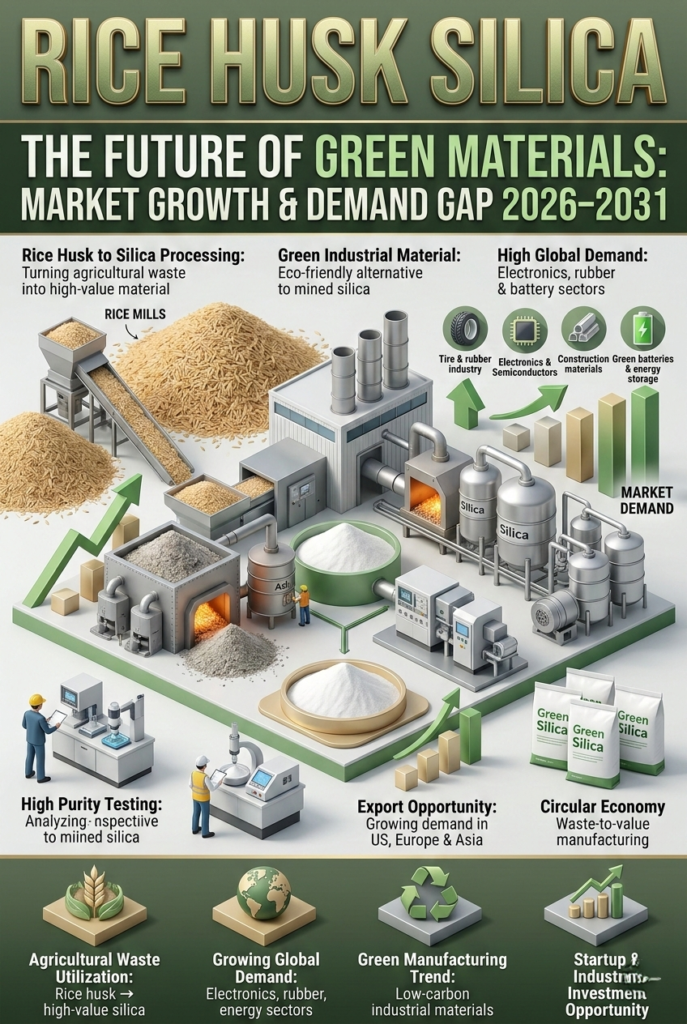
India produces huge quantities of rice every year, and in the process, huge quantities of rice husk which is produced as a by-product. Much of this husk is used as biomass fuel in rice mills and power plants, and produces rice husk ash.(Rice Husk Silica for Green Tyres)
Despite this wealth of raw material, India imports large amounts of high grade silica used in specialty industries.
Trade data suggests that in 2024:
- The following are some of the imports that India made from China: – India imported more than USD 100 million of silicon dioxide
- Exports less than imports, thereby a net import dependency
Another interesting pattern is the price difference of suppliers. Countries like China and Malaysia export in large quantities at relatively low prices; and countries like Germany and Japan export in small quantities but at much higher prices.
This pattern typically reflects that the higher-priced imports are specialty or premium grades of silica, typical uses being in tyres and in advanced industrial applications.(Rice Husk Silica for Green Tyres)
Players Operating in the Indian Silica Industry
Several companies in India have made a good position in the silica market.
Tata Chemicals has developed rice husk derived specialty silica products. These materials are intended to optimise the performance of the tyre by improving grip, reducing rolling resistance and by reducing noise.
Madhu Silica Pvt Ltd is another major manufacturer that has huge production capacity and is in good relations with tyre manufacturers. The company supplies silica to well-known tyre brands and has developed expertise in producing a high quality precipitated silica.
Emerging companies other than established companies are developing innovative methods to turn rice husk ash into commercially useful silica products. The startups plan to establish a circular business model which transforms agricultural waste into raw materials for industrial production.(Rice Husk Silica for Green Tyres)
Business Opportunities for Entrepreneurs
The increasing demand for rice husk silica provides multiple opportunities for investors and entrepreneurs. However, success in this industry demands technical expertise and the quality of the product.(Rice Husk Silica for Green Tyres)
Some of the potential business models are:
- Setting up silica production facilities near the rice mills to secure steady supply of husk
- Developing tyre grade highly dispersible silica for specialty markets
- Produce of sodium silicate intermediates for silica production
Entrepreneurs who can combine the ability to reliably provide the raw materials with advanced processing technology may find good opportunities in this sector.(Rice Husk Silica for Green Tyres)
Read More: Project Reports & Profiles
Husk Silica Production Technical Challenges in Rice
Although the market outlook is promising, rice husk silica production is associated with multiple technical challenges.(Rice Husk Silica for Green Tyres)
One of the biggest problems is the variability of rice husk ash. The chemical composition of ash may vary according to the temperature of combustion and the original husk quality. Producers need to have purification processes because these processes enable them to keep their silica materials at high quality standards.
Another issue or challenge is environmental compliance. Silica extraction processes include chemical reactions that create wastewater together with production waste materials. Proper treatment systems to comply with environmental regulations are necessary.(Rice Husk Silica for Green Tyres)
Finally, to get into the business of tyres, there are strict supplier approval processes to follow. Tyre manufacturers often use a lot of testing before approving new suppliers of raw materials.(Rice Husk Silica for Green Tyres)
Future Outlook
The long-term outlook of silica in rice husks continues to be very positive. The automotive industry is actively pursuing energy efficient solutions and sustainable practices which will lead to increased demand for high performance silica materials.
Companies create agricultural waste-based bio-silica products to achieve their goal of decreasing carbon emissions while transitioning toward circular production methods. With huge rice production and the development of its chemical industry, Asia, and especially India, has the potential to become one of the leading suppliers of rice husk silica in the world.(Rice Husk Silica for Green Tyres)
FAQ
What is rice husk silica?
Rice husk silica is a form of high purity silica obtained from rice husk ash generated from biomass burning in rice mills.
Why is silica used in tyres?
Silica improves tyre performance because it reduces rolling resistance and wet grip while enhancing fuel efficiency.
What is Highly Dispersible Silica?
Highly Dispersible Silica This is a special type of silica that is designed to be able to disperse evenly in the rubber compounds used in tyres.
Is there a demand for rice husk silica in India?
Yes, in India, large quantities of high-grade silica are imported, which implies a high level of demand and opportunity for local production.
Can Startups enter Rice husk Silica Market?
Yes, but they have to meet strict quality standards and invest in a sophisticated processing technology, if they want to compete in the tyre industry.


