





Furfuryl Alcohol Plant in India
The Indian specialty chemicals sector has been quietly emerging as one of the most promising opportunities for first-time entrepreneurs and MSME investors. Of the high-value chemicals, furfuryl alcohol is of outstanding interest because of its many emerging uses in industry, export prospects and underdeveloped market in the United States.
Furfuryl alcohol has been extensively utilized in the foundry industry as a binder for furan no-bake resins, which are important in the metal casting industry for automotive, aerospace and heavy engineering industries. Beyond foundries, it is utilised in corrosion-resistant coatings, Fiber-reinforced composites, adhesives and as a precursor to levulinic acid, an emerging green chemistry chemical.
Globally, the market is worth more than USD 600 million, and its growth rate is expected to be 5-6% annually. While China continues to be the largest producer, increasing labour costs, supply chain disruptions and ESG-driven demand for bio-based chemicals have created an opening for Indian manufacturers.
Table of Contents
ToggleRead the Complete Book Here: Handbook On Chemical Industries (Alcohol Based)
Why India is Strategic Location
India generates millions of tonnes of pentosan-rich agricultural residues which makes it ideal for furfuryl alcohol production. The important feedstocks are rice husks, sugarcane bagasse and corncobs which are concentrated in the states such as Punjab, Uttar Pradesh, Maharashtra, Karnataka and Tamil Nadu.
Major benefits for setting up in India are:
- Low raw material cost compared to Europe or East Asia
- Closeness to foundry clusters such as Coimbatore, Rajkot, Kolhapur and Howrah
- Growing domestic demand, with most foundries currently having a reliance on imports
By exploiting these benefits, a new MSME plant will soon become a trustworthy supplier.
Raw Material Strategy
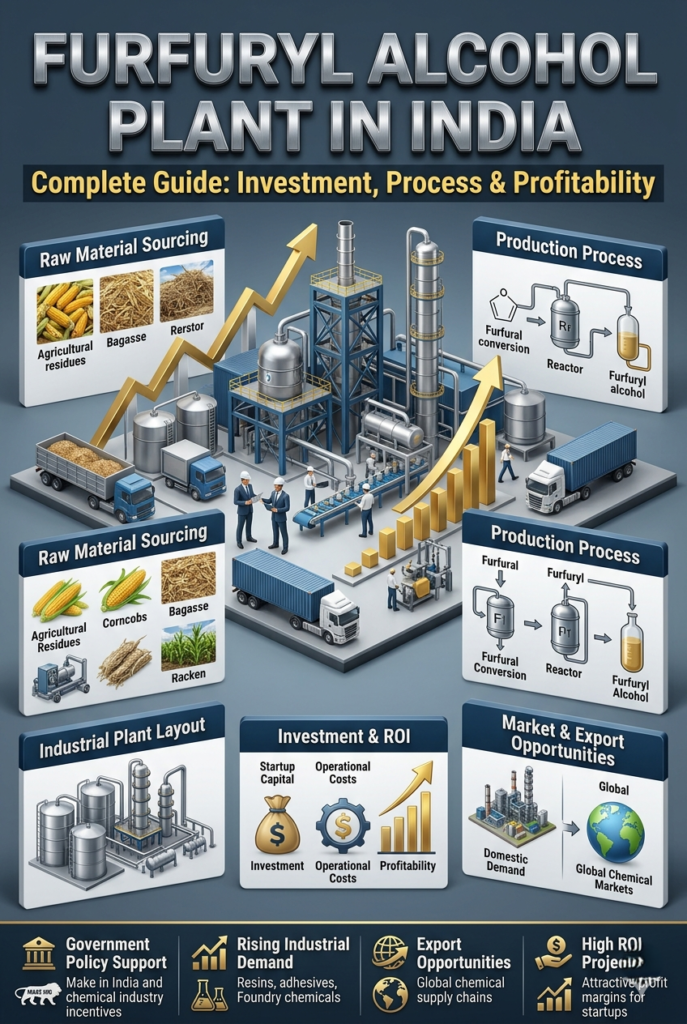
The primary raw material is furfural, which is made from biomass with the use of dilute sulfuric acid. The entrepreneurs have two strategic options:
- Integrated Plant: The company will produce furfural through its production facilities which will process rice husks and bagasse to create furfuryl alcohol.
- Pros: Improved margins, control of feedstock
- Disadvantages: Increased capital and engineering complexity
- Non-Integrated Plant: The company will obtain furfural through domestic sources and international imports to focus on manufacturing furfuryl alcohol.
- Pros: Less investment, quicker start up
- Disadvantages: Depends on external supply
Other supporting chemicals such as sulfuric acid and sodium hydroxide are highly available throughout India, keeping the cost of operation low.
Get Detailed Project Report (DPR): Alcohol-Based Fuel Gel: Manufacturing & Business Guide
Manufacturing Process
Furfuryl alcohol is obtained by catalytic hydrogenation of furfural. The reaction utilizes a copper-chromite or copper-zinc catalyst under conditions of elevated temperature and pressure and reduces the aldehyde group of the furfural to a hydroxymethyl group. The product is then purified by distillation to over 98% commercial grade purity.
A typical plant size MSME with 1,000 MT/year capacity consists of:
- Hydrogenation reactor system
- Hydrogen storage or generation setup
- Distillation columns, heat exchangers
- Storage tanks for feedstock and product
- Effluent Treatment Plant (ETP) for Waste Water and Spending Catalyst Management
The environmental regulations exist as essential rules. Furfuryl alcohol plants require both Consent to Establish and Consent to Operate permits because they belong to the Orange pollution classification category.
Investment and Financial Considerations
The establishment of a 1,000 MT/year furfuryl alcohol production facility requires an investment between INR 5.5-7 crore which covers expenses for land acquisition civil construction plant equipment installation utility systems and operational funds. The financial summary presents the following essential information:
- Plant & Machinery: INR 2.5–3.5 crore
- Working Capital: INR 0.8–1.2 crore
- Annual Revenue (at INR 120/kg): INR 12 crore
- Net Profit Margin: 15–20%
- Payback Period: 4–6 years
- Debt-Equity Ratio: 70:30
MSME units can avail 15% subsidy on plant & machinery under CLCSS and priority sector lending by banks which reduces the effective capital requirement.
Export Potential
India has a good opportunity for grabbing the world furfuryl alcohol market demand, particularly from Germany, Netherlands, US and Japan as buyers are looking for alternatives to Chinese supply.
To maximize potential for export:
- Have constant quality and laboratory certifications
- invest in export discipline and market development
- Make use of government schemes like CHEMEXCIL, Advance Authorization for duty-free imports, RoDTEP for tax remission
A disciplined approach can mean exporting 30-50% of output within 3-5 years, producing a hedge to dollar-denominated revenues.
Business Opportunities
Beyond the standalone production of furfuryl alcohol, entrepreneurs can pursue:
- Integrated Furfural + Furfuryl Alcohol Plant – Full backward integration for better margins
- Furan Resin Manufacturing: To convert furfuryl alcohol into ready-to-use foundry resins
- Furfural-based Agrochemicals: Serving the Chemical and Agricultural Markets at the same time
- Levulinic Acid Production: Enter the high value green chemistry market
Each of the avenues enable scale up in phases, while capturing a higher value along the chemical chain.
Government Support
The Indian government is promoting specialty chemicals and bio-based manufacturing through various initiatives:
- Priority Sector Lending: Concessional finance to MSME units
- CLCSS: 15% subsidy on machinery
- Advance Authorization Scheme (duty free import for export production)
- RoDTEP- Remission of embedded taxes of exported products
- State Chemical Zones: Incentives in infrastructure, land and tax (Gujarat, Maharashtra, Telangana)
Such support is known to mitigate upfront risk and enhance long-term profitability.
Lessons of the Successful Chemical Entrepreneurs
Companies like Deepak Nitrite Limited and Aarti Industries prove that early entry, niche chemical focus, backward integration and export discipline are the keys to long term growth. Furfuryl alcohol presents a similar opportunity for entrepreneurs who are quality driven, process oriented and strategic in positioning themselves in the market place.
Conclusion
Setting up of furfuryl alcohol manufacturing unit in India is a high value and low competition opportunity. With ample availability of feedstocks, growing domestic demand, high export potential and favourable government policies, MSME investors can create a profitable and sustainable chemical business. Focusing on quality, process, and strategic market positioning ensures long term growth and competitive advantage.
FAQs
What is furfuryl alcohol used in?
Mostly in foundries for furan no-bake resins, and coatings, adhesives, composites and green chemistry applications.
How much investment is necessary?
INR 5.5 – 7 crores for a 1000 MT/year MSME plant. An integrated furfural + alcohol plant may cost INR 12-20 crores.
Is there an export market?
Yes. Countries such as Germany, Netherlands, US and Japan are trying to find a workaround to China.
What Environmental Approvals are Required?
Orange category compliance CTE, CTO, ETP, proper disposal of spent catalysts.
So how does a first time entrepreneur get started?
Conduct a professional feasibility study and DPR including process design, raw material sourcing, financials and market research.


