






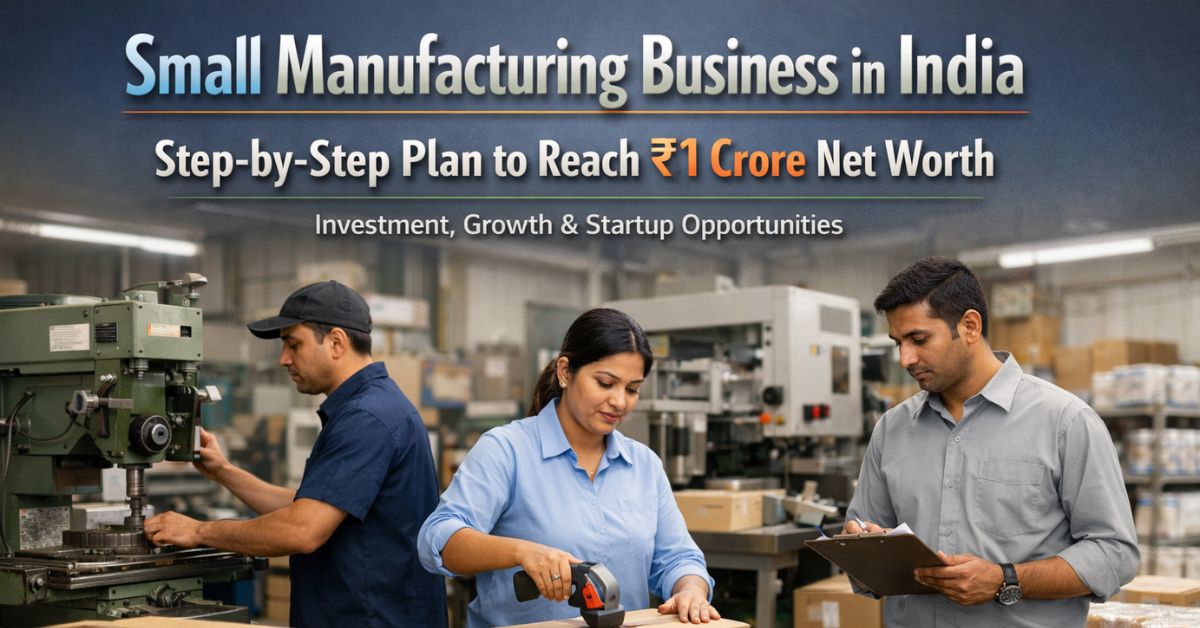
Introduction: Small Manufacturing Business
In recent years, many aspiring entrepreneurs have been drawn toward technology startups, online businesses, and digital ventures. While these sectors offer exciting opportunities, one of the most reliable and time-tested ways to build long-term wealth in India remains small-scale manufacturing.
Thousands of small production facilities produce stable revenues and accumulate valuable assets in towns, semi-urban areas and industrial clusters. These are businesses that might not be given media coverage but they are highly needed in the economy and they give the business owners and their families financial stability.
Detergent unit, spices processing plants, packaging and paper products are just but a few examples of the everyday consumer goods that are needed on a regular basis whether the economy is in boom or recession. Through good financial management, financial planning and reinvestment of earnings net worth of 1 crore in four to six years is not a far-off dream of most small manufacturers.
This guide will detail how manufacturing companies generate wealth, what areas have great opportunities, and the real steps that an entrepreneur can take to establish financial success.
Table of Contents
ToggleThe reason why manufacturing businesses constitute wealth at an accelerated pace
The manufacturing companies present distinct strengths that enable them to be good wealth creation instruments as opposed to most service oriented businesses.
- Tangible Asset Creation
Asset accumulation is one of the largest manufacturing strengths. There are machinery, equipment, inventory and factory infrastructure that all directly contribute to the overall value of the business. With time, these assets grow the net worth of the entrepreneur.
- Stable Demand of Necessary Goods.
Majority of the manufactured goods are categorized under those that are used by people on a daily basis, including cleaning commodities, food products, packaging materials and household materials. This generates predictable demand and steady revenue bases.
- Scalability Lack of Proportional Cost Increase.
After production systems are put in place, a business can produce more without having to incur huge cost. This enhances profit margins and speedy financial growth.
- Government Support and Subsidies.
The small manufacturing industry in India enjoys a number of government programs aimed at promoting entrepreneurship and industrial growth. Such programs offer financial support, training and infrastructural support to mitigate risk to new business owners.
The main Benefits of small manufacturing firms
- Stable and consistent demand.
- High growth in asset values.
- Opportunities for expansion
- Capacity to cater to local and regional markets.
- Long-term financial stability
These benefits ensure that manufacturing is one of the surest ways to accumulate wealth, particularly among first-generation entrepreneurs.
Profitable Small-scale Manufacturing Companies to consider
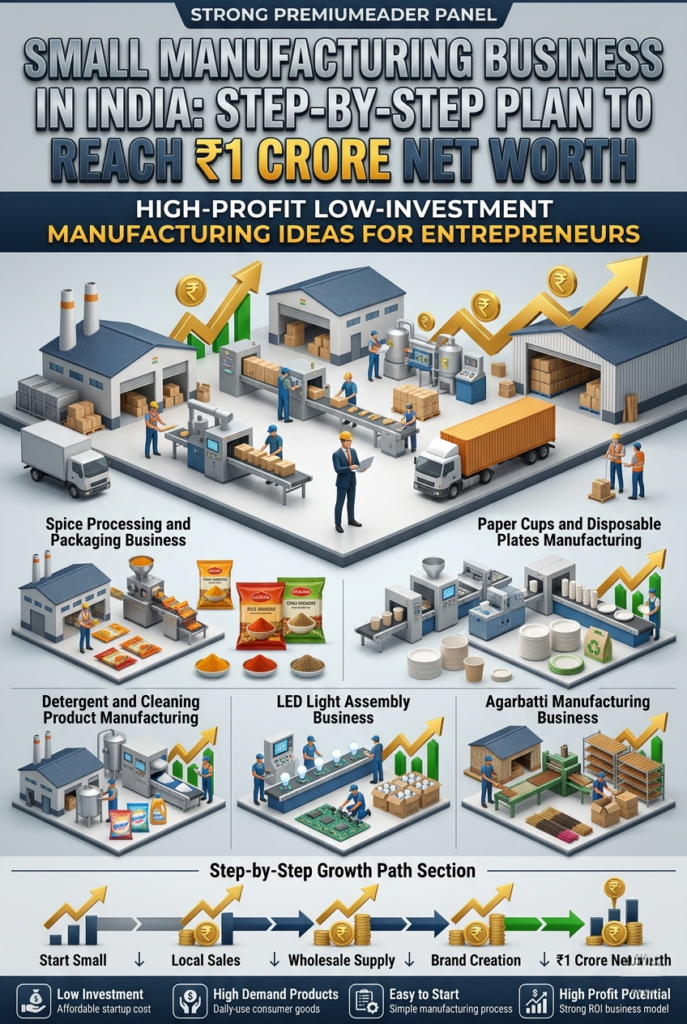
One of the most significant choices when launching a manufacturing business is to find the appropriate industry. The best industry is one that has consistent demand, investment needs that are easy to handle, and growth opportunities.(Small Manufacturing Business)
1. Spice Processing and Packaging Business
India produces and consumes spices at a large scale. A spice processing facility enables business people to package and retail products in their own brand.
This business offers:
- Moderate startup investment
- Retail markets are in high demand.
- Strong brand-building potential
- Regional expansion opportunities.
Spice businesses will be able to make constant monthly revenues with the right branding and distribution.
Get Detailed Insights from This Book: Handbook on Spices, Seasonings and Condiments Processing, Extraction with Kitchen Spices Manufacturing
2. Manufacturing of Paper Cups and Disposable Plates
The rise in environmental consciousness and the ban on using plastic items have raised the need to have solutions that are environmental friendly. Disposable plates and paper cups are popular in restaurants, events, and food delivery businesses.
Key benefits include:
- Relatively low start-up cost.
- Simple production process
- High market demand
- Short payback period.
A number of entrepreneurs make a profit in the first year of operation.
Get Detailed Project Report (DPR): Paper Cups Manufacturing Plant Project Report
3. Detergent and Cleaning Product Manufacturing
In every home, hotel and business premises, cleaning products are indispensable. This sector is very stable with the demand being steady all through the year.
Common products include:
- Detergent powder
- Floor cleaner
- Dishwashing liquid
- Liquid hand wash
This is an industry where one can begin with small business and grow over time as the demand of customers goes up.
4. LED Light Assembly Business
Lighting has also become energy efficient in residential premises, offices and business premises. The cost of LED assembly plants is moderate and has a high growth potential in the long term.
The strengths of this business are:
- Increased demand because of infrastructure expansion.
- Opportunities to provide government and private projects.
- Scaling of production at a gradual rate.
5. Agarbatti Manufacturing Business
One of the most available industries to new entrepreneurs is agarbatti manufacturing. It does not demand extensive technical expertise and is not that demanding on investment.
It is a business particularly appropriate to:
- Small towns and rural regions.
- Family-operated units
- Entrepreneurs interested in low risk opportunities.
The domestic demand is good and the export markets have further expansion opportunities.
Step-by-Step Path to Reach ₹1 Crore Net Worth
Creations that lead to the creation of a 1 crore net worth in building usually have a systematic development pattern. Business owners who are financially disciplined, and reinvest the profits, are always more likely to achieve this milestone sooner.(Small Manufacturing Business)
Phase 1: Business Establishment and Stability (02 Years)
In the initial phase, operations, product quality, and customer base are the main concerns.
The main tasks in this stage:
- Purchasing of machinery and equipment.
- Obtaining raw material suppliers.
- Formulation of product quality standards.
- Establishing relationships with local distributors.
Typical financial outcomes:
- Annual revenue- 25-40 lakh.
- Early production of assets in the form of machinery and inventory.
- Gradual market recognition
This stage is a precursor to long term development.
Phase 2: Expansion and Growth (24 Years)
When the business stabilizes, it starts to increase production capacity and expand distribution channels.
Key growth strategies:
- The innovation of new product variations.
- Improving production efficiency
- Expanding to the local markets.
- Hiring additional staff
This is the point when the revenues start rising sharply, and the business worth increases exponentially.
Phase 3: Scaling and Wealth Creation (46 Years)
The last stage of growth is when the emphasis is put on expansion and brand building.
Common developments include:
- Investment in automated equipment.
- Regional or state market expansion.
- Better packaging and branding.
- Increased production capacity
Typical results:
- Annual income of above 1 crore.
- Strong brand recognition
- Net worth or more than 1 crore ₹.
The Significance of Discipline in Financing
One of the most important aspects in business success is financial discipline. Lots of companies do not succeed due to the fact that their products are not demanded, but they have a poor management of cash flow.(Small Manufacturing Business)
There are some basic financial habits that successful manufacturers observe.
Key Financial Practices
- Plow profits back into business.
- Have a sufficient working capital.
- Monitor expenses regularly
- Avoid unnecessary borrowing
- Separate business and personal finances.
The practices assist business in staying afloat when things are not going well and help it in the long run.
Projected Startup Cost and Profit Potential
The table below provides general representation of investment and profit forecasts of small manufacturing businesses.
Business Type | Estimated Investment | Monthly Revenue | Monthly Profit | Break-Even Period |
Agarbatti Manufacturing | ₹3–5 lakh | ₹80,000–₹1.2 lakh | ₹20,000–₹30,000 | 8–10 months |
Detergent Manufacturing | ₹6–8 lakh | ₹1.5–2 lakh | ₹35,000–₹45,000 | 12–14 months |
Paper Cup Manufacturing | ₹10–15 lakh | ₹2–2.5 lakh | ₹40,000–₹50,000 | 14–16 months |
Spice Processing | ₹7–12 lakh | ₹1.8–2.8 lakh | ₹45,000–₹60,000 | 12–15 months
|
General Problems with Small-Scale Manufacturing
Any manufacturing company encounters problems on the path of its development. Awareness of these barriers beforehand will ensure that entrepreneurs develop solutions.
- Rising Raw Material Costs
Profit margins may change due to fluctuations in the prices of raw materials. Having numerous supplier alliances can be used as a risk mitigation tool.
- Local Market Competition.
New companies may be competing with well developed brands. Customers can be loyal through the provision of uniform quality and prices.
- Cash Flow Management
Customers may fail to pay on time, which may put a strain on finances. It is imperative to have adequate working capital.
- Low Growth in Sales at the outset.
It is time-consuming to gain trust in the market. Business people who are patient and concentrate on the quality of products tend to have a progressive growth in sales.
The reason why a proper business planning is necessary before starting
It is possible to make expensive errors when launching a manufacturing business without a plan. Businesspeople can either overestimate costs, select the wrong equipment, or fail to estimate the market correctly.
A business plan prepared properly has clarity and financial risk is minimized.(Small Manufacturing Business)
A Business Plan of a Professional is usually composed of
- Market demand analysis
- Details of machinery and equipment.
- Raw materials sourcing strategy.
- Production cost estimates
- Profitability projections
- Break-even analysis
This data assists entrepreneurs to make sound decisions and acquire loans through banks or other financial institutions.
Creation of Wealth Over the Long-run by means of Manufacture
The manufacturing companies accumulate wealth by creating steady growth and reinvestment through discipline. In contrast to the speculative projects, manufacturing is based on the stable demand and development of assets.
In the long run the business yields:
- Regular monthly income
- Valuable physical assets
- Strong brand recognition
- Increased resale value
This is a combination of factors that produces long-term financial stability of the entrepreneurs and their families.
NPCS: Reliable Industrial Project Consultants
Niir Project Consultancy Services also referred to as NPCS is a top-ranked industrial consultancy firm that helps entrepreneurs to start manufacturing firms successfully.
The firm offers technical advice to those who desire to develop new sectors or to increase the size of the old ones. They have the skills in various industries such as food processing, chemicals, packaging, and manufacturing consumer goods.
NPCS helps entrepreneurs by offering:
- Detailed Project Reports (DPR)
- Demand analysis and market research.
- Process and machinery direction.
- Budgeting and estimation of costs.
- Business feasibility evaluation
Most financial institutions and banks depend on the structured feasibility report in the screening of loan applications. A professionally prepared report enhances credibility and has higher probabilities of getting funding.
Conclusion
A small manufacturing business in India can be grown into a 1 crore net worth which is realistic and achievable. It does not involve exceptional resources or technology. It only needs meticulous planning, diligence, and budgetary control.(Small Manufacturing Business)
The entrepreneurs who make the right choice of industry, do not compromise on the quality of their products and reinvest the profits in their development may slowly grow their income and business value as time goes by.
The manufacturing sector in India is still on the rise because of the increase in consumer demand, development of infrastructure, and favorable government policies. Even first-generation entrepreneurs may be able to develop a strong financial base and long-term wealth through small-scale manufacturing with determination and correct strategy.
Frequently Asked Question (FAQ)
What would it cost to initiate a small manufacturing company in India?
The majority of the small manufacturing enterprises may start with an investment of 5 lakh to 30 lakh rupees. This varies according to the type of product, machinery and the amount of production capacity.
What is the time to break even of 1 crore net worth?
In the case of a properly managed manufacturing business, it normally needs four to six years to achieve a net worth of 1 crore. This milestone is significantly contributed by consistent reinvestment and consistent growth.
What is the most beginner manufacturing business?
The safest types of businesses are those that manufacture goods that are needed on a daily basis. These are cleaning products, items of disposables, spices, and household supplies since demand is constant all the year round.
Does it have government support in manufacturing businesses?
Yes, there are various plans, that are provided by the Ministry of Micro, Small and Medium Enterprises, which offer financial support, subsidies and training to the new entrepreneurs.
What is the rationale behind creating a project report prior to the commencement of a business?
A project report gives a clear picture in terms of costs, profits and risks. It assists entrepreneurs to borrow money in banks and to organize operations efficiently to evade losses.


