






Introduction: Dhirubhai Ambani lessons
The Dhirubhai Ambani story remains a source of inspiration to entrepreneurs in India since it demonstrates that success is not confined to individuals who have wealth or networks. He began by a small trading venture and slowly expanded one of the biggest industrial conglomerates in the nation. His adventure reveals that ambition, strategizing and the willingness to take chances can turn an average thought into a strong business.
The current entrepreneurs of a startup and MSMEs have various challenges, yet the principles of business success are the same. Markets are dynamic, technology is dynamic and competition is more dynamic, but the basics of growth, planning and execution continue to be the difference between the survival and the failure of a business.
This paper describes the most useful insights provided in his business philosophy and relates them to the current opportunities in manufacturing and entrepreneurship.
Table of Contents
ToggleRelated Article:Dhirubhai Ambani Business Strategy: Lessons for Entrepreneurs, Startups, and MSMEs in India
Lesson 1: Think Bigger Than You Have.
Most entrepreneurs do not grow enough since they are only interested in what they possess now. Effective business leaders look ahead. They develop operations which can grow with the growth of demand.
By thinking big at the inception, the businesses enjoy:
- Better production efficiency
- Lower per-unit costs
- Stronger market presence
- Higher long-term profitability
Growth planning does not imply wasteful expenditure. It refers to developing a base that facilitates growth.
Lesson 2: Learn Government Policies and Incentives.
Government policies are significant in business success particularly in manufacturing and industrial sectors. Those entrepreneurs that are aware of these policies are able to minimise costs and maximise profitability.
India has a number of schemes to assist new businesses including:
- Capital subsidies on manufacturing units.
- Small business loans.
- International trade incentives on exports.
- Tax incentives to some industries.
Being aware of how to get these advantages can prove to be quite a boost during the initial years of operation.
Lesson 3: Develop Step by Step According to the Market Demand.
Intelligent enterprises grow slowly, based on their demand and not mere conjecture. The method mitigates risk and provides stable growth.
As an illustration, a small food processing company can begin with one product and subsequently introduce new products with increased sales. Such an approach enables the company to gain experience and change its approach with time.
Demand-led growth is sustainable compared to assumption-led growth.
Get Detailed Insights from This Book: Our Books
Lesson 4: Dominate a Big Market rather than a small niche.
Targeting products that are regularly used by the people is one of the best business strategies. Demand products bring in predictable revenues and minimize financial risk.
The industries with high customer bases are:
- Packaged food and drinks.
- Construction materials
- Household products
- Agricultural inputs
The companies in these industries enjoy a consistent demand and recurrent customers.
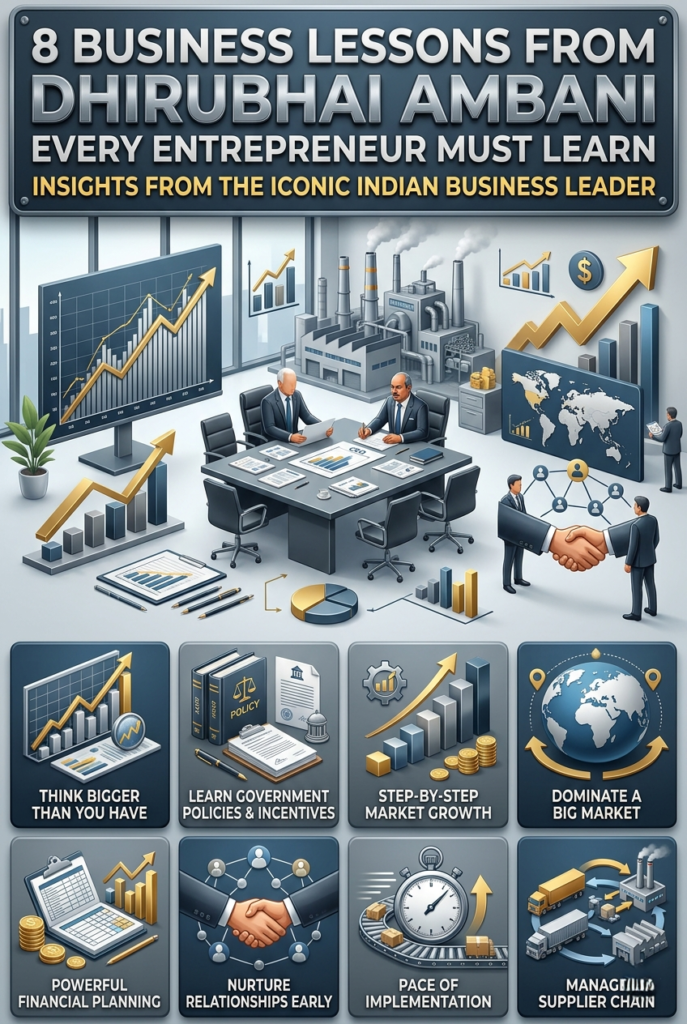
Lesson 5: Powerful Financial Planning is a Must.
The success of any business is based on financial discipline. Business owners will need to know the flow of money in and out of their business. Even viable businesses may collapse without proper planning.
A financial plan must consist of:
- Estimated startup investment
- Monthly operating expenses
- The anticipated revenue and profit margins.
- Working capital requirements
These figures assist entrepreneurs to make a wise choice and not experience financial strain.
Lesson 6: Nurture Relationships When they are not necessary.
Trust and collaboration among various stakeholders are the keys to business success. Many entrepreneurs extend out relations at an early stage which makes it easier to resolve conflicts and tap opportunities.
Major ones are suppliers, customers, bankers, and industry partners. Partnerships that would be of good use can be connected with the help of networking at trade exhibitions and business associations.
Good relationships bring stability and long term growth.
View Full Project Details: Project Reports & Profiles
Lesson 7: Pace of Implementation is Important.
Delays are expensive in competitive markets. Fast moving businesses usually have an upper hand as compared to those that move slowly. Quick implementation enables the firms to realize revenue earlier and earn investment quicker.
Entrepreneurs ought to emphasize on effective planning and decision making. Such minimal inconveniences as delays in production or delivery can influence profitability.
Speed does not mean rushing. It is all about keeping the momentum and not taking unnecessary hurdles.
Lesson 8: Manage Your Supplier Chain.
The reliance on foreign suppliers may pose some threats like prices and out of stock supplies. Supply chain control businesses are better suited to deal with the emergent challenges.
This is a type of strategy that is referred to as backward integration and assists companies:
- Reduce production costs
- Maintain consistent quality
- Ensure uninterrupted supply
- Increase profit margins
This method is employed by many prosperous manufacturing firms in order to reinforce their competitive advantage.
India has high demand manufacturing business opportunities.
The increasing economy in India has raised demand in a number of industries. Businessmen who make the right industry selection will be able to grow quicker and earn consistent revenue.
Part of the opportunities in manufacturing involves:
- Food processing and packaging.
- Specialty chemical production
- Construction materials manufacturing
- Recycling and renewable energy.
- Agricultural input production
Such industries enjoy increasing demand, government subsidies and growing markets.
Why Feasibility Studies Are Important Before Starting a Business
One of the most prevalent mistakes an entrepreneur may make is starting up business without adequate analysis. A feasibility study gives a close information regarding the demand in the market, cost of production and performance.
It assists the entrepreneur to answer important questions including:
- Does the product have demand?
- What is the amount of investment needed?
- Which is the anticipated profit?
- How many years will it take to recover investment?
This knowledge minimizes risk and boosts confidence prior to starting up a business.
About NPCS (Niir Project Consultancy Services)
NPCS is a professional consultancy company that assists business people with their business planning and start-up. The company deals with preparing project reports and feasibility studies of manufacturing and industrial ventures.
Their services normally involve market research, technical planning and financial analysis. Such reports assist the business people on the full needs of their business prior to investing money.
NPCS collaborates with the start-up founders, owners of MSMEs and investors in different industries. They aim at giving practical advice that transforms business concepts to lucrative businesses.
Conclusion: Making Vision A Reality.
Any successful business starts with a vision yet not only a vision. Entrepreneurs should be able to blend ambition with planning, discipline, and diligent efforts. The concepts presented in this article demonstrate that anyone can become successful as long as he is ready to learn and change.
India presents huge potential to entrepreneurs particularly in the field of manufacturing and industry. Even the small enterprise can develop into the powerful and sound organization with the help of the right strategy and preparation.
The point is that one should start with confidence, have a plan, and want to grow long-term.
Frequently Asked Question (FAQ)
Which is the most appropriate business to start in India today?
The food processing, chemicals, construction materials, and renewable energy businesses are currently presenting a great growth opportunity; owing to the rising demand and governmental backing.
What is the minimum amount of investment required to start manufacturing business?
The minimum amount required to invest in investment is different according to the industry, however, most small manufacturing businesses have an initial investment of between 5 lakh and 50 lakh.
Why is a feasibility report important?
A feasibility report assists entrepreneurs to know the cost, demand and profit potential by first investing. It decreases financial risk and enhances decision-making.
What should I do to get my business successful fast?
Pay attention to the following three factors:
- Select the appropriate market.
- Plan finances carefully
- Execute operations efficiently
- Long-term success requires consistency and discipline.
What does NPCS do?
NPCS offers professional project reporting, market research, and business planning services that can assist business people in beginning and expanding their business successfully.


