







Indian business families
The biggest business families in India are not only a representation of wealth, they are decades of strategic investment, planning, and foresight in how they can see opportunities before others. Their success stories indicate how businesses change as the markets and government policies change. These families established diversified businesses that impact the global economy today; out of textiles and trading to energy, telecommunications, infrastructure and consumer goods.
These stories have lessons to the first-generation entrepreneurs. The experience of these firms proves that luck is not always enough to achieve success. It relies on the ability to select the appropriate industry, reduce risks, and ensure operational efficiency in the long-term.
Table of Contents
ToggleThe Reliance Story: Building Scale Through Integration
The development of the Reliance Group can be discussed as one of the most impressive changes in the Indian business history. The firm began with textile and progressively ventured into petrochemicals, refining, telecommunication and digital services. All expansions were well thought out in such a way that one business supported another.
This is referred to as backwards integration. The company managed the costs and enhanced efficiency through the control of the raw materials, production, and distribution. This strategy has over the years resulted in a powerful competitive edge that has seen the company conquer several industries.
The most important Business Lessons of the Reliance Model.
- Manage key elements of your supply chain.
- Invest in large scale infrastructure.
- Get into long-term demand industries.
- Put emphasis on technology and innovation.
The firm is currently making significant investments on renewable energy and online business, which are likely to expand in the years ahead.
The Adani Model: Infrastructure as a Long-Term Strategy
The Adani Group realized at an early stage that the economic growth in India would be pegged on good infrastructure. The company concentrated on ports, logistics, and power generation as opposed to competing in the congested consumer markets. These are industries that demand a lot of capital to invest in but generate long time stable revenue.
The infrastructure development still provides the chances of the small and medium businesses. There are numerous large projects that are dependent on suppliers and service providers, which enables smaller companies to contribute to industrial expansion on large scale.
Emerging Opportunities Around Infrastructure
- Logistics and warehousing services
- Solar energy equipment production.
- Construction materials supply
- Maintenance and engineering services in the industry.
The entrepreneurs, who coordinate their business with the development of infrastructure, tend to have stable demand and the contracts over the long-term period.
The Tata Group: The Strength of Trust and Brand Reputation.
Tata Group enjoys a reputable ethical business ethic coupled with long term vision. The company has established a reliable and quality reputation over the generations. This confidence saw the group venture into various other industries, which included steel, automobiles, information technology, and aviation.
Responsible management and financial discipline is one of the main factors that have contributed to the success of the group. The company does not just invest in innovation and long-term development unlike other companies that only aim at short-term profitability.
To entrepreneurs, the Tata story emphasizes the role of credibility. Companies with transparent processes and providing quality are at a higher position of attracting customers, investors and collaborators.
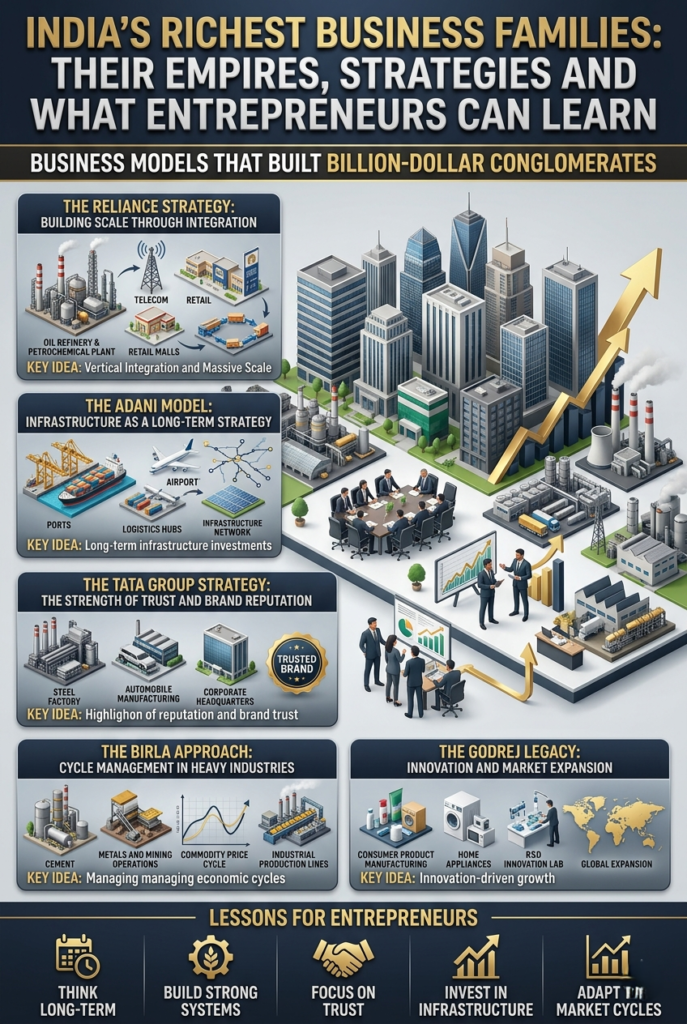
The Birla Approach: Cycle Management in Heavy Industries.
The Aditya Birla Group deals with industries whose demand is fluctuating periodically. Industries like cement, metals, and chemicals are commonly cyclical. The control of these cycles needs a lot of financial planning and effective operations.
The strategy of the group is on cost control and productivity. The operations prove to be efficient even when the market is declining and this keeps the company profitable. Geographic diversification is also a way of decreasing risk as it diversifies operations in various markets.
Lessons that Entrepreneurs can learn about the Birla Strategy
- Plan in advance economic changes.
- Maintain financial reserves
- Concentrate on operational efficiency.
- Expand markets where feasible.
Companies that strategize against uncertainty are in a better position to go through tough times.
Godrej Legacy: Innovation and Market Expansion.
The Godrej Group has established its prosperity through targeted product innovations and good distribution channels. The company progressively grew its household products to include agriculture, real estate and international markets. Its capabilities of comprehending customer needs enabled it to build brand loyalty at a long-term basis.
The emphasis on the market expansion has been one of the most significant elements of the strategy of the group. The company has managed to enter new markets without losing its competitive edge by making changes to its products to suit the local tastes and investing into the distribution channels.
This strategy shows that innovation and customer insights are crucial to business development.
Get Detailed Insights from This Book: Our Books
High-Growth Manufacturing Sectors for Entrepreneurs in India
The growth in economy India has led to new opportunities in various industries. The manufacturing is growing because of rapid urbanization, growing consumer demand, and government spending on infrastructure. Those entrepreneurs that come into these industries with proper planning are capable of establishing stable and profitable ventures.
Currently, industries with good growth potential include:
- Food processing and packaged foods.
- Specialty chemicals and industrial materials.
- Solar energy and renewable equipment.
- Pharmaceutical intermediates and medical products.
- Construction and building materials.
These industries enjoy both the domestic and the export markets; hence, they are good investment opportunities.
Why Planning and Feasibility Analysis Are Essential
Most businesses fail due to inadequate planning before venturing into business. Business people tend to underestimate expenses, make faulty demand predictions, or fail to consider operating difficulties. Professional feasibility study assists in overcoming these risks prior to the major investment.
A good feasibility report should contain:
- Market demand analysis
- Production process details
- Equipment needs and machinery requirements.
- Estimates of cost and investment.
- Break-even and profit projections.
Such information enables entrepreneurs to make the right decisions and save them the expensive errors.
View Full Project Details: Project Reports & Profiles
About NPCS — Supporting Entrepreneurs with Professional Project Reports
Niir Project Consultancy Services commonly referred to as NPCS is a top industrial consultancy body that assists entrepreneurs to start up new businesses with the assurance. The organization has been doing technical and financial reporting preparation on manufacturing and service industries with decades of experience.
NPCS offers detailed advice to business people who would like to assess business opportunities prior to the allocation of capital. Banks and other financial institutions extensively use its reports to determine the viability of projects and give approval to fund them.
Core Services Provided by NPCS
- Detailed Project Reports (DPR)
- Techno-Economic Feasibility Studies
- Market Research and Industry Analysis.
- Manufacturing Process Planning
- Financial and Investment Projections.
These services assist entrepreneurs in minimizing risk, enhancing the accuracy in planning and increasing business success.
Key Takeaways for First-Generation Entrepreneurs
The greatest business families in India have established their empires by planning, executing and thinking long term. Their experience can provide valuable lessons to those venturing in business today.
The highest principles are:
- Select industries having high future demand.
- Align the policies of the government with the business plans.
- Be of high product quality.
- Invest in financial planning and research.
- Consult professional advice prior to investing.
Companies that adhere to these principles have higher chances of attaining sustainable growth.
Conclusion
The most successful business families in India have been able to create their empires with patience, discipline and strategic thinking. They were not lucky but planned well, innovative, and focused on quality to emerge successful.
To business people, what matters most is to invest in industries where there is a high demand, invest in efficient systems and ensure that they conduct ethical businesses.
Even small business can be transformed into a successful business with proper planning, market research, and determination.
It takes vision, persistence and readiness to learn on the part of the person to know how to make it in business.
Frequently Asked Questions (FAQ)
Which manufacturing business is most profitable in India?
Food processing, specialty chemicals, renewable energy equipment, and pharmaceutical products are some of the most profitable industries now. The advantages of these industries are increased demand and government incentives.
What is the amount of investment needed to launch a manufacturing company?
The amount of investment needed is different with the industry and capacity of production. Small units might need medium capital, and medium and large projects need big capital. It is with the aid of a feasibility study that one can ascertain the precise financial requirement.
What is the importance of a feasibility report prior to beginning a business?
Feasibility report determines the market demand, cost of production and financial risk. It offers an excellent road map to starting up a business and raises the chances of getting bank financing.
Is it possible to make first-generation entrepreneurs in manufacturing?
Yes, there are numerous business leaders who had a successful business start even in the absence of family business. New entrepreneurs can develop profitable manufacturing companies with appropriate planning, technical expertise, and considered management.
What is the benefit of NPCS in assisting entrepreneurs to initiate new industries?
NPCS supports entrepreneurs by providing market research, project planning, and financial analysis. Its professional reports enable businesses to make well-informed investment decisions and raise funds with financial institutions.


