





chemical industry business India
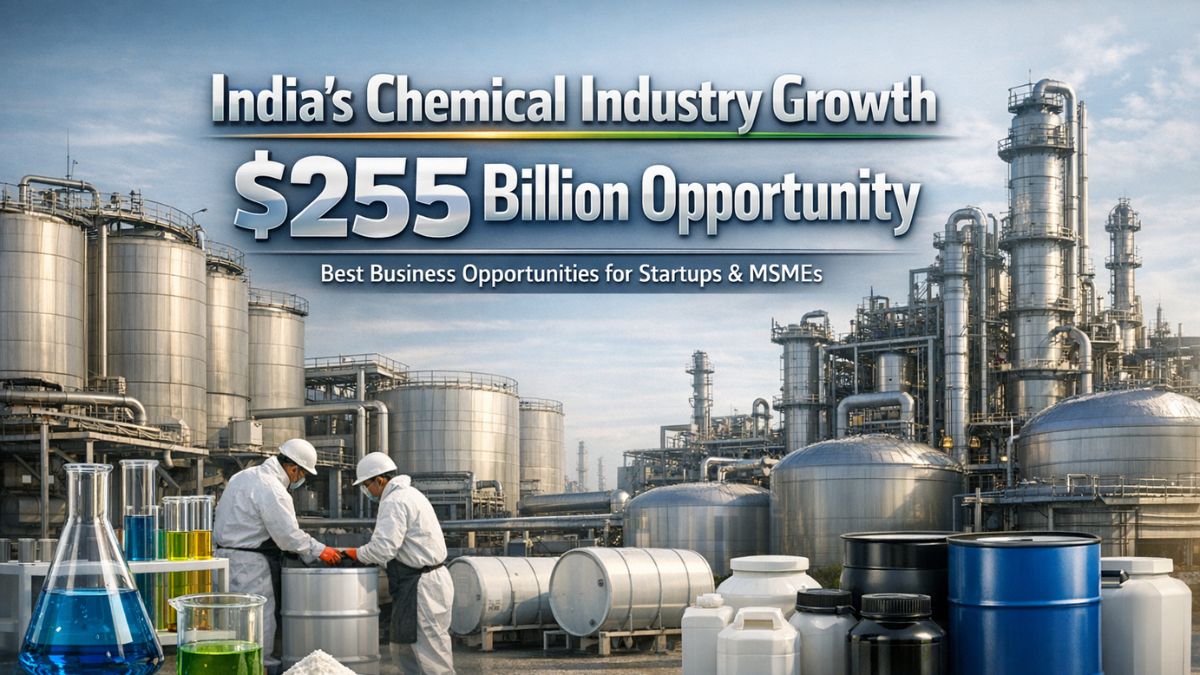
The chemical industry in India is in a strong growth stage that is likely to transform the manufacturing environment in the next ten years. The industry, which is estimated at present between $155 billion and $165 billion, was estimated to hit almost 255 billion in the next few years. This growth is supported by the growing industrial demand, infrastructure growth and the growing global interest in India as a manufacturing hub.
Projections of the chemical industry by McKinsey and Company show that the industry will experience a growth of about 8 to 9 percent per year. In the case of entrepreneurs and MSMEs, this gradual development provides a stable business climate in which the demand will be stable and long-term profitability can be expected.
The chemical industry features prominently in nearly all manufacturing processes. Chemicals are an important constituent in the production process whether in construction materials, automotive parts, textiles, agriculture inputs or consumer goods. With the growing economy of India, chemical products will automatically be in demand, thus this particular business opportunity is one of the most stable and scalable.
Table of Contents
ToggleKey Factors Driving Growth in India’s Chemical Industry
The phenomenon of the fast development of the chemical industry is not a coincidence. It can be attributed to the powerful economic forces and government programs which are promoting local production.
India has one of the largest motivators in the form of the huge development of infrastructure. Highways, rail, housing, and industrial projects, which are of large scale, demand large volumes of specialized chemicals. The projects last years long, guaranteeing the chemical suppliers long-term demands.
The global transformation of supply chains is another key factor. Most global firms are also de-Chinafizing and seeking other sources of production. India has emerged as one of the most preferred locations because of the availability of skilled labor force, developing industrial base and favourable policies.
Some of the key growth drivers are:
- Blistering infrastructure and building development.
- Increased demand by the manufacturing industries.
- Incentives of government on local production.
- Increasing export opportunities
- Increasing population and consumer demand.
A combination of these factors gives a robust base to industry growth.
Get Detailed Insights from This Book: Handbook On Chemical Industries (Alcohol Based)
The $31 Billion Import Substitution Opportunity
India also imports high amount of chemicals at present. This will offer a good chance to the local manufacturers to manufacture such products in the country.
The chemical trade deficit in the country is approximated to be approximately 31 billion USD, which implies high demand that is yet to be fulfilled by local production.
The major import deficits are:
- Inorganic chemicals with a value of about $12 billion.
- Polymer products worth almost 13 billion dollars.
- Specialty chemicals used in packaging and manufacturing.
This scenario is a market indication to entrepreneurs. In an instance whereby the industries will be already purchasing the imported products, the local manufacturers can enter the market confidently upon assuring consistency in their quality and competitive prices.
Profitable Chemical Manufacturing Business Ideas for Startups
The major merit of the chemical industry is that most of the companies can be launched at a medium investment level. Business people do not require huge refineries or industrial complexes. Rather, smaller units have a chance to specialize on specific products that can serve specific industries.
Some of the most promising business opportunities in the chemical manufacturing sector are below.
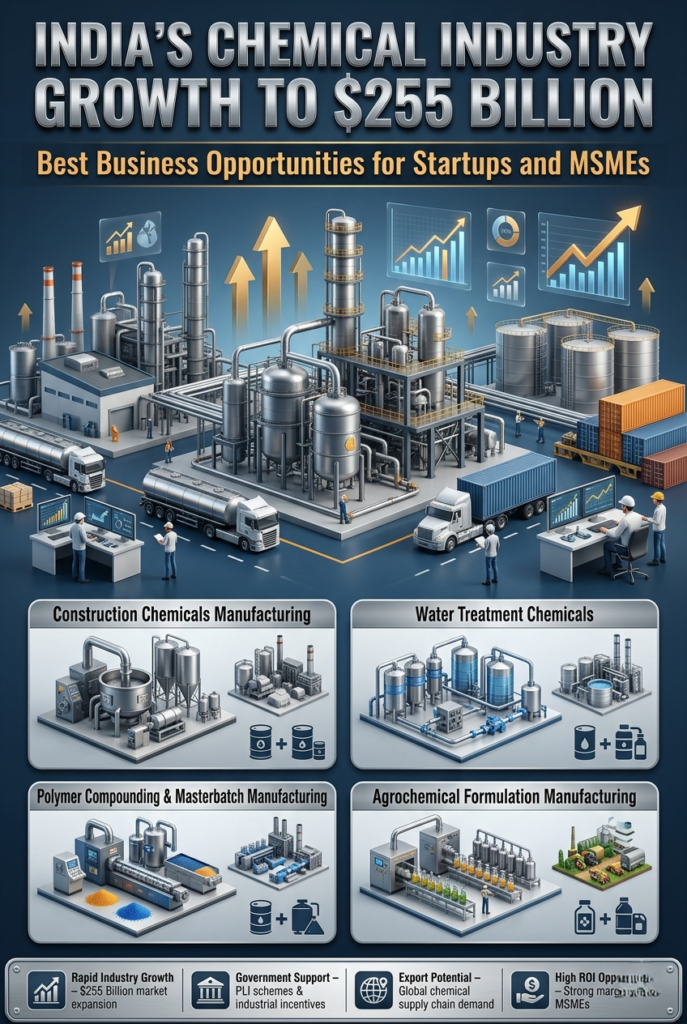
Construction Chemicals Manufacturing
One of the fastest-growing industry segments includes construction chemicals. The products play a fundamental role in enhancing strength, durability and life span of the buildings and infrastructure.
This segment deals in common products such as:
- Waterproofing compounds
- Tile adhesives
- Concrete admixtures
- Structural repair chemicals
- Sealants and coatings
The need to continue urbanization and infrastructure development is projected to keep the demand of such products high.
Water Treatment Chemicals
The treatment of water is an urgent need of industries, cities and living quarters. Water should be treated properly to maintain the safety and sustainability of the environment as required by the governments and environmental regulations.
Common products made in this sector are:
- Coagulants and flocculants
- pH adjustment chemicals
- Disinfectants and biocides
- Wastewater treatment chemicals
This is a good business since the treatment of water is a need than a one time purchase.
Polymer Compounding and Masterbatch Manufacturing
Polymer compounding refers to the process of altering plastic materials with an aim of improving their performance. These materials find extensive applications in packaging, automotive and consumer products.
This business has a number of benefits:
- Moderate investment requirement
- High demand in industries.
- Good repeat shoppers.
- Export potential
Those entrepreneurs who prepare specialized formulations are able to establish a long-term relationship with industrial customers.
Agrochemical Formulation Manufacturing
The agricultural sector continues to be among the biggest industries in India and the contemporary farming relies on the use of chemical inputs to enhance crop yields.
Agricultural chemistry formulation departments normally manufacture finished products like herbicides and pesticides. Formulation businesses need less capital and less complicated production processes compared to the production of raw chemical ingredients.
Due to the growing demand of food, the crop protection chemicals are in constant demand.
Access Complete Business Plan: Fertilizers and Plant Nutrients
Government Support for Chemical Manufacturing Startups
The Indian government has launched a number of programs to spur local production and minimize dependence on imports. Such programs are aimed at simplifying the process of opening new production units by the entrepreneurs.
The invention of industrial clusters that produce chemicals is one of the most important ones. These clusters offer common infrastructure and utilities and logistic aid, which makes it cheaper to establish a factory.
Significant government support programs are:
- Chemical parks that have prepared infrastructure.
- So-called Production Linked Incentive (PLI) schemes.
- Industrial corridor development
- Subsidies for manufacturing units
- Export promotion policies
These programs lower the risk of startups and enhance survival of the business.
Lessons from India’s Leading Industrialists
Effective entrepreneurs tend to get good tips of studying successful entrepreneurs in the industry.
As an example, Mukesh Ambani established one of the biggest petrochemical enterprises in the world by targeting value-added products, instead of the raw materials. His strategy shows that it is crucial to take a step closer to the end customer in the value chain.
Likewise, Kumar Mangalam Birla diversified his business to various chemical markets and generated stability and robustness to market uncertainties.
A second motivating case is that of Karsanbhai Patel who began with a small scale detergent production business and over time, he created a nationally brand. His victory underscores the significance of high product quality and effective distribution channels.
Why a Detailed Project Report (DPR) Is Essential Before Starting a Chemical Business
The establishment of a chemical production plant includes technical, financial, and regulatory issues. Even the business with good prospects may encounter difficulties in its operations without a proper plan.
A Detailed Project Report assists entrepreneurs to consider the viability of the investment and organize their operations.
The standard DPR of a professional consists of:
- Market demand analysis
- Manufacturing process details
- The needs of machinery and raw materials.
- Profitability estimates and financial forecasts.
- Risk assessment and compliance planning.
Some organizations like Niir Project Consultancy Services (NPCS) specialize in preparing such reports to new industrial ventures. Their knowledge is valuable in enabling entrepreneurs to learn the market conditions, calculate cost correctly and acquire financing by the banks or investors.
Working with seasoned consultants can greatly decrease risk and enhance decision-making in the case of first-time business owners.
Why This Is the Right Time to Start a Chemical Manufacturing Business
The contemporary market conditions present a rare set of incentives of growth that enable chemical production to be amongst the most appealing entrepreneurial ventures.
A number of factors are converging at the same time:
- Good domestic demand.
- Large opportunity to substitute imports.
- Manufacturing support by government.
- Expanding export markets
- Increasing industrialization
These factors provide a good base to business success in the long term.
With appropriate planning, quality assurance, and effective operations, entrepreneurs can develop sustainable businesses that can cater to both the local and foreign consumers.
Frequently Asked Questions (FAQ)
How much money would be needed to start a chemical manufacturing company in India?
The majority of small-scale chemical manufacturing plants can be set up at an investment of between ₹2 crore and ₹10 crore. This would depend on the nature of the product, scale of production and degree of automation.
Can startups make it in the chemical industry?
Yes. The industry enjoys the advantage of a steady demand in the various sectors such as construction, agriculture and manufacturing. Companies that deal in special or value-added products tend to have constant profit margins.
Is it possible to export chemical products by MSMEs?
Exporting has great opportunities provided that one meets quality standards and regulation requirements. After getting the required certifications, many small manufacturers are able to supply their products to the international markets.
What is the significance of having a feasibility report before establishing a chemical business?
A feasibility report entails an examination of demand, cost, and profitability. It assists entrepreneur in knowing the risks that may arise and also makes sure that the decisions made in investing are made with the right data.
What is the role that NPCS can play in helping new entrepreneurs in the chemical industry?
Niir Project Consultancy Services (NPCS) can help an entrepreneur by writing project reports in detail, carrying out market research and offering technical and financial planning advice. Their experience aids in minimizing risk and enhancing the possibility of success in the business in the long term.


