





Cotton Processing Business
India is the biggest cotton producer in the world which produces a huge quantity of raw material annually. The nation has a surplus of cotton production as compared to the domestic consumption and this presents a great opportunity to the processing industries and export business. This excess production aids in the development of other industries like spinning, weaving, garment fabrication and cotton seed processing.
The cotton industry has a special advantage to new entrepreneurs. The demand is steady, the rate of raw material is quite high and the government support programs decrease the cost of starting a business. Through appropriate planning and investment, firms within the cotton processing industry would be in a position to produce a stable income and long-term growth.
Table of Contents
ToggleGet Detailed Insights from This Book: The Complete Technology Book on Textile Spinning, Weaving, Finishing and Printing (4th Revised Edition)
Market Overview and Growth Potential
Cotton is also an extremely significant agricultural product in India since it is grown in large scale. The clothing and textile industry is a major source of employment and export, and as such, cotton products have remained high.
The continuous growth in the demand of value added cotton products is one of the most significant market trends. Businesses are currently producing finished goods with higher profit margins, as opposed to exporting raw cotton. The world needs more clothing, home textiles and industrial fabrics as a result of increasing consumer markets and population growth.
Key factors driving the growth of the cotton industry include:
- Increased demand of textiles and clothing in the world.
- Increased export markets.
- Access to skilled labour.
- Incentives by the government in the production.
- Growth of e-commerce and fashion industries.
All these reasons contribute to making cotton processing a stable and prospective business opportunity.
Government Support for Cotton Processing Businesses
Indian government has introduced a few schemes to stimulate investment in textile industry. These programs assist the entrepreneurs to make the cost reduction, enhance the quality of production and compete in global markets.
Government initiatives that are of the greatest importance include:
- Minimum Support Price (MSP) of cotton farmers.
- Technology upgrading schemes, subsidized modern machinery.
- Creation of textile parks with inbuilt infrastructure.
- Export incentives and tax incentives.
- Skills development of the workers.
Companies that make use of these schemes are able to enhance their profitability and efficiency of operation tremendously.
Why Value-Added Cotton Products Are More Profitable
The sale of raw cotton is normally a low income earning product due to lack of processing of the product. The transformation of cotton into a finished or semi-finished product however, introduces value at every level of production. This process boosts revenue and generates new business.
As an illustration, cotton is subject to a series of steps:
Raw cotton Yarn Fabric Garments.
The steps add value to the product in the market and profitability. Value-added companies are also less susceptible to fluctuations in the prices of raw materials.
Brand development is another benefit. Finished goods businesses may establish quality and reliability in their products that attracts loyal customers and helps them to expand into new markets.
Promising Business Opportunities in the Cotton Sector
The cotton industry has numerous lucrative opportunities, both small-scale and large manufacturing plants. Depending on their ability to invest and the demand in the market, entrepreneurs are free to select a business model.
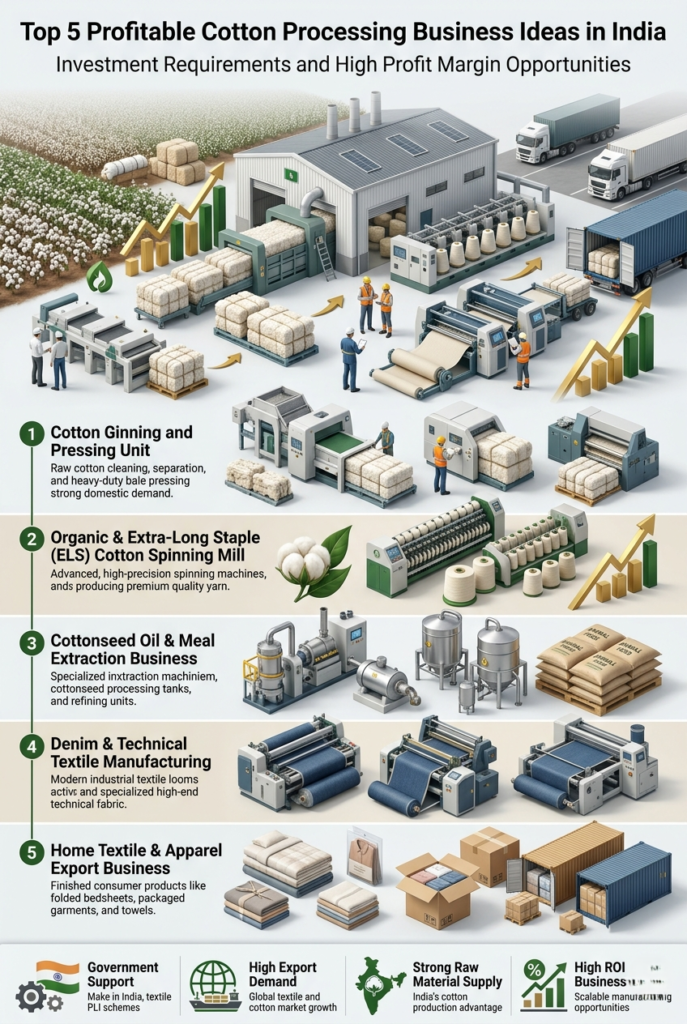
1. Cotton Ginning and Pressing Unit
The separation of cotton fiber and cotton seeds and compressing the fiber into bales is called cotton ginning. This venture is one of the easiest points of entry into the cotton industry since it needs moderate capital and is a consistent demand by textile mills.
Main advantages of this business:
- Stable spinning mill demand.
- Extra revenue of cottonseed sales.
- Government subsidies.
- Fairly straightforward production process.
Such a business is very favourable to those entrepreneurs who are close to cotton producing areas.
Get Detailed Project Report (DPR): Cotton Ginning and Pressing Business Plan
2. Organic and Extra-Long Staple (ELS) Cotton Spinning Mill
Organic and extra-long staple cotton yarn is very sought after in the international markets due to its ability to provide better strength and softness. These are commonly employed in fine apparel and upscale fabrics.
Though the start up cost would be more, the profit margins are also much higher than those of normal production of yarns. Companies of this industry have to ensure a high quality level and have to provide trustful contracts with certified farmers.
To start this business, it requires:
- High-quality raw cotton supply
- Modern spinning machinery
- Skilled technical staff
- Quality control systems
- Export certification
It is the ideal segment that would suit entrepreneurs wishing to reach high-end markets.
3. Cottonseed Oil and Cottonseed Meal Extraction Business.
A perfect example of transforming agricultural waste into useful products may be the cotton seed processing. The cotton seed may be turned to edible oil and animal feed, which are highly demanded in the local markets.
This is a good long-term investment because the business can offer consistent income despite the fluctuations in cotton prices.
Goods manufactured out of cotton-seed:
- Edible cottonseed oil
- Animal feed (cotton seed meal)
- Industrial by-products
Due to its diversified sources of revenue, this business is deemed to be financially sound.
4. Denim and Technical Textile Manufacturing
Some of the most rapidly expanding textile industries are denim and technical textiles. Denim is one of the fashion products that are in high demand across the world, with the application of technical textiles in the medical, construction, and transportation sectors.
These products demand sophisticated equipment and labor force, and the growth opportunities and profit margins are high.
Some products made of technical textiles are:
- Medical fabrics
- Fire-resistant clothing
- Industrial safety gear
- Automotive textiles
Investors in modern technology can be able to develop highly competitive businesses in this segment.
5. Home Textile and Apparel Export Business
Home textiles and garments are one among the largest export segments in the textile industry. Bed sheets, towels, curtains, and clothing are some of the products that are always in demand at home and abroad.
Branding and product innovation is also possible in this business. Companies which concern themselves with quality and design are able to gain a good market base and spread to various parts of the world.
Reasons for the popularity of this business:
- Continuous consumer demand
- Strong export potential
- Access to skilled employees.
- Opportunities to develop a brand.
This section is particularly appealing to entrepreneurs who want to invest in creative and customer-oriented companies.
Steps to Start a Cotton Processing Business
Establishing a cotton processing enterprise is a venture which should be carefully planned and prepared. Before starting up their venture, entrepreneurs are required to know the market conditions, financial needs and the processes involved in the operation.
The fundamentals are to identify an appropriate business model, distribute the location, finance, and set up equipment. Licenses and registrations are also needed to be obtained to make sure that there is no legal violation and legal operation.
Important steps to follow:
- Conduct market research
- Make a business plan.
- Choose an appropriate location.
- Arrange funding
- Install machinery
- Obtaining licenses and approvals.
These steps can be followed to minimize risk and enhance business success.
Risk Management in the Cotton Industry
All businesses are risky and cotton processing is not an exception. Unless properly managed, price fluctuations, supply disruptions, and equipment failures can all impact profitability. Nonetheless, these risks may be reduced by adequate planning and effective management.
Companies that diversify their products and have good relations with suppliers are more prepared to cope with changes in the markets. The periodic service of machines and constant observation of the tendencies within the industry are also significant in terms of stability.
Common risks in cotton businesses include:
- Fluctuations of the price of raw materials.
- Market demand changes
- Machinery breakdown
- Supply chain disruptions
Efficient risk management best practices enable companies to sustain a consistent growth.
About NPCS (Niir Project Consultancy Services)
Niir Project Consultancy Services or NPCS is a professional consultancy or services that help entrepreneurs start manufacturing companies. The company offers elaborate project reports and technical advice to enable investors to make wise decisions.
NPCS serves companies in various sectors, such as textile, food processing, chemicals, and engineering. Their reports involve feasible details concerning production procedures, equipment needs, market expectations and financial forecasting.
Some of the main services of NPCS:
- Project feasibility reports
- Market analysis
- Machinery and technology advice.
- Budgeting and estimation of costs.
- Business setup support
With the help of professional consultancy, entrepreneurs will be able to minimize the risks and increase their probability of succeeding over the long term.
Conclusion
One of the most prospective businesses in India is cotton processing. A large raw material base, excellent government assistance and an increasing demand in the world market provide an excellent business environment in the country. Companies dealing with value-added goods and effective operations are able to gain stable revenue and sustainable development.
Through proper planning, innovation, and professional advice, entrepreneurs can easily establish lucrative businesses within the cotton sector and help expand the textile industry.
Frequently Asked Questions (FAQ)
- What is the best cotton business for beginners?
The most recommended options as starting point are cotton ginning and cotton seed oil extraction that need moderate capital and demand stability. - What will be the cost of starting a cotton processing business?
Investment varies with the size of the business, with small units typically needing moderate investment, and large manufacturing plants needing more investment.
- Is the cotton processing a lucrative business in India?
Yes, cotton processing is lucrative with high demand, export and government encouragement.
- What cotton product has the greatest profit margin?
The highest profit margins are usually on premium products like organic cotton yarn, technical fabrics and branded apparel.
- What can NPCS do to assist entrepreneurs to begin a cotton business?
NPCS offers project reports, market research, financial planning, and technical advice to enable business people to establish their business effectively.


Gulbarga near Commercial
Land for sell any interested call