






Steel to Software: Starting an IT Services Company in India
The Counterintuitive Truth About Geography and Tech
Ranchi is not a part of the list of top IT cities of India. The name of the city evokes the image of heavy industry – SAIL steel plants, coal blocks, mining rights. However, since the last ten years, a small group of IT services companies quietly has been making export money from Ranchi, filing returns with STPI (Software Technology Parks of India), and providing services to B2B clients from Europe, the Gulf with net margins that Bengaluru mid-tier companies would only envy.
One of them has generated revenue of more than ₹30 crore in the previous financial year. The founder’s first career was in steel trading.
This is not typical. It is a formula that can be repeated. Structural advantages, not accidents: low real estate costs and engineering talent in the 35-40% range, below metro rates, and state IT policies that actively encourage capital investment. So, the question isn’t if an IT service company can be successful in an eastern tier-2 city in India. The question is why very few of the founders have noticed this.
That’s one of the reasons why most people who create IT businesses have an IT background. The entrepreneur who is most likely to be successful in geographic arbitrage is the outsider who has no sunk cost in the “real” city, no loyalty to the conventional way of doing things, and nothing to lose by trying a very different city.
Get Detailed Insights from This Book: Steel and Iron Handbook
The Gap — Talent Exists, But Firms Don’t
The All-India Council for Technical Education (AICTE) has recorded more than 15 lakh engineering graduates in India a year ago. Almost 40% of them are from central and eastern states of India like Jharkhand, Bihar, Odisha, Chhattisgarh, Madhya Pradesh. Most of them move to Hyderabad, Pune or Bengaluru within six months of their graduation. It’s because of this – there are no employers of scale at home.
This results in a paradox. States with lowest percentage of untapped technical talent have the least number of IT companies. A fresh B.Tech graduate of BIT Mesra or NIT Jamshedpur is being recruited for a salary of Rs. 3.5–4.5 lakh per annum in Ranchi. It is priced at ₹6-8 lakh in Bengaluru for the same. So a difference of ₹2–4 lakh in salary with a team of 30 is the difference of ₹60–120 lakh in annual savings — without impacting the quality of output.
According to the National Association of Software and Service Companies (NASSCOM), IT-BPM sector contributes more than $245 billion in revenues to the Indian economy every year. Less than 3% of this comes from outside of the defined metros and tier-1 clusters. The engineering colleges, the ready manpower, government infrastructure, in the eastern part of the country exists.It is in the east where the supply side — engineering colleges, willing manpower, government infrastructure — exists. The demand side connections just haven’t been developed.
In the meantime, Indian MSMEs and mid-market businesses are investing in ERP upgrades, data management, Web apps, and digital compliance tools across all sectors. SIDBI’s MSME Pulse report indicates that more than 63% of Indian MSMEs are looking to boost their investments in IT over the next three years. This demand is not location restricted. Can be serviced from anywhere.
Table 1: IT Sector Size and Talent Access — State-wise Comparison
| State | IT Sector Size | Key IT Clusters | State IT Policy | Talent Availability |
| Jharkhand | ₹1,200 Cr (est.) | Ranchi, Jamshedpur | Jharkhand IT Policy 2022 | Moderate, growing |
| Odisha | ₹3,800 Cr | Bhubaneswar STPI | IT & ITeS Policy 2022 | Strong (KIIT, SOA) |
| Chhattisgarh | ₹900 Cr (est.) | Raipur, Naya Raipur | IT Policy 2021 | Moderate |
| Bihar | ₹700 Cr (est.) | Patna IT hub | Bihar IT Policy 2017 | Emerging |
| Telangana | ₹2,10,000 Cr | Hyderabad HITEC City | TS iPASS 2014 | Abundant |
| Bengaluru (KA) | ₹5,50,000 Cr+ | Electronic City, Whitefield | Karnataka IT Policy 2020 | Highest in India |
Source: NASSCOM State IT Reports, STPI Annual Report, State IT Policies (respective state governments)
View Full Project Details: Steel and Steel Products Project Report
Why the Timing Is Right
Three forces are converging right now to make the tier-2 IT services model more viable than at any point in the past two decades.
First, remote/hybrid working has permanently broken the connection between a client’s office and a vendor’s office. A business process outsourcing or custom software company in Ranchi can provide a manufacturing company in Coimbatore or a logistics startup in Dubai (with no physical presence there) with no change. In theory this was the case before the dawn of “broadband normalisation,” in practice, it was not. Now this is only the truth.
Secondly, that governments at the state level have taken their interest in IT policy to heart. The IT Policy of Jharkhand provides 15% capital subsidy on eligible investments, subsidy on power and single window clearance by Jharkhand Industrial Area Development Authority (JIADA). The State of Odisha provides power tariff concession of 25% to STPI registered unit. The policy of Chhattisgarh consists of the stamp duty exemption, employment generation incentives, etc. Far fewer founders have collected than the half of benefits they are entitled to in these states.
Third, the MeitY TIDE 2.0 scheme under the Ministry of Electronics and Information Technology offers up to ₹7.5 lakh of seed grants to the technology startups at supported incubators (along with mentorship and investor contacts and prototype funding). Individually, the Startup India programme (DPIIT) offers tax exemption on income tax for three years, and a tax holiday for IP registration, for eligible companies. These schemes stack. IT services companies, eligible for STPI registration, Startup India recognition and state level capex subsidy, can avail of the non-dilutive benefits of ₹25–50 lakh in the first year itself.
The window is open. The founder who moves in the next 18 months will give the other three years’ advantage.
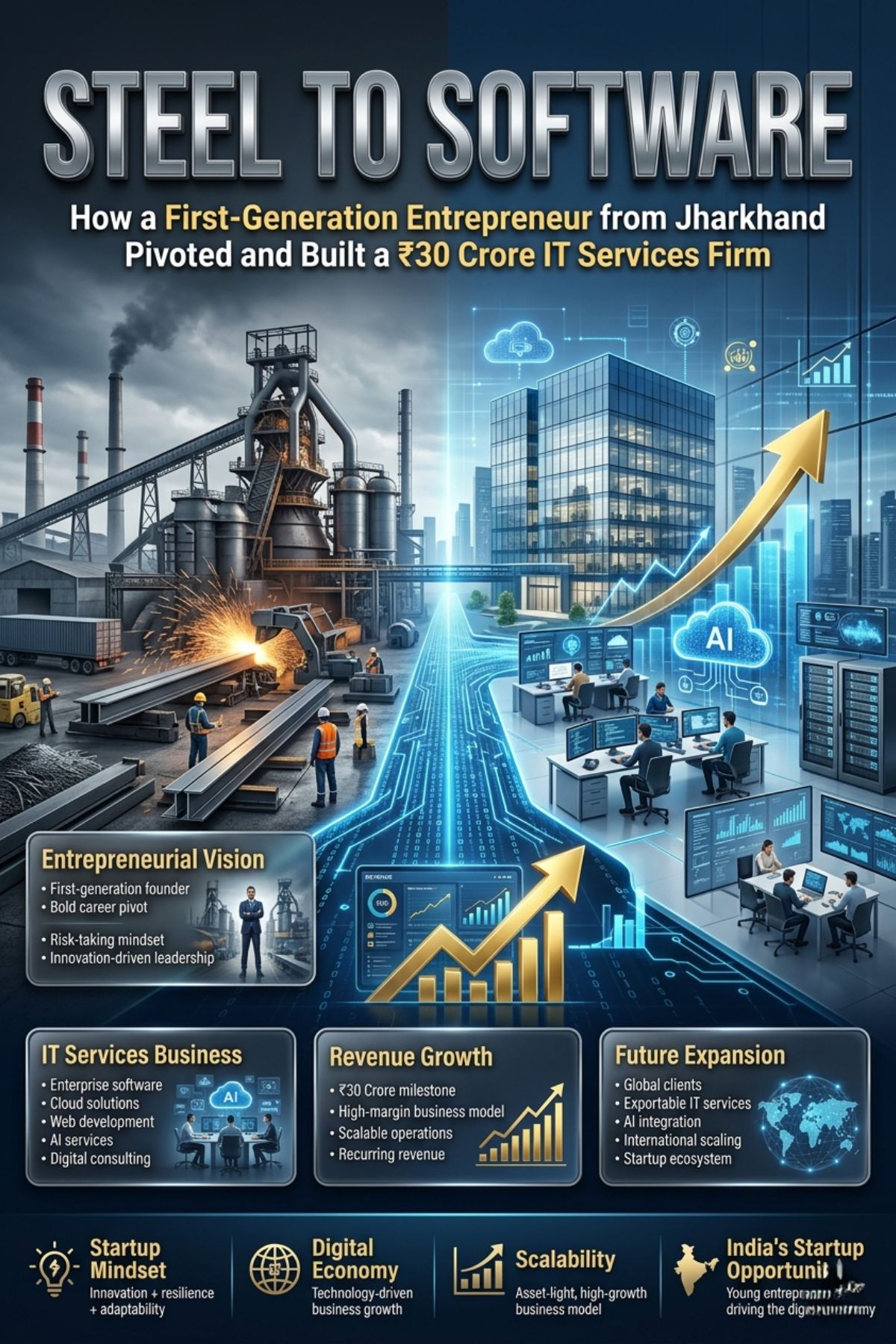
How to Set It Up — Step by Step
Step 1: Incorporate and register as an MSME
Register as a Private Limited Company along MCA 21 portal. This will take 7–10 working days and will involve government fees of around ₹8,000–15,000. At the same time, get Udyam Registration – free, online and instant. This unlocks CGTMSE credit facility with no security, lower interest rates for priority sector lending, and preferential lending terms for MSMEs. Do both on day one.
Step 2: Choose your delivery focus before you hire
The first thing that most first time IT services founders do wrong is to recruit generalists and then figure out what it’s doing. Reverse this. Before you’re 5 hires, select two to three service lines. Popular B2B offerings in India are custom ERP implementation, data analytics and dashboards, mobile application development, or IT-enabled back-office services. They all have their own marginal profiles and selling cycles. The gross margins of ERP implementation range between 28–35%. Staff augmentation delivers 15–20%. If productised, analytics projects can be as large as 40%+.
Step 3: Register with STPI
No matter if you are planning to receive any export revenue even to receive USD one time invoice, register with STPI immediately. The Software Technology Parks of India registration provides your unit with 100% Income Tax exemption under Section 10A/10B of the Income Tax Act (conditions apply), Import duty exemption for capital goods used in the export production process and simplified Foreign Exchange management. Registration takes 30-45 days, involves a short project report, an office space statement and an export plan. Annual compliance is light: export performance reporting.
Step 4: Office and infrastructure
A leased 1,200–1,500 sq ft of office space should be adequate for a 15-member founding team. In Ranchi or Raipur, this costs ₹25–40 per sq ft per month — roughly ₹37,500–60,000 monthly. Provide 15 workstations (Core i5 or equivalent memory and storage, 16 Gb – 27″ monitors), a NAS server for shared storage, redundant internet connection (primary fibre and 5G back-up) and a UPS. The network setup should be done right from the beginning, otherwise a security incident at year two will cost much more than a Cisco firewall of ₹1.5 lakh today.
Step 5: Hire for client delivery, not headcount
The recommended number of people for a launch is 15. Recommended staffing: 1 founder (business development + account management); 1 delivery head (senior engineer or architect); 8 developers (3-5 years’ experience); 2 QA/testing engineers; 1 project coordinator; 1 finance and compliance resource; 1 office manager. Avoid signing an agreement or a credible Letter of Intent before hiring. The anchor client model is a lot better than trying to do ten smaller projects at a time because the former provides a stable income of ₹40–60 lakh per year.
Key licences and registrations required:
- Certificate of Incorporation (MCA)
- Udyam Registration (MSME Ministry)
- GST Registration (required if turnover is in excess of ₹20 lakh and also mandatory for export)
- STPI Registration (for export units)
- Finance Department: Ligue de la distribution et des services aux entreprises (state-specific, usually within 30 days of beginning operation)
- Professional tax is a state levy that is only applicable to certain professions and is registered at the state level, such as in Jharkhand, Odisha, etc.
- DPIIT Startup India Recognition (voluntary but very useful)
Usual time of company registration until first invoice: 90-120 days, if the founder already has a pipeline of clients. If no pipeline is available, then add another 90 days.
Build a profitable business with the right idea
Table 2: Investment Breakdown for a 15-Person IT Services Unit (Tier-2 City)
| Cost Head | Details | Min (₹) | Max (₹) |
| Office Space (leased, 1,500 sq ft) | Tier-2 city rate ₹25–40/sq ft/month | 4,50,000 | 7,20,000 |
| Workstations & Hardware (15 units) | Core i5, 16 GB RAM, 27″ monitors | 9,00,000 | 13,50,000 |
| Servers & Network Infrastructure | NAS server, switches, UPS, firewall | 3,00,000 | 5,00,000 |
| Software Licences (Year 1) | Microsoft 365, dev tools, CRM | 1,50,000 | 3,00,000 |
| STPI Registration & Compliance | One-time + annual filing | 40,000 | 75,000 |
| Interior, Furniture & Fit-out | Workstation partition, AC, wiring | 3,50,000 | 6,00,000 |
| Working Capital (3 months) | Salaries, rent, utilities, misc. | 12,00,000 | 18,00,000 |
| TOTAL | 33,90,000 | 53,45,000 |
Note: Figures are indicative estimates for a Tier-2 city setup (Ranchi / Raipur / Bhubaneswar). Metro costs will be 40–60% higher.
Financial Snapshot
The amount of investment required to start a unit of 15 persons is in the range of ₹34 lakh to ₹54 lakh per unit (with the average at ₹42 lakh per unit). The monthly operating cost at full staff level (salaries, rent, utilities, software, miscellaneous) is in the range of ₹9 lakh to ₹14 lakh depending on the mix of seniority in the staff and the location.
If the monthly revenue is between ₹15 lakh and ₹22 lakh, it is for a single client project with a capacity utilisation of 60% (9 of 15 billable resources are active on a client project). With 100% utilisation from month 8-10 (a well-managed team), revenue comes to ₹24-36 lakh/month or ₹2.9-4.3 crore/year. In year three, a company with around 40–50 staff can reasonably expect ₹10–15 crore in annual revenue and 18–26% in its EBITDA margins.
The gross margin for IT services projects is usually between 30-45%. Net margins, once overhead and statutory costs have been deducted, range between 15–22%, for a well managed Tier 2 unit. This is 4–6 percentage points better than any firm of similar scale in Bengaluru or Pune, just due to costs.
Table 3: Government Schemes Applicable to IT Services MSMEs — Benefits and Eligibility
| Scheme | Nodal Body | Benefit | Eligibility for IT Units |
| STPI Scheme | Software Technology Parks of India | 100% income tax exemption (Sec 10A/10B), duty-free imports | Units with ≥25% export revenue |
| Startup India | DPIIT, MoCI | 3-year tax holiday, fast-track IP filings | Incorporated ≤10 yrs, turnover <₹100 Cr |
| CGTMSE | SIDBI + MoMSME | Collateral-free loans up to ₹2 Cr | Udyam-registered MSMEs |
| MeitY TIDE 2.0 | Ministry of Electronics & IT | ₹7.5 lakh grant per startup + mentoring | Tech startups at TIDE-supported incubators |
| State IT Policy (Jharkhand) | Dept. of IT, Govt. of Jharkhand | 15% capex subsidy, power tariff rebate | Units registered in Jharkhand with min ₹10 lakh investment |
| MUDRA Tarun Loan | MUDRA / scheduled banks | Loan up to ₹10 lakh, no collateral | Service-sector MSMEs, first-gen founders |
Sources: STPI Annual Report, DPIIT Startup India portal (startupindia.gov.in), SIDBI CGTMSE guidelines, MeitY TIDE 2.0 scheme document
Entrepreneur Spotlight
Arun Kumar Singh, Founder, TechAxis Solutions Pvt. Ltd., Ranchi, Jharkhand
Arun has been associated with steel trading for 11 years, where he was busy in sourcing billets and TMT bars to the construction industry in the state of Bihar and Jharkhand. The steel market was cyclical and he did not wait for recovery when margins dropped below 4%. He charted out his client engagements, most of those were MSMEs in manufacturing who were very keen to avail ERP and inventory management solutions. He joined a six-month Software Project Management course, joined 2 engineers from NIT Jamshedpur and registered TechAxis under STPI. The company currently employs 62 people, serves 14 clients in India and UAE and earns an annual turnover of ₹8.2 crore. His main lesson: When you pivot the client relationships you built in the old business are assets not liabilities.
Getting Your Project Report and Feasibility Study Right
If a founder is going to approach any bank, a state investment promotion body or an equity investor, he must have a credible Detailed Project Report (DPR) with techno-economic feasibility, cost estimation, revenue generation plan, plant and office layout, and the roadmap for regulatory compliance. Niir Project Consultancy Services (NPCS) available at niir.org and Entrepreneur India (entrepreneurindia.co) provide just this. NPCS offers detailed project report, techno-economic feasibility study, office and plant layout design, and end-to-end consultancy for IT services unit comprising STPI registration guidance and state-wise policy mapping. In the case of a first-generation founder constructing in a new market, a DPR prepared by NPCS helps to not only shorten the time to approval, but also minimize the risk of expensive structural errors in the first few months of construction.
Related Article: Is Steel Manufacturing Still Profitable in India? A DPR Analysis
The One Decision That Separates Builders from Bystanders
All components of this model are available now. The talent exists. Rather, incentives exist for the policy. The demand amongst Indian MSMEs and mid-market exporters is genuine and are on the increase. The cost benefit for running a business from Ranchi, Bhubaneswar or Raipur as compared to Bengaluru or Pune is proven and sustainable.
So, what most founders lack aren’t resources, they lack a commitment to a decision. Technology transformation, that is, transitioning from steel to software, from manufacturing to managed services, and from product to platform, is not triggered by reading an article. The reason is that a founder, who has learned from what they have done in their last sector, chooses to create something new from the assets he or she already has on a certain date.
If you are that founder, the next step is concrete: you need to create your project report, find one anchor client from your network, register your company and file for STPI status within 90 days. All the team, all the second client, all the growth capital is a result of those four actions. Don’t look for the right time. There isn’t one.
Frequently Asked Questions
Q1. What is the investment needed to start an IT services company in Tier 2 city?
The estimated amount of a realistic starting cost is ₹34–54 lakh for a 15-person unit for office fit-out, hardware, software licences, STPI registration and three months of working capital. The lower end can be obtained by leasing furnished space and deferring the cost of hardware. The upper end is designed for those who, from the very beginning, are creating a full range of infrastructure and are keeping high-quality professionals on board.
Q2. Which licences and registrations are required for getting started?
Minimum: Certificate of Incorporation, Udyam Registration, GST Registration and Shop and Establishment Registration. The registration under STPI is virtually compulsory, if you are looking to earn foreign currency revenue and allows duty-free import and Section 10A/10B tax benefits. The recognition from DPIIT under Startup India is voluntary and has a lot of value in terms of tax holidays, investor credibility etc.
Q3. Is it possible to recruit technical staff in cities such as Raipur / Ranchi?
Yes — and this is one of the best-kept secrets of the model. Ranchi, Raipur, Bhubaneswar and Patna are all cities with a good concentration of engineering colleges. There are hundreds of placement ready B. Tech students from the NIT Jamshedpur, BIT Mesra, NIT Raipur, KIIT Bhubaneswar and NIT Patna. Tech graduates annually. As for the starting salaries, the average for 2–3 year experienced developers in these cities are in the range of ₹3.5–5.5 lakh, whereas it is ₹6.5–9 lakh in Bengaluru.
Q4. Does IT Services business in tier-2 city really make money, or is it a squeeze?
With consistent usage of 70%+, net profit margins can be obtained at 15-22%. The crucial factor is billing rate discipline. Many tier-2 companies will be tempted to undervalue the work because they want to secure a client – something that is made much easier with a clear service line (ERP, analytics, mobile development) and a rate card in hand. For most types of software service, gross margins are greater than 35%, and the leak of profitability occurs in sales overhead and underutilisation, not in delivery.
Q5. Which Government schemes are worth looking at first in Y1?
Three schemes should be immediately activated: STPI registration (for export benefits and duty exemption on hardware imports); Udyam Registration (for access to credit from CGTMSE and for eligibility for the MSME scheme); and DPIIT Startup India recognition (for the duty exemption for three years under the Startup India scheme). At the same time, review the IT policy of your own State — most founders do not bother to claim power tariff concessions and capex subsidies in Jharkhand, Odisha, and Chhattisgarh. State benefits are first come-first served, with budget caps, so timing is important.
Q6. What services can NPCS provide me to set up an IT services unit?
Niir Project Consultancy Services (NPCS), niir.org, designs project reports for IT services units, which include investment planning, office layout, staffing model, financial projections, and regulatory compliance roadmap. An NPCS DPR is credible and recognised documentation for founders applying for state investment boards or bank finance. There are sector reports and founder resources available too on entrepreneurindia.co.


