





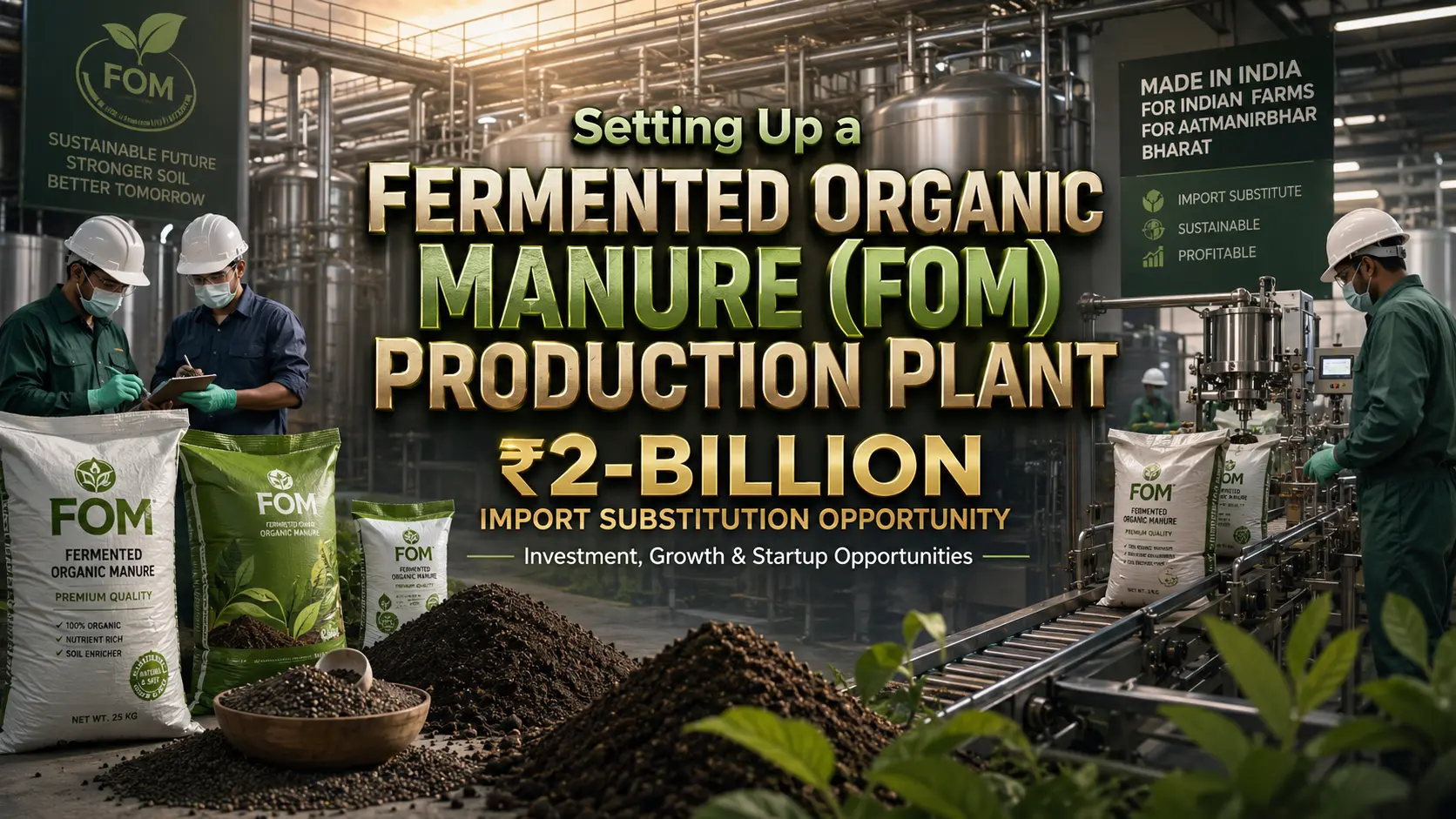
Fermented Organic Manure Production Plant in India
India imports over $2 billion worth of fertilisers every year. The figure might further reduce drastically — if Indian manufacturers hurry up with fermented organic manure (FOM). The Indian Biogas Association (IBA) has delivered a white paper titled ‘FOM Feeds Soil, Soil Feeds Sustainability’, urging that FOM should be blended with chemical fertilisers to 10% level by 2030. The proposal was cited in the 19 May 2026 edition of the magazine Chemical Weekly and the impact for the agri-inputs manufacturing industry in India is significant.
It is not the speculative demand. IBA has proposed a phased blending mandate — 1% by 2026-27, 3% by 2027-28, 5% by 2028-29, and 10% by 2029-30. They are institutional purchase commitments based on policy linkages to the Nutrient Based Subsidy (NBS) scheme, Soil Health Card and Parampara at Krishi Vikas Yojana (PKVY). As the government supply chain begins to pass on FOM purchases via public sector undertakings, the whole offtake risk equation for new plants shifts. That’s what savvy promoters look at when deciding to enter.
Soil Organic Carbon (SOC) in India is at a very low level, which is just 0.4% compared to the recommended level of 1.5% for ensuring good agricultural productivity. Over a long period of use of chemical fertilizers, the soil structure and its water holding capacity in large areas of Punjab, Haryana, Vidarbha and coastal Andhra Pradesh has been affected and its microbial activity has been reduced. The problem is a costly, measurable and real problem. FOM’s biological solution is not only cost-effective, but it’s the answer the IBA is now calling on the government to implement.
Get Detailed Project Report (DPR): Macronutrients, Micronutrients & Fertilizers Guide
Why This Sector Offers Genuine Startup Traction
The system of the market here is very clear. FOM enjoys a policy assured offtake pathway as compared to most agri-input categories where demand creation takes years. In case the blending mandate is enforced, all the fertiliser distributors in India, including IFFCO and state fertiliser corporations, will have to have FOM in their supply chains. This would also bolster fertiliser distribution systems via public sector undertakings as well as allow for region-specific nutrient solutions, the IBA added. For a first time MSME promoter, that’s a big, organized buyer market, not retail fragmentation.
As pointed out in the IBA submission to the Ministry of Chemicals and Fertilisers, India wastes more than $2 billion on fertiliser imports every year. Import substitution is FOM’s main value added, apart from soil restoration. A tonne of quality FOM replaces the importation of measurable amount of DAP and urea improving the natural nutrient absorption efficiency of the soil. In the large scale, this logic is applicable to both demand policy and subsidy reallocation.
The economics of the feedstocks are good. The fermented slurry is a byproduct of the biogas plant and the compressed biogas (CBG) plant. The ministry of New and Renewable Energy (MNRE) had planned to have 5,000 plants under CBG by 2023-24 in the country. 20-40 tonnes of bio-slurry is being generated at each CBG plant every day. Most of that slurry is composted by informal means or discharged without processing infrastructure. When you are a co-located FOM processing unit, you turn a waste problem into a revenue opportunity, and, that’s one of the few business models where your raw material supplier is actively seeking you.
The capital investment cost for a small-scale FOM plant (2-5 TPD output) is in between ₹1.2 crore and ₹2.8 crore which includes fermentation tanks, drying unit, granulating equipment, basic quality testing equipment etc. That bracket falls in the credit guarantee limit of MSME Ministry and can be availed via the Tarun category of MUDRA. Registration of a fertiliser dealer is simple under the Fertiliser Control Order (FCO) and packaging of organic fertilisers needs to be certified by BIS for organic inputs used for food products must be certified by FSSAI.
Business Selection Logic and Margin Structure
FOM production is not a commodity product. Marges are very different depending on the type of product and the market’s positioning. The price of FOM is ₹3,500 to 5,000 per tonne for loose bulk FOM sold to the State Fertiliser Boards. The distributor price of packaged, certified FOM in granulated form is in the range of ₹6,000-9,500 per tonne, depending on how the package is labeled or branded. It’s not all about branding – it’s about product stability, consistency in microbiological counts and shelf life and all of this requires process investment but can be done at MSME scale.
The operating cost of a 3 TPD plant is around ₹1800-2200 / tonne of production excluding the cost of feedstock (if not provided by the co-located biogas units), utilities, packaging, wages etc. Gross margin is in the range of 55-65% when sold at an average price of ₹5,500. The working capital cycles are short – 30-45 days for bulk institutional buyers, much better than most agri-input categories. A typical break-even period for a ₹2-crore plant with 60% utilisation is 18-24 months.
The path for scalability is logical. A pilot unit is used to validate parameters of the process, buyer relationship and quality certification 1-2 TPD. The benefits of a plant scale of 10-15TPD include granulation, bulk packing and winning State level supply contracts. The unit economics are good enough after 25 TPD for custom strain development, branding and direct farmer facing distribution, which will provide better margin protection.
The major threats are controllable and achievable. The largest operational risk is the raw material consistency, which depends on the type of feedstock (food waste, MSW, agriculture residues). This is minimised by standardisation of the process and sourcing of dedicated CBG plants. Regulatory risk relates to the process of amendment to the FCO, which is still a proposal, and when it will be enacted is unclear. Medium term, demand side risk is less than most people think as the organic certification premium market is expanding at APEDA documented compound rates without the mandate in place.
Project Opportunities Worth Evaluating
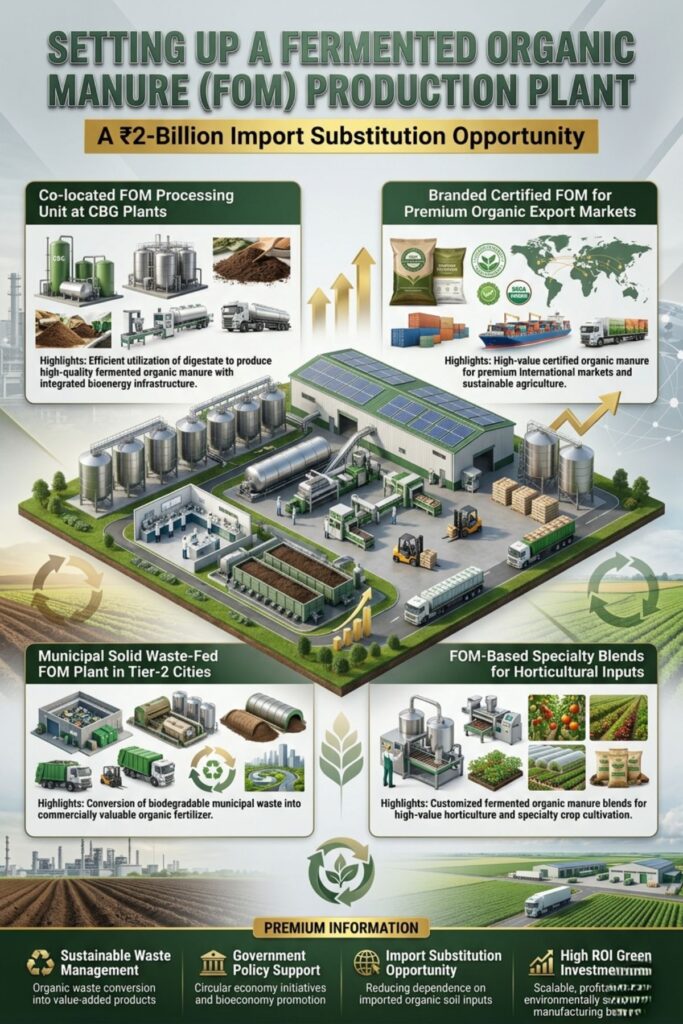
1. Co-located FOM Processing Unit at CBG Plants
Scale of Production: 5-10 TPD granulated FOM Target buyers are State Fertiliser Corporations, farmer producer organisations (FPOs) and organic exporters. Capex: ₹1.8-3.2 crore (Depending on granulation level and drying technology) Margin outlook: 50-60% gross margin at ₹5,000-7,000/tonne selling price. The obvious principle is that India’s SATAT scheme has resulted in a rapidly expanding network of CBG facilities producing bio-slurry they simply don’t have the capacity to utilize. Where the FOM is co-located and the operator has a revenue-sharing deal with the raw material supplier, the key procurement risk is removed and the FOM is a captive supplier. In India, this also opens the doors to opportunities for carbon credit bundling within the voluntary carbon market framework, providing a non-operating income stream.
Get Detailed Insights from This Book: Biogas and Compressed Biogas (CBG) Production Handbook (from Waste & Renewable Resources)
2. Branded Certified FOM for Premium Organic Export Markets
Scale of production: 2 to 5 TPD with NPOP (National Programme for Organic Production) certification for exportable production. Target buyers: Exporters of organic fruits and vegetable to organic markets in Maharashtra, Karnataka, Himachal Pradesh and direct export to the Gulf Cooperation Council (GCC) countries to which India exports certified organic crops based on bilateral agreement. Capex: ₹2.5-4 crore (with testing laboratory and certification compliance infrastructure). Margin outlook: 70-80% gross margin at ₹8,000-12,000/tonne. According to APEDA data, India had organic exports value of $1.07 billion, which is still low and certified input suppliers are still facing a shortage. This segment demands process accuracy, but it provides price leverage that can’t be found in bulk commodity channels.
3. Municipal Solid Waste-Fed FOM Plant in Tier-2 Cities
Optimum capacity: 10 to 20 TPD using segregated urban local body (ULB) organic waste. The target buyers are District Agriculture Department, State horticulture missions and institutional buyers under PM KUSUM and other schemes. Capex: ₹3.5 – 6 crore (Pre-processing equipment for MSW sorting and contamination removal) Outlook on margins: 45-55% gross margin plus some tipping fee revenue from municipalities for waste processing. A few of the Tier-2 cities already have segregated waste collection, but don’t have any capacity for the processing of organic waste downstream. Under the Special Purpose Vehicle route, such projects are supported by the Ministry of Housing and Urban Affairs (MoHUA) through its Swachh Bharat Mission (urban component) with a support of 30% of the eligible project cost.
4. FOM-Based Specialty Blends for Horticultural Inputs
The production scale: 1-3 TPD of customised FOM blends that are enriched with rock phosphate, sulphur and bio-inoculants. Target farmers: Grape, pomegranate and mango orchardists of Nashik, Pune and Chittoor belt, floriculture farmers serving domestic and export markets. Capex: ₹1.5-2.5 crore (incorporating formulation lab and packaging line). Margin for specialised formulations: ₹10,000-18,000/tonne, gross margin 65-75%. This is the most profitable business segment within FOM manufacturing which can be achieved at a micro enterprise level. When yield quality is clearly affected, as it is in horticultural products when FOM is applied, the price-insensitive farmer won’t be happy, and buyers know the documented impact horticultural farmers experience when using FOM: ROI in Brix counts.
Discover business ideas that actually make money
Indian Entrepreneurs Who Understood Organic Input Value Early
When chemical distributorships were being sought by most agri-input operators, it was an early bet by Prabhat Fertilisers & Chemical Works, promoted by the Patil family from Kolhapur, Maharashtra on sugarcane press-mud composting. They got access to raw material at low cost – bagasse and press-mud from co-operative sugar mills – by pivoting to certified compost and bio-fertiliser mixes, something other players could not compete with. The lesson is that the proximity to the raw materials is a structural moat and not a temporary advantage in this sector. Feedstock security should be the starting point in any promoter’s consideration of FOM, rather than product planning.
Biomax Fuels Ltd., an organics company based in Gujarat, that started with compressed biogas infrastructure and then bio-fertiliser production, is a classic example of anchoring the organics business with compressed biogas infrastructure. They had demonstrated the business model, with CBG production coupled with FOM offtake, that is, running two revenue streams from a single feedstock, at 15-20TPD scale. The message for new players is architectural: start with the idea of making money from the plant from the beginning, rather than after.
Prior to the competitors in the B2B certified organics market understanding the benefit of certification, Varsha Bioscience and Technology India, promoted by Dr. C. Rama Mohan Reddy in Hyderabad, had established a credible institutional buyer base by investing in testing and documentation by NABL. Their investment at a tendering age in the quality infrastructure enabled them to be in the state government tenders where there is transparency in price discovery with the predictability of volumes. What this means for new FOMs: Investing ₹20-30 lakh in testing and certification set-up in year one will open up institutional channels which farmer facing competitors can’t access.
Import-Export Opportunity Analysis
The domestic FOM opportunity is grounded in the $2-billion annually spent on importing fertilisers by India, highlighted specifically in the IBA white paper mentioned in Chemical Weekly’s 19 May 2026 issue. The blended FOM can partially meet the demand of urea imports (12.51 lakh tonnes), DAP imports (0.76 lakh tonnes), and MoP imports (2.88 lakh tonnes). Not direct displacement, but the nutrient efficiency improvement: FOM at 10% blending increases cation exchange capacity of soil by 15-25%, which improves the efficiency of chemical fertiliser use. Thus, the effective import substitution value is also a multiple of the volume of the FOM.
On the export side, opportunity exists in certified organic input supply to four key corridors viz GCC (where the import of organic produce from India is having double digits growth rate); EU (where the Indian organic products are imported in certified manner and bilateral organic equivalency is recognised by the EU); Southeast Asia (where the demand for certified horticultural input is more than the supply); and the US (Indian organic products export volume is consistently growing as per the trade data from DGCI&S). The single FOM plant certified to NPOP / certification of equivalent standards in EC regulation 2018/848 would be able to supply both domestic exporters for organic products and directly export to importers in GCC markets in 20 tonne FCL consignment, which currently import similar products from China and Malaysia at high prices.
The structural cost advantage of Indian FOMs for export is that the feedstock cost is 40-60% lower than for EU or Australian FOMs, labour is much cheaper than in competitor markets and the organic waste supply chain (from city municipalities to food processing clusters) is on the way to become structured. Certification is the barrier to entry and not cost. That’s an investable hole.
Related Article: Organic Fertilizer & Bio-Stimulant Manufacturing Business in India: Cost, Profit & Market Opportunity
Policy Framework and Pre-Investment Research
The Ministry of Chemicals and Fertilisers, responsible for the implementation of the Fertiliser Control Order and the subsidy scheme for NBS, is the key policy instrument for mainstreaming FOM. IBA’s white paper directly recommends inclusion of FOM in the NBS framework, including subsidy pass-through of blended FOM-fertiliser products, which is a critical enabler for institutional sales at significant volumes. Building DPRs for FOM plants should be closely monitored for notification from this ministry of the amendment to the FCO as the moment a plant becomes eligible for subsidy brings a step change in the demand addressability.
If founders are serious about doing detailed pre-investment evaluation, market survey cum detailed techno-economic feasibility reports are not available as an option, but rather as the decision infrastructure. Niir Project Consultancy Services (NPCS) prepares such reports for FOM and allied organic fertiliser manufacturing plants, which include full manufacturing process details documentation, market demand analysis by region and fertiliser buyer category, process flow engineering, product mix recommendations, specifications of the required machinery and raw material along with sourcing information, and complete project financials with sensitivity analysis. Having access to such a report means that founders are not going to waste anywhere between ₹1.5 crore to ₹3 crore of their capex before they realize that their geography is not experiencing the same pace of demand. NPCS reports are important for credit and/or application under SIDBI-CGTMSE for MSME lending because these reports provide a structured feasibility documentation that can have a significant impact on the lending decisions.
Other reference frameworks useful for the project planning of FOM are ICAR – Indian Council of Agricultural Research soil health standards for the region; FOM application protocol standards for agri-input MSME projects; the refinancing schemes applicable to agri-input MSME projects by the National Bank for Agriculture and Rural Development (NABARD). NABARD’s rural infrastructure lending window and rural infrastructure finance window have been providing assistance for composting and bio-fertiliser units in Maharashtra, Gujarat and Tamil Nadu — and, in turn, agro-processing units where the bio-fertiliser can be viewed as a project for rural infrastructure may be eligible for the same.
Conclusion: The Window Is Open, But Not Indefinitely
The IBA blended mandate, as proposed in the Chemical Weekly report dated 19 May 2026, will result in a structured institutional demand of about 3-4 million tonnes of FOM in India by 2029-30, with 10% of the overall fertiliser demand in India (about 35-40 million tonnes per year). This is a market size worthy of several mid-size manufacturing plants in each agricultural state.
There is opportunity now. The policy support is believable, the supply chain of feedstock is available, the import substitution arithmetic is valid, and the export premium market is separate from the mandate. The lack currently is manufaktur production and that is what a well structured MSME investment can provide.
The window of opportunity for first-mover advantage is closing in two ways. The first phase is now, in the policy consultation and mandate design phase, where plants established pre-mandate are able to benefit from institutional supply contracts that are, usually, provided to operational units. The second stage ends in 2027-28 when the blending obligation is 3%, and the market is sufficiently competitive such that the late-comers are put at a disadvantage of having to compete with the prices of earlier entrants.
The problem in India is the structure of its soils. The FOM solution is a viable way to end up with a policy aligned and manufacturing ready solution. The only thing that remains to be decided on is whether Indian founders move on it or imports do.
Data Table: FOM Production Models — Capex vs. Margin Outlook
| Project Model | Scale (TPD) | Capex (₹ Cr) | Selling Price/T | Gross Margin |
| Co-located CBG FOM Unit | 5–10 | 1.8–3.2 | ₹5,000–7,000 | 50–60% |
| Branded Certified FOM (Export Grade) | 2–5 | 2.5–4.0 | ₹8,000–12,000 | 70–80% |
| MSW-Fed FOM Plant (Tier-2 City) | 10–20 | 3.5–6.0 | ₹4,500–6,500 | 45–55% |
| Horticultural Specialty FOM Blends | 1–3 | 1.5–2.5 | ₹10,000–18,000 | 65–75% |
| Bulk Institutional Supply (State Boards) | 15–30 | 4.0–7.5 | ₹3,500–5,000 | 40–50% |
FAQ: Founder’s Perspective on FOM Manufacturing
Q1. What should be the minimum capex to start a viable FOM production unit in India?
For making 2-3 TPD of granulated FOM, the capex is ₹1.2-2 crore for fermentation tanks, drying and granulation equipment and basic packaging. Such a plant yields revenues of ₹1.2-1.8 crore per year at 60-70% utilisation. This bracket is open without collateral and is available as CGTMSE and MUDRA Tarun category lending, which truly facilitates the entry of the first-generation promoters.
Q2. What type of licensing and certifications are required for commercial sale of FOM?
The fertiliser dealer registration is required as per the Fertiliser Control Order (FCO) and BIS IS 14923 certification is required for packaged organic manure. NPOP certification is compulsory for export and/or premium institutional supply. The full certification process, from commissioning of the plant, is 4-6 months for domestic FCO and 8-12 months for NPOP. Build into your financial model for this: The number one reason for first-year revenue shortfall in this category is delay in certification.
Q3. How long can be considered a realistic break-even period for such a plant with an investment of ₹2 crore for FOM?
A 3 TPD plant makes around ₹360 per day of gross contribution at 60% utilisation of the capacity with selling bulk granulated FOM at the rate of ₹5,500 per tonne. Fixed costs (loan servicing, salaries etc. overheads) are ₹1-1.2 lakh per month, which means it takes 18-22 months to break-even. Pre-commissioning offtake agreements with FPOs or the state agriculture departments can help reach the break-even point at a quicker pace and indeed lenders’ applications for loans can be significantly bolstered.
Q4. What is the largest challenge with raw materials in FOM production?
The main operational risk is feedstock consistency. While bio-slurry quality is dependent on the input mix that the CBG plant receives, a food waste slurry is richer in nitrogen, and the crop residue slurry is higher in carbon-to-nitrogen (C: N) ratio. If the inputs are not consistent, then the microbiological levels of the final product will be variable, and may not meet FCO quality requirements. The mitigation is a formal feedstock supply agreement which includes quality specifications and incoming testing. If you want a simple testing setup, plan to invest ₹15-25 lakh, which will be recouped within the initial year.
Q5. What if the IBA blending requirement doesn’t get passed, is the FOM opportunity still feasible?
Yes. There is no blending mandate for the organic certification premium market, the export market to the GCC and EU or the horticultural input market. India’s organic exports rose to $1.07 billion and the certified input supply chain is still short of supply. A FOM plant located in Maharashtra or Karnataka catering to NPOP certified horticultural buyers operates profitably at 45-50% capacity with no forced demand. If adopted, the mandate only speeds up the market to enable 15-20 more mid-size plants nationwide.


