





Steel Manufacturing Business in India
The future of steel industry in India is changing rapidly. In the past, the industry was largely controlled by big integrated steel works manufacturing bulk commodity steel. The most promising opportunities are now expected to shift to downstream processing, fabricated structures, coated steel products and specialty steel manufacturing, which are well suited for MSMEs and first-generation entrepreneurs as they can build their scalable business with relatively lower investment.
There is a huge long-term demand for steel products due to the Indian government’s initiatives to develop infrastructure, expand renewable energy, establish industrial corridors, boost warehousing, and promote defence manufacturing. As per industry estimates, India will be among the largest steel consuming markets in the world and the consumption of steel in the country could touch 250 million metric tons by 2035.
Even as India imports high value steel products, there is a huge scope of opportunities for value added and import substitution performances from the Indian manufacturers in this segment.
Get Detailed Insights from This Book: The Complete Technology Book on Hot Rolling of Steel (2nd Edition)
Why Steel Manufacturing in India Remains Profitable
The private industrial expansion and the government’s spending on steel are still good for the industry in India. The growth of demand for fabricated and processed steel products is being directly driven by initiatives such as PM Gati Shakti, industrial corridor development, railway modernization and renewable energy projects.
Several other factors are contributing to the profitability of the industry:
- Rising infrastructure construction across highways, warehouses, and industrial parks
- Growth in solar and renewable energy installations
- Rising demand for Pre-engineered Buildings (PEBs)
- Government assistance through the PLI Scheme, Government of Steel
- Import substitution opportunities in specialty steel products
- Expansion of manufacturing under the “Make in India” initiative
Despite all the previous years in which price competition ruled the market, today’s consumers are more likely to care about the following factors:
- Product quality
- Dimensional accuracy
- Coating standards
- Timely delivery
- Technical reliability
This change presents opportunities for structured MSME manufacturers.
Most Profitable Steel Manufacturing Businesses in India
Not all steel companies are profitable. Standard TMT bars are generally competitive in the market and have less margins. Opportunities are greater in value-added steel processing and fabrication.
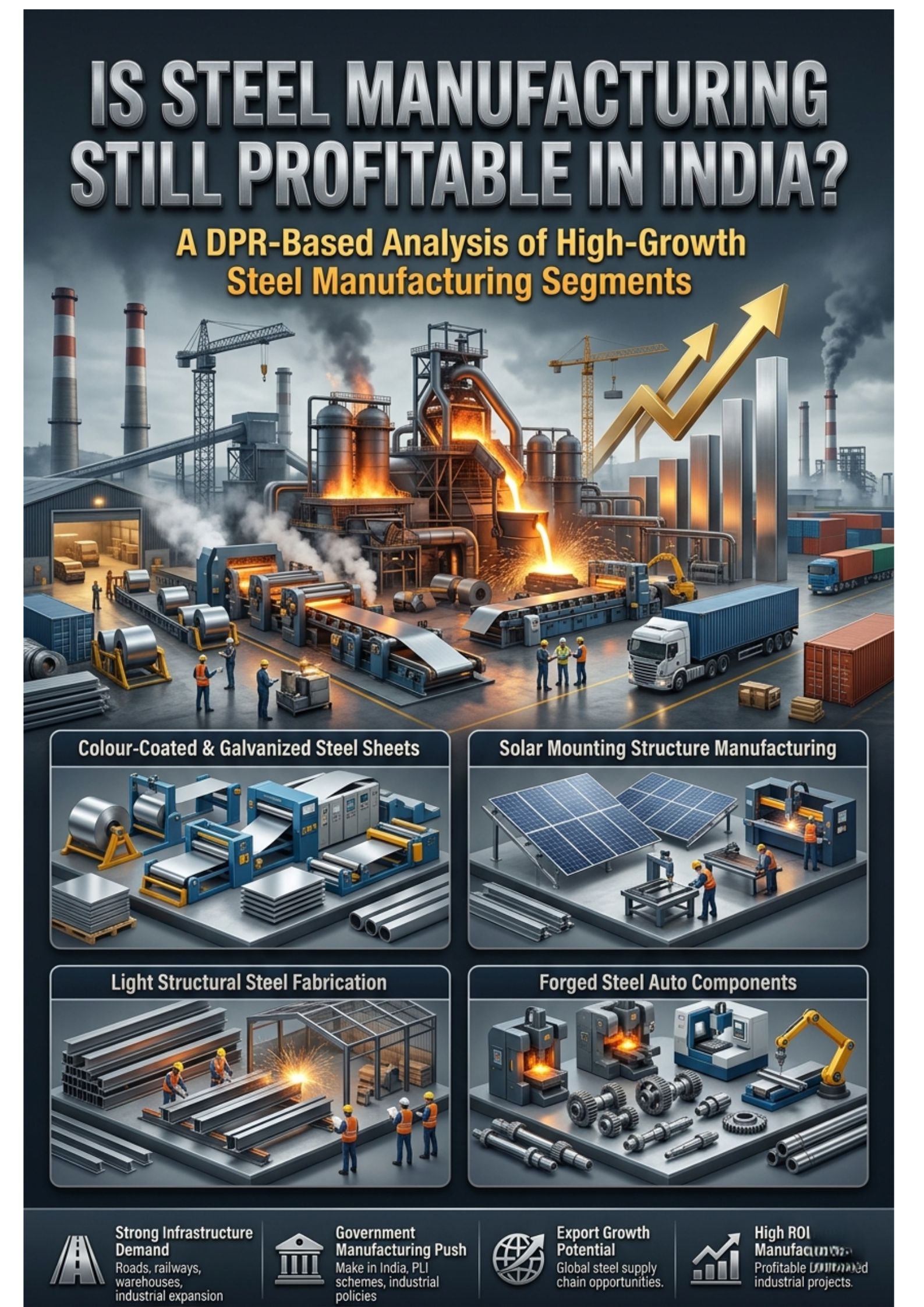
1. Colour-Coated & Galvanized Steel Sheets
Colour-coated roofing sheets and galvanized products are widely used in:
- Industrial sheds
- Warehouses
- Prefabricated buildings
- Agricultural storage
- Commercial roofing
These products are in high demand due to growth in industrial and infrastructure.
Project Snapshot
| Particulars | Details |
| Capacity | 12,000–18,000 TPA |
| Investment | ₹8–14 Crore |
| EBITDA Margin | 14–19% |
| Main Buyers | Construction distributors & prefab manufacturers |
This segment has a relatively stable demand and has a good working capital cycles compared to government infrastructure contracts.
2. Solar Mounting Structure Manufacturing
The Renewable Energy sector offers one of the fastest-growing opportunities in the field of structural steel fabrication in India. Solar EPC companies require large quantities of:
- Mounting rails
- Structural channels
- Galvanized support systems
- Fabricated frames
If quality is kept at high standards, a medium size solar fabrication facility catering to solar projects can be quite profitable.
Project Snapshot
| Particulars | Details |
| Capacity | 8,000–12,000 TPA |
| Investment | ₹4–7 Crore |
| EBITDA Margin | 15–21% |
| Main Buyers | Solar EPC Contractors |
This is one of the finest business opportunity for MSMEs in the steel making industry.
3. Light Structural Steel Fabrication
The logistics parks, warehouses, pharma units and manufacturing zones are expanding rapidly, leading to a rise in demand for fabricated structural steel products.
Products generally include:
- Purlins
- Girts
- Primary steel frames
- Roofing structures
- Industrial shed components
Industrial clusters provide benefits for manufacturers in the proximity to the cluster because of lower transportation costs and procurement costs.
Get Detailed Project Report (DPR): Steel Fabrication Business Plan & Feasibility Study
Project Snapshot
| Particulars | Details |
| Capacity | 10,000–15,000 TPA |
| Investment | ₹5–9 Crore |
| EBITDA Margin | 13–18% |
| Main Buyers | PEB contractors & industrial builders |
4. Forged Steel Auto Components
However, precision-forged engineering components remain in high demand for India’s automotive and EV industry.
Key products include:
- Wheel hubs
- Shafts
- Steering parts
- Motor housing components
This business is technically complex but also has a great export potential and long-term scalability.
Project Snapshot
| Particulars | Details |
| Capacity | 3,000–6,000 TPA |
| Investment | ₹12–25 Crore |
| EBITDA Margin | 8–14% |
| Main Buyers | Auto OEMs & Tier-1 suppliers |
Key Risks in Steel Manufacturing
Steel production is a very profitable business but only if all risks involved in it are taken care of.
Raw Material Volatility
The price of steel scrap and steel coils is very volatile. Businesses must maintain:
- Strong supplier relationships
- To plan for raw material inventories
- Flexible product mix
BIS Certification Requirements
The BIS certification is a mandatory requirement for many steel products before they can be put on the market. If manufacturers do not have a proper certification, then they could be subject to:
- Supply rejection
- Legal penalties
- Market restrictions
Power & Operational Costs
Electric power is one of the primary costs in the steel industry and in fabricating steel. Industrial units in industrial areas tend to enjoy cost benefits on account of improved infrastructure and tariff benefits.
Choose the right startup backed by real market demand
Government Support & PLI Benefits
An updated version of PLI Scheme 1.1 by the Ministry of Steel has made it easier for MSMEs to enter specialty steel manufacturing.
Products eligible for this assistance are:
- Coated steel products
- Alloy steel
- Electrical steel
- High-strength specialty steel
Key benefits of the scheme are:
- Production-linked incentives
- Faster scale expansion
- Better financing access
- Improved export competitiveness
Other incentives are available for investments in manufacturing from state governments of Odisha, Jharkhand, Chhattisgarh, Gujarat and Andhra Pradesh.
Why DPR & Feasibility Reports Are Important
When manufacturing projects fail it is due to the inaccuracy of planning. Entrepreneurs make several mistakes in estimating the cost of the machinery, power consumption, raw material requirement, or working capital.
A detailed project report (DPR) prepared professionally can help in the evaluation of:
- Market demand
- Production capacity
- Machinery configuration
- Profitability projections
- Break-even analysis
- Financial viability
- Raw material sourcing
- Bank loan feasibility
In steel projects, it is crucial that a feasibility study is conducted before investments are made.
Related Article: Top 10 Profitable Steel Manufacturing MSME Business Opportunities in India
About NPCS (Niir Project Consultancy Services)
NPCS Official Website is a top-class industrial consultancy firm in India, assisting entrepreneurs to start manufacturing units in various industries.
NPCS provides:
- In addition, Detailed Project Reports (DPRs) will be produced.
- Techno-economic feasibility studies
- Market research reports
- Business plans to use the bank for financing.
- Attending to machinery and advising on production.
In steel manufacturing projects, NPCS helps entrepreneurs to understand:
- Plant setup requirements
- Production processes
- Financial projections
- Government incentives
- Project feasibility
Several business owners utilize NPCS reports to limit investment risk and increase financing approval chances.
Conclusion
The Indian steel industry still has ample opportunities particularly in downstream and specialty industries. Value-added products like fabricated structures, coated steel products, solar mounting systems and engineered components offer healthy margins while commodity steel products are getting more competitive.
The expansion of infrastructure, growth of renewable energy, industrialization are driving long-term demand for organized steel manufacturers in India. With the proper feasibility planning, quality production and product selection, entrepreneurs can still make very profitable businesses in this sector.
The next few years could prove to be one of the most opportune entry points for MSMEs in specialty steel and fabrication manufacturing, before things get too much consolidated.
FAQs
Q1. What is the minimum investment that is needed to start the business of Steel in India?
Capacity and automation of small fabrication and solar mounting structure units can range from ₹4 crore to ₹7 crore.
Q2. Which sector of Steel production is the most profitable?
Commodity steel products do not provide as high of a margin as specialty coated steel, solar fabrication, structural steel fabrication or precision engineering products do.
Q3. Does MSMEs have a PLI Scheme in the Ministry of Steel?
Yes. This is the learning that was incorporated into the new PLI 1.1 scheme with special focus on supporting MSMEs in specialty steel.
Q4. How long will it take a steel making project to pay off?
If the production utilization is constant, the most downstream steel units break even after 18-24 months.
Q5. What is the need for DPR prior to establishment of a steel manufacturing plant?
Before the investment, A DPR is helpful to evaluate the feasibility of the project, the planning of the machines, financial projections, profitability, and requirements for financing.


Thanks for sharing such an amazing blog. I found a very useful thing for machinery