





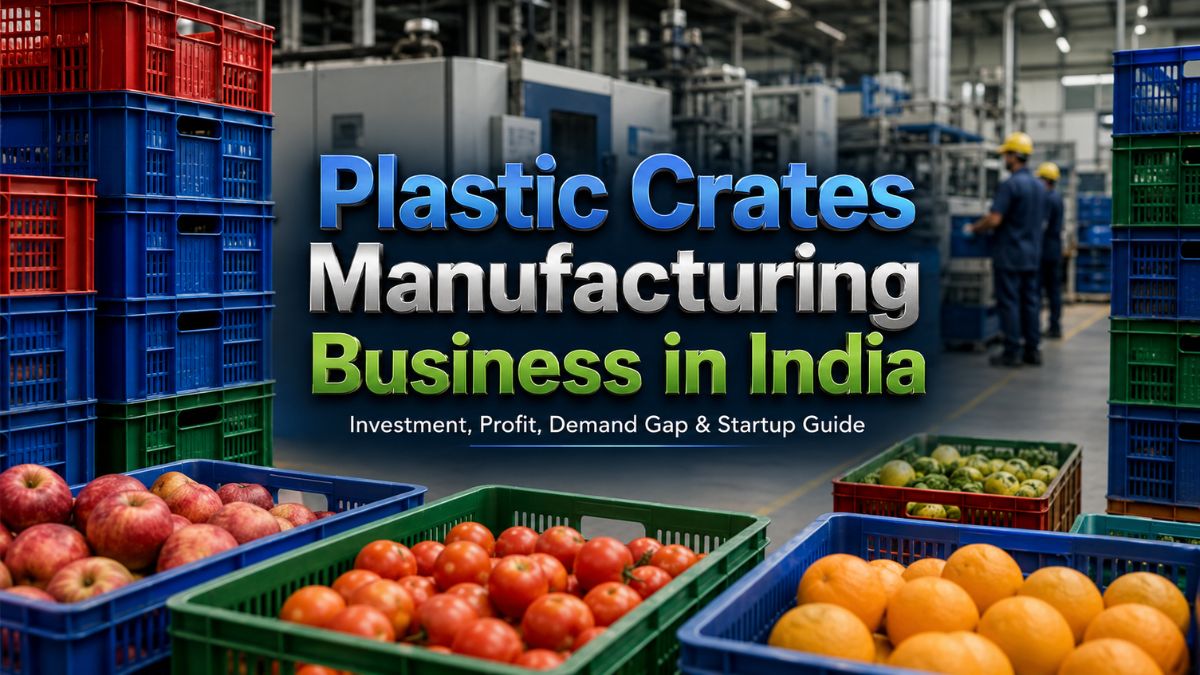
Plastic Crates Manufacturing Business in India
Plastic crates production in India is an industry that is increasingly becoming one of the most promising yet under exploited manufacturing opportunities available to MSMEs. Although most entrepreneurs invest in high-visibility industries, plastic crates have been silently but steadily driving the logistics ecosystem of India. From agriculture and food processing to e-commerce and pharmaceuticals, these crates are essential for safe, efficient, and reusable transportation of goods.
The market size as of 2024 is estimated to be about ₹4,800 crore and its market size is projected to increase to a figure higher than ₹8,200 crore by 2030. This expansion is not merely theoretical; it is supported by actual demand by industries which are highly dependent on organized supply chains. More to the point, it can be seen that there are supply shortages in the main segments, which is an open entry point of new manufacturers.
Table of Contents
ToggleExplore This Book: Modern Technology of Plastic Processing Industries (2nd Edition)
Why Plastic Crates Are in High Demand
Plastic crates are favoured as an alternative to traditional packaging materials due to their durability, reusability, and adherence to modern safety standards. Industries are increasingly opting for standardized crates so as to improve efficiencies and minimize waste in transit.
Several structural changes are underway in the Indian economy which have resulted in an increasing demand:
- The fast growth of e-commerce and fast commerce.
- Vigorous expansions in food processing and cold-chain logistics.
- Bringing more attention to hygiene and food safety laws.
- Expansion of organized retail and warehouse base.
- Increasing pharmaceutical exports that necessitate logistics that are temperature controlled.
These aspects are not temporary fads. They are the long-term changes that will keep on driving the demand upwards.
Market Growth and Future Outlook
The market of plastic crates in India is developing at a rather slow rate of approximately 910 percent per year. But some of the segments are increasing at a very rapid rate because of the changing needs in the industry.
The areas that are growing rapidly also include:
- Collapsible crates used in logistics and exports
- Pharmaceutical cold-chain containers
- Retail distribution crates and e-commerce.
This reflects that the industry is outgrowing fundamental crates to more specialized and value-added products.
Demand–Supply Gap: The Biggest Opportunity
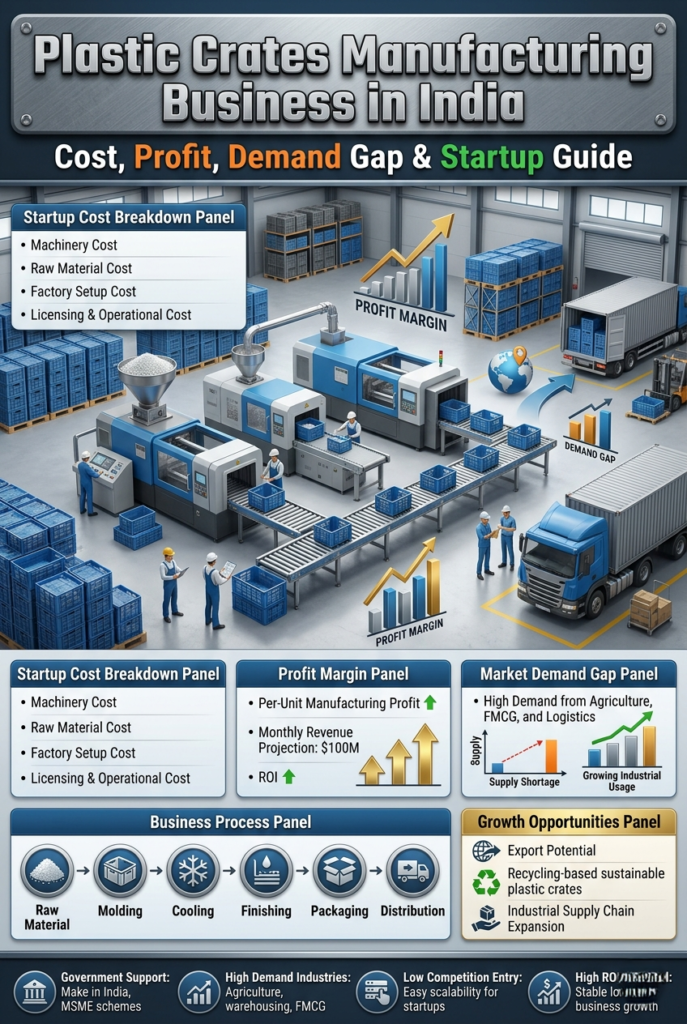
The obvious lack of demand and supply in certain segments is one of the most convincing reasons to venture into this business. On the one hand, the general production volume seems to be adequate, yet, on the other hand, the quality of products and their certification remain insufficient.
The most essential gaps lie in the following aspects:
- Food grade plastic crates were demand in excess of supply by almost 3040 percent.
- Foldable crates, in which India has become highly dependent on imports.
- Pharmaceutical-grade containers, only a few domestic manufacturers.
This loophole offers an immediate competitive edge to new entrants who are able to develop quality-conforming and certified products.
Access Complete Business Plan: Plastics, Polymers and Resins
Import Dependency and Market Advantage
India also imports plastic crates and other related products to the tune of USD 90 million annually and that too mainly of Chinese origin and other Asian nations. This is a clear indication that the domestic production is not able to satisfy the entire demand.
To new business people, this generates a great competitive edge:
- Local manufacturing saves logistics expenses.
- Quick delivery as opposed to imports.
- Competitive pricing opportunity
- Increased demand towards the products of Make in India.
Startups are able to rapidly penetrate the market by targeting heavier import-heavy segments.
Competitive Landscape
Some already established players in the Indian market include Supreme industries limited and Nilkamal Limited. These are companies of large-scale production and standard product types.
Their size however provides a drawback too. They are more inclined to mass production and they also allow smaller manufacturers to specialize in a niche market, like food-grade or pharma-grade crates. This leaves the way open to startups to compete based on quality, customization and compliance and not just on price.
Investment and Setup Overview
A plastic crates manufacturing business is relatively easy to start as opposed to other industrial businesses. It relies on the injection moulding process that is not only widely used but also technically available.
This is a barebone perspective of the arrangement:
- Investment required: ₹3.5–5.5 crore
- Space needed: 5,000–8,000 sq ft
- Machinery: Injection moulding machines.
- Raw materials: HDPE and polypropylene.
At medium usage, a unit will earn an average of 6-8.5 crore of annual revenue. The profit margins are good, particularly in special segments, and are normally between 22% and 32%.
Why This Business Is Ideal for MSMEs
The present business climate is quite promising to manufacturing startups particularly in manufacturing industries such as plastic crates. This is the correct time to enter due to several factors:
- Good and stable demand in all industries.
- Government assistance in the form of MSME schemes and subsidies.
- Access to low-cost machinery and technical know-how.
- Simple access to bulk buyers, including food companies and logistics companies.
- The chance to grow and expand slowly, without excessive start-up.
This sector is more stable and predictable as compared to many other businesses that rely on consumer trends.
How Niir Project Consultancy Services (NPCS) Can Help You
When it comes to starting a manufacturing business, there are various steps that need to be followed and these include planning and financing of the business as well as the execution. This is where NPCS is very essential.
NPCS is a renowned industrial consultancy firm that has decades of experience in assisting entrepreneurs to establish successful manufacturing companies. Their support covers:
- Comprehensive project reports (DPR) bank accepted.
- Market research and demand analysis.
- Selection of machinery and plan plant layout.
- Projections and analysis of profitability.
- Loan and government schemes guidance.
Through professional advice of NPCS, entrepreneurs have a great opportunity to reduce risks significantly and enhance their success probability.
Final Thoughts
The plastic crates manufacturing business offers a rare combination of low competition, strong demand, and scalable growth. This is an industry that does not rely on speculation and fads but on necessity which provides it with stability in the long run.
An entrepreneur who can tap this sector, emphasizing on quality, certification and branding can setup a very lucrative business. With proper planning and execution, it has great potential for giving sustained returns in the long run.
Frequently Asked Question (FAQ)
Q1. How much is the minimum investment?
Approximately 3.5 to 5.5 crore is required for setting up a small to medium size unit.
Q2. Will this be a lucrative business?
Yes, the profit margins are normally around 22-32 percent depending on the type of product and the efficiency.
Q3. What part shall I begin with?
It is comparatively easier to enter in food-grade and agricultural crates while pharma crates would offer high returns.
Q4. Which are the raw materials?
The major raw materials are HDPE and polypropylene.
Q5. Am I required to be certified?
Yes, institutional buyers consider such certifications as BIS and food-grade compliance.
Q6. What is the start-up time?
Initial production normally requires 12 -18 months to commence full-scale production.


