





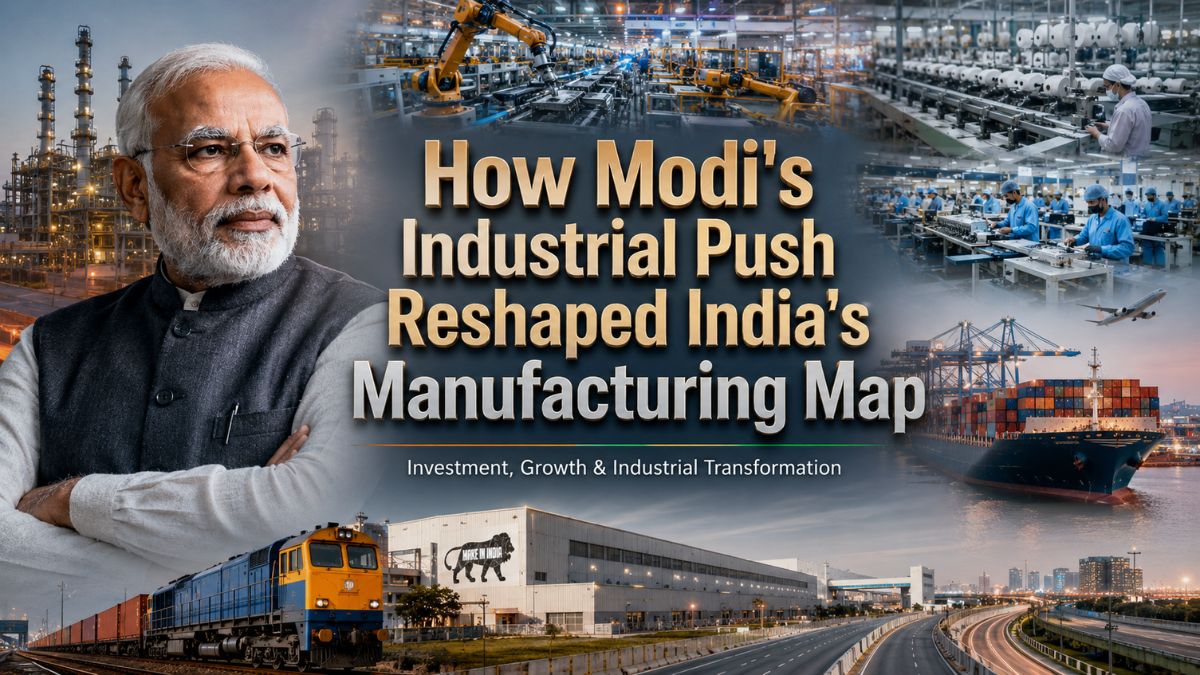
Modi Manufacturing Push & India’s Industrial Growth
This is one of the most significant overhauls of manufacturing in decades in India. Entrepreneurs had a lot of problems leading to slow growth of industries in India for many years. First-generation business owners faced manufacturing challenges due to delayed approvals, high logistics costs, inadequate infrastructure, credit constraints and reliance on imports.
The government of Prime Minister Narendra Modi has, however, put an emphasis on industrial development in the economic policy agenda over the past decade. The government moved beyond just making announcements, introducing miscellaneous reforms aimed at boosting domestic manufacturing, enhancing exports, streamlining compliance and boosting manufacturing investment.
In the present scenario, India is emerging as a significant manufacturing hub in the world and it is presenting excellent opportunities for startup founders and MSME entrepreneurs.
Table of Contents
ToggleThe Rise of Make in India and PLI Scheme
The Make in India initiative had started the debate on ‘Make in India’ and the genuine thrust for industrialisation was provided by the Production Linked Incentive (PLI) scheme.
The government announced the government incentives of almost ₹1.97 lakh crore for various sectors under the PLI program, such as:
- Electronics manufacturing
- Pharmaceuticals
- Food processing
- Telecom equipment
- Technical textiles
- Specialty chemicals
- Manufacturing drones and batteries.
PLI differs from the previous subsidy regimes in that it pays companies for actual production and sales increases. This gave impetus to businesses to expand operations at a faster pace and enhance export competitiveness.
These effects are happening now. India has emerged as one of the biggest smartphone manufacturing bases in the world. Mobile phone exports have grown steadily and overseas companies are stepping up their manufacturing collaborations within the country.
Why India’s Manufacturing Environment Has Improved
The most significant improvement has been in terms of business infrastructure and industrial support systems. Previously, companies in the manufacturing sector were facing years-long issues with bottlenecks in their operations. These barriers have been lowered in recent years.
Easier Credit Access for MSMEs
Access to loan increased for small manufacturers due to the rollout of Udyam registration and MSME financing schemes. Now entrepreneurs have access to:
- Collateral-free loans
- Government-backed credit guarantees
- Better banking access
- Emergency liquidity support schemes
This has thus eased the burden of finance for many first-generation manufacturers initiating operations.(Modi Manufacturing Push)
Better Logistics and Faster Transportation
Some important steps are happening towards development in India’s logistics network:
- Bharat Mala highways
- Dedicated Freight Corridors
- PM Gati Shakti master plan
- Established modernized ports and industrial corridors
Faster delivery speeds cut transportation costs & time for manufacturers.
Reduced Compliance Burden
Previously, industrial companies faced a lot of paper work and aging compliance regulations. The Jan Vishwas initiative streamlined thousands of compliances and promoted digital approvals.
The initial challenges have been resolved and GST implementation has enhanced the efficiency of interstate supply chain.
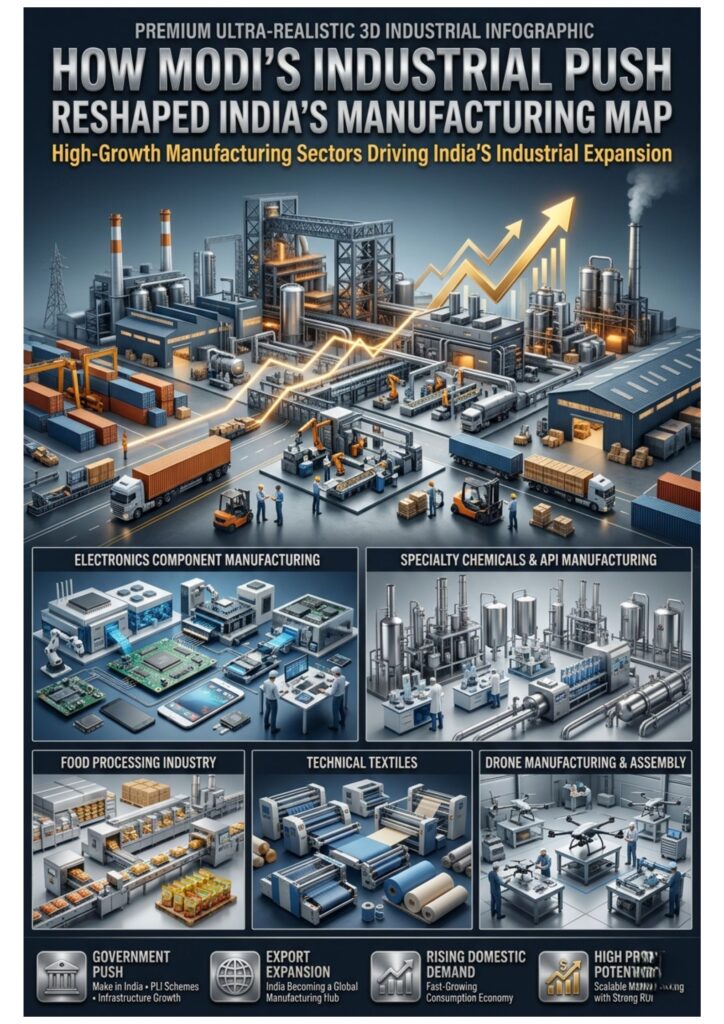
Best Manufacturing Sectors for Startups in India
Electronics Component Manufacturing
India still imports billions of dollars’ worth of electronics components every year. PCB assemblies, connectors, lithium-ion cells and display modules are among the many products that provide a tremendous opportunity for import substitution.
Mid-scale electronics assembly businesses are benefiting from growing demand generated by companies like:
- Dixon Technologies
- Foxconn
- Tata Electronics
This sector has a promising growth opportunity as India continues to have a high growth in electronics consumption.
Get Detailed Insights from This Book: Electronic Products Handbook With Circuit Diagrams
Specialty Chemicals and API Manufacturing
The “China Plus One” strategy is gaining traction among global companies, which are seeking to diversify their supply chains. The “China Plus One” strategy is also gaining momentum among global companies, as they diversify their supply chains. The Indian pharmaceutical and chemical industry is a booming sector and it is a desirable manufacturing location.
The benefits of this sector are:
- High export demand
- Strong profit margins
- Growing global sourcing opportunities
- The government providing support for bulk drug parks.
But environmental approval and pollution control compliance are still significant issues.
Food Processing Industry
Food processing is one of the most feasible and convenient sectors for the MSME entrepreneurs as it has domestic demand and export opportunities as well.
Common high growth segments are:
- Millet products
- Organic foods
- Fruit pulp processing
- Packaged ready-to-eat foods
The government also provides food processing businesses with subsides and micro enterprise schemes.
Technical Textiles
Technical textiles are gaining popularity and are becoming more profitable than conventional textile manufacturing, since they are dedicated to the specific industrial uses.
Products include:
- Surgical gowns
- Medical fabrics
- Agro textiles
- Geotextiles
Healthcare, infrastructure and export markets are growing the demand.
Drone Manufacturing and Assembly
After drone restriction, the manufacturing of drones is a new opportunity for industry.
Demand is increasing rapidly in:
- Agriculture
- Surveying
- Infrastructure inspection
- Defense applications
The investment in assembling a drone is comparatively less than the investment in heavy industries, and it is also a quicker scaling process.
Indian Entrepreneurs Manufacturing Startups Should Study
These are examples of North American business leaders who have made discipline pay off in the creation of successful manufacturing businesses.
Guided by Sunil Vachani, Dixon technologies turned into a giant electronics manufacturer in India with an emphasis on operations and sustainable business relations.
Dilip Shanghvi built India’s largest drug company, careful choices and strategic acquisition.
Mukesh Sangla won by knowing rural India’s distribution better than others.
These travelogs clearly demonstrate that execution, discipline more than hype or trend are key to success in manufacturing.
Why Feasibility Studies Are Important Before Starting a Factory
Entrepreneurs often overlook the cost of manufacturing and other operational difficulties, which dooms many manufacturing projects. Common mistakes include:
- Wrong machinery selection
- The analysis of the market demand is not strong.
- Lack of good working capital management
- Failure to comply with environmental regulations comes at a price.
This is why a techno-economic feasibility report is quite crucial before the investment is made in any industrial project.
Niir Project Consultancy Services (NPCS) assists the entrepreneurs to prepare:
- Detailed Project Reports (DPRs)
- Market survey reports
- Techno-economic feasibility studies
- Financial projections
- Machinery and raw material planning
Such reports give investors insight into the profitability of a project, potential risks, market demand, and operational needs before production begins.
The success or failure of a manufacturing company in terms of finances for first generation entrepreneurs depends on the planning they do.
Challenges Still Exist
The industrial landscape in India has greatly improved, but there are still some risks associated with manufacturing.
Major challenges include:
- Inadequate or insufficient land approvals
- High industrial electricity tariffs in some states
- Skilled labor shortages
- Working capital pressure
- Environmental clearance delays
Rather than relying solely on government incentives, Entrepreneurs should make a careful plan.
Conclusion
The manufacturing revolution in India is providing one of the largest industrial opportunities for entrepreneurs in last few decades. The policies related to Modi development have enhanced the infrastructure, export competitiveness, MSME financing and domestic manufacturing incentives.
The electronics, specialty chemicals, food processing, technical textiles and drone sectors are forecast to expand at a high rate in the coming decade. But to be successful in manufacturing, one must execute well, have a sound plan and realistic project analysis.
Policy opportunities and sound operational planning are key to creating the next generation of successful Indian manufacturing firms.
FAQs
Q1. Which sector has the most potential in the manufacturing sector in India?
The manufacturing of electronics, specialty chemicals, food products, technical textiles and the assembly of drones are strong growth areas at present.
Q2. In India, what would be the investment required to set up a factory?
Investment depends on the sector. The capital requirement for small manufacturing units is in between ₹1 crore to ₹3 crore, while the bigger manufacturing works need more capital.
Q3. Why are feasibility reports important?
Feasibility reports can be used by entrepreneurs to gain insight into project expenditure, machinery needs, demand in the market, future profitability and risks associated with the operation of the project before they invest money.
Q4. What are the top challenges that manufacturing start-ups face?
One of the biggest challenges is the working capital management, which can be impacted when customers are late with payment.
Q5. What are the services offered by NPCS?
NPCS helps entrepreneurs prepare project reports for manufacturing businesses in India, market analysis, feasibility reports and industrial planning reports.


