





Introduction: Indian Manufacturing Growth PM Modi
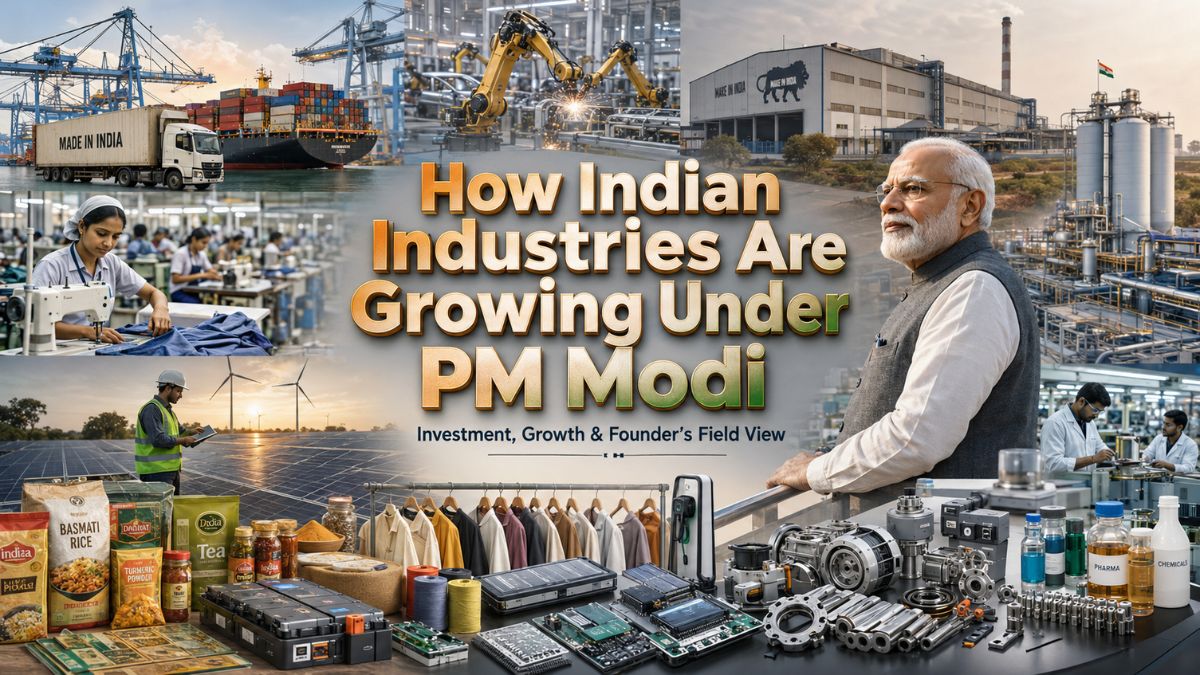
The industry sector in India is going through one of the best growth periods in recent years. Entrepreneurs are increasingly confident in factory investments, industrial projects and industrial machinery across manufacturing clusters in Gujarat, Tamil Nadu, UP, Maharashtra and Telangana. It was once a tough and risky business model but now MSMEs are finding it an opportunity to create wealth for them.
The government’s efforts to reform regulations, build infrastructure, export and industrial production-led incentives are all fuelling the growth of Indian industries under the leadership of Prime Minister Narendra Modi. The manufacturing ecosystem has also improved due to various policies like Make in India, PLI schemes, PM Gati Shakti and MSME easy lending.
The first generation of entrepreneurs are entering a domain previously occupied by big families of industries. It’s not just metros anymore. Due to the development of logistics, the decrease of operational costs and the increase of policy support, the second-tier and third-tier cities have shown great development potential for the industries.
Table of Contents
ToggleRelated Article: How Modi’s Industrial Push Is Changing India’s Manufacturing Industry | PLI Scheme Explained
Why Indian Industries Are Growing Rapidly
This industrial development is attributed mainly to the emphasis the government has placed on a manufacturing-driven development strategy. What is being announced now, are policies which reward actual production and exports.
PLI Scheme (Production Linked Incentive) scheme has given the boost to number of industries namely electronics, pharmaceuticals, telecom equipment, electric vehicle component sector, etc. It has given leap growth to electronics manufacturing system in India and consequently requirement of smaller suppliers and ancillaries.
The following are some of the greatest benefits that are contributing to industrial development:
- Better road, rail, and freight connectivity
- Faster industrial approvals
- Rising export demand
- The availability of loans to MSMEs is becoming easier.
- Growing domestic consumption
- Reduced logistics costs
- There is a strong demand for rather substituting imports.
In the past, many industrial projects faced difficulties due to the fact that transportation and logistics deducted a lot of profits. PM Gati Shakti has led to an improvement in infrastructure planning, which has been beneficial for businesses to cut costs in running their operations and operations efficiency for the delivery.
The other crucial one is that India has emerged as an alternative manufacturing base in the “China Plus One” strategy. The international companies are now shifting focus towards India for a long-term manufacturing collaboration.
Best MSME Manufacturing Opportunities in India
Some industries are more promising than others. Others are doing better due to a growing domestic demand and government backing.
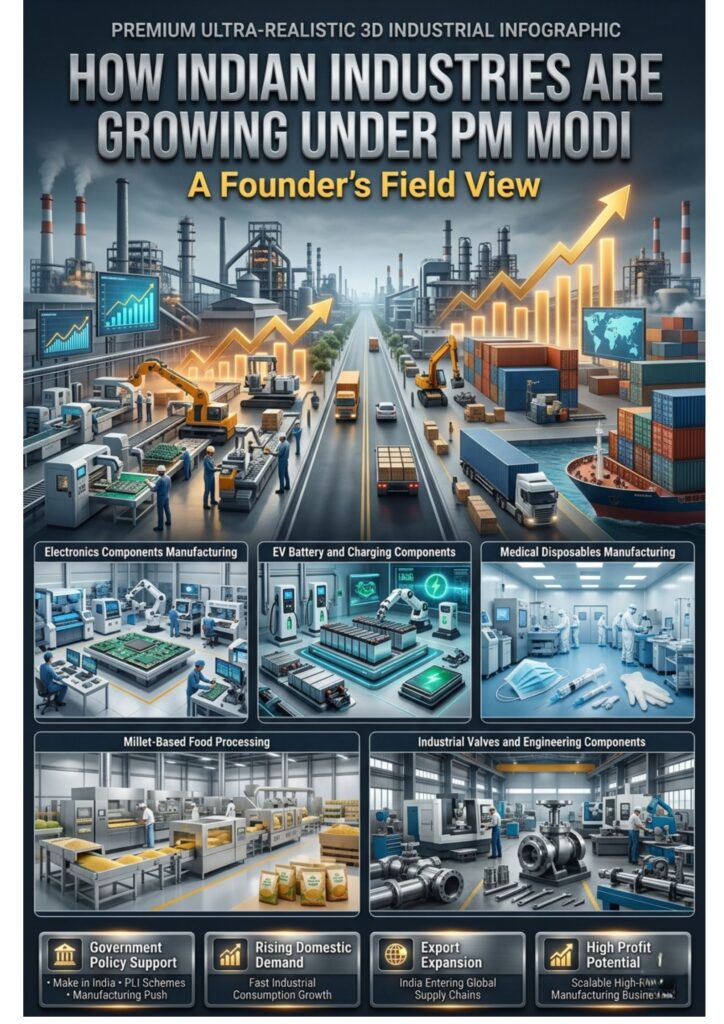
Electronics Components Manufacturing
Despite this, India imports a considerable number of electronic components. This provides good opportunities to MSMEs manufacturers:
- PCB assemblies
- Mobile connectors
- Wiring systems
- Battery accessories
- Adapters and chargers
The overall growth in demand of OEMs and EMS companies makes it a very long-term sector to consider.
Get Detailed Insights from This Book: Electronic Products Handbook With Circuit Diagrams
EV Battery and Charging Components
The EV industry in India has seen a rapid growth. With the rise of EV adoption, related industries are also expanding.
Key opportunities include:
- A pack of lithium-ion batteries for assembly.
- Charging infrastructure hardware
- Battery management systems
- EV wiring harnesses
Industry is expected to continue to be a one of the fastest-growing manufacturing industries in India in the coming decade.
Medical Disposables Manufacturing
Demand for health care services in India is also growing due to expansion of hospitals and health care delivery schemes of the government.
Items that have good market demand are:
- Syringes
- IV sets
- Surgical gowns
- Disposable medical kits
- Diagnostic consumables
This sector also provides export market opportunities to Africa, Southeast Asia and Middle East.
Millet-Based Food Processing
Indian customers are increasingly becoming interested in healthy food products. The growing health-consciousness of consumers has given a big boost to the growth of millet-based packaged food products.
Popular categories include:
- Instant millet mixes
- Healthy snacks
- Breakfast cereals
- Ready-to-cook products
Food processing projects have margins that are attractive, and usually a lower investment than the heavy industrial projects.
View Full Project Details: Fruits & Vegetables Value Addition and Food Processing
Industrial Valves and Engineering Components
Demand for industrial engineering products is rising in India due to infrastructure projects. Precision engineered components are essential to water projects, oil and gas installations and industrial utilities.
There’s continued demand for:
- Industrial valves
- Precision castings
- Pipe fittings
- CNC machined components
This is a sector with a steady demand from industries for its long-term operations.
How Smart Entrepreneurs Select Manufacturing Businesses
Many first-time entrepreneurs decide on what business to start because of just market hype. But good manufacturing companies are created in a way that has a lot to do with money and the discipline of operation.
Before starting a project, entrepreneurs should evaluate:
- Realistic profit margins
- Working capital requirements
- Raw material availability
- Buyer payment cycles
- Scalability potential
- Power and infrastructure availability.
Most one of the main reasons why manufacturing startups fail is because they have bad cash-flow management. Founders tend to overlook one factor: inventory and late customer payment.
Successful entrepreneurs typically start with limited production capacity, develop stable operations, acquire consistent customers and grow incrementally rather than rushing into the initial stage of production with too high an investment.
Importance of Detailed Project Reports (DPR)
A Detailed Project Report aids the entrepreneurs in finding out if a manufacturing concept is commercially viable or not, before investing a lot of money.
Most professional DPRs will contain:
- Market demand analysis
- Manufacturing process details
- Machinery selection
- Raw material sourcing
- Plant layout planning
- Utility and power requirements
- Financial projections
- Break-even analysis
- Profitability estimates
- Risk assessment
Feasibility planning helps to prevent costly pitfalls during implementation.
About NPCS – Niir Project Consultancy Services
One of the leading industrial consultancy firms in India, Niir Project Consultancy Services assists entrepreneurs in finding lucrative business opportunities and developing manufacturing projects.
NPCS provides:
- Detailed Techno-Economic Feasibility Reports
- Market Survey Reports
- Industrial Project Profiles
- Startup Manufacturing Ideas
- Financial and Technical Analysis
- Industrial Consultancy Services
Their reports are being utilized by MSME startups, industrial entrepreneurs, investors, and MSME founders aiming to enter into manufacturing industries like food processing, chemicals, engineering, packaging, pharmaceuticals, textiles, and export-oriented industries.
Good feasibility study for first generation entrepreneurs can help save a lot of time, money and risks in business.
The Future of Indian Manufacturing
Multiple long-term trends are expected to spur continued expansion of India’s manufacturing sector.
These include:
- Rising middle-class consumption
- Export growth
- Government infrastructure spending
- China Plus One supply-chain diversification
- Increasing industrial digitization
- Support from strong policies for MSMEs.
But still discipline is necessary for industrial success. Those entrepreneurs that are able to maintain working capital wisely, and concentrate on specific product categories, and have consistent buyer relationships, have a greater chance of establishing sustainable businesses.
The opportunity in India’s manufacturing is out there, but the long-term success will go to those who are ambitious and good at execution.
FAQ
- Which manufacturing sectors are growing the fastest in India?
Some of the fastest growing areas in India include electronics manufacturing, EV components, food processing, medical disposables, specialty chemicals and industrial engineering products.
- How much investment is needed to start a manufacturing unit?
The investment range of a serious MSME manufacturing unit is from ₹5 crore to ₹15 crore, which depends upon machinery costs, infrastructure costs, and working capital requirements.
- What is the significance of PLI scheme for the industries in India?
The PLI scheme promotes domestic manufacturing by providing incentive on increase in production which is expected to lead to better industrial ecosystem and supplier opportunity.
- Which is the greatest difficulty for MSME manufacturers?
One of the largest challenges is the management of working capital, as payment delays and the costs of inventory can all lead to cash flow problems.
- Which are the methods by which NPCS assists the manufacturing entrepreneurs?
NPCS provides assistance to entrepreneurs by making feasibility reports, making project plans, conducting market analysis, providing industrial consultation and technical assistance for industrial setup.


