





Construction Materials in India
Every road you drive on, every hospital you visit, every warehouse a manufacturer operates it all starts with construction. And construction starts with materials. In India today, the construction sector is not just a component of the economy; it is one of its central engines.
India’s infrastructure investment has crossed historic thresholds. Government programmes such as the PM Gati Shakti National Master Plan, AMRUT 2.0, the Smart Cities Mission, and the National Infrastructure Pipeline (NIP) which targets capital investment of over 111 lakh crores by 2025 are collectively driving demand for construction materials at a scale this country has rarely seen before. Residential real estate is expanding rapidly in Tier-2 and Tier-3 cities. Industrial parks, logistics hubs, semiconductor fabs, and data centres are coming up at speed. All of this means one thing: the demand for construction materials from basic bricks and lime to structural steel and advanced polymer concrete both enormous and enduring.
According to Invest India, the infrastructure and construction sector is one of the largest employers and investment destinations in the country. The Indian construction industry is projected to become the third-largest in the world by 2030.
Table of Contents
ToggleMarket Demand & Growth: The Numbers Tell the Story
India’s construction sector contributes approximately 8–9% of GDP and employs over 50 million people. But raw employment figures understate the real opportunity. What matters for entrepreneurs, manufacturers, suppliers, and investors is the supply chain behind construction the materials ecosystem that feeds every project.
Global demand for cement and concrete additives alone is projected to grow at 8.3% annually over the next several years. India is a core driver of this trend. According to the Ministry of Statistics & Programme Implementation (MoSPI), construction value-added has consistently grown faster than the overall GDP in recent years, making it one of the most resilient sectors in the economy.
For MSMEs, the opportunity is particularly striking. Brick kilns, lime manufacturers, precast concrete units, ready-mix concrete suppliers, tile producers, and building hardware makers are all part of a vast sub-economy that feeds large contractors and real estate developers. The government’s push for affordable housing with over 3 crore homes targeted under PM Awas Yojana keeps the demand for basic construction materials consistently high.
Meanwhile, advanced materials high-strength concrete, fibre-reinforced polymers, thermal insulation panels, and specialty architectural coatings are gaining traction as builders seek more durable and sustainable structures. The Bureau of Indian Standards (BIS) regularly updates standards for building materials, signalling the sector’s evolution toward quality and compliance.
Future Opportunities: Where the Growth Is
Several emerging trends are reshaping the construction materials landscape in India:
- Green building materials fly ash bricks, AAC blocks, recycled aggregate concrete are gaining regulatory support and market acceptance.
- Prefabricated construction is growing rapidly in industrial and institutional projects, demanding precisely specified structural materials.
- The logistics and warehousing boom accelerated by e-commerce is driving large-format construction in every major state.
- Data centre construction, EV battery gigafactories, and semiconductor plants require highly specialised structural and fire-resistant materials.
- Smart city infrastructure creates demand for architectural-grade materials with both functional and aesthetic specifications.
As per the Ministry of Housing & Urban Affairs, India is urbanising at an unprecedented pace — by 2030, over 600 million people are expected to live in cities. Each new urban agglomeration demands construction materials at industrial scale.
Challenges & Why Expert Guidance Matters
Despite the optimism, entrepreneurs and professionals entering the construction materials space face real challenges. Material selection is not intuitive — choosing the wrong grade of concrete for a given application, misunderstanding the classification of stones, or misjudging the thermal properties of a building material can result in structural failure, regulatory penalties, and significant financial loss.
The sector is also technically dense. Civil engineers need to understand the geological origin of stones to assess their load-bearing properties. Manufacturers of bricks need to control clay plasticity and firing temperatures. Suppliers of steel castings need to understand the difference between grey iron and cast iron in terms of tensile strength. Without proper technical grounding, costly mistakes are inevitable.
This is precisely where a reliable, comprehensive reference becomes invaluable. Not a quick internet search, not a one-page product spec sheet but a thorough, authoritative guide that covers the full spectrum of construction materials from first principles to practical application.
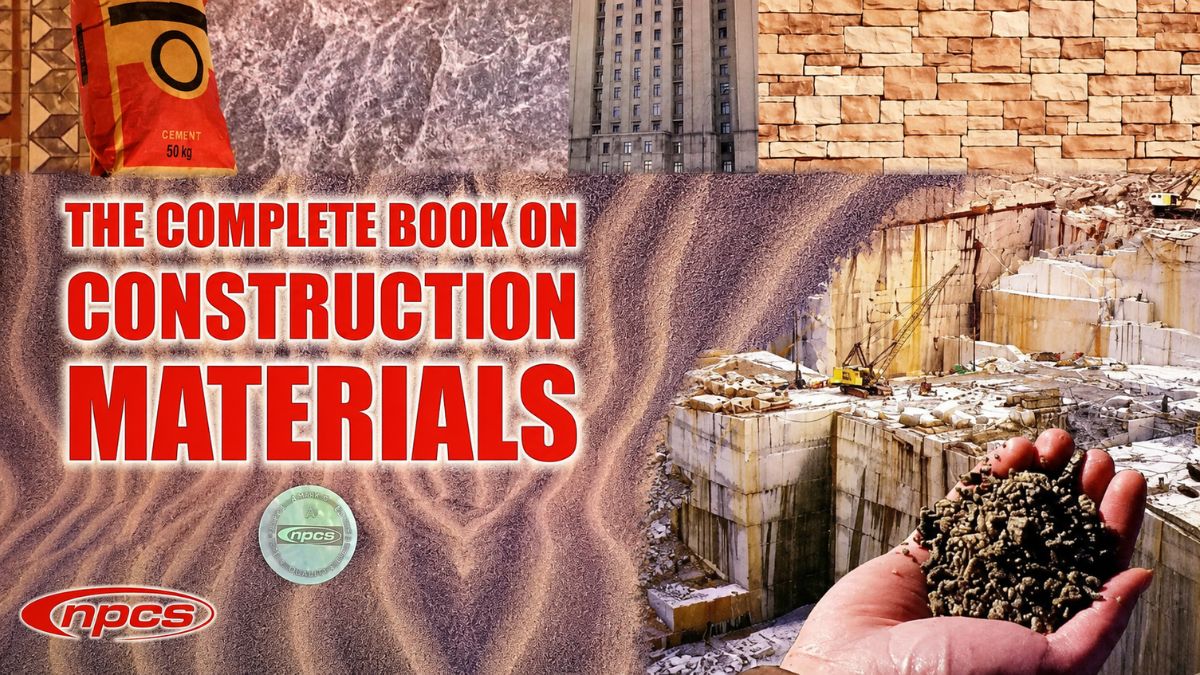
The Complete Book on Construction Materials
Published by Niir Project Consultancy Services (NPCS) and authored by the NPCS Board of Consultants & Engineers, The Book is exactly what its title promises, a comprehensive, 672-page technical and commercial reference for anyone working in or entering the construction sector.
This book does not merely list materials. It explains the science behind them, the standards that govern their use, and the practical contexts in which they perform best. For someone setting up a manufacturing unit, planning a construction project, or studying civil engineering, this is the kind of foundational reference that saves time, prevents errors, and builds real expertise.
What the Book Covers?
The book organizes its content around the major families of construction materials, giving each the depth it deserves:
- Rocks, Stones & Their Classification
A large portion of the book is dedicated to the fundamental material beneath all construction stone. Readers learn the four classification systems used for rocks: geological, physical, chemical, and hardness-based. This is not abstract theory; understanding whether a stone is igneous, plutonic, sedimentary, siliceous, or stratified directly determines how it should be used in foundations, facing, or aggregate. The book covers rock-forming minerals, the texture of rocks, types of fractures, and the natural bed of stone all critical knowledge for engineers, quarry operators, and material suppliers.
- Bricks: Manufacturing, Types & Applications
Brick is the workhorse of Indian construction. The book covers the full manufacturing process — from clay selection and moulding (soft mud, stiff mud, and semi-dry processes) through firing and quality assessment. It details the full range of brick types: heavy-duty bricks, sand-lime bricks, sewer bricks, refractory bricks, acid-resistant bricks, and specially shaped bricks. Each type has a different performance profile and a specific application domain — the book maps these clearly.
- Lime, Mortars & Concrete
Lime’s role in construction is ancient but far from obsolete. The book explains its uses as a binding material in mortar and concrete, for plastering, for glass manufacturing, for soil stabilisation, and for producing sand-lime bricks. The coverage of concrete is particularly thorough — readers learn about different concrete classifications based on binders (mud concrete, lime concrete, cement concrete, polymer concrete), mix design principles, and performance characteristics. Given that cement and concrete additives are among the fastest-growing product categories globally, this section is of direct commercial relevance.
- Metals: Steel, Cast Iron, Grey Iron & Aluminium
The book does not stop at traditional materials. It covers the mechanical and structural properties of steel castings, cast iron, grey iron, and aluminium alloys in the context of construction. This is particularly relevant for engineers specifying structural members, facades, and industrial construction components. Understanding the difference between grey iron and cast iron, or knowing when aluminium alloys are preferable to steel, directly impacts project cost and performance.
- Wood: Properties, Treatment & Performance
Timber remains a critical material in Indian construction, particularly for formwork, shuttering, doors, windows, and interior finishing. The book addresses the practical dimensions of wood use in construction moisture content as a variable, wettability and water repellence, and resistance to fungal attack and termites. These are exactly the concerns a construction professional or materials supplier needs to address to avoid failures in the field.
- Architectural Paints & Finishes
The book rounds out its coverage with architectural paints and surface coatings — a sector with its own significant commercial opportunity and technical complexity. Paint selection depends on substrate type, exposure conditions, and aesthetic requirements. The book provides the grounding needed to navigate these choices.
Why this Book is useful for Readers and Entrepreneurs?
The value of this book lies in its integration of scientific grounding with practical, commercial utility. It is not written for researchers trying to advance the frontier of materials science. It is written for practitioners’ people who need to make decisions about what to build with, what to manufacture, what to specify, and what to invest in.
For an entrepreneur setting up a brick kiln or a precast concrete unit, the chapters on bricks and concrete provide the manufacturing process knowledge that no brief course can substitute for. For a civil engineer specifying materials on a large project, the coverage of stone classification, steel properties, and lime mortars provides the reference depth that BIS standards and product data sheets alone cannot offer. For an investor evaluating a construction materials business, the book provides the technical context needed to assess viability and risk.
The book is also notable for what it does not do: it does not talk down to the reader. It assumes a serious professional intent and delivers accordingly — covering topics like DMA characterisation of partially cured resins, chemical mechanical relations, and differential scanning calorimetry alongside more accessible content on bricks and concrete. This range makes it useful across a wide spectrum of expertise levels.
Who Should Buy This Book?
- Civil engineers and construction professionals seeking a comprehensive technical reference
- Entrepreneurs planning to enter construction materials manufacturing (bricks, concrete, lime, paint, etc.)
- MSMEs already operating in the building materials supply chain who need to upskill
- Contractors and project managers involved in industrial, residential, or infrastructure projects
- Students of civil engineering, architecture, and construction management
- Investors evaluating construction materials manufacturing businesses
- Technical consultants and project advisors working in the built environment
- Exporters and importers of construction materials and industrial minerals
Why Buy This Book?
There is no shortage of information about construction materials on the internet. But fragmented articles and product brochures cannot replace a structured, authoritative guide that takes you from the geology of rocks to the chemistry of polymer concrete in a single coherent reference.
This book is published by Niir Project Consultancy Services (NPCS) an ISO 9001:2015 certified organisation with over 30 years of experience preparing techno-economic feasibility studies, Detailed Project Reports (DPRs), and industrial research for thousands of entrepreneurs and professionals across India and internationally. The NPCS editorial standard is well regarded across technical libraries, engineering institutions, and industry associations.
At Rs.1,475 for 672 pages, the cost per page of genuine technical knowledge is remarkably low. This is a reference you will return to repeatedly whether you are starting a business, specifying materials for a project, or simply seeking to understand the materials that make up the built environment around us.
Recommend This Book To
- Construction companies building at scale for their engineering and procurement teams
- Technical institutes and engineering colleges as supplementary reading in civil and structural engineering courses
- Industry associations in the building materials sector as a member resource
- MSME Development Centres and SIDBI-supported incubators for entrepreneurs in manufacturing
- Libraries of government departments involved in infrastructure and urban development
Reference Data Sources
Invest India – Infrastructure Sector Overview
Ministry of Statistics & Programme Implementation (MoSPI) – Construction Sector Data
Ministry of Housing & Urban Affairs – Urbanisation & Smart Cities
Bureau of Indian Standards (BIS) – Building & Construction Material Standards
Ministry of MSME – Construction & Manufacturing Sector Support
Frequently Asked Questions (FAQ)
Q1: Who is the target audience for The Complete Book on Construction Materials?
The book is written for a broad professional audience: civil engineers, construction contractors, building materials manufacturers, students of civil and structural engineering, technocrats, entrepreneurs planning to enter the construction materials space, and investors evaluating related businesses. It is equally useful as a library reference and as a working technical guide.
Q2: What makes this book different from standard civil engineering textbooks?
Standard textbooks focus on structural theory and design methodology. This book focuses specifically on materials their origin, classification, manufacturing processes, properties, and practical applications. It covers a wider range of materials than most textbooks (including metals, wood, paints, and advanced composites alongside traditional stone and concrete) and integrates commercial context that academic texts typically lack.
Q3: Is this book useful for entrepreneurs starting a construction materials manufacturing business?
Very much so. The book covers manufacturing processes for bricks, concrete products, and other materials in sufficient technical depth to support both business planning and operational decisions. Combined with a formal Detailed Project Report (DPR) from NPCS, it provides a strong foundation for anyone entering construction materials manufacturing.
Q4: Does the book cover green or sustainable building materials?
The book covers a comprehensive range of materials including those with sustainability relevance (lime-based materials, natural stone, timber). While it is not exclusively focused on green building, the technical grounding it provides — particularly on material properties and performance is directly applicable to evaluating and selecting sustainable alternatives in construction.
Q5: Where can I buy The Complete Book on Construction Materials?
The book is available directly from the website (Niir.org) as well as on Amazon India and Flipkart. Details and purchase links are provided in the section below.
Purchase This Book
The Complete Book on Construction Materials is now available on our official website, Amazon, Flipkart
Price: 1,475/-
Publisher: Niir Project Consultancy Services (NPCS)
ISBN: 9788190439831
Pages: 672
Whether you are an engineer who wants a reliable reference, an entrepreneur sizing up a manufacturing opportunity, or a student preparing for a career in the built environment this book delivers the depth and breadth you need. It is the kind of resource you invest in once and continue to benefit from for years.
Questions about the book or NPCS? Visit Niir.org or contact NPCS directly for information on Detailed Project Reports (DPRs), techno-economic feasibility studies, and market research for the construction materials sector.


