





Green Manufacturing Business Ideas
A significant change is taking place in the Indian way of doing business and product manufacturing. The main focus of manufacturing for decades has been on large scale production with little regard for environmental impacts. The times have changed though today. A sustainable, recycling, renewable materials and environment friendly manufacturing techniques are the future of Indian manufacturing.
Some of the largest business opportunities lie within materials that were previously deemed as useless wastes, making this shift even more exciting. Rice husk, bamboo, aluminium scrap, agricultural residue, paper pulp and biodegradable sources are now being used to make commercially viable products that are in great domestic and international demand.
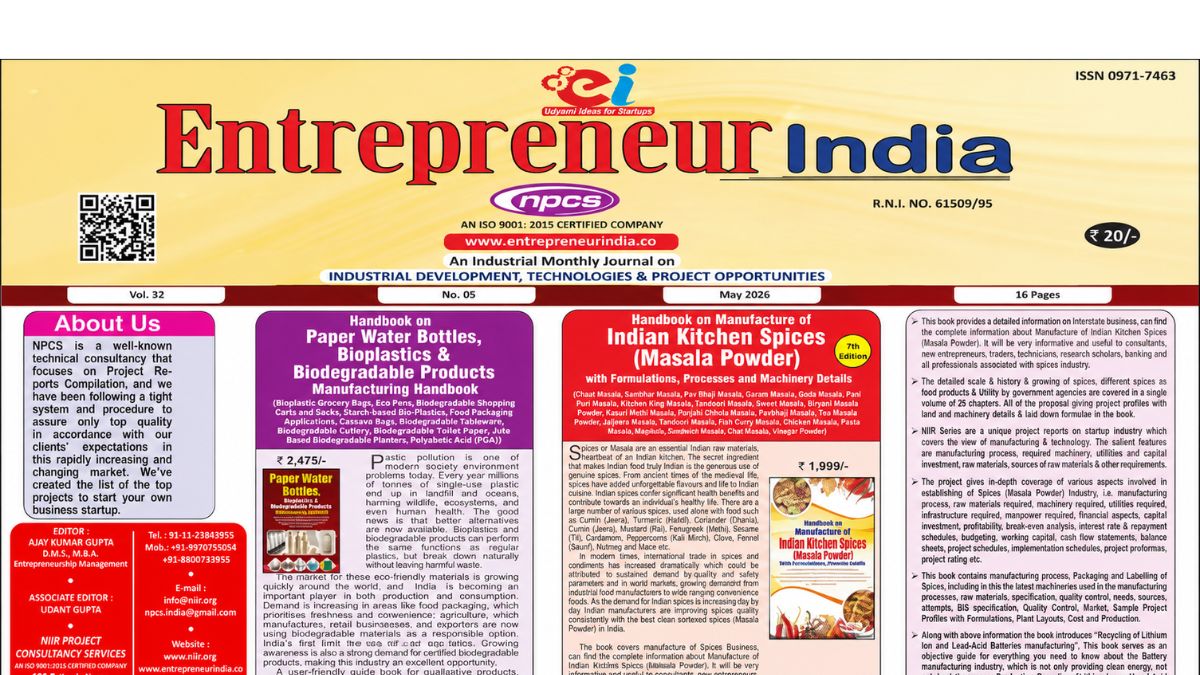
The Entrepreneur India May 2026 is the latest issue of NIIR Project Consultancy Services (NPCS) which elucidates the growth of green manufacturing as one of the fastest rising sectors of the start-up industry in India. The environment is increasingly conscious, governments back it, export possibilities are increasing, and sustainability in the world is the current trend, making this a perfect business opportunity.
If you’re searching for a business idea that will be relevant for the next ten years, eco-friendly manufacturing could be one of the best options.
Why Green Manufacturing Is Growing Rapidly in India
India’s Green Economy is growing due to several reasons that are encouraging the industries towards sustainable production. The government of India has strictly put a check on some single use plastic items and has encouraged businesses that tend to focus more on recycling and green production processes.
Meanwhile, consumers are increasing their awareness of the environment. There is a new trend for sustainable, biodegradable and recyclable products. Eco-friendly packaging is also becoming a part of global branding and large corporations are making the switch.
Some key reasons for the emergence of green manufacturing are:
- Ban on many single-use plastic products
- Government support for sustainable industries
- Rising global demand for eco-friendly products
- ESG-focused investments in green startups
- Growth of export markets for biodegradable products
- Increasing awareness about climate change and pollution
With these modifications, the green businesses are no longer looked upon as small niche business. They are gaining momentum as mainstream industrial opportunities with decent growth prospects.
Related Article: Entrepreneur India May 2026 Is Here — Download Free & Explore India’s Most Profitable Manufacturing Business Ideas
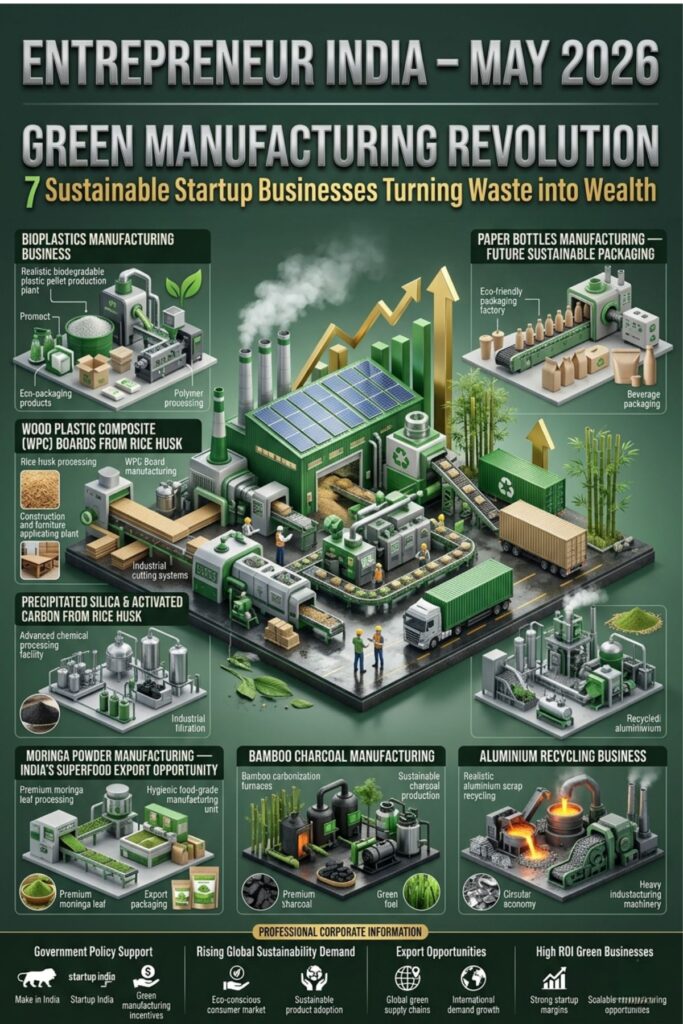
1. Bioplastics Manufacturing Business
Bioplastics are emerging as one of the best alternatives to conventional plastic products. Bioplastics are not founded from petroleum, but from renewable natural resources like corn starch, rice starch, cassava, potato waste, compounds based on PLA.
The biodegradable materials are being used more and more in food packaging, disposable cutlery, shopping bags, industrial packaging and healthcare products.
One of the greatest benefits of bioplastics is that they will naturally break down without causing long term environmental pollution. The government across the globe is promoting industries to shift toward biodegradable packaging and it is generating huge demand for eco-friendly alternatives to plastic packaging.
The retail, eCommerce, and food delivery sector in India is expected to drive India as one of the largest markets for biodegradable products.
Why Bioplastics Manufacturing Is Profitable
- Strong demand from FMCG companies
- High export opportunities
- Long-term sustainability trend
- The government gives 100% support for biodegradable products.
- Need for packaging industry growth
There is both domestic and international demand that can benefit entrepreneurs who join this industry because the world moves towards stricter sustainability regulations.
2. Paper Bottles Manufacturing — The Future of Sustainable Packaging
One of the most innovative packaging developments is paper bottles. Worldwide, beverage firms are spending billions of dollars to develop paper bottles as a substitute to plastic bottles.
They are made with moulded paper pulp and protective inner barriers to protect the liquids in the bottles. They are easy to carry, easy to recycle and ecofriendly.
As companies and consumers continue to look for environmentally friendly packaging materials and solutions, the global paper bottle market is projected to increase steadily over the next ten years.
The paper bottle manufacturing plant of 19200 bottles per day can expect a return of around 27 percent, according to project estimates mentioned in Entrepreneur India May 2026.
Major Advantages of Paper Bottle Manufacturing
- Eco-friendly packaging solution
- Growing demand from beverage companies
- Strong export potential
- This product is suitable for recycling and biodegradation.
- Positive brand image for companies
They will predominantly see paper bottles in the water, juice, dairy, and beverages industries and will heavily feature the environment in purchasing decisions.
Explore This Book: Paper Water Bottles, Bioplastics & Biodegradable Products Manufacturing Handbook
3. Wood Plastic Composite (WPC) Boards from Rice Husk
Every year, millions of tonnes of rice husk are generated in India. Historically, much of this agricultural waste would be burned or thrown away resulting in environmental pollution. Innovative companies have turned rice husk into Wood Plastic Composite (WPC) boards today.
WPC boards, which are made from rice husk and recycled plastic polymers, are among the products that are used in the construction industry. The boards are durable, moisture-resistant, termite-proof and are used commonly in the construction and interior design industry today.
Common applications of WPC products are:
- Furniture manufacturing
- Modular kitchens
- Outdoor decking
- Wall panels
- Construction interiors
The WPC market is poised for significant growth in the near future due to the increasing preference of builders and consumers for sustainable construction materials.
The advantages of WPC Manufacturing Business opportunity are very clear.
- Efficiently uses farm waste
- Powers up recycling of plastic waste
- Saves on wood usage
- The demand for concrete in the construction sector is increasing.
- Long lasting and low maintenance product
This business is a perfect example of the circular economy in which all the waste materials are transformed to valuable industrial products.
4. Precipitated Silica and Activated Carbon from Rice Husk
Rice husk is not only useful in the production of WPC boards. It can also be processed to form high-value industrial products such as precipitated silica and activated carbon.
These products are popular in the following applications:
- Green tyres
- Water purification systems
- Pharmaceuticals
- Toothpaste manufacturing
- Air filtration industries
The activated carbon market has been particularly high as companies around the globe invest in water treatment and pollution control technologies.
The precipitated silica market is already in the billions of dollars worldwide and is expected to expand at a brisk pace, estimates say.
Project Details
- The capacity of precipitated silica is 630MT per annum.
- Annual capacity of activated carbon: 690 MT
- Cost of Plant & Machinery is Rs. 485 Lakhs
- Expected Return: Around 25%
The combination of sustainability and industrial demand is a promising factor that makes this business have a long-term potential.
5. Moringa Powder Manufacturing — India’s Superfood Export Opportunity
All the Moringa products are produced in world and India is the largest producer of the product thus Indian entrepreneurs have large scope to earn from this in the worldwide super food business.
Moringa powder is regarded as very nutritious and this is the reason it is used in:
- Health supplements
- Herbal tea products
- Smoothie powders
- Nutraceuticals
- Cosmetic products and skincare products are among the applications.
The United States, Germany, France, Japan, and the United Kingdom are among the countries that are importing more moringa products from an organic source.
Increasing awareness of health worldwide is one of the big factors for moringa’s popularity. Natural, plant-based nutrition products are becoming a growing sought after product for consumers.
Why Moringa Manufacturing Is Growing Fast
- Strong international demand
- High export potential
- Organic certification opportunities
- Sustainable farming model
- Low generation of agricultural waste
Another advantage of growing moringa is its contribution to environmental sustainability, as it has a lower water requirement than many other crops.
Access Complete Business Plan: Moringa Oleifera Powder. Formulation and Processing of Moringa Oleifera
6. Bamboo Charcoal Manufacturing
The bamboo charcoal industry is now one of the fastest-growing eco-friendly industries in Asia. Bamboo is highly renewable raw material, which is able to regenerate naturally and grows quickly.
Pyrolysis bamboo charcoal is being used in:
- Water purification systems
- Air filtration
- Cosmetics
- Personal care products
- Cooking fuel and BBQ products
The bamboo charcoal market is projected to experience substantial expansion owing to the demand for environmentally friendly purification products from industries and consumers.
Why This Business Is Attractive
- Lower investment requirement
- Renewable raw material supply
- Increasing export opportunities
- Growing environmental awareness
- High-margin specialty products
The project estimates showed that the bamboo charcoal production can create good profit at the same time promote sustainable industrial development.
7. Aluminium Recycling Business
Aluminium recycling is one of the world’s most environmentally friendly manufacturing companies. Aluminium is made from recycled scrap at about 5% of the energy used when it is produced from bauxite ore.
This provides significant environmental and economic benefits.
Recycled aluminium ingots are widely used in:
- Electric vehicles
- Aerospace manufacturing
- Construction industries
- Industrial machinery
- Automotive components
With the growth of electric vehicle production, there will be a high demand for recycled aluminium.
Why Aluminium Recycling Has Strong Future Potential
- Reduces mining activities
- Conserves huge amounts of energy
- Works towards circular economy objectives
- Growing EV industry demand
- High industrial usage
Even larger entrepreneurs with larger investment capacity can build up scalable recycling businesses that have strong long-term demand.
About NIIR Project Consultancy Services (NPCS)
NIIR Project Consultancy Services (NPCS) is a premier consultancy firm in India which assist the entrepreneurs to find lucrative manufacturing business opportunities.
NPCS offers professional assistance in the following ways:
- Detailed Project Reports (DPRs)
- Techno-economic feasibility studies
- Market research reports
- Manufacturing guidance
- Machinery supplier information
- Startup consultancy services
Thousands of business owners in India use the NPCS reports to gauge the market demand, investment needs, production processes, and profitability of new enterprises before they enter the market.
Entrepreneur India May 2026 by NPCS gives valuable insights into the most promising eco-friendly manufacturing opportunities in the country and is also a practical guide for the startup entrepreneurs and investors.
Smart entrepreneurs start here—find your perfect venture
Free Download: Get the Full May 2026 Issue
The information about the market, project profiles and financial estimates mentioned in this article are taken from the Entrepreneur India May 2026 issue which is available free of cost.
Free Download: Entrepreneur India May 2026
Conclusion
There’s a green revolution going on in India that is bringing a new generation of profitable businesses based on sustainability, recycling and renewable materials. Manufacturing industries which used to serve only production are now trying to move towards the eco-friendly manufacturing standards.
But eco-friendly companies are now playing a big role in the growth of industries, such as moringa powder, bamboo charcoal, aluminium recycling, bioplastics, paper bottles, and rice husk products.
The increase in exports, the increasing global trend toward sustainability and the awareness among consumers, along with the backing of the government, is turning green manufacturing as the best sector for startups in India from 2026 onwards.
People who get involved in these fields at an early age can also create growth-oriented companies and also contribute to sustainable development by preventing pollution.
Frequently Asked Questions (FAQs)
Is India’s green manufacturing viable?
Yes, eco-friendly manufacturing companies are indeed gaining a lot of profits as there is a high demand and export potential as well as government support for green industries.
What is the company that needs less investment among the green manufacturing companies?
The production of bamboo charcoal is one of the most affordable eco-friendly manufacturing processes in India.
What is driving the growth of demand for the non-woven biodegradable products globally?
The reduction of plastic pollution and the promotion of alternative solutions that do not harm the environment is being sought by governments and consumers around the world, thereby growing demand for biodegradable products.
Are there any eco-friendly products made in India that can be exported?
Yes, there is significant export demand for the eco-friendly products in Europe, North America, Japan and Middle Eastern countries of India.
What are the advantages of recycling aluminium?
The recycling of aluminium conserves energy, minimizes mining, helps to achieve sustainable development objectives, and provides raw materials for sectors including the production of electric vehicles and the aerospace industry.
What kinds of in-depth project reports are available for entrepreneurs?
NIIR Project Consultancy Services (NPCS) provides feasibility reports and manufacturing advice to entrepreneurs in its official website.
What is the interest of investors in green startups?
Green startups appeal to investors because they fit in with goals of Environmental, Social, and Governance (ESG), sustainability trends, and potential future regulations.


