






Industrial Land Acquisition in India: Plot Allotment Guide
The Plot Nobody Told You About
In India, more than 4,700 industrial estates are under the jurisdiction of development authorities and most first-generation entrepreneurs never apply for a plot. Rather, they negotiate with the private landowner and pay 30-50% more than the market rate, receive no legal protection, and question why their cost of operation is not decreasing.
The figures are shocking. Only Maharashtra’s MIDC has earmarked more than 75,000 industrial plots since its inception. RIICO Rajasthan provides plots in 300+ industrial zones with pricing as low as ₹600 per sq. m in Tier-2. Tamil Nadu: SIPCOT has developed almost 50 industrial parks, including many with existing power, treated water, and effluent treatment plants.
Yet, most of the country’s 63 million MSMEs (tracked by Ministry of MSME) have no title to their space and are doing business from rented sheds, encroached land or informal industrial space. This non-formal approach comes with a price tag that grows annually.
The state industrial development authorities are the cheapest and the legal safe way to obtain industrial land in India if known to the industrial investors and MSME founders.
Why Most Entrepreneurs Get the Land Decision Wrong
The investment pipeline for manufacturing in India is vast. The total FDI inflow into manufacturing reached $100 billion in the last decade, says the Department for Promotion of Industry and Internal Trade (DPIIT). Hundreds of billions in project announcements are attracting industrial corridors – from Delhi-Mumbai to Chennai-Bengaluru. However, one constraint which still hampers the small and mid-sized manufacturer is land acquisition.
There are three problems. First, most entrepreneurs are unaware of the fact that state industrial authorities always have plots available for them at a subsidized rate.First, the most of the entrepreneurs don’t know that there are plots available to them for an enterprise at a subsidy rate by the state industrial authorities. Secondly, there is a lack of transparency in the allotment process: multi-step applications, committee approvals, and waiting lists can be 6–18 months long. Third, many authorities have undeveloped land they are giving to applicants that still has not been built (eventually), where they are misrepresentation of available inventory.
Sub-adequate infrastructure access – including industrial land – is also the top three constraint for growth of MSMEs, consistently ranked by the RBI’s MSME Pulse, along with credit and skilled labour. Some states such as Uttar Pradesh, Bihar, Odisha, Jharkhand, have significant land banks for industries, but low utilisation rates due to lack of information regarding where to begin.
The outcome: a manufacturer from Pune, who has been buying land from a private developer, might find that he has to pay ₹8,000-12,000 per sq m, but a plot nearby in the same Phase in the MIDC is available at ₹3,500-6,000 per sq m, which has power and water infrastructure already in place. Even in a 2-acre land, that gap is in crores.
Related Article: What Is a Detailed Project Report (DPR)? Format, Contents & Cost — A Complete Guide for Indian Entrepreneurs
Table 1: State-wise Industrial Authorities, Key Clusters & Prevailing Land Rates
| State | Industrial Authority | Key Industrial Clusters | Approx. Land Rate (INR/sq m) | Typical Plot Size |
| Maharashtra | MIDC | Pune, Nashik, Nagpur, Aurangabad | ₹1,500–₹8,000 | 500 sq m – 20 acres |
| Tamil Nadu | SIPCOT / TIDCO | Chennai, Coimbatore, Hosur, Tuticorin | ₹800–₹5,000 | 1 acre – 50 acres |
| Rajasthan | RIICO | Bhiwadi, Neemrana, Jodhpur, Jaipur | ₹600–₹4,500 | 250 sq m – 10 acres |
| Gujarat | GIDC | Surat, Vadodara, Rajkot, Anand | ₹1,200–₹6,000 | 500 sq m – 25 acres |
| Uttar Pradesh | UPSIDA / YEIDA | Noida, Greater Noida, Kanpur, Agra | ₹900–₹5,500 | 500 sq m – 40 acres |
| Andhra Pradesh | APIIC | Visakhapatnam, Krishnapatnam, Tirupati | ₹700–₹3,500 | 1 acre – 30 acres |
| Telangana | TSIIC | Hyderabad, Warangal, Kakinada SEZ | ₹1,000–₹6,000 | 500 sq m – 20 acres |
| Karnataka | KIADB / KSSIDC | Bengaluru, Hubballi, Mysuru, Tumkur | ₹2,000–₹10,000 | 500 sq m – 15 acres |
Sources: MIDC (midc.maharashtra.gov.in), SIPCOT (sipcot.com), RIICO (riico.co.in), GIDC (gidc.gov.in), UPSIDA (upsida.co.in). Rates indicative as of recent allotment rounds.
Why This Is the Right Moment to Secure Industrial Land
There are three forces coming together today. One, India’s China-plus-one manufacturing strategy is no fiction and is gaining momentum. Companies are actively exploring the possibilities of repatriation of supply chain or to increase manufacturing in India, particularly in electronics, chemicals, textiles, and auto components. What is lacking is the industrial land with appropriate title, zoning and infrastructure to meet this demand.
Second, the Government’s industrial corridor programme, under the management of the NICDIT (DPIIT) is developing greenfield industrial townships in 9 states. The reputation of being the first to enter the corridor, especially in UP’s Purvanchal region, the Neemrana-Khushkhera belt of Rajasthan and the Krishnapatnam node of Andhra Pradesh, is likely to work in their favor along with the state-level investment incentives.
Third, there has been some reform of state governments’ industrial land allocation policies. Now, RIICO is accepting online applications for plots below 4,000 sq m with a processing time of 30 days in the state of Rajasthan. Tamil Nadu’s SIPCOT has launched an integrated clearances system, which includes land and building plan approval process and environmental NOC in a single portal. These are actual advances and not promises.
Developed under the appropriate Government Scheme, PM Gati Shakti National Master Plan for integrating infrastructure plan across ministries and state governments. The multi modal logistics connectivity to industrial units in PM Gati Shakti corridor is accelerated, thereby cutting logistics costs by an estimated 7-10% of turnover. Details at pib.gov.in.
The Invest India portal brings together industrial land for investors, and provides them with an option to filter it based on the sector, plot size, and infrastructure. This is one of the most useful tools that is not being used by MSMEs, and one of the best ways to start manufacturing for any entrepreneur.
Read the Complete Book Here: Our Books
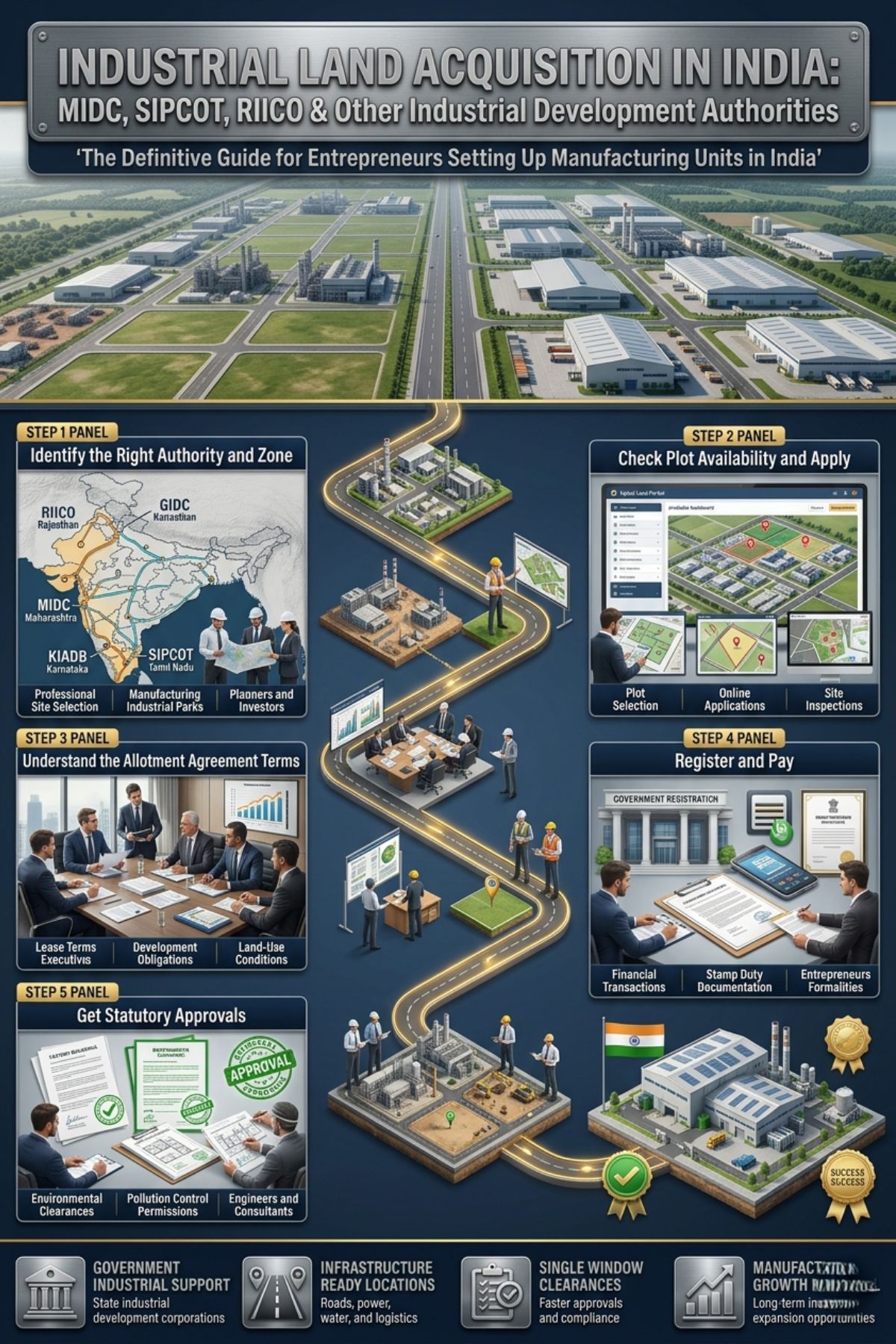
How to Acquire Industrial Land in India: Step-by-Step
Step 1 — Identify the Right Authority and Zone
Begin by choosing your industry type. Polluting industries such as Chemical, Dyes and Tanneries are required to be set up in specific areas with access to CETP. Proximity of food processing units and pharma units is essential to minimize transport costs of raw material. Duty Free importation of electronics units is available directly adjacent to SEZ. The zoning map is available for each authority. Download these before any shortlisting of plot: MIDC’s at midc.maharashtra.gov.in, GIDC’s at gidc.gov.in.
Step 2 — Check Plot Availability and Apply
The major authorities are all transitioning their forms to online. RIICO’s website showcases all the available plots in the industrial areas along with their sizes, rates, and infrastructure. MIDC has an allotment system based on tenders for the allotments of big size and direct system for small/medium size of allotments. Make a project report, promoter identity proof, promoter’s address proof, business registration certificate, bank solvency certificate and a site utilisation plan beforehand. These are a necessary part of your application or else it will stall at your first desk.
Step 3 — Understand the Allotment Agreement Terms
Industrial authorities do not sell the land in its entirety. They allocate it on a 99-year lease basis (MIDC & SIPCOT) or freehold after construction (RIICO). Closely read the allotment letter for: Start of construction date (typically 1–2 years), Start of production date, employment generation requirements, re-allotment requirements. If production does not start on time, you may lose your premium and production may be cancelled.
Step 4 — Register and Pay
Pay the land premium upon receipt of the allotment letter (land premiums can be paid in 25% – 50% in advance and the remaining 50% over a number of EMIs over 5-7 years for most landlords). Proceed for the execution of the lease deed or sale deed at sub-registrar’s office. Stamp duty is different from state to state – most states have a 5-7% stamp duty, some states offer stamp duty concessions for MSME units (e.g. Tamil Nadu has waived 50% of stamp duty for new industrial units in SIPCOT parks).
Step 5 — Get Statutory Approvals
Once the properties are registered, obtain the building plan sanction from the technical division of the industrial authority, Factory Licence from the State Labour Department (for 10+ employees having power), Pollution Control Board Consent to Establish (CTE), GST registration and Udyam Registration. In the case of food units, add FSSAI. If storing flammable materials add PESO (Petroleum and Explosives Safety Organisation) approval for chemical units.
Investment needed: Land acquisition costs from ₹10L (for 500 sq m land in Tier-2 RIICO zone) to ₹10Cr+ (10 acres in MIDC Phase-1 industrial area near Pune). Include a 15-20% registration, infrastructure and legal fees. The range of micro unit land budget is between ₹15L to ₹50L and for medium size manufacturing unit the land budget should be in between ₹1Cr to ₹5Cr.
Application to first production: 12- to 18-months. Land allotment: 2-6 months, Registration: 3-6 months and statutory approvals: 6-12 months depending on the unit size.
The team to be on site at start-up: A site manager, plant engineer, legal/compliance consultant, who may be outsourced, and an accountant. The entire production team is assembled when the unit goes into production.
Table 2: Industrial Land Acquisition Cost Breakdown by Unit Size
| Cost Head | Small Unit (500–1000 sq m) | Medium Unit (1–3 acres) | Large Unit (5–10 acres) |
| Land Cost (Authority Allotment) | ₹8L – ₹30L | ₹40L – ₹2Cr | ₹2Cr – ₹10Cr |
| Registration & Stamp Duty | ₹50K – ₹2L | ₹2L – ₹10L | ₹10L – ₹50L |
| Development Charges (Infrastructure) | ₹1L – ₹5L | ₹5L – ₹20L | ₹20L – ₹75L |
| Legal / Documentation Fees | ₹25K – ₹75K | ₹75K – ₹2L | ₹2L – ₹5L |
| Environmental Clearance (if applicable) | NIL / ₹50K | ₹1L – ₹3L | ₹3L – ₹10L |
| Water & Power Connection Deposit | ₹50K – ₹2L | ₹2L – ₹8L | ₹8L – ₹25L |
| Total Estimated Acquisition Cost | ₹10L – ₹40L | ₹50L – ₹3.5Cr | ₹2.5Cr – ₹12Cr |
Note: Figures are indicative averages across MIDC, SIPCOT, RIICO, and GIDC rates. Actual costs depend on specific industrial area and plot category.
Financial Snapshot: What the Numbers Actually Look Like
For a medium sized manufacturing unit occupying 1 acre land on an industrial area:
- Capital expenditure (land + civil construction + machinery): ₹2Cr – ₹6Cr based on the sector and location
- Monthly operating cost (manpower + power + raw material + lease instalment): It ranges between ₹15L – ₹40L per month based on 60% capacity.
- Average revenue per square meter per month at 60% usage: ₹25L to ₹60L (by sector)
- Expected revenue at 100% capacity: ₹45L – ₹1.1Cr/month
- Note: Gross margin of 28–42% for most light manufacturing and 18–28% for heavy fabrication.
- Net margin at full capacity: 12-22% as per debt servicing and power cost.
- Payback period: 4-7 years (for a well-located, well utilised unit) up to 10 years (for high-cost urban areas).
The variable is the price of the land. A ₹1,500 per sq. m. land available to an entrepreneur through a state authority as against a ₹6,000/sq. m. land available from a private developer, thus saves the entrepreneur with a rough estimate of saving about ₹1Cr per acre, which can be used to finance the working capital for two more years. This one choice can make or break a unit’s ability to outlast its first 5 years. For current allotment rates and data on the industrial areas, please refer to the portal of National Investment and Infrastructure Fund (NIIF) and the investment promotion boards of the states.
Access Complete Business Plan: Project Reports & Profiles
Table 3: Key Government Schemes Supporting Industrial Land Acquisition
| Scheme / Policy | Nodal Agency | Key Benefit for Land Acquisition | Who Qualifies | Max Support |
| PM Mitra Scheme | Ministry of Textiles | Subsidised land in textile parks; plug-and-play infrastructure | Textile & apparel MSMEs | ₹300Cr per park |
| DPIIT Industrial Corridor Projects (DMIC, CBIC, etc.) | NICDIT / DPIIT | Greenfield industrial townships with pre-developed plots | All manufacturing sectors | Plot-based allotment |
| Amended Technology Upgradation Fund (ATUF) | Ministry of Textiles | Capital subsidy on land & building in notified clusters | Textile units | Up to 10% of project cost |
| PLI Scheme (Sector-specific) | Ministry of Commerce | Incentive for setting up production in notified areas | 14 sectors incl. electronics, pharma, food | 4–20% on incremental sales |
| State Investment Promotion Schemes | State Govt. / IDAs | Stamp duty waiver, land at concessional rates, power subsidy | New industrial units | Varies by state; up to 100% SD waiver |
| MSME Cluster Development Programme | Ministry of MSME | Common facility centres, infra upgradation in industrial clusters | MSMEs in recognised clusters | Up to ₹15Cr per cluster |
| SIDBI Term Loans for Land & Building | SIDBI | Long-term credit for acquiring industrial land & construction | MSMEs with Udyam registration | Up to ₹25Cr |
Sources: Ministry of MSME (msme.gov.in), DPIIT (dpiit.gov.in), SIDBI (sidbi.in), Ministry of Textiles (texmin.nic.in).
ENTREPRENEUR SPOTLIGHT
Ramesh Gupta, Rajasthan
Ramesh Gupta is an entrepreneur in the precision engineering segment in Bhiwadi industrial area in Rajasthan, India, in the company of his unit. In 8 years, the land area has grown from 1,000 sq m to 3,500 sq m. His main lesson: he submitted his application to RIICO before finalizing his machinery. The plot allotment, which he acquired in four months with a rate of ₹900 per square metre, provided him with the confidence to obtain a term loan of ₹40L from UCO Bank. Key lesson: Apply for an industrial land first then apply for any bank loan. A confirmed allotment letter is a de-facto collateral for MSMEs.
Build a profitable business with the right idea
Where to Get Detailed Project and Feasibility Support
Niir Project Consultancy Services (NPCS) provides detailed and ready to use Project Reports on Land & Civil Costs Estimates, Plant Layout, Machinery Specifications, Raw Material Sourcing and Techno-Economic Feasibility Studies for more than 5000 manufacturing and industrial projects, which are easily available at niir.org and entrepreneurindia.co for those who wish to jump from intention to application. These reports are not academic, they’re designed to meet the project report requirements of banks, state industrial authorities and governmental applications for schemes. An NPCS project report is one thing that the various authorities ask for when an entrepreneur applies for an allotment in the MIDC, SIPCOT or RIICO. It is end-to-end consultancy catering to the Indian manufacturing reality, and not imported frameworks.
One Decision That Changes Your Cost Structure
Industrial land that is purchased at a concession rate from a state authority is not only cheaper real estate, but it also possesses the following advantages. Low-cost power (especially in many MIDC and GIDC parks there are separate substations), joint effluent treatment system, common dock facilities for logistics and — crucially — legally valid title for taking bank and NBFC term loans at competitive rates.
Don’t enter into negotiations with the private landowner(s) first. Open the door of your state’s industrial development authority today. Locate one industrial region within 100 km of the proposed site. Download the plotting list (if available). Make an appointment with the regional MIDC/SIPCOT/RIICO office. Your first-mover advantage in your sector isn’t just due to the hardware; it’s the land at the right price, and at the right time.
Refer to the Invest India portal and the investment promotion board of your state for your state-specific details regarding the industrial area and for investment promotion contact. The updates in the DPIIT Industrial Infrastructure also include the most recent timelines for the corridors and parks.
Frequently Asked Questions
Q1. Minimum investment to acquire industrial land via MIDC or RIICO?
RIICO’s plots in the Tier-2 industrial belt of Jodhpur/Sri Ganganagar start around 6L-15L (250-500 sq m). MIDC plots in the Phase-1 zones of Nashik start at 25L-40L (500 sq m). These are land costs only. Increase this by 20-25% to account for Registration charges, Infrastructure Deposit and Legal Costs to arrive at the Total Acquisition cost.
Q2. Which licenses and permissions are required to start production in an industrial plot?
You Need a Factory License (10+ workers and power), GST Registration, Udyam Registration, Pollution Control Board Consent to Establish, and a Building Plan Sanction from allotted industrial development authority. Some other necessary licenses are food license (for food industry), drug license (for pharmacy), and BIS certification. The entire process (if planned parallelly) is likely to take 3 to 5 months post land registration.
Q3. Can first-time entrepreneurs use an allotment letter of an industrial plot as collateral for bank finance?
Yes. Allotment letters issued by reputable state industrial development corporations (MIDC, SIPCOT, RIICO, GIDC, KIADB) are considered primary collateral by most Public Sector Banks (PSBs) and SIDBI for extending term loans. The allotment letter will strengthen the loan application, although banks prefer established businesses for unsecured (CGTMSE) loans of up to 2 Cr. A term loan against an allotment letter can usually be processed in 45-90 days.
Q4. Profitability of manufacturing on industrial authority land versus private land?
It’s not a minor difference – it’s structural. An MIDC or GIDC plot is 30-50% cheaper in land cost, and power is 8-15% cheaper (thanks to dedicated industrial substations). Critically, it removes the title deed ambiguity that often worries lenders. On a 3 Cr project, acquiring land at 1,500/sq m in a designated industrial zone versus 5,000/sq m in the private sector saves you 70 L to 1.5 Cr, directly improving your profit margins by 3-5 percentage points over the initial 4 years.
Q5. Which government schemes offer direct support for industrial land acquisition by MSMEs?
The PM MITRA (Mega Integrated Textile Regions and Apparel) Scheme the govt is offering sub-allocated land & ready infrastructure for textile manufacturing MSME Cluster Development Programme lends its name to funding of Common Facility Centres in notified clusters. Most state investment promotion schemes grant large concessions (50-100%) in stamp duty to a new unit of MSME on land acquisition. You might check sidbi.in for Term Loan products (approx 8.5-11% now).
Q6. How can NPCS project reports assist in the industrial land application process?
Niir Project Consultancy Services also generates the following thorough project reports (DPRs): The project report contains all the required parameters required by MIDC, SIPCOT, RIICO, and even the bank/investment agency. The following are incorporated in a project report: Details of the plant layout CAPEX & OPEX forecasts Land & Civil works estimates Machine specification Estimates of financing feasibility Bank acceptance DPR reports from Niir Project Consultancy Services except for bank loans & applying for state allocated land. Browse the product listing in niir.org Or download our business plans in entrepreneurindia.co.
Key Data Sources & References
- Ministry of MSME, Government of India — msme.gov.in
- DPIIT — Industrial Infrastructure & Corridors — dpiit.gov.in
- Invest India — Industrial Zones & Incentives — investindia.gov.in
- SIDBI — MSME Finance & Land Loans — sidbi.in
- Reserve Bank of India — MSME Sector Reports — rbi.org.in
- RIICO — Rajasthan Industrial Land Portal — riico.co.in
- Niir Project Consultancy Services — niir.org
- Entrepreneur India — entrepreneurindia.co


