





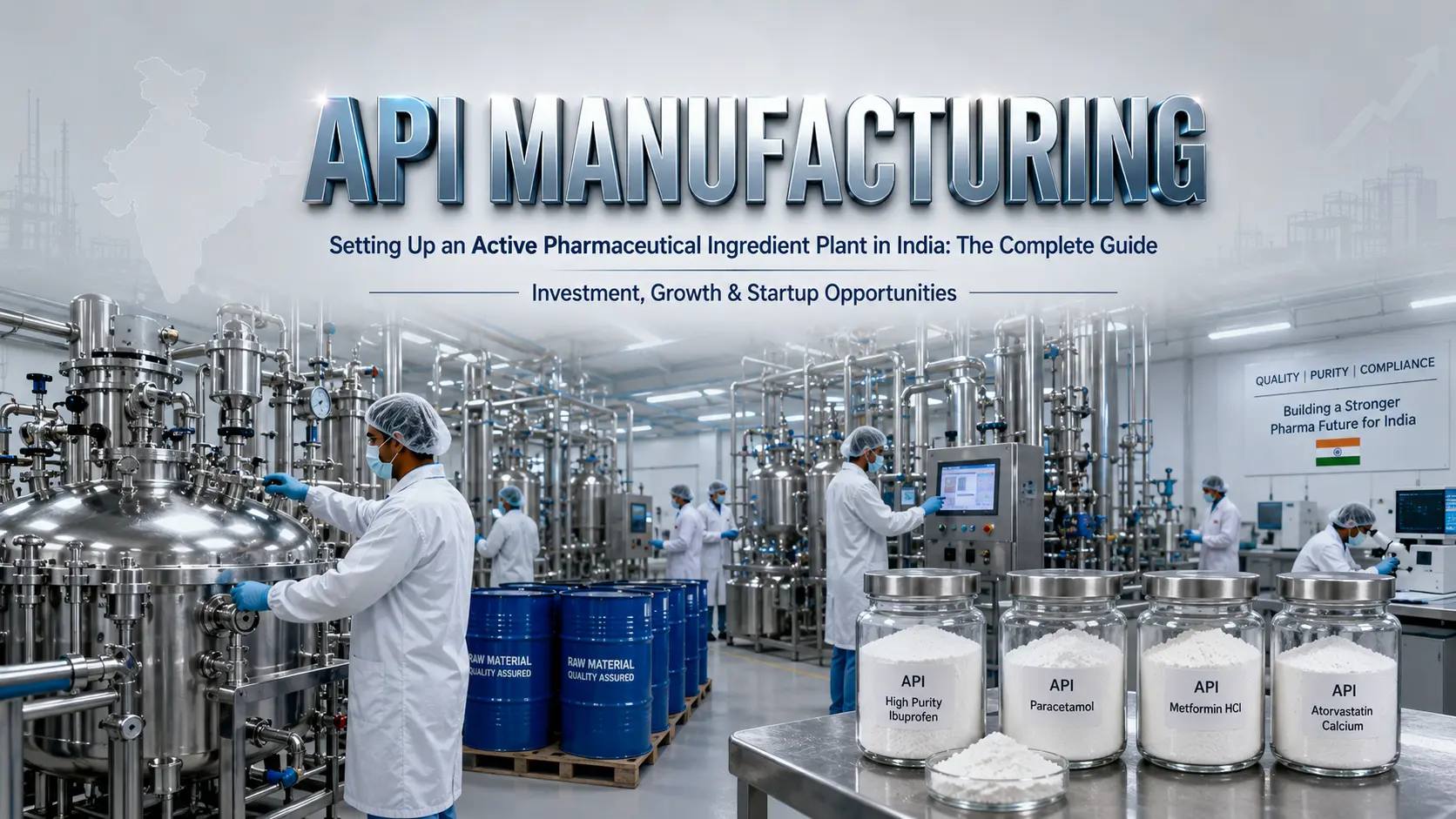
API Manufacturing Plant in India
The Pill Behind Every Pill
Each tablet that your local chemist dispenses is based on something that few people know about: the Active Pharmaceutical Ingredient, or molecule that performs the therapeutic action. The painful reality is that India is 43% dependent on China for APIs, the self-proclaimed ‘Pharmacy of the World’, says data from the Pharmaceutical Exports Promotion Council (Pharmexcil). That dependence is essentially 100% for 25 to 35 specific categories of APIs, such as critical antibiotics like Penicillin G, cephalosporins and the intermediates of rifampicin.
This is no fringe finding. The India government’s own ministry of Chemicals & Fertilizers has admitted it in Parliament. Imports from China climbed from ₹18,646 crore in 2020-21 to ₹27,032 crore in 2024-25, a rise of roughly 45% in five years. Indian formulation manufacturers try to pay off spot prices every time Chinese environmental authorities close a plant – as they have done many times over the last decade. Margins collapse. Medicines are in short supply.
Now that’s the weakness that’s soaking up the opportunity! The government has set aside ₹6,940 crore under PLI scheme to turn this trend. There are 3 established Bulk Drug Parks in Andhra Pradesh, Gujarat and Himachal Pradesh, with construction works in progress. There is a trend toward de-China-ization of supply chains for the US and European buyers. The molecule-making business is open now in India, and if you want to make a small but viable API business, you can start from about ₹3.5 crore.
Get Detailed Insights from This Book: Drugs & Pharmaceutical Technology Handbook
The Supply Gap Nobody Is Talking About Enough
India exported pharmaceuticals worth over ₹2.06 lakh crore in 2023-24, according to Pharmexcil data. It accounts for 20% of the world’s generics market turnover. However, the raw material for such formulations — the APIs — is coming in far more from one country. API imports in India for FY 2024 were valued at ₹37700 crores of which China accounted for ₹27032 crores.
The weakness of the structure is multi-layered. The first is the cost, Chinese manufacturers, with government supports and huge volumes, are manufacturing the commodity API on the whole at prices which the Indian small-scale producers could never compete on. The price of Paracetamol API has dipped to ₹250/kg from ₹900/kg during the peak of the pandemic. Second, it’s concentration: India has almost complete dependence on China for pyridine compounds, barbituric acid derivatives, sulphonamides and key intermediates for penicillin and cephalosporin, says Directorate General of Commercial Intelligence and Statistics (DGCI&S).
There are entire API categories that Indian formulation companies desperately want, and that is where opportunity is to be found, third. Domestically, a number of chronically undersupplied APIs include cardiovascular, anti-diabetic, oncology intermediates, and specialty fermentation-based APIs. The clusters that are the worst hit: Hyderabad (Telangana) has more than 40% of India’s formulation capacity, but is almost dependent on imported APIs, Baddi–Barotiwala–Nalagarh in Himachal Pradesh produces every third medicine sold in the country and the Vapi–Ankleshwar corridor in Gujarat is a key chemical and pharma manufacturing belt already geared up for handling hazardous chemicals.
TABLE 1: Key API Pharma Clusters in India — Demand, Capacity & Import Gap
| State / Cluster | Pharma Cluster | Formulation Units | Dominant Import Dependency | Key APIs Needed Locally |
| Telangana | Hyderabad (Genome Valley) | 750+ | 70–80% APIs from China | Oncology, CVS, anti-infective APIs |
| Himachal Pradesh | Baddi–Barotiwala–Nalagarh | 650+ | 75–80% APIs imported | Paracetamol, antibiotic APIs, vitamins |
| Gujarat | Vapi–Ankleshwar–Bharuch | 500+ | 60–70% APIs from imports | Chemical synthesis APIs, specialty molecules |
| Maharashtra | Pune–Aurangabad belt | 400+ | 65% dependence on imports | Hormonal, neurological APIs |
| Rajasthan | Udaipur–Jaipur RIICO parks | 150+ | 55% import dependence | Anti-diabetic, anti-malarial APIs |
| Andhra Pradesh | Visakhapatnam–Kakinada | 200+ | Bulk Drug Park under construction | Fermentation APIs, penicillin derivs. |
Sources: Pharmexcil, DGCI&S, Department of Pharmaceuticals (DoP)
Why the Window Is Open Right Now
The API manufacturing entry is a more compelling case than ever in the last 10 years as three forces are coming together at the same moment.
- The US Biosecure Act effect. In the wake of the US Biosecure Act, which has banned federal contractors from using certain Chinese biotech companies, American buyers are eager to move away from dependence on China. Mordor Intelligence market data indicated that there was a 50% rise in the number of RFQs received by Indian contract API manufacturers in 2024. This is the direction in which Europe is going. Producers of domestic API in India who are located in the vicinity of existing hubs of API production will benefit directly.
- PLI Scheme for Bulk Drugs — ₹6,940 crore in the coffers. The Department of Pharmaceuticals manages the Production Linked Incentive (PLI) Scheme which includes incentives for incremental domestic sales of 41 identified critical APIs and KSMs for a period of 6 years. Of the 41 products, 33 have been subscribed and 48 greenfield projects approved. Committed investment is at ₹4,329.95 crore, but actual investment has already crossed over ₹4,814 crore, indicating that the market is going past the scheme’s own targets.
- Subsidy for bulk Drug Park — 70-90% of the cost of Infrastructure covered. The common infrastructure of these three parks— effluent treatment plant, power sub-station, road, warehousing and utility connection—is being funded by the centre in these three parks (East Godavari, Gujarat-Bharuch and Himachal Pradesh-Una) under a Scheme for Promotion of Bulk Drug Parks (outlay of ₹3,000 crore). Within these parks, units can be deployed with OSIplug and play infrastructure at a significantly lower price. The cost of the infrastructure in the hilly state of Himachal Pradesh is 90% funded by the government.
- Access to credit by 4. MUDRA and CGTMSE. The collateral-free loan facilities available to MSME API units include MUDRA (Tarun category) loan of up to ₹2 crore and collateral-free loan facilities, provided through Credit Guarantee Trust for Micro and Small Enterprises (CGTMSE) which provides guarantees to banks for lending to MSMEs without requiring any physical collateral. This reduces the amount of capital that is needed for the first-generation entrepreneurs.
Get Detailed Project Report (DPR): Active Pharmaceutical Ingredient (API) Products, Bulk API Manufacturing
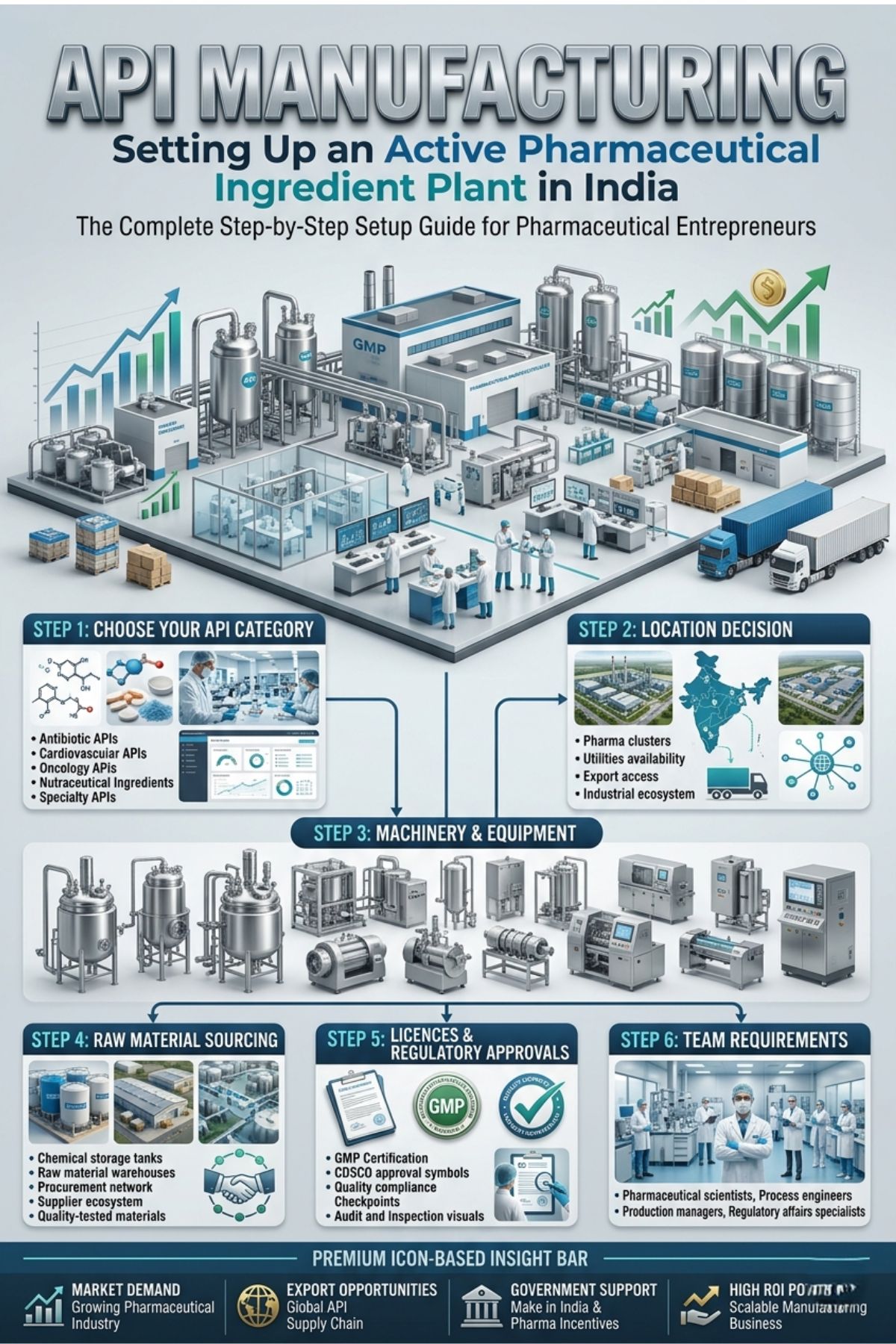
Step-by-Step: Setting Up Your API Unit
Step 1: Choose Your API Category
Some APIs are simpler and require less capital than others. Chemical synthesis APIs are the focus of new players, not fermentation-based APIs. Conventional organic chemistry reactors are necessary to make the chemical synthesis APIs, as well as paracetamol, metformin, aspirin or ibuprofen, and are much simpler to licence, operate and quality certify than fermentation processes (antibiotics, enzymes). Begin with one molecule or two that are familiar and have stable domestic demand in a formulation cluster in close proximity.
Step 2: Location Decision
It is highly recommended to set up in a designated pharmaceutical industrial park or GIDC estate (Gujarat), APICOL estate (Andhra Pradesh) or HIMUDA estate (Himachal Pradesh). The areas have been provided with pre-sanctioned Consent to Establish from the State Pollution Control Board, common effluent treatment plants (CETP), bonded warehousing and shorter time for obtaining licences. Small API unit size: 2,000 – 5,000 sq ft built up area (production + QC lab + storage). Greenfield land requirement (ETP and open area buffer): 0.5-1 acre minimum.
Step 3: Machinery & Equipment
Small Chemical Synthesis API Plant – Core Equipment:
- Stainless steel reactors (SS-316L): 2 × 1 KL capacity — ₹18–25 lakh each
- Nutsche filter / filter dryer: ₹12-18 lakh
- Vacuum Distillation Unit: ₹8–12 lakh.
- Multi-effect evaporator (for solvent recovery): ₹10-15 lakh
- Suitable laboratory instruments (HPLC, UV-Vis, Karl Fischer etc): ₹25-35 lakh
- ETP (Effluent Treatment Plant): If not on CETP then ₹15–25 lakh.
The major equipment suppliers are based in Pune (Godrej Process Equipment), Mumbai (Praj Industries), Ahmedabad (GMM Pfaudler) and Chennai (HLE Glascoat). Most of them have a deferment of payment for MSME buyers registered as Udyam.
Step 4: Raw Material Sourcing
KSMs and chemical intermediates are mostly sourced from Gujarat (Ankleshwar & Vapi), Maharashtra (Tarapur & Dombivali MIDC) and Rajasthan. By starting the production process with the involvement of two or three domestic KSM traders, building suppliers can reduce risks in the supply chain. Indian Chemical Council (ICC) has a vendor directory for sourcing verification of specialty solvents and reagents.
Step 5: Licences & Regulatory Approvals
Udyam Registration (MSME portal) — Free and Online Registration, Instant Registration. Do this first.
CDSCO Drug Manufacturing Licence (Form 25/28) through State Drug Controller. Permission under API (Form CT-13) – Government fee ₹5,000. The official website of the CDSCO is cdsco.gov.in.The CDSCO SUGAM website is cdsco.gov.in.
State Pollution Control Board — Consent to Establish (CTE) & Consent to Operate (CTO). API units fall under ‘Red Category’ industries. Allow 60–90 days.
Factory Licence – issued by the State Labour/Factories Inspectorate in accordance with the Factories Act 1948. Must be done when the number of workers exceeds 10 (with power) or 20 (without power).
GST Registration — mandatory. HSN codes of APIs belong to Chapter 29 (Organic Chemicals) and Chapter 30 (Pharmaceutical Products).
IEC from DGFT (Import Export Code) – If exports / imports of raw material.
WHO-GMP / Schedule M compliance – required for selling to regulated-market formulation units or for export. CDSCO is responsible for GMP inspections.
Time for total licencing: 12 – 18 months if a new unit is well planned.
Step 6: Team Requirements
To start operations, at least 1 qualified person (B.) is required.Pharm or M.1 QC, 2 production operators, 1 maintenance technician, 1 accounts/compliance person, 1 Sc Chemistry (required by Drugs & Cosmetics Act). Total: 6–8 at start up. Expand to 15–20 at 60% capacity.
Related Article: Specialty Chemicals & Pharmaceutical API Manufacturing Business in India – Investment Guide
TABLE 2: Investment Breakdown for a Small-Scale API Unit (Chemical Synthesis, 100–200 TPA)
| Cost Head | Low Estimate (₹) | High Estimate (₹) | % of Total CapEx |
| Land (leased inside industrial estate) | ₹25 lakh | ₹60 lakh | 10–12% |
| Civil Construction (production + QC + store) | ₹40 lakh | ₹80 lakh | 15–18% |
| Reactors, Dryers & Core Equipment | ₹80 lakh | ₹1.50 crore | 28–32% |
| QC Laboratory Setup | ₹25 lakh | ₹50 lakh | 9–11% |
| ETP / Pollution Control System | ₹15 lakh | ₹30 lakh | 6–8% |
| Working Capital (6 months raw material + wages) | ₹60 lakh | ₹1.20 crore | 20–22% |
| Licences, Contingency & Pre-operative Expenses | ₹15 lakh | ₹25 lakh | 5–6% |
| TOTAL ESTIMATED CAPEX | ₹2.60 crore | ₹5.15 crore | 100% |
Note: Figures based on a 100–200 TPA chemical synthesis API plant in a pharma industrial estate. Scale and state-specific costs will vary. Source: IMARC Group DPR estimates, NPCS project data.
Financial Snapshot: What the Numbers Actually Look Like
On a representative API chemical synthesis unit of size ₹3.5 crore and manufacturing capacity of 150TPA of a mid-complexity chemical API:
- Monthly operating cost: ₹18–24 lakh (raw materials 55–60%, utilities 20%, wages 15%, overheads 10%)
- Revenue at 60% capacity: ₹90–1.10 crore per year (assuming ₹1,000–1,200/kg realization)
- Revenue at 100% capacity: ₹1.50–1.80 crore per year
- They range from 38% to 48% for APIs (chemical synthesis) and 55% to 65% for APIs (fermentation). APIs with fermentation methods feature higher gross margins but require higher setup costs.
- Net margin – full capacity: 18-24% post depreciation, interest and taxes
- Payback period: 4-6 years, for a good location, well managed, lean unit.
These figures are in line with the IMARC Group API Manufacturing Plant Project Report, which estimates gross margins of the chemical synthesis APIs at 50–65% and net profit at 25–40% at full capacity for larger-scale operations. Smaller units are nimbler, have lower margins, but are closer to the customer. Units going to semi regulated markets (Africa/Southeast Asia) via pharmexcil registered channels can be sold at premium of 12–15% above domestic price.
TABLE 3: Government Schemes Applicable to API / Bulk Drug Manufacturing Units
| Scheme | Administering Body | Benefit / Quantum | Eligibility |
| PLI — Bulk Drugs | Dept. of Pharmaceuticals (pharmaceuticals.gov.in) | 10–20% incentive on incremental sales over 6 years | Greenfield plants producing any of 41 notified APIs/KSMs |
| Bulk Drug Park Scheme | Dept. of Pharmaceuticals + State Govts. | 70–90% of common infra cost covered by Centre | Units setting up in approved parks in AP, Gujarat, HP |
| MUDRA – Tarun Loan | SIDBI / Bank branches | Up to ₹20 lakh (Shishu ₹50K, Kishor ₹5L, Tarun ₹20L) | Micro enterprises; no collateral required |
| CGTMSE | SIDBI + MoMSME (cgtmse.in) | Credit guarantee up to ₹5 crore (collateral-free) | MSME units with Udyam registration, lending bank participation |
| PMEGP | KVIC / KVIB / DIC (kviconline.gov.in) | 15–35% subsidy on project cost up to ₹50 lakh (mfg.) | New entrepreneurs; not for existing units; mfg. up to ₹50L project |
| Technology Upgradation Fund (TUF) — Pharma | Dept. of Pharmaceuticals / SIDBI | Interest reimbursement of 5% on machinery loans | MSMEs upgrading to GMP-compliant facilities; Schedule M compliance |
| Startup India — Tax Exemption (80-IAC) | DPIIT (startupindia.gov.in) | 100% tax exemption for 3 consecutive years out of first 10 | DPIIT-recognised startups with turnover under ₹100 crore |
Sources: Department of Pharmaceuticals (pharmaceuticals.gov.in), SIDBI, KVIC, CGTMSE, DPIIT.
ENTREPRENEUR SPOTLIGHT
Macsen Labs Group, Udaipur, Rajasthan
In early 2025, Macsen Labs began construction of a new API facility at its RIICO Industrial Area in the town of Gudli, Udaipur, which will be five times as large as its current facility. Its flagship manufacturing plant, Macsen Drugs is USFDA-inspected and has TGA-GMP and WHO-GMP certificates. PLI funding is a part of expansion plan of the company and serves as a blueprint for the MSME origin API businesses to scale their businesses into regulated export markets. The big lesson: Make it GMP compliant from the start — it will always be more expensive to retrofit.
Build a profitable business with the right idea
Planning Your Project: Where to Find Serious Technical Support
As an entrepreneur at the feasibility stage, it is critical to get the techno-economic numbers correct before investing the capital. Niir Project Consultancy Services (NPCS) at niir.org has published detailed project reports and feasibility studies which are specifically on API and bulk drug manufacturing in India. They include plant layout design, equipment specifications, raw material sourcing maps, margin modelling and regulatory compliance checklists, all of the level of detail that saves months of trial and error. The publication arm of entrepreneurindia.co also releases project profiles and sector guides for pharmaceutical manufacturing entrepreneurs for investment planning. For the first time API investors who may have capital but not necessarily the know-how of the sector, NPCS provides end-to-end consultancy in plant design, process selection and techno-economic feasibility studies.
The Next Step Is Specific, Not General
India’s API market is no myth. Policy architecture is in place. The demand of formulation clusters can be measured. It has been documented that there is a supply gap from China. The lack of increased MSME capital investment in the manufacturing chain is what is missing.
If you’re reading this and know that there’s a molecule you need to bring to market that’s currently being imported by local formulation companies in your vicinity, and you have a deployable capital of ₹3-5 crore this week, the number one thing you can do is do a techno-economic feasibility study on one molecule. Contact the State Drug Controller’s office in your state regarding the licencing requirements. Please check the nearest Bulk Drug Park for availability of plot allocation.
It’s not the chemistry that’s hard. The determination to start is.
Frequently Asked Questions
Q1. What is the minimum investment to set up an API manufacturing unit in India?
A small chemical synthesis API unit producing 100–150 TPA can be established with a total CapEx of ₹2.60–5.15 crore, including land, civil construction, core equipment, QC lab, ETP, and six months’ working capital. The lower end assumes setting up inside an existing pharma industrial estate (where common infrastructure is shared). Fermentation-based APIs require significantly higher investment — typically ₹8–20 crore for a comparable scale, due to bioreactor and sterile processing requirements.
Q2. What licences are compulsory before starting production?
At minimum: Drug Manufacturing Licence from the State Drug Controller (Form 25/28 under D&C Act 1940), Pollution Control Board CTE and CTO (API plants are ‘Red Category’), Factory Licence, GST Registration, and Udyam Registration. If exporting or importing raw materials, an IEC from DGFT is also mandatory. For selling to regulated-market buyers (US, EU), WHO-GMP or Schedule M (revised) compliance certification from CDSCO is additionally required. Apply through the CDSCO SUGAM Portal.
Q3. Can raw materials for API manufacturing be sourced domestically?
Partially. For many chemical synthesis APIs, primary raw materials and solvents are available from Indian chemical manufacturers in Gujarat (Ankleshwar, Vadodara), Maharashtra (Dombivali, Tarapur), and Rajasthan. However, certain Key Starting Materials (KSMs) — particularly for antibiotic and anti-infective APIs — still have to be imported from China. The PLI scheme for Bulk Drugs specifically targets 41 such KSMs for domestic production, and availability will improve as those greenfield units commissioned under the scheme reach full output.
Q4. What profit margins are realistic for a small API unit?
A well-run small chemical synthesis API unit can achieve gross margins of 38–48% and net margins of 18–24% at full capacity. Margins are higher for specialty and niche APIs with fewer domestic competitors. Commodity APIs like paracetamol are subject to price pressure from Chinese imports and are better suited to units operating at scale (500 TPA+) or units located inside subsidised Bulk Drug Parks where infrastructure cost is negligible. The payback period on a correctly capitalized unit is 4–6 years.
Q5. Which government schemes specifically support API entrepreneurs?
The most impactful schemes are: PLI for Bulk Drugs (10–20% incentive on incremental sales), the Bulk Drug Park Scheme (70–90% of common infrastructure cost funded by Centre), CGTMSE for collateral-free credit up to ₹5 crore, and MUDRA Tarun loans up to ₹20 lakh. Units upgrading to GMP standards can access interest reimbursement under the Technology Upgradation Fund for Pharma. All schemes are coordinated through the Department of Pharmaceuticals. DPIIT-recognised startups in this sector also qualify for 3-year tax exemption under Section 80-IAC.
Q6. Where can I find detailed project reports for API plant setup?
NIIR Project Consultancy Services (niir.org) publishes comprehensive project reports for API and bulk drug manufacturing, covering plant layout, equipment lists, raw material maps, financial projections, and regulatory compliance frameworks. Entrepreneur India (entrepreneurindia.co) publishes sector guides for manufacturing entrepreneurs. The Department of Pharmaceuticals website also has scheme documents and investor guides. IMARC Group and Mordor Intelligence publish paid market research reports with detailed DPR sections for those requiring third-party validated financials.
KEY CITATIONS & DATA SOURCES
Department of Pharmaceuticals, Government of India — PLI Scheme Updates — Scheme details, investment data, progress reports.
Press Information Bureau — Bulk Drug Park Approvals — Official PIB release on PLI and Bulk Drug Park progress.
CDSCO — Central Drugs Standard Control Organization — Drug manufacturing licence procedures, SUGAM portal, Schedule M.
Pharmexcil — Pharmaceutical Export Promotion Council — Export and import data, registered exporter lists.
CGTMSE — Credit Guarantee Fund Trust for MSMEs — Collateral-free credit guarantee scheme for MSME manufacturers.
Indian Chemical Council (ICC) — Raw material supplier data, chemical manufacturing cluster maps.
DGCI&S — Directorate General of Commercial Intelligence & Statistics — India API import/export statistics, HS code-wise data.


