





Handloom D2C business in India
The Craft That Should Have Died
The double-ikat sari, in which both the warp and weft threads are tie-dyed, takes around 45 days to weave at Bargarh district in Odisha by a master weaver of Sambalpuri sari. The same saree if sold through a middle man at a city showroom fetches about ₹800 from the weaver. It is sold at the showroom price of ₹18000.It is offered on the showroom at ₹18000.
The arithmetic (800 to 18,000) is what was behind the next generation’s decision to drop handloom weaving from Odisha. The question is, when labourers charge ₹500 per day in Bhubaneswar, why pay ₹500 per day for a saree to be made in 45 days? But by all economic reasoning Sambalpuri ikat would have been a museum artifact by now.
It didn’t. And here is a quiet D2C revolution taking place at the village level — totally unrelated to VC, Shark Tank, and all it entails, just a weaver who said no to Cheap.
The 4th All India Handloom Census (from the Office of the Development Commissioner for Handlooms) states that there are 72% women handloom workers and 88.7% of them are residing in the rural areas of the country with a total of 35.22 lakh workers. It is estimated that 2.5 lakh of those weavers are in Odisha alone. It just isn’t dying, because there’s no lack of talent. It’s dying the death of a thousand cuts; it’s dying from not having somebody who will hold the price.
Get Detailed Insights from This Book: The Complete Technology Book on Textile Spinning, Weaving, Finishing and Printing
The Margin Problem (And the Market Gap Behind It)
There is a structural failure in handloom business at the distribution level. The price most artisans charge primary mahajans (wholesalers) is between ₹500 and ₹1,200 per piece. The latter sell to the state emporia or the retailers in the towns at 3–4 times markup by the mahajans. The price of the weaver to the ultimate consumer is only rarely more than 8–12% of the finished price. In the meanwhile, the buyer — largely a premium urban customer or one from the Indian community in the United States — is ready to buy an authenticated, story-based handloom product at an extra cost of ₹4,000–₹25,000.At the same time, the buyer, more often a premium urban customer or an Indian expatriate abroad, will pay extra ₹4,000-25,000 for an authenticated, story-based handloom.
The difference between weaver’s earnings and the earnings from the market is not a product problem. It’s an issue of distribution and branding.
Consider the numbers. According to the Handloom Export Promotion Council (HEPC), India exported handloom products worth of Rs. 1,146 crores in FY24 with the United States being the highest market. According to industry surveys, premium handloom saree (above ₹10,000) now accounts 27% of all the Sarees being bought in the domestic market. Over the last four years, the demand for ‘handloom’ products of authenticated and registered origin with GI tag is experienced at a rate of 12–15% per annum, which is attributable to the ‘slow fashion’ trend, ‘wedding-gifting’ culture and rising consciousness about cultural origin.
At the same time the demand situation is equally acute: skilled weavers are present in most of the handloom clusters, but they do not have direct access to markets, such as Bargarh, Sambalpur, Bolangir and Sonepur in Odisha, Pochampally in Andhra Pradesh, and Tant in Nadia, West Bengal. They don’t have the professional photo skills to take their product photographs. They are not able to take an online order. They are unable to write an English product story. It is not the weaving itself that is the problem, it is that skill gap that is the problem that is why they don’t get a premium price.
The opening is to close that gap, whether working as a weaver who is establishing a direct brand — or as an entrepreneur who is creating an aggregation-and-branding platform for a group of 20 to 50 artisans.
Table 1: State-wise Handloom Weaving Clusters — Market Potential and GI Status
| State | Key Weave / Product | No. of Weavers (Est.) | GI Tag Status | D2C Market Potential |
| Odisha | Sambalpuri Ikat, Bomkai, Kotpad | ~2.5 lakh | Multiple GIs registered | Very High — premium urban demand |
| West Bengal | Muslin, Tant, Jamdani | ~7.2 lakh | Jamdani registered | High — pan-India bridal segment |
| Uttar Pradesh | Banarasi Silk, Chanderi | ~5.8 lakh | Banarasi GI registered | High — wedding & export demand |
| Andhra Pradesh | Pochampally Ikat, Gadwal | ~3.1 lakh | Pochampally GI registered | High — South India + NRI buyers |
| Assam | Muga Silk, Gamosa, Mekhela | ~1.8 lakh | Muga GI registered | Medium-High — cultural gifting |
| Tamil Nadu | Kanjivaram Silk, Chettinad | ~2.44 lakh | Kanjivaram GI registered | Very High — bridal premium |
Source: Office of the Development Commissioner for Handlooms, Ministry of Textiles; Handloom Census 2019-20.
Why Right Now Is the Right Time
Direct to consumer (D2C) handloom businesses are viable now, owing to three independent trends that they have experienced in the last five years or so.
The premium consumer move is the first. The urban Indian consumer, especially women aged 28 – 45 years in metro and Tier-1 cities, are actively pushing away from mass market polyester fabrics and are moving toward handmade, natural fibre fabrics with a known origin. A Sambalpuri ikat stole of ₹2200 is not in competition with Shein scarf. It is going up against a kurta from Fabindia. Addressable market is big and continually expanding.
Secondly, social commerce infrastructure is now extending to artisan villages. Weaving videos regularly get 1–4 lakh organic views on Instagram Reels. No website required for managing orders, cataloguing products and taking payments with WhatsApp Business. This is not a ‘work around’.
Thirdly, there has been a great improvement in government support. A number of schemes which are specifically designed for handloom entrepreneurs are directly funding them.
The Ministry of MSME’s SFURTI offers grants of up to ₹2.5 crore for traditional industry clusters that have a minimum of 50 artisans. It provides funding for common facility centres, design development, improvement of equipment and marketing exposure without any cost to the individual weavers participating in the cluster.
The Office of Development Commissioner (Handlooms) is running the National Handloom Development Programme (NHDP), which includes the workshed construction support, loom upgradation and design assistance in 29 Weavers’ Service Centres in India.
PMEGP is a programme that provides 15–35% subsidy up to ₹50 lakh on the project cost to manufacturing units. The production unit for handlooms qualifies. Eligible are first generation entrepreneurs including the rural artisans.
Growing demand for premium windows, easy access to social media and the availability of grant money from the government makes them the most commercially viable window handloom entrepreneurs of a generation.
View Full Project Details: Business Opportunities and Investment Projects in Odisha
How to Set It Up: A Step-by-Step Guide
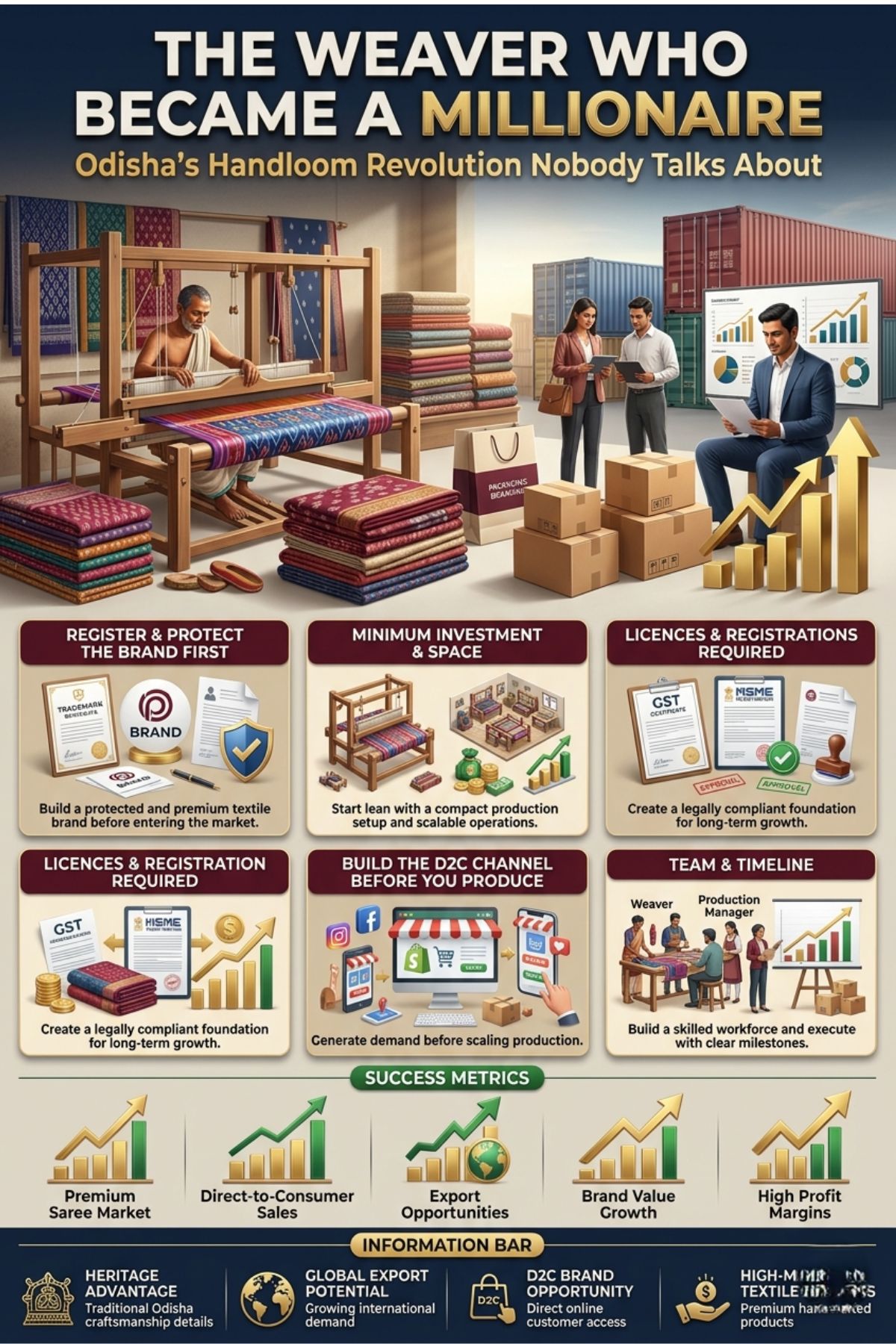
Step 1 — Register and Protect the Brand First
Apply for the authorised user status for the GI tag before purchasing a single loom. If your product falls under any of the existing GIs (Sambalpuri, Bomkai, Orissa Ikat, Pochampally Ikat, etc.), you can register it at the IP India GI Registry for a fee of ₹1,000 to ₹5,000. That means you have legal protection against fakes, and the right to use the GI certification mark, which provides a strong trust signal for premium buyers. At the same time, register your business as an MSME on the Udyam Registration Portal (free, online and takes 20 minutes to complete).
Step 2 — Minimum Investment and Space
A small-scale handloom unit should have:
- Space for covered workspace on the floor: 400-600 sq ft on rural land (owned/leased)
- 8-10 pit or frame looms: Rs. 12,000 – 16,000/- per loom from local carpenters or weavers’ cooperatives
- Initial stock of yarn and raw materials: ₹60,000-₹80,000 (cotton yarn from Surat or Ichalkaranji; natural dye raw materials from Ahmedabad or the forest in tribal Odisha)
- Branding and packaging: ₹25000- ₹40000 (tags, tissue paper packaging, brand story card, product photography)
- Website or Shopify store: ₹15,000–₹25,000 (optional; WhatsApp Business alone is sufficient to start)
Step 3 — Licences and Registrations Required
- Udyam Registration (MSME): Free, compulsory for accessing the scheme
- GST Registration: If turnover exceeds ₹20 lakh, then it is compulsory to register the business for the GST Act and 5% GST applicable on handloom fabrics.
- The GI Tag Authorised User Certificate costs ₹1,000 to ₹5,000 (through IP India).
- Weaver’s Pehchan card: Must have for access to NHDP and RMSS scheme (available from nearest Weaver’s Service Centre)
- Factory Licence: Not applicable for manual handloom units, but required for those with power who are employing 10+ workers.
- Optional but highly recommended – Register your brand name via IP India to prevent copying – ₹4,500-₹9,000 filing fee
Step 4 — Build the D2C Channel Before You Produce
Most weavers don’t do this step. Register Instagram Business account and WhatsApp Business account on the same day when you register your Udyam. Record videos on site from day one of post weaving process. The loom, the string being tied, the dye vat — this is content that is highly compelling to urban buyers. Grow 500 followers before the launch of your first product. Send a WhatsApp broadcast message to 50 initial contacts. These 50 are your first customers and your first customers’ advocates.
Step 5 — Team and Timeline
- Equipped with a team of 4-6 weavers (including yourself) and one person to get orders and pack, you are ready to go.
- Udyam Registration (Day 1); 2. GI Filing (Week 2); 3. Workspace ready (Month 2) and 4. First production batch (Month 3); 5. First sale (Month 3-4).
- Design training: Free design training is offered at Weavers’ Service Centres in Bhubaneswar, Kolkata, Hyderabad and 26 other centres.
Build a profitable business with the right idea
Table 2: Investment Breakdown for a Small Handloom D2C Production Unit
| Cost Head | Estimated Amount (INR) | Notes |
| Handlooms (8–10 units, pit or frame) | ₹1,20,000 – ₹1,60,000 | Local carpenters; govt subsidy available |
| Yarn & raw material (initial stock) | ₹60,000 – ₹80,000 | Cotton/silk from Surat, Bhagalpur, or local |
| Natural dye kit and mordants | ₹20,000 – ₹30,000 | Eco-dyes from Ahmedabad suppliers |
| Workspace / shed construction | ₹80,000 – ₹1,20,000 | Rural land; SFURTI provides partial grant |
| Branding, packaging, photography | ₹25,000 – ₹40,000 | One-time; critical for D2C premium pricing |
| Website + Shopify store setup | ₹15,000 – ₹25,000 | Freelancer; or use Instagram Shop |
| GI tag authorised user registration | ₹1,000 – ₹5,000 | Near-free; applied via IP India portal |
| Working capital (3 months operations) | ₹75,000 – ₹1,00,000 | Covers wages, dyes, utilities |
| Total Estimated Capex + Working Capital | ₹3,96,000 – ₹5,60,000 | Central estimate: ~₹4.8 lakh |
Note: SFURTI cluster grants and NHDP subsidies can reduce net capex by 30–60%. Figures based on Odisha/eastern India context; costs vary by state.
Financial Snapshot
The following estimates are based on a 10-loom unit producing primarily cotton-silk handloom sarees and stoles, operating in western Odisha or a comparable handloom cluster state:
| Financial Parameter | Estimate |
| Total Capital Expenditure | ₹3.96 lakh – ₹5.6 lakh (central estimate: ₹4.8 lakh) |
| Monthly Operating Cost (wages, yarn, dyes, packaging) | ₹55,000 – ₹75,000 per month at full capacity |
| Monthly Revenue at 60% Capacity (6–7 looms active) | ₹1.20 lakh – ₹1.60 lakh (avg. 25 pieces/month at ₹4,800–₹6,400 per piece) |
| Monthly Revenue at 100% Capacity (10 looms active) | ₹2.00 lakh – ₹2.80 lakh (avg. 40–45 pieces/month) |
| Gross Margin | 42–50% (D2C direct pricing vs. material cost; raw materials are ₹800–₹1,200/piece) |
| Net Margin (after wages, overhead) | 18–24% at full capacity |
| Payback Period | 14–20 months at 75%+ capacity utilisation |
The D2C channel is what makes these margins possible. A weaver selling through a mahajan or state emporium receives 8–12% of end price. The same weaver selling through Instagram and WhatsApp receives 100% of end price, minus payment gateway fees of 1.9–2%. At ₹6,000 per saree, the difference is ₹4,800 versus ₹600. That is not a marginal improvement. It is a structural one.
Table 3: Government Schemes for Handloom Production Units — Benefits and Eligibility
| Scheme Name | Nodal Ministry | Key Benefit | Eligibility |
| SFURTI | Ministry of MSME | Up to ₹2.5 cr grant for traditional industry clusters | Artisan groups, cooperatives, NGOs — min 50 artisans |
| PMEGP | KVIC / Ministry of MSME | 15–35% subsidy on project cost up to ₹50 lakh | First-gen entrepreneurs in mfg/service |
| National Handloom Dev. Programme (NHDP) | Ministry of Textiles | Loom upgrade, workshed, design dev., marketing support | Registered weavers with Pehchan Card |
| Raw Material Supply Scheme (RMSS) | Ministry of Textiles | 15% price subsidy on cotton/silk yarn; transport subsidy | Handloom weavers enrolled in portal |
| Weavers MUDRA Loan | Ministry of Textiles / MUDRA | Collateral-free loans up to ₹10 lakh at concessional rate | Handloom weavers with Udyam Registration |
| Handloom Mark Scheme | Ministry of Textiles / DC Handlooms | Branding certification; boosts premium market access | All genuine handloom producers |
Sources: msme.gov.in/sfurti
Related Article: What is Textile Designing and How Can You Build a Career in It?
ENTREPRENEUR SPOTLIGHT
Madhusmita Panda, Bargarh, Odisha
Madhusmita began with two pit looms, a ₹40,000 investment and an Instagram page she created. She is a master weaver of Sambalpuri double-ikat stoles and sarees from her home in Bargarh district where weavers of mastery have been working for more than three centuries. Now, she ships 60-80 units per month in 14 cities in India and the average order value is ₹3,800. 70% of her monthly income comes from her repeat customers who are on the 400+ repeat customers list on her WhatsApp broadcast group. She didn’t go to any distributor. Her only morsel of advice: ‘Knot your story to each saree. Buyers are NOT paying for the thread alone!
Monthly turnover: ~₹2.4–2.8 lakh | Net margin: ~22% | Team size: 4 weavers + self
Where to Get Technical and Financial Project Support
Techno-economic feasibility reports, Detailed Project reports (DPRs), and Plant layout designs are available for handloom and textile manufacturing units from Niir Project Consultancy Services (NPCS) at niir.org for entrepreneurs who require an in-depth feasibility analysis before investing funds in a project. Their DPRs include capital cost estimates, machinery specifications, raw material sourcing maps, financial projections, and regulatory checklists – everything a first-time entrepreneur would need to present to the bank or a scheme officer with credibility. The entrepreneurindia.co portal, published by NPCS, also features sector specific project profile and investment guide for handloom and SFURTI eligible businesses. A detailed project report prepared by a reputable consultancy like NPCS generally saves a huge amount of time for a unit to acquire the bank loan for PMEGP/MUDRA.
What You Should Do Next
The handloom opportunity in Odisha and in all the important handloom villages ranging from Pochampally to Chanderi to the famous handloom villages of Tant country in Bengal is not a hypothetical one. The demand exists. There is a government support. Social media channel does exist. Most often, it is just one individual who is prepared to hold the price, add the story, and sell direct.
Don’t sell your next weaving to a mahajan. Take a picture of it, post it to Instagram, and set the price at 45 days of skill. As a businessman / entrepreneur, support the weavers’ cluster by arranging 50 weavers, apply for SFURTI and distribute the work completely.
The first step is to visit the website handlooms.nic.in and find the nearest Weavers’ Service Centre. Schedule a complimentary design consultation. Next, open a WhatsApp Business account and begin recording the weaving process starting today, before you have any products to sell. The crowd will be here. The problem of distribution of handloom is resolved. There is only one thing remaining – the choice to start.
Frequently Asked Questions
Q1. How much does it cost to start a handloom D2C business from scratch?
A 10-loom set-up needs initial capital infusion of Rs 3.96 lakh to Rs 5.6 lakh. This will include capital costs for workplace and loom and preliminary expenditure like that of raw materials and branding, plus 3 months’ working capital. Craftsmen and artisans forming a cluster get 30-60% subsidy on the net expenditure for the set-up under SFURTI or NHDP scheme. A solo weaver starting with two looms and an Instagram page can begin for under ₹1.2 lakh.
Q2. Which licences are mandatory for a handloom unit?
The mandatory registrations are Udyam Registration (free, online) and GST registration once turnover crosses ₹20 lakh per year. A Weaver’s Pehchan Card — issued by the Ministry of Textiles after Handloom Census verification — is required to access NHDP subsidies and the Raw Material Supply Scheme. GI tag authorised user registration is strongly recommended and costs between ₹1,000 and ₹5,000.
Q3. Where can weavers in Odisha source quality yarn and natural dyes?
Cotton yarn is available from cooperative depots in Bargarh, Sambalpur, and Bolangir, or through the Raw Material Supply Scheme at 15% subsidised rates. Mulberry silk is procurable from the Central Silk Board’s Odisha offices. Natural dye raw materials — including hareetaki, mahua bark, and vegetable extracts — are locally available in Koraput and Kalahandi districts. Ahmedabad-based suppliers like Seva Ni Dukan also ship nationally.
Q4. Is the handloom business profitable at small scale?
At full D2C price levels net margins between 18-24 % are possible at utilization levels of > 75 %. A 10-loom facility, run at 60 % utilization levels brings in a monthly revenue of 1.2-1.6 lakh. Payback of such a facility is between 14-20 months. The key driver of profitability is avoiding intermediaries: selling direct through Instagram and WhatsApp at ₹4,000–₹8,000 per piece, rather than through a distributor at ₹600–₹1,200.
Q5. What government support is available specifically for handloom entrepreneurs?
Six major schemes are directly relevant: SFURTI (up to ₹2.5 crore cluster grant via msme.gov.in), PMEGP (15–35% subsidy on project cost), NHDP (loom upgrades, work shed, design support), Raw Material Supply Scheme (15% yarn price subsidy), Weavers’ MUDRA Loan (collateral-free up to ₹10 lakh), and the Handloom Mark Scheme. Details of all schemes are available at handlooms.nic.in.
Q6. How does NPCS help entrepreneurs in the handloom sector?
Niir.org create project report (DPR), technoeconomic viability report, plant and machinery layout designing report and project report finance for establishing of handloom and textile processing industries and based on this report the investor applies for various schemes like PMEGP, SFURTI scheme and bank financing scheme. Beside of this, entrepreneurindia.co provide project report with investment guideline and sector analysis for Handloom based industry and ready to use project cost template of handloom products and the summary of govt schemes.


