





Paper Bottle for Pharma and Health Drinks
There is a quiet revolution taking place in the packaging industry. In pharma corridors and health-drink boardrooms, the question is no longer if we’re moving away from plastic, but how fast, and how much it will cost us. Amidst the evolving landscape of environmental concerns, consumer choices, and brand differentiation, paper bottles have emerged as one of the most promising sustainable packaging business opportunities. This is not a mere environmental discussion for startups and MSMEs, it is a window into the market that is rapidly closing due to the large players noticing it.
India produces millions of tonnes of plastic packaging waste annually. The highest amount of contribution comes from the pharma and health-drink market segments. The norms are becoming stringent for both the sectors under the Plastic Waste Management Rules and the Extended Producer Responsibility (EPR) scheme. In the meantime, consumers around the world have made virtue of packaging as a reflection of brand authenticity. Paper bottles solve all these pressures at once: They are constructed of recycled paperboard or moulded pulp with thin food-safe liners. They’re lightweight, printable, compostable and more and more cost competitive.
Explore This Book: Paper Water Bottles, Bioplastics & Biodegradable Products Manufacturing Handbook
Why the Paper Bottle Sector Is Growing Faster Than Expected
The global sustainable packaging market is expected to expand at a compound annual growth rate of more than 6% over the forecast period, with the paper-based formats taking the lead. In the pharma niche, OTS, nutraceutical syrups and protein supplements packaged in paper bottles have been gaining popularity in Europe. India is about three to five years behind the curve and the opportunity for market entry is available, but it is not for long.
To meet the demand of their retailers, health drink brands—especially those catering to the gym-going, health-conscious and young urban markets—are facing extreme pressure. Some leading chains such as D-Mart, Reliance Smart and quick-commerce have already started to factor in the packaging sustainability score in their vendor scorecard. The Indian Brand Equity Foundation (IBEF) has data showing that the packaged health-food and nutraceuticals industry in India is growing at 20 percent per year. Much of that growth will come from premium positioning – and packaging is at the heart of the story.
Moreover, the single-use plastic ban is necessary for India’s Paris Agreement’s Nationally Determined Contributions (NDCs). This provides paper bottle makers with a structural boost beyond consumer shifts. The sector is moving forward with policy action.
Government Policies and Incentives Supporting Paper Bottle Businesses
India’s policy landscape for sustainable packaging business is also greatly improved. The Ministry of MSME provides credit linked capital subsidies under the Credit Linked Capital Subsidy Scheme (CLCSS) for technology upgradation for eligible plant and machinery costs of upto 15%. Eco-packaging is a category of paper bottle manufacturing which is eligible under multiple MSME friendly schemes.
The government’s Production Linked Incentive (PLI) scheme has been expanded to allied industries such as food processing packaging by the Department for Promotion of Industry and Internal Trade (DPIIT). MSMEs who have ventured into the pharma packaging niche can also avail of other schemes, such as the MUDRA Tarun loan scheme, which offers up to ₹10 lakh loans without security, and the Stand-Up India scheme, which provides loans between ₹10 lakh to ₹1 crore to first generation entrepreneurs.
Under the Plastic Waste Management (Amendment) Rules, EPR will push pharma and FMCG brands to either collect and recycle their plastic packaging or move to alternatives. There is a strong demand among many brands for paper bottle suppliers to be able to comply with these requirements with no disruption to their operations. The Make in India initiative also actively promotes packaging as an advanced material sector, providing export and FDI facilitation, among others, benefits to the packaging industry.
These central schemes are supplemented by state level benefits. There are a number of industrial zones such as Rajasthan, Gujarat and Tamil Nadu where eco-friendly manufacturing units are provided with exemption on electricity duty and GST input credit. The National Bank for Agriculture and Rural Development (NABARD) also offer funding for paper pulp processing units as part of its rural industries initiative that can be tapped by the upstream paper bottle manufacturers.
Business Ideas: Specific Project Opportunities in Paper Bottle Manufacturing
1. Moulded Pulp Bottle Manufacturing Unit (Pharma-Grade)
Establishing a moulded pulp bottle line that is dedicated to pharma products may be the most technically challenging and lucrative area of entry. For pharma use, paper bottles must be lined internally with a thin layer of PLA (polylactic acid) or bio-based PE, to prevent moisture from entering and contaminating the product, while keeping it sterile. The capital investment for a unit of 50,000 units per day is about ₹80 lakh to ₹1.2 crore, which includes capital investment in pulp moulding machines, liner application machines, and a Class D clean room finishing area. The margins are attractive: today pharma companies are willing to pay a 30-40% premium on the paper alternative to standard plastic bottles, mainly due to limited supplier base. This also provides an early player with a pricing edge, which will only be lost as the market grows, probably in three to five years from now.
2. Spiral-Wound Paper Tube Bottles for Health Drinks
Health drink brands, especially premium protein shakes, electrolyte drinks, and superfood powder brands, are rushing to switch from the HDPE container to spiral-wound paper tubes. These have paper strips that are wound around under pressure, and are fastened with metal or composite ends. They are already widely used in high end packaging for tea and spices. However, when it comes to health drinks, the required machinery investment is in the middle range of ₹50-70 lakh for a mid-scale machine, with the format requiring barrier coatings compatible with food and certified printing inks. The best part of this is that health drink companies are more likely to place larger and more consistent orders as compared to pharma clients, which reduces the volatility of demand. A team of three to four anchor clients can generate revenue of ₹1.5 crore to ₹2.5 crore per year in the D2C nutraceutical segment within two years of stabilisation.
Get Detailed Project Report (DPR): Paper Industry and Allied Products: A Comprehensive Reference
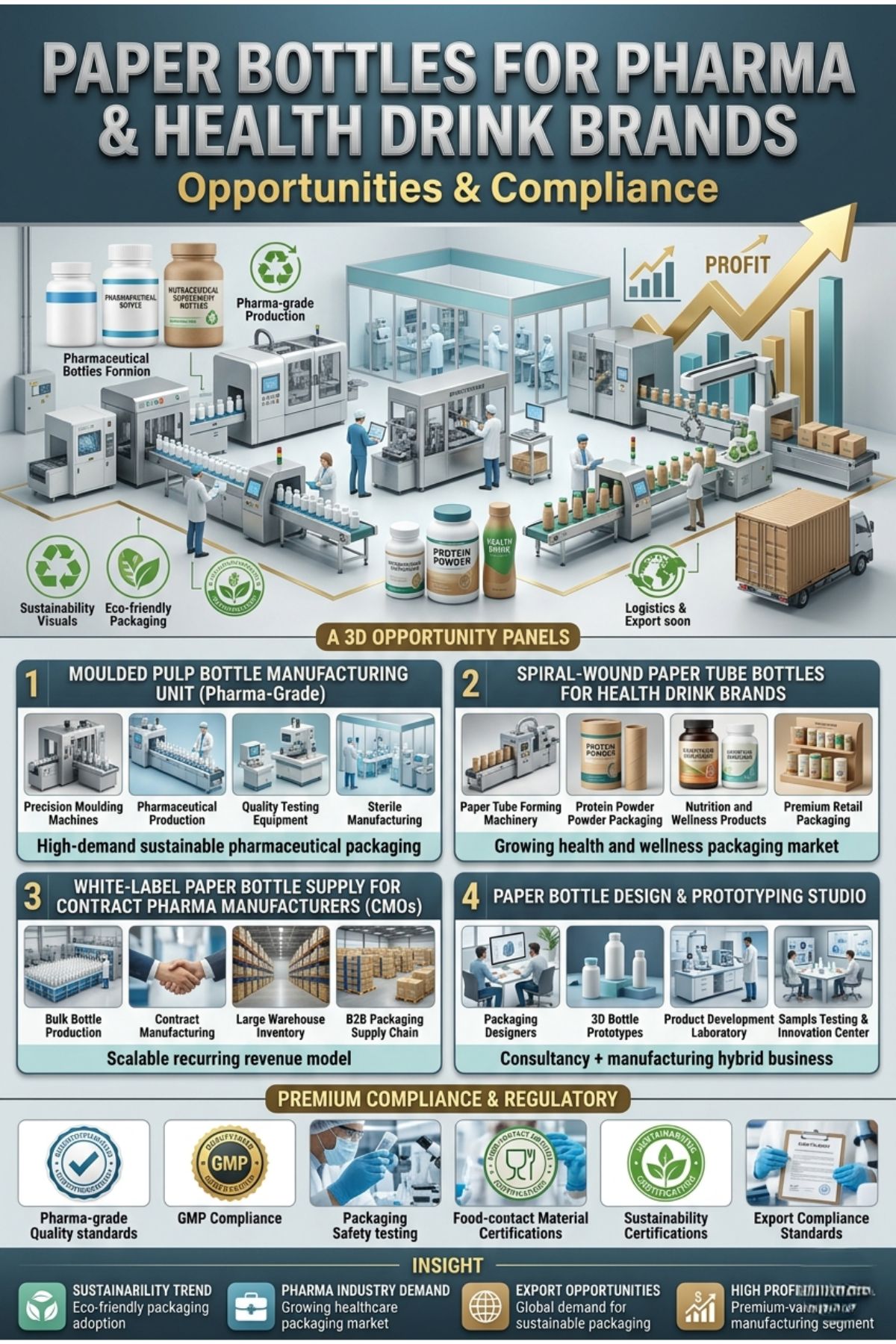
3. White-Label Paper Bottle Supply for Contract Pharma Manufacturers (CMOs)
As the pressure on pharma CMOs to deliver sustainable packaging solutions continues to rise from their Big Pharma and MNC customers. But most CMOs do not have sufficient R&D resources to develop new packaging formats on their own. That’s exactly what a startup is filling with itself, claiming to be a white-label paper bottle supplier to CMOs, providing pre-validated packaging stability test results and dossiers. It is a B2B, recurring revenue, and somewhat protected from retail competition business model. Investing in regulatory documentation and quality certifications (such as ISO 15378, Schedule M) is not easy, but it does form a long-lasting competitive moat. Ideally, the founder will have a background in pharma regulation or have the technical expertise needed to guide this niche.
4. Paper Bottle Design and Prototyping Studio (Consultancy + Manufacturing)
Some business owners don’t necessarily require a complete manufacturing process on day one. One interesting hybrid approach is to establish a design and prototyping lab that supports the brands in creating customised paper bottle concepts, oversees the development of the tools, and then outsources production to a manufacturing partner, while maintaining the design IP and client relationship. The cost of this model is quite low (around ₹20–30 lakh) and the income comes from design fees, prototype fees and production fees. This asset light model is redundant to a number of global packaging design companies. The in-house team of brand managers in mid-sized FMCG and pharma companies often don’t have the packaging engineering expertise in India, and this can drive up the fees of a boutique packaging studio to commercialize paper bottle packaging far beyond the price of a traditional product design consultancy.
Import–Export Opportunity Analysis for Paper Bottle Startups
The export of paper packaging in India is still in the nascent stage but promising. The Agriculture and Processed Food Products Export Development Authority (APEDA) system already has packaging sustainability standards set for organic food and health supplement exporters for the destination countries. India’s paper bottle suppliers are now directly sought after by European Union (EU) based importers as a result of the EU’s ban on single use plastic packaging that takes effect on most product categories.
In terms of imports, some key inputs are still reliant on overseas supply. Barrier liner materials (bio-PE, PLA films), specialty moulding chemicals and high precision pulp moulding dies continue to be mainly imported from Germany, Japan and Taiwan. But, with the government’s effort of making India self-reliant (Atmanirbhar Bharat), there are opportunities for the ancillary component makers in India for import substitution. A startup company that first enters into paper bottle manufacturing and at the same time develop import substitution liner materials could create a two-layer income generating system, which in the long run will provide a better margin profile.
However, Middle Eastern markets including UAE, Saudi Arabia and Qatar have exhibited keen interest in high quality health drink products from India in the export market. Various brands of Ayurvedic and nutraceuticals have already penetrated these geographies, while paper packaging gradually becomes a mandatory feature for its presentation on the shelves of high end formats. An exporter can have a solid start in an export-oriented supply chain by connecting with Indian exporters through The Federation of Indian Export Organizations (FIEO) through the quick establishment of anchor supply relationships.
Identify high-growth industries before others do
Indian MSME Success Stories in Sustainable Packaging
Commercial viability and scalability of sustainable packaging is already proven by Indian entrepreneurs. Their journeys provide tangible takeaways for first-time entrepreneurs venturing into the realm.
Sahajanand Laser Technology / EcoPackage Ventures — Ahmedabad
Recognizing the push to EPR compliance from their pharma customers, Sahajnand Laser Technology shifted a part of its packaging business to eco-material solutions. The company has been investing in the pharma insert business for its pharma blister packs with the use of pulp, and it was able to secure institutional orders from the mid-size pharma manufacturers of Gujarat. The decision criteria were to enter with one pharma client anchor, validate quality & regulatory acceptability, and then scale. This helped de-risk the investment cycle significantly for the unit and it reached breakeven in 18 months. The important takeaway for new entrants: In the regulatory environment, don’t target the broad market, focus on the client strategy.
Kalpana Plast / Ecocraft India — Pune
A Pune-based MSME, Ecocraft India developed a niche supplying health supplement industry with moulded pulp trays and inserts. As a promoter he realised that supplement companies would be more willing to accept the price being adjusted as compared to commodity FMCG companies since he would be able to provide them quality and short-run custom orders. Ecocraft spent a lot of money developing semi-automated pulp moulding lines that could easily switch between SKUs, something that is difficult to achieve in large moulded pulp factories in China. Now, they dispense to more than 40 brands in health and wellness in India, and are taking a plunge into paper bottle formats as well. The takeaway: Indian MSMEs indeed have a competitive edge over larger players in terms of their flexibility and responsiveness to small order volumes.
GreenPack Solutions — Coimbatore
To cater to the requirement of pharma distributors from Sri Lanka and Southeast Asian countries for cost-effective paper based secondary packaging, GreenPack Solutions made a smart gamble on the export market. From day one, founder Meena Krishnaswamy ensured that her company received BRC (British Retail Consortium) certification, which was an unusual approach by a small manufacturer, but which helped her company secure export tenders that most domestic MSMEs were unable to bid for. Revenue would steadily build up on export deals, which would provide cash flow for then investing in domestic pharma bottle capacity. The take away: Even at the lower initial volumes, export positioning will help finance domestic expansion and provide regulatory credibility quicker than domestic sales will.
Related Article: Paper Bottles for Beverages: A Profitable and Sustainable Manufacturing Opportunity
How NPCS Can Help You Evaluate This Opportunity
A detailed feasibility study is critical before making an investment in any manufacturing project in this field. For entrepreneurs who are thinking of starting a business in industries such as Paper Bottle Manufacturing, Niir Project Consultancy Services (NPCS) provides them with Market Survey cum Detailed Techno-Economic Feasibility Reports (DPRs). Our reports include detailed manufacturing processes, process flow diagrams, product mix and capacity planning, identification of all the machinery and raw materials used along with the details of their suppliers, and complete financial statements of your project including profitability analysis and break-even projections. Primary market research and demand analysis is conducted for specified geography and customer segment as well. When considering a paper bottle project for the pharma or health drink industry, an NPCS feasibility report provides you with a data-driven basis for engaging lenders, investors, and government subsidy bodies with confidence.
Paper Bottle Market & Project Overview: Key Data Snapshot
| Parameter | Details / Estimate | Remarks |
| Global Sustainable Packaging Market CAGR | ~6.2% | Paper formats leading growth |
| India Nutraceutical Market Growth Rate | ~12–15% annually | Source: IBEF / FSSAI data |
| EPR Plastic Packaging Obligation | Mandatory for all pharma & FMCG brands | Plastic Waste Mgmt Rules |
| Moulded Pulp Unit (Pharma-Grade) Investment | ₹80 lakh – ₹1.2 crore | 50,000 units/day capacity |
| Spiral-Wound Tube Unit Investment | ₹50 – ₹70 lakh | Health drink segment focus |
| Design Studio Model Investment | ₹20 – ₹30 lakh | Asset-light entry model |
| Price Premium for Paper vs Plastic (Pharma) | 30–40% above plastic cost | Thin supplier base advantage |
| Estimated Revenue (Pharma-Grade Unit, Yr 2) | ₹1.5 Cr – ₹2.5 Cr | 3–4 anchor pharma clients |
| Key Govt. Schemes Applicable | CLCSS, MUDRA Tarun, PLI (Allied), Stand-Up India | MSME Portal / DPIIT |
| Export Markets with Active Demand | EU, UAE, Saudi Arabia, Sri Lanka | Premium retail & pharma |
Frequently Asked Questions (FAQs)
1. Can pharmaceutical liquid products be safely packaged in paper?
Yes, but on the condition that. Pharma liquids use, such as paper bottles, must be lined from the inside with a barrier liner to stop moisture transferring and to keep the bottle sterile, which is usually a food-safe aluminium foil laminate or a bio-PE or PLA barrier. The liners should meet the schedule M of the Drugs and Cosmetic Act and preferably the food contact safety certification as per IS standards. Commercialization of dry pharma products and powder supplements is possible with less complex engineering and has a lower barrier requirement in paper format.
2. What is the license/ certificates required for establishing a pharma paper bottle unit?
You will need at least MSME Udyam Registration, GST registration, Factories Act Factory Licence and BIS Food Contact Paper Packaging Certification. ISO 15378 (Primary Packaging Materials for Medicinal Products) certification is strongly recommended and is becoming a requirement by big pharma customers for Direct to Pharma Manufacturers. Production must be started after obtaining state pollution control board consent (NOC).
3. How to obtain the initial customers for a paper bottle business?
Narrow prospecting to focus on anchor clients first. Target mid-size pharma companies (₹50-500 crore revenue) and D2C health supplement brands – They are big enough to order significant quantity but small enough to be open to sourcing from new brands. Early connections can be made faster by being at CPhI India (pharma expo) and interacting with Indian Drug Manufacturers Association (IDMA). In addition, presenting CMOs in your state with a regulatory-ready packaging dossier—along with the product—can greatly cut the time spent evaluating the product, and accelerate approvals.
4. Will paper bottles be cost competitive with plastic bottles at scale?
Only at par for not all applications. For the same volume of production, paper bottles are now 25–45% more expensive than the equivalent PET or HDPE bottles. But at the larger production volume, this difference is considerably less and makes a significant contribution to the cost savings for brands in meeting EPR requirements. Furthermore, high quality health drink companies regularly cover the price difference as a brand investment, especially if there is a price premium in paper-packaged items at retail. In the case of commodity-priced pharma generics, it is indeed a difficult proposition due to cost considerations and thus the first step should be to go for premium and specialty markets.
5. What are the raw materials required and where to get them in India?
The main raw materials used are recycled kraft paper or virgin bleached paper pulp, barrier film layers (PLA or bio-PE) and food-grade printing inks. Kraft paper and pulp is easily available in the domestic market from suppliers in Tamil Nadu, Maharashtra and Telangana. Barrier liner films are partly available domestically but for special variants for pharma applications, imports from Germany or Taiwan are still prevalent. Domestic paper boards are available from reliable sources like FIBC (bulk paper suppliers) and paper boards from APPM or JK Paper. The paper commodity index is tracked through CPPAI (Confederation of Paper & Paperboard Industry of India), to control input cost volatility.
6. Does the government support this type of eco-packaging unit in any way?
Yes, there are several schemes. Capital subsidy on the machinery is given by the CLCSS under MSME with 15% subsidy. Mudra loans in Tarun and Kishore category provide collateral-free working capital. Also, the National Mission for a Green India (NMGI) and some state government green manufacturing incentives provide interest subvention for eco-friendly manufacturing unit. The Startup India portal (DPIIT) provides tax exemption to eligible startups under Section 80-IAC and various other environmental and labour laws provide certain benefits of self-certification in the initial years, thereby reducing the compliance burden.
Conclusions: A market maturing at a quicker rate than most founders realize
Paper bottles for pharma and health drink brands is not a hypothetical concept, but an active market segment that has moved from the early adoption stage to becoming the mainstream. The pressure of regulation is present, the need for brands is increasing and the supply-side deficit is large. This is one of the better business ideas in Indian manufacturing to venture into at the right time for first generation entrepreneurs and MSME investors, owing to the support measures, potential for foreign market exports and lack of competition in the country.
The window won’t remain open forever. The advantage in the initial market will diminish as more startups and existing packaging firms are aware of this opportunity and margins will shrink. Entrepreneurs who enter this market now will have a clear grasp of the technical aspects, a customer segment already in place and regulatory readiness.


