






The One Number Your Bank Checks Before Everything Else
In India, about 85% of MSME loan applications fail due to not having a clear understanding of the working capital cycle, not because of bad credit, aren’t they? That’s what SIDBI and IFC found during field surveys, and an affliction that every first-generation founder must tape to their desk.
The working capital cycle is simple, you buy raw materials, make or sell a product, make a delivery, wait for the money. The disparity between the time in which your suppliers get paid and you are paid by your customers is a hole you are able to fill, or your bank is able to fill.
That divide is dangerous for an MSME with thin margins – and most do – because it can be fatal. It takes 60-90 days for the payment of the garment exporters of Tiruppur for foreign countries. A pharma formulation unit in Baddi has ₹ 25–40 lakhs of raw material in stock at any point of time. A food processor gives a credit of 45 days to his distributor in Nashik. They are unable to compete on a level playing field. They need a working capital loan. The point is: which bank, which scheme and on what terms? This article provides the details, and not promises, on that question.
The Working Capital Crunch in Indian MSMEs: What the Data Says
MSMEs provide employment to more than 11 crore persons and account for around 30% of the GDP but the penetration of credit has been very low in the formal credit market in the country. The ministry of MSME’s Annual Report estimates that the credit gap for the MSMEs is about ₹20–25 lakh crore. This is primarily working capital, not loans for machinery but finance for day-to-day operations.
The MSME sector has consistently been getting less than 16% funding from the total scheduled commercial bank lending as per the Report on Trend and Progress of Banking (RTPB) of the Reserve Bank of India, despite representing 45% of the industrial output. The impact of this structural mismatch, at least in terms of the financial implications, is that an estimated 63% of micro enterprises and 48% of small enterprises take out loans from informal moneylenders or from their own working funds and are charged 24–36% a year interest.
Uttar Pradesh, West Bengal, Tamil Nadu, Rajasthan and Maharashtra are the states having highest working capital stress, which are also the states having dense clusters of MSMEs in textile, leather, engineering and food processing sectors. A credit market that under-serves buyers of handloom goods in Varanasi, with a credit market that under-serves the suppliers of cycle parts in Ludhiana, and a credit market that under-serves the buyers of hosiery goods in Tirupur — all have the same structural problem.
As per the latest data, there are more than 3.5 crores of MSMEs registered on the Udyam Registration Portal. Only a part of them has active formal working capital lines. The remainder are either informally over-leveraged or are under-funded and under-resourced, and thus vulnerable to any disruption in the supply chains.
Related Article: PMEGP Loan 2026: How to Apply, Eligibility & Subsidy Amount
Table 1: Working Capital Requirement by MSME Sector and Bank Recommendation
| MSME Sector | Monthly Raw Material Cost (₹) | Debtors Outstanding (₹) | Ideal Working Capital Limit (₹) | Suitable Bank | Best Scheme |
| Food Processing (small) | 3,00,000–6,00,000 | 1,50,000–3,00,000 | 5,00,000–10,00,000 | SBI / PNB | CGTMSE CC |
| Textile / Garment Unit | 8,00,000–18,00,000 | 5,00,000–12,00,000 | 15,00,000–35,00,000 | PNB | MSME Sahyog |
| Auto Components (Tier-2) | 12,00,000–30,00,000 | 8,00,000–20,00,000 | 25,00,000–60,00,000 | SBI / HDFC | SME CC / BGL |
| Pharmaceutical (formulation) | 10,00,000–25,00,000 | 6,00,000–15,00,000 | 20,00,000–50,00,000 | SBI | CGTMSE Loan |
| Construction Materials | 6,00,000–15,00,000 | 3,00,000–8,00,000 | 10,00,000–25,00,000 | PNB / SBI | Udyog Mitra |
| Agri-Input / Seed Trading | 5,00,000–12,00,000 | 2,00,000–6,00,000 | 8,00,000–20,00,000 | SBI / PNB | e-Mudra / CC |
Source: SIDBI MSME Pulse Report; RBI MSME Credit Data; Industry estimates
Get Detailed Project Report (DPR): Food Processing and Agriculture-Based Projects
Why Now Is the Right Time to Formalise Your Working Capital
Why is it now the appropriate time to formalise your Working Capital?Why is it now the right time to formalise your Working Capital?
There are three forces that are coming together and 80% of MSMEs that rely on informal credit are behind the curve if you take action now.
The first one is that interest rates for MSME working capital are quite competitive right now after more than 10 years. Due to SBI’s External Benchmark Lending Rate (EBLR) being tied up with the RBI Repo Rate, the public sector banks are providing working capital cash credit at the rate of 8.55% per annum and above. This is three or four times more expensive than the majority of informal credit.
Second, the limit for collateral-free loans by the Credit Guarantee Fund Trust for Micro and Small Enterprises (CGTMSE) is now extended to ₹2 crore, which includes 90%+ of the working capital requirement of MSMEs (not within large cluster units). This implies that a Promoter from Jaipur or Coimbatore can borrow Rs.50 lakh to Rs.1 crore without availing property.
Thirdly, the Trade Receivables Discounting System (TReDS) — RBI’s invoice discounting platform — now connects MSMEs to big corporate buyers via RXIL, M1xchange and Invoicemart. An MSME selling to a PSU or big buyer can convert their 60-day receivables into cash in 48-72 hours without availing a bank loan.
Under the Interest Subvention Scheme of MSME Ministry, the working capital loans of Udyam registered units will be offered 2% rebate per annum on loans availed from PNB and SBI, which will reduce the rate of working capital loans by the MSME Ministry from 9.5% to 7.5%. That’s just ₹1 lakh saved per year by registering on Udyam, at ₹50 lakh outstanding.
In addition, larger buyers are now required to pay within 45 days to MSMEs as per the guidelines of MSME Development and Regulation Act, and MSME Samadhaan portal also enables MSMEs to file against defaulters. The more formal the credit and the quicker the payment collected, the more solid and healthy the cash position will be.
Table 2: SBI, HDFC, and PNB Working Capital Schemes — Key Parameters Compared
| Parameter | SBI e-Mudra / SME CC | SBI CGTMSE Loan | HDFC Business Growth Loan | PNB MSME Sahyog | PNB Udyog Mitra |
| Loan Amount | Up to ₹50,000 (e-Mudra); ₹10L–₹500L (CC) | ₹10L–₹200L | ₹50,000–₹5 Cr | ₹1L–₹500L | Up to ₹500L |
| Interest Rate (p.a.) | 8.55%–10.85% (linked to EBLR) | 8.90%–11.25% | 10.75%–22.50% | 8.80%–12.50% | 9.25%–13.00% |
| Collateral Required | No (up to ₹10L) | No (CGTMSE cover) | Minimal; clean (up to ₹40L) | No (CGTMSE) | Yes (above ₹25L) |
| Processing Time | 3–7 working days (online) | 7–15 working days | 5–10 working days | 7–14 working days | 10–15 working days |
| Repayment Tenure | Revolving (12-month renewal) | 12–60 months | 12–48 months | 12–60 months | Up to 60 months |
| Eligibility (Turnover) | Min ₹1L GST sales | Up to ₹500 Cr | Min ₹40L turnover | Up to ₹250 Cr | Up to ₹250 Cr |
| CGTMSE Cover | Yes (select products) | Yes — primary feature | No (own credit assessment) | Yes | Yes (on select variants) |
Source: SBI MSME Products (sbi.co.in/sme), HDFC Bank Business Loans, PNB MSME Schemes (pnbindia.in); rates as per recent published schedules — subject to change.
How to Apply: A Step-by-Step Guide for First-Time Borrowers
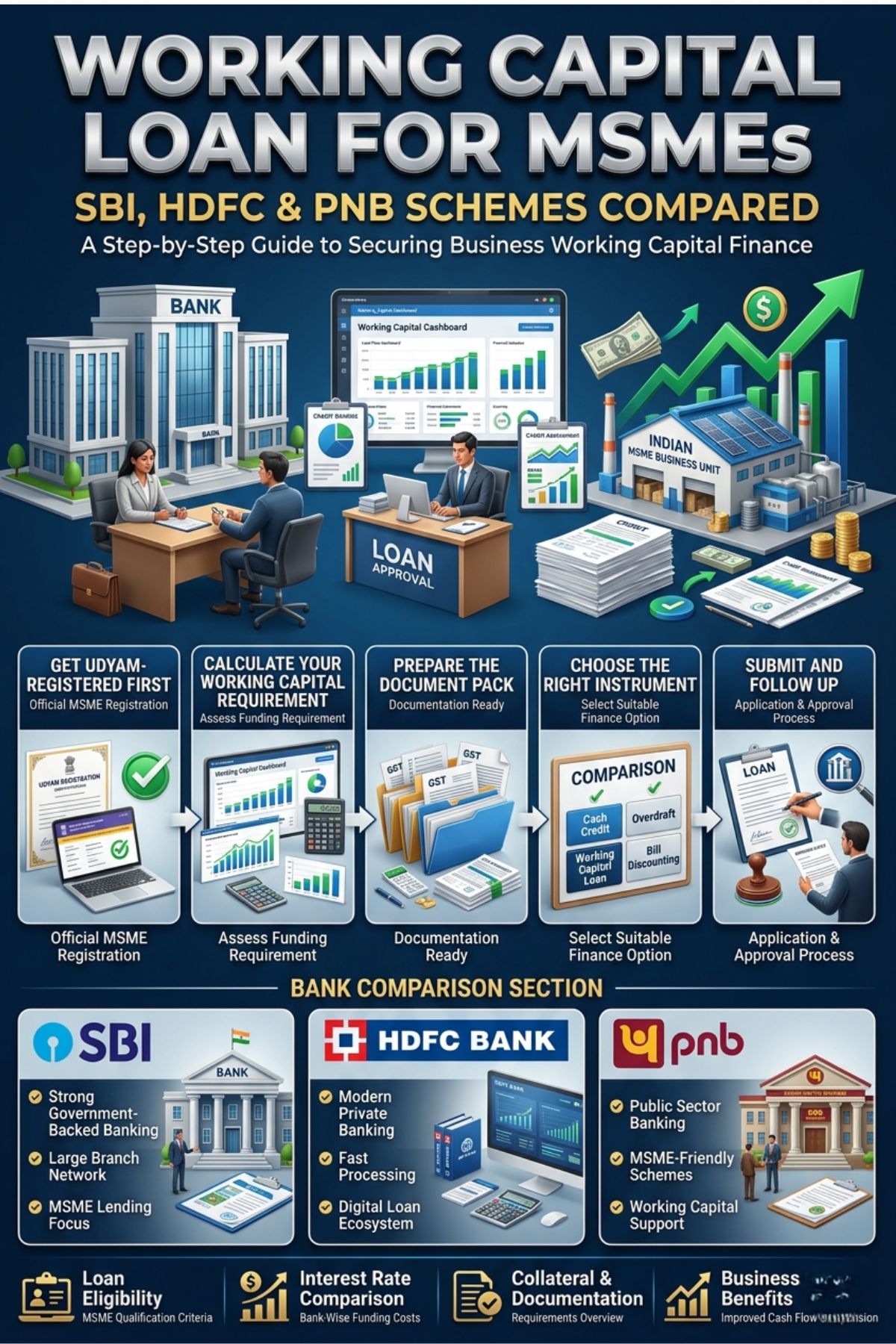
Step 1 — Get Udyam-Registered First
Register on the Udyam Registration Portal before going to any bank. It’s free, takes 15 minutes and required for CGTMSE coverage & interest subvention. If you don’t have a Udyam number, you can’t apply for a loan in the bank and your application is considered to be an informal business.
Step 2 — Calculate Your Working Capital Requirement
Never go to a bank without a number. Follow this formula: Working Capital Need = (Inventory Days + Debtor Days – Creditor Days) × (Monthly Operating Cost / 30). A textile unit with 30 days of inventory, 60 days of debtors, and 20 days of creditor credit, running ₹15 lakh/month in costs, needs: (30 + 60 − 20) × (15,00,000 ÷ 30) = 70 × 50,000 = ₹35 lakhs. This is the first offer that you make.
Step 3 — Prepare the Document Pack
Typical documents required by public sector banks (SBI, PNB): (a) Last 2 years of ITR and Audited balance sheets; (b) GST returns for last 12 months; (c) Bank statements for last 12 months; (d) Udyam Registration Certificate; (e) KYC of promoters; (f) One page business profile with product, customers, key suppliers. Additionally, HDFC Bank conducts a bureau check and requests trade references.
Step 4 — Choose the Right Instrument
If you have a recurring working capital requirement with monthly fluctuations, a Cash Credit (CC) account will be suitable for you, for example, in trading, textile and food businesses. Seasonal businesses such as agri-processors or crackers manufacturers would benefit from using a Demand Loan or Working Capital Term Loan (WCTL) where they require a larger amount of money in a lump sum to be used for 6-9 months. An Overdraft (OD) against property is ideal for a promoter who owns property and desires the lowest rate of interest.
Step 5 — Submit and Follow Up
Apply for SBI through YONO Business app and dedicated SME branch in your cluster area. The cities have MSME relationship managers, who can process files quickly for PNB, the MSME hub. HDFC Bank’s Business Growth Loans are primarily digital and can be applied using HDFC Bank’s NetBanking portal. Once submitted, check on the task every 3–4 days. In the case of a typical CC at SBI or PNB, the account should open in 10-20 working days after the submission of all documents.
Get Detailed Insights from This Book: 50 Best Home Businesses To Start With Just 50,000
Typical Investment / Cost Breakdown for Establishing Credit
New borrowers often forget the following costs to consider when taking out a working capital facility:
- Guarantee fee: 0.37% – 1.35% per annum (paid upfront, or annually by the bank, but included in the effective rate)
- Processing fee is from 0.5% to 1% of the loan granted which is negotiable with the public sector banks.
- The stamp duty for the loan agreement varies by state, ranging from ₹500 to ₹5,000.
- CA certificate for net worth / stock statement: ₹3,000–₹10,000
- On CC accounts, Renewal fee varies from ₹2000 to ₹5000 per annum.
Financial Snapshot: What a ₹25 Lakh Working Capital Facility Actually Costs
Let’s consider a typical case in which a small Surat-based garment manufacturer, with an annual turnover of ₹1.2 crore, applies for a CC account of ₹25 lakh with SBI under the CGTMSE scheme.
Imported from interest cost: If the average utilisation of ₹20 lakh is 9.25% per annum, then the interest that is to be paid annually is ₹1,85,000.
SBI factor in the above rate is CGTMSE fee – approximately ₹23,000-27,000 per annum.
Total annual financing cost: Approximately ₹2,10,000–₹2,30,000.
The revenue potential of this working capital: This Surat unit has obtained an average float of ₹20 lakh, which translates to an extra turnover of ₹70–80 lakh per quarter, with gross profits of ₹10–14 lakh at 15–18% margins. The financing cost of ₹2.1-2.3 lakh is easily recovered in the first quarter.
Working capital loan is not a term loan and therefore has no ‘payback period’. It is the interest coverage that is important and if the NO margin is > 4-5%, the WC facility is self-sustaining.
Compare this with informal credit: A moneylender lending ₹20 lakh at 2% per month gets back over ₹4,80,000 annually compared to the SBI rate. This basic maths is enough to support your effort in formalising your credit.
Table 3: Government Schemes Supporting MSME Working Capital — Eligibility and Benefits
| Scheme | Nodal Agency | Max Guarantee / Subsidy | Who Can Apply | Key Benefit for Working Capital |
| CGTMSE | SIDBI + MoMSME | ₹2 Cr (75–85% of loan) | All MSMEs | Collateral-free WC loans up to ₹2 Cr |
| MUDRA – Tarun | MUDRA Ltd. (via banks) | Up to ₹10 Lakh | Non-corporate MSMEs | Instant WC for micro units; no collateral |
| PMEGP | KVIC / DIC / Banks | 15–35% capital subsidy | New manufacturing units | Reduces initial WC burden through upfront grant |
| TReDS (RXIL/M1xchange) | RBI-licensed platforms | Invoice discounting at 7–10% | MSMEs with corporate buyers | Convert receivables to cash within 2–3 days |
| Emergency Credit Line (ECLGS) | NCGTC / Banks / NBFCs | Up to 20% of outstanding credit | Existing MSME borrowers | Supplementary WC without additional collateral |
| Interest Subvention (MoMSME) | Ministry of MSME / Banks | 2% p.a. interest rebate | Udyam-registered MSMEs | Reduces effective WC loan cost by 2% |
Source: CGTMSE (cgtmse.in), MUDRA (mudra.org.in), KVIC (kvic.gov.in), RBI (rbi.org.in), Ministry of MSME (msme.gov.in)
Project Reports and Feasibility Studies: Where NPCS Can Help
Many MSME entrepreneurs present the bank with a good business concept but an inadequate paper trail. Banks do not lend to stories; they lend to numbers. The banker is presented with what he/she truly requires: Projected financials, working capital computation, plant layout, and break-even analysis all in a format that the banker’s credit committee will accept, all in a Detailed Project Report (DPR) or techno-economic feasibility study. Niir Project Consultancy Services (NPCS) — niir.org and entrepreneurindia.co — is well established in the field of DPR preparation and feasibility studies, plant layout designs, market research reports and end-to-end business setup consultancy for 45 years and in 50+ countries. They have more than 8,000 project reports in their database, ranging from specialty chemicals to agro-processing to renewable energy, across the various sectors. If you are a MSME founder applying for a bank loan or are in the process of applying for a bank loan via CGTMSE, a good project report is not an option, it is a must-have for approval.
Your investment deserves the right opportunity
The Decision You Need to Make This Week
End informal credit business management. The maths is simple: It’s half (or one-third) of what you will pay a moneylender or relative to get a formalized working capital facility from SBI, HDFC or PNB. The application process is not complicated, but it also is not mysterious. It’s a documentation task where you can take guidance from any competent CA or Business Consultant and complete in 4-6 weeks.
Your one action item this week is to calculate your working capital cycle using the working capital cycle formula above, obtain your Udyam certificate (if you don’t have one already it is free at udyamregistration.gov.in), and meet with your nearest SBI SME branch or PNB MSME Hub. Bring your GST returns and bank statements. Just show up with a number — not some nebulous ‘working capital’ request.
You lose one additional month in opportunity cost for 2x-3x times the expense rate of what your desired price point of this money should be. It the true opportunity cost.
Entrepreneur Spotlight
Ramesh started with an initial capital of ₹12 lakh, from his father’s property, and 18 employees and with a turnover of ₹3.2 crore per annum. After three years, he switched to a formal cash credit facility from CGTMSE with the SBI at a 9.4 per cent and released the property’s lien with an annual saving of 6 per cent of the interest. His one lesson: ‘The bank did not turn down my application earlier. It’s just that I didn’t submit the proper paperwork. After making a proper Stock and Debtor Statement with my CA, the account was sanctioned in 11 days.’ He has two production lines and 60 workers today.
Frequently Asked Questions
1. What is the minimum turnover needed for availing working capital loan from SBI or PNB?
The minimum annual GST turnover does not exist for a CC account, but practically, most public sector banks demand a minimum of ₹15-20 lakh in verifiable GST turnover for a CC account. As little as ₹1 lakh in declared sales will be enough to avail SBI’s e-Mudra. PNB’s MSME Sahyog is aimed at MSMEs with a turnover range of ₹10 lakh and ₹250 crore.
2. Is there a working capital loan without any collateral, above the limit of ₹10 lakh?
Yes. Collateral free working capital loans are available under CGTMSE scheme up to ₹2 crore. SBI and PNB are the leading banks under CGTMSE. The list of member lending institutions can be verified from cgtmse.in. Most of the times, the bank bears the guarantee fee; it is incorporated in the interest rates.
3.What is the time that a working capital CC account takes to be sanctioned?
For CGTMSE cases, SBI normally sanctions in 7-15 working days and for e-Mudra cases, it takes 3-7 days with full documentation. HDFC Bank takes 5-10 working days to process the Business Growth Loan. The PNB is 7-14 days. It is nearly always caused by an incomplete document — not processing time at the bank. Ensure to have all the relevant statements and documents ready before filing the application, such as the last 2 years of ITR, bank statements, GST returns, and Udyam certificate.
4. Who is better for the first time MSME borrower SBI or HDFC bank?
SBI or PNB through CGTMSE is a better choice for first time borrower with less credit history. Public sector banks are required to meet the MSME lending targets and have greater flexibility with regard to credit history gaps, provided the business fundamentals are good. Their processing speed is quicker and the customer experience on digital banking is also better, but they offer a tougher credit assessment and sub-₹50 lakh borrowers may face interest rates 150–300 basis points higher than that offered by SBI.
5. What are the government schemes that help to lower the cost of working capital borrowing?
The three schemes that are important are (a) CGTMSE, which waives collaterals for loans of up to ₹2 crore, (b) MoMSME Interest Subvention, which provides a 2% per annum interest rebate on WC loans for Udyam-registered units and (c) TReDS, which lets corporate receivables be converted to cash at a 7–10% discounting cost. Information about all three can be found at msme.gov.in.
6. What does NPCS do to help me apply for a working capital loan?
Niir Project Consultancy Services (NPCS) prepares Detailed Project Reports (DPRs) and techno-economic feasibility studies which include the estimated financials, working capital calculation, market analysis which are required by the bank credit committees. Various banks and NBFCs in the public and private sector in India accept these reports. Go to niir.org or entrepreneurindia.co and read through their catalogue or get a tailored DPR for your particular business.


