





Dialysis Concentrate Manufacturing Business
The dialysis infrastructure is expanding at a much faster rate than the production of dialysis consumables in India. Each dialysis treatment, which is performed millions of times nationwide, relies on a carefully calibrated combination of chemicals: acid concentrates, bicarbonate concentrates, pharmacy grade sodium bicarbonate and machine disinfectants. These are required inputs and cannot be skipped. They are essential things that people need in their medical care. However, the production of products such as Haemodiasate Dry Citrate Powder, Bicarb Dry Bicarbonate Concentrate, and disinfectants for use in dialysis, is still significantly lower than the demand for these products. It is a good place to look for entrepreneurs who have manufacturing business ideas with real long-term demand, strong institutional buyers, and government tailwinds.
The Structural Demand Story Behind This Industry
Chronic kidney disease (CKD) and end-stage renal disease (ESRD) are impacting a large and rapidly increasing population of people in India. The Pradhan Mantri National Dialysis Programme, under the National Health Mission, has brought a sea change in the provision of dialysis in government district hospitals. Concurrently, the number of private dialysis chains has increased in tier-1 and tier-2 cities.
This translates to a gap in the supply of structures. A continuous and reliable supply to the dialysis centres is required for acid concentrates (Part-A), bicarbonate concentrates (Part-B), pre-measured sodium bicarbonate sachets and machine disinfectants. Loss of any of these consumables prevents delivery of patient care. The procurement managers thus prefer to be sure of the local supply than of ready-made imports, which are often less reliable.
The Indian Council of Medical Research (ICMR) has stated that uncontrolled diabetes and hypertension, and poor-quality water in the agricultural areas are the main reasons for the increasing prevalence of CKD in India. This in turn signifies that dialysis needs will continue to rise regardless of the economic cycle.
Related Article: How to Set Up a Manufacturing Plant for Hemodialysis Dialysate Concentrates and Dialysis Cleaning Chemicals in India
Why Import Substitution Creates a First-Mover Advantage
Presently, Germany, Japan and China are the major suppliers of dialysis concentrate in India. Manufacturers in India who can make a comparable quality product at 20–35% less cost are instant attractive options for the hospital procurement team. Further, chain disruptions experienced by the hospital chains around the world in the recent years have made the Indian hospital chains favor domestic suppliers, as they are unable to rely on other countries for critical consumables. This strategic preference is not likely to change.
Government Schemes That Make This Investment More Attractive
The Ministry of MSME and DPIIT has developed a policy framework which clearly incentivises MSME manufacturing of medical consumables. Several instruments will be of benefit to entrepreneurs who are entering the dialysis concentrate space.
The Production Linked Incentive (PLI) Scheme for Pharmaceuticals, under the Department of Pharmaceuticals, provides incentive to medical device/ consumable manufacturers to achieve incremental production. All the dialysis concentrates that are registered properly with the Central Drugs Standard Control Organisation (CDSCO) fall under the eligible product categories.
Credit Guarantee Fund Trust for Micro and Small Enterprises (CGTMSE) offers insurance-backed credit facilities, allowing first-generation entrepreneurs to avail term loan facilities without offering any personal security. With the PMEGP scheme of KVIC which provides up to 35% of capital subsidy for manufacturing units in backward areas, a new business owner will be able to significantly lower equity investment.
States provide extra incentives including reduced power tariff and exemption from stamp duty on pharmaceutical manufacturing in policies at the state level in Gujarat, Maharashtra, Telangana and Karnataka. Make in India Medical Devices portal offers a one stop repository for all the applicable national schemes.
Specific Business Ideas for MSME Entrepreneurs in This Sector
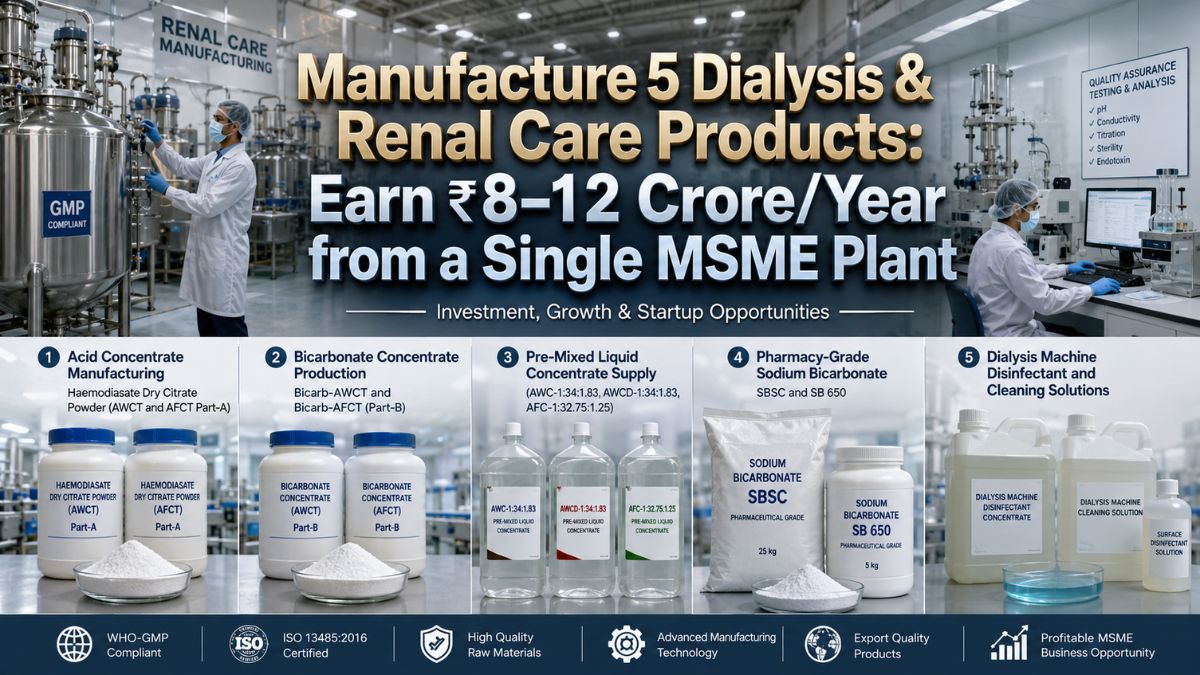
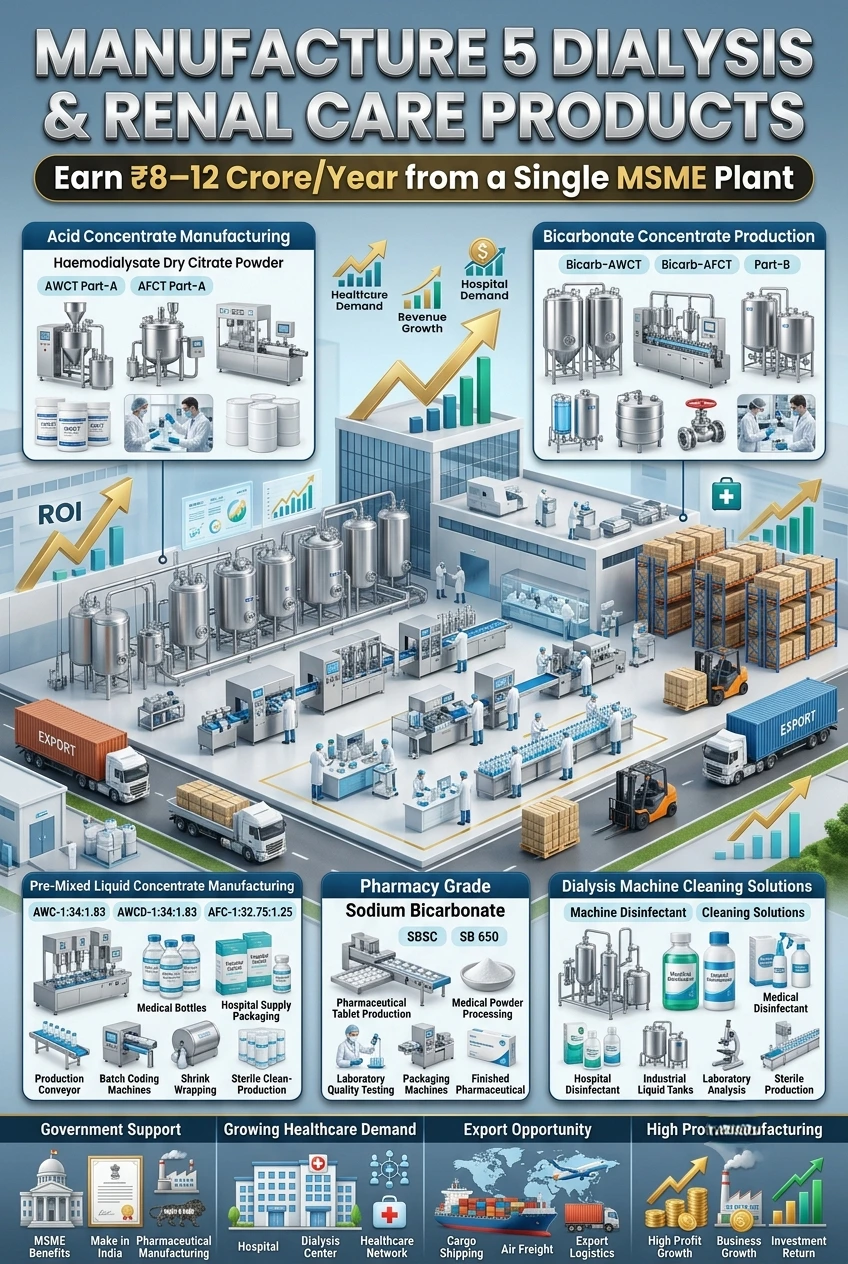
1. Acid Concentrate Manufacturing — Haemodiasate Dry Citrate Powder (AWCT and AFCT Part-A)
Acid concentrate or part-A is one of two essentials for each haemodialysis treatment. Two predominant machine architectures used among the dialysis centres in India are Haemodiasate Dry Citrate Powder in AWCT formulation (dilution ratio 1:34:1.83) & AFCT formulation (dilution ratio 1:32.75:1.25). A MSME manufacturing both variants has a complete range manufacturing facility with the capacity to supply to almost any sort of dialysis machine setup offered available in the marketplace. The dry powder product format has several benefits over liquid concentrates such as extended shelf life, reduced freight cost per unit active ingredient, ease of storage etc. A plant with its capacity of 600-1,000 MTY can support a hospital cluster of 40-60 dialysis chairs on continuous replenishment contract.
Get Detailed Project Report (DPR): Production of Bicarbonate Cartridge Acid Concentrate Hot Disinfectant Cold Disinfectant
2. Bicarbonate Concentrate Production — Bicarb-AWCT and Bicarb-AFCT (Part-B)
Part-A and purified water are combined at the point of use with Part-B or bicarbonate concentrate to make the final dialysate fluid. In those markets with poor cold chain facilities the dry bicarbonate format (Bicarb-AWCT and Bicarb-AFCT) is the major supply mode since no refrigerated transport is needed. This makes dry bicarbonate a particularly attractive product for the manufacturers, who are geared towards addressing the needs of hospital or tier-2 dialysis centres. Also, a manufacturer that makes both Part-A and Part-B products may be able to sell a hospital the bundled supply contract, which is a major commercial benefit, simplifying the hospital’s procurement process and the benefit of the supplier being a preferred vendor.
3. Pre-Mixed Liquid Concentrate Supply (AWC-1:34:1.83, AWCD-1:34:1.83, AFC-1:32.75:1.25)
Liquid concentrate formats (AWC, AWCD, AFC) are suitable for dialysis centres which want to use ready-to-use formats and have the storage facilities to accept liquid products. Commonly, liquid concentrates are used for operational efficiency by metro hospital chains, large private dialysis providers and 80+ high throughput centres. As one manufacturer moves into the Liquid Concentrate market, they are gaining access to the premium market segment. Simple additional capital investment could be required for the installation of liquid concentrate lines in a dry powder plant, to enable the plant to operate for both market segments and help maximise capacity utilisation throughout the year.
4. Pharmacy-Grade Sodium Bicarbonate — SBSC and SB 650
Sodium Bicarbonate IP 600gm with 235gm NaCl (SBSC) and Sodium Bicarbonate IP 650gm (SB 650) are standard products which are used in large quantities in dialysis centres which prepare their own bicarbonate. Manufacturers having pharmaceutical production experience will find it easy to make these products as they follow a well-defined Indian Pharmacopoeia monograph which complies with the regulations. The unit economics is predictable and margins are consistent. The startup capital cost is modest and cash flow can be break-even as soon as possible, making it an ideal choice for the new players entering the dialysis supply market, who intend to build institutional relationship first and gradually expand their business to concentrate production.
5. Dialysis Machine Disinfectant and Cleaning Solutions
The most neglected part of dialysis consumables manufacturing is disinfection and cleaning portfolio including Diatro-Sterile, Diatro-Clean, Hydrogen Peroxide Solution, Formaldehyde Solution, Vinegar Solution, Sodium Hypochlorite and Citric Acid Powder. All dialysis machines are disinfected during a complex process between each dialysis session. These chemicals are used in large amounts every day. Most dialysis centres, however, obtain them from the general industrial chemical suppliers, which have not established a clinical-grade quality assurance system. If the manufacturer markets these solutions specifically for dialysis usage, with a standardised concentration, certified sterility and appropriate labelling, it will be able to charge a relevant price premium and establish sticky supply relationships. Entry costs are lower than concentrate manufacturing, regulations are less complex and the product range provides rapid scale up.
Import and Export Opportunities for New Manufacturers
However, Germany and Japan sourced dialysis concentrates usually cost 30-50 % more than the same concentrates made domestically. GMP compliant and CDSCO registered Indian producers can competitively price their products as compared to imported products while having a good margin of profit. Pharmexcil actively promotes the export market access for Indian medical consumable manufacturers and has special programmes for Southeast Asian and African markets.
The country is importing dialysis concentrates at huge scale, without any production capacity, including Bangladesh, Myanmar, Sri Lanka, Kenya, Nigeria, and some in the Gulf. Gaining the WHO-GMP and ISO 13485 is an excellent option for Indian manufacturers to be able to sell their products in such markets at competitive prices worldwide. Export revenue for a well-structured MSME can be sizable, ranging from 20-40% of turnover in the third year of operations.
Moreover, the new global supply chains since the outbreak of the pandemic have opened a window for the Indian manufacturers to emerge as preferred suppliers of the international dialysis chains which are operating across the South Asian countries. In India, there are various multinational dialysis companies which are actively looking for domestic sourcing partners to minimize risk of procurement.
Discover business ideas that actually make money
Indian Entrepreneurs Who Built Scale in Medical Manufacturing
Vijay Chordia — Trivitron Healthcare (Chennai)
To turn one of India’s most popular medical device and consumables companies, Trivitron Healthcare identified high import areas with no manufacturing momentum and consciously developed manufacturing strength for each segment by creating the right organizational infrastructure. They have a growth strategy that can be translated to dialysis concentrates: Start with products in which import substitution offers immediate pricing power and then develop export capacity. Chordia showed that it’s not price, it’s quality certification that’s the competitive moat.
Suresh Vazirani — Transasia Bio-Medicals (Mumbai)
Suresh Vazirani transformed the trading company of Transasia into becoming the largest in-vitro diagnostics manufacturer in India, by consistently providing quality products and timely supply to the institutional clients – government health programmes and hospitals. Dialysis concentrates entrepreneurs: The lesson is obvious—to serve the institutional audience you need to serve as an anchor for this business. They place in bulk, they are quick to pay, and they give the credibility of reference that is required for scaling.
NephroPlus — Kamal Shah (Hyderabad)
Founded by Kamal Shah – who used to be a dialysis patient himself – NephroPlus evolved into the country’s largest dialysis chain by establishing uniformity in clinical protocols and supply chain management at hundreds of its centres. NephroPlus closely cooperates with domestic suppliers of consumables that satisfy their quality standards. MSMEs who want to introduce a dialysis concentrate business find an institutional anchor buyer like Nephrol’s an ideal customer because of the following reasons:
How NPCS Can Help You Evaluate and Execute This Project
Niir Project Consultancy Services (NPCS) prepare detailed Market Survey cum Detailing Techno-Economic Feasibility Reports (DPRs) for the entrepreneurs who are intending to enter in the manufacturing of dialysis solutions and medical solutions business. Our reports span the entire production process of products such as Haemodiasate Dry Citrate Powder (AWCT/AFCT), Bicarb Dry Bicarbonate Concentrate, sodium bicarbonate IP formulations, and the entire dialysis disinfectant product range. The report contains the plant layout, process flow diagram, detail of machinery and raw material sourcing, detail of regulatory compliance roadmap as per CDSCO and Indian Pharmacopoeia standards, complete financial modelling with the profitability projection, and market demand analysis for domestic as well as export markets as well. For a list of our project reports for the pharmaceutical and medical devices industry, visit niir.org.
Download the Full Guide: Biotech & Pharmaceutical Handbook
Key Product Data: Dialysis Concentrates and Medical Solutions Manufacturing
| Product | Formulation / Dilution | Plant Capacity (Annual) | Project Cost (₹) | Indicative Revenue (₹) |
| Haemodiasate Dry Citrate Powder AWCT (Part-A) | AWC 1:34:1.83 | 600–1,000 MT | 1.8–2.5 Crore | 5–8 Crore |
| Haemodiasate Dry Citrate Powder AFCT (Part-A) | AFC 1:32.75:1.25 | 500–800 MT | 1.5–2.2 Crore | 4–7 Crore |
| Bicarb Dry Bicarbonate Concentrate (Part-B) AWCT/AFCT | AWCD / AFCT B | 700–1,200 MT | 1.2–2.0 Crore | 3–6 Crore |
| Sodium Bicarbonate IP — SBSC & SB 650 | 600gm+235gm / 650gm | 1.5–2.5 Mn units | 80L–1.5 Crore | 3–5 Crore |
| Dialysis Disinfectants (Diatro-Sterile, Diatro-Clean, H₂O₂, NaOCl) | Various grades | 1,000–2,000 KL | 60L–1.2 Crore | 2–4 Crore |
| Citric Acid Powder & Vinegar Solution (Dialysis Grade) | IP / USP Grade | 500–900 MT | 50–80 Lakh | 1.5–3 Crore |
Indicative estimates based on MSME-scale operations. Actual financials depend on capacity, location, and plant configuration.
FAQ: What First-Generation Entrepreneurs Want to Know
Q1. Is dialysis concentrate manufacturing regulated under the Drugs and Cosmetics Act?
Yes. Dialysis concentrates can be considered a drug or medical device depending on their formulation. Drug product manufacturing License is required from the State Licensing Authority and CDSCO registration is required for market authorisation. This regulatory regime is set up and is not unusual for entrepreneurs who have qualified pharmacists or technical personnel on their staff.
Q2. How does a small manufacturer compete against large companies like Fresenius or Baxter?
In the case of big multinational companies, they provide services to the large hospital chains, through standardised procurement with high volume. These companies, however, are not catering to the needs of mid-size dialysis chains, independent nephrology clinic operators, government district hospitals, and tier-2 centre operators. With rapid turnaround, customer service in the local language, and competitive pricing, a focused MSME can grab this mid-market. A first goal that is achievable is to win over one regional hospital group as an anchor client.
Q3. What raw materials are required, and are they domestically available?
Present raw materials are sodium chloride, potassium chloride, calcium chloride, magnesium chloride, citric acid, sodium acetate and sodium bicarbonate all are commercially available in India from chemical manufacturers. Sourcing of pharmaceutical grade raw materials is well supported with established raw material distribution network in cities such as Vapi, Ankleshwar, Hyderabad, Mumbai etc.
Q4. Can this business operate from a tier-2 city?
Yes, and that can be beneficial! Many Dialysis Centres are struggling in tier 2 and 3 cities due to lack of supply chain in those areas. The freight cost advantage and the speed of replenishment are a desirable advantage for a manufacturer closer to these markets, which are appreciated by procurement managers of smaller dialysis centres.
Q5. What certifications does a manufacturer need before supplying to private hospital chains?
For medical device suppliers to become part of the medical device supply chain in most major private hospital chains, they need to obtain ISO 13485 certification as well as the statutory drug manufacturing licence. The majority of the time, in order to be eligible for export, the product must be certified by WHO-GMP. Quality system certification is an investment that is valid once, and unlocks multiple institutional buyers at once.
Q6. How should an entrepreneur estimate demand in their target geography?
Demand estimation starts with counting the number of dialysis chairs within a 200–300 km radius of the proposed plant, then applying standard per-chair consumption data for concentrates and disinfectants. Industry norms suggest each dialysis chair consumes approximately 2–3 kg of acid concentrate and 1–1.5 kg of bicarbonate per session. With session frequencies typically at three per chair per week, per-chair annual consumption volumes are predictable and easy to model.
Conclusion: Manufacturing What India’s Patients Cannot Do Without
Dialysis concentrates and medical solutions manufacturing sits at the intersection of moral urgency and commercial opportunity. The demand is non-discretionary — patients depend on these products for survival. The supply gap is real and growing. Government policy strongly supports domestic production. And the barrier to entry, while meaningful, is not insurmountable for a well-prepared MSME entrepreneur with the right technical partnerships and regulatory guidance.
Entrepreneurs who invest in quality certification early, target institutional buyers strategically, and build reliable supply relationships will find this sector delivers precisely what most manufacturing businesses cannot — predictable, recurring, high-retention revenue from clients who genuinely cannot afford to switch suppliers arbitrarily.
For further guidance on setting up a dialysis concentrate manufacturing plant, visit the Ministry of Chemicals and Fertilizers and the DPIIT Startup India portal for applicable scheme documentation and regulatory contacts.


