






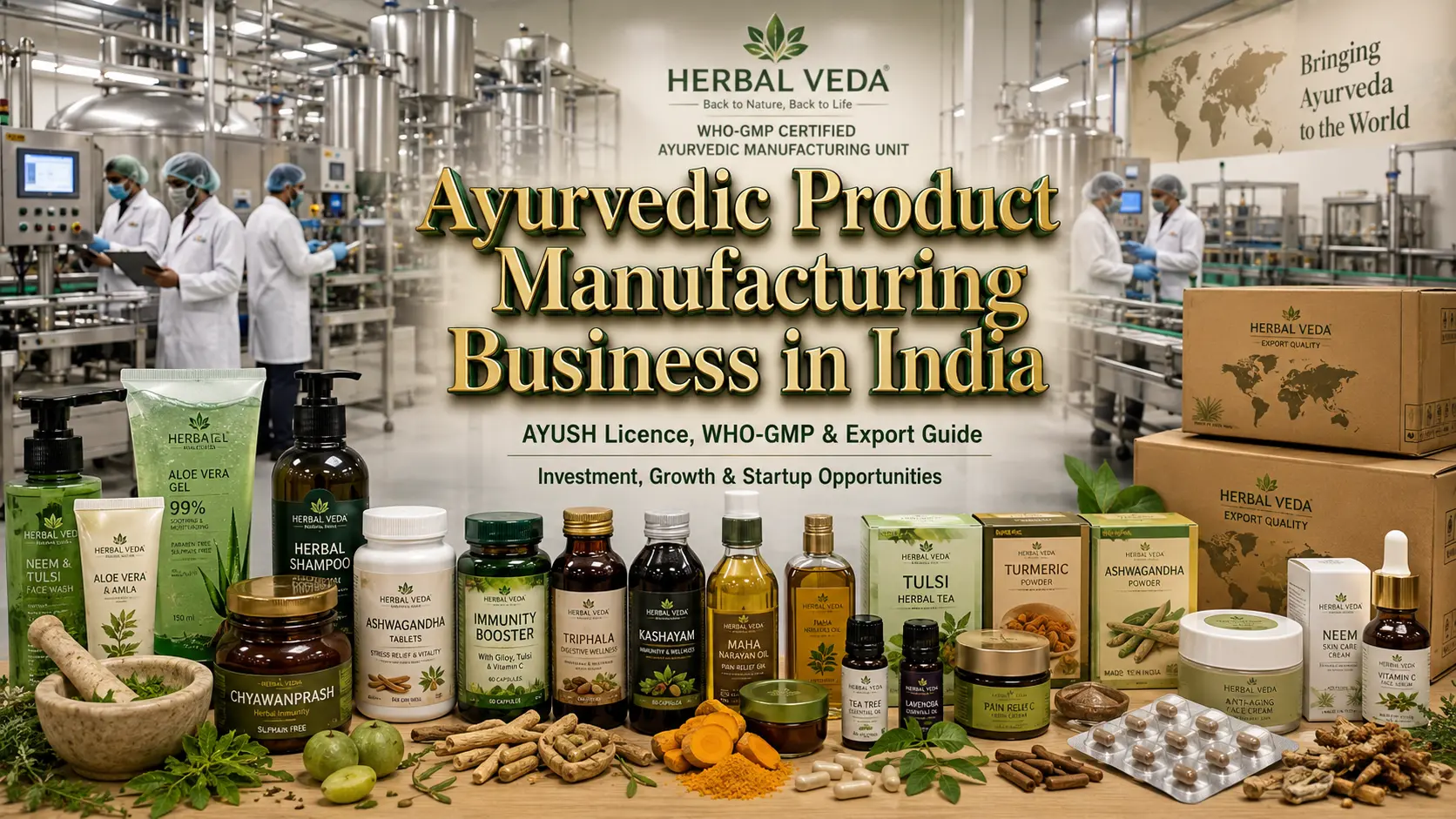
Ayurvedic Product Manufacturing Business
Gone were the days when Ayurvedic and herbal products were considered a niche traditional medicine product, and today it is a mainstream wellness business, among one of the most promising business ideas in the consumer healthcare manufacturing. There has been an unprecedented surge in consumer trust in immunity-boosting herbal products during the COVID-19 pandemic, and brands such as Patanjali, Himalaya and Dabur have proven just how high premiums can be achieved for Ayurvedic products in the local and global market.
A Rs.8 Crore Ayurvedic and herbal product manufacturing plant strategically located for WHO-GMP compliance (international quality standard for access to global market) is a structural demand driven business with government support from the Ministry of AYUSH and premium export opportunity to a global wellness market valued at trillions.
Read the Complete Book Here: Handbook on Ayurvedic and Unani Medicines With Formulae, Process & Their Uses
Why Ayurvedic Manufacturing Is Booming in India
The Ayurvedic and herbal product market in India is expanding at a rate of 15 to 20% per year, with much higher growth than the traditional pharma market. The Ministry of AYUSH has monitored data from the market, which indicates that the consumption of its products is also increasing in both urban and rural areas. A parallel growth trend is witnessed in the international markets, especially in the USA, Europe and South East Asia for natural and plant-based wellness products which shares the same culture of Ayush system in India.
The regulatory environment has also undergone significant improvement – India now has over 80 countries into which its Ayurvedic manufacturers can export without facing too many hurdles from the regulators, who are now qualified under the WHO-GMP. This is a huge opportunity for the Indian manufacturers, who did not have this opportunity 10 years ago.
Government Policies Supporting AYUSH Manufacturing
The Ministry of AYUSH has established schemes for Ayurvedic manufacturing, such as National AYUSH Mission, to provide financial assistance to improve the quality of AYUSH manufacturing units. The AYUSH Mark quality certification programme helps in positioning premium certified products. MSME Ministry offers Technology upgradation funds applicable to Ayurvedic equipment. The APEDA supports export of herbal/Ayurvedic products. AYUSH startups are also recognised under the Startup India programme for benefits. Production licenses for ayurvedic drugs are given by the state drug licensing authorities as opposed to obtaining licenses for modern drugs.
Top Business Ideas in Ayurvedic Manufacturing at Rs.8 Crore Scale
Immunity and Wellness Supplement Range for Modern Retail and Export
The demand growth for the immunity supplement category (Chyawanprash, Ashwagandha capsules, Giloy tablets, Amla extracts, Turmeric formulations) was explosive after COVID and has continued to be so as consumers continue with their preventive health habits. A Rs.8 Crore manufacturing unit having extraction, granulation, tablet pressing, capsule filling and packing plant can manufacture a complete range of immunity and wellness products in a branded way. WHO-GMP certification of the manufacturing facility will ensure export to countries with regulated markets such as the EU and USA, which are multi-billion dollars a year. Typical gross margins vary from 55 to 75% for branded Ayurvedic supplements (modern retail/ecommerce channels).
Herbal Cosmetics and Personal Care Manufacturing
India’s herbal cosmetics market is an extension of the manufacturing capacity of India in Ayurvedic medicines and involves the huge Indian cosmetics market of Rs.80,000 Crore, which includes hair oils, face packs, herbal soap, skin creams and hair care products. The licensing process for herbal cosmetics is based on the Cosmetics Rules, not the Drug Rules, making compliance easier, but without relaxing the standards for product quality. One Rs.8 Crore plant with the combination of Ayurvedic supplements manufacture and herbal cosmetics manufacture maximises the facility utilisation and provides a diversified revenue base.
The D2C channel for herbal cosmetics is especially promising – companies such as Mamaearth, WOW Skin Science, and Khadi Naturals, have shown that consumers in urban areas are willing to pay premium prices for products that are genuinely positioned as herbal, with clean labelling.
Get Detailed Project Report (DPR): Herbs and Herbal Based Products: Ayurvedic Medicines & Cosmetics
Classical Ayurvedic Medicines for Hospital and Pharmacy Supply
Classical Ayurvedic formulations such as Triphala, Brahmi, Shatavari, Arjuna and hundreds more found in Ayurvedic Pharmacopoeia are used by AYUSH doctors in India and are provided to Government and AYUSH hospitals as well as private Ayurvedic clinics. This B2B institutional supply channel affords stable and predictable income in addition to the consumer-facing product business. Giving to National AYUSH Hospitals, ESI dispensaries and Defence supply via GeM portal brings an institutional revenue anchor thereby decreasing the dependency on retail marketing expenditure.
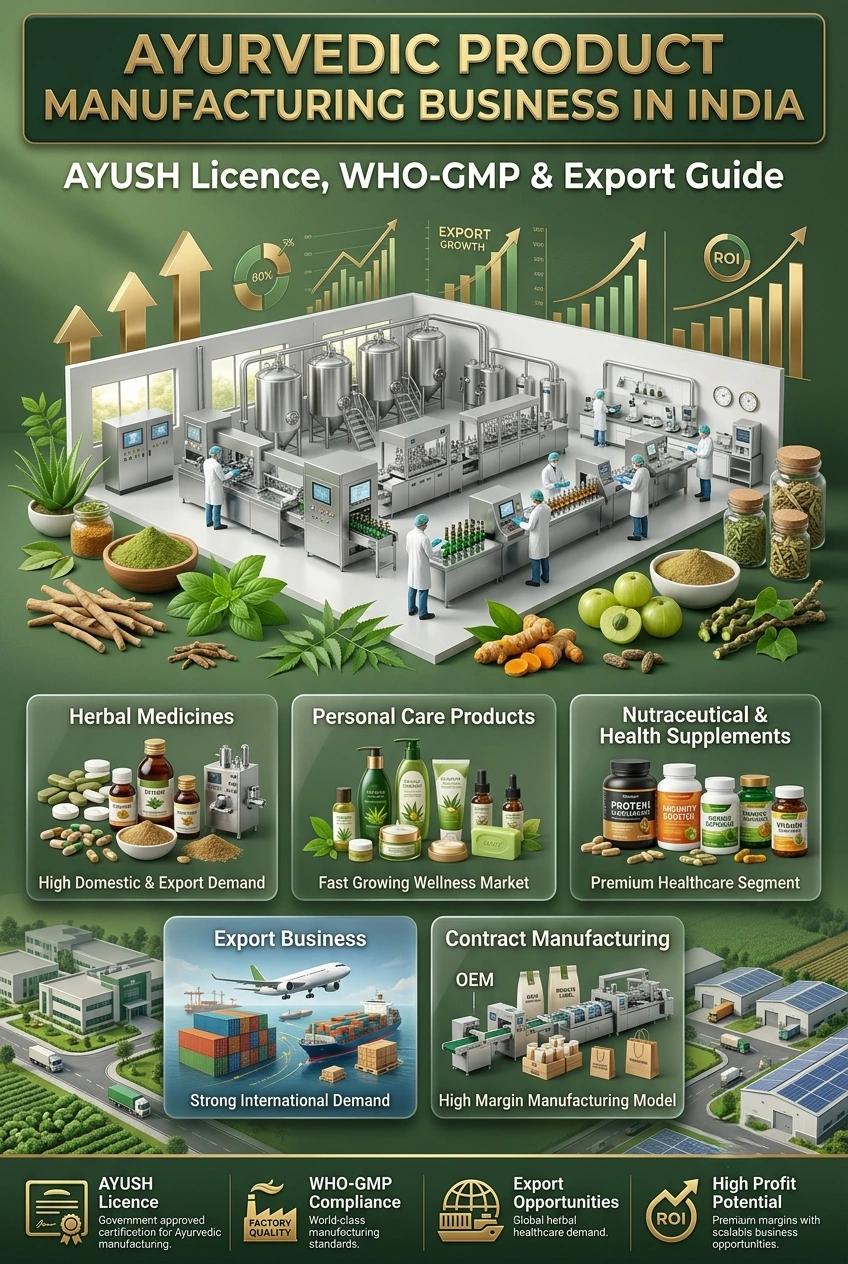
Import-Export Opportunity Analysis
There has been a significant growth in India’s exports of Ayurvedic and herbal products, with the USA, Germany, UAE and UK being the major markets. APEDA is working together with the Ministry of AYUSH for the promotion of exports of Ayurvedic products to the outside world through different world class Ayurvedic trade shows and exhibitions on natural products in Europe. The most important qualification for international market access is WHO-GMP. Internationally traded commodities like Ashwagandha extract, Turmeric curcumin and Bacopa extract are manufactured in India and country is one of the leading exporters of these herbs. Apply for IEC code with DGFT and know about AYUSH export promotion programmes.
Indian MSME Success Stories in Ayurvedic Manufacturing
Himalaya Drug Company: Building a Global Herbal Brand from Bengaluru
For decades, M Manal has invested in clinical research, quality manufacturing and market development in international markets, laying the foundation for one of India’s most trusted herbal pharmaceutical brands, Himalaya Drug Company. The company’s business philosophy, based on the-validation of Ayurvedic formulations with modern scientific studies, established a credibility platform which allowed the company to charge a premium for its products across the world.
Today, Himalaya has expanded its presence to 90+ countries and products are sold in pharmacies, hospitals, and modern retail stores all over the world. The message for new Ayurvedic manufacturers is that there is no option of not having clinical evidence and quality certification for international market access — it is essential to be part of the game.
Start with clarity—choose the best business idea
Patanjali Ayurved: Scaling through Trust and Distribution
Both the positioning of the brand as an Ayurvedic brand and the trust created due to the brand’s association with Yoga and a natural lifestyle contributed to Patanjali Ayurved’s rapid climb to be the fastest consumer brand in India. The investments made by Patanjali in manufacturing in Haridwar resulted in a vertically integrated manufacturing process from raw herbs to the final product, making it difficult for his competitors to match the product price. Patanjali’s model shows that it can out-compete some established FMCG players, even without the big advertising budgets, when it comes to proving a genuine Ayurvedic positioning.
How NPCS Can Help You Set Up Your AYUSH Manufacturing Plant
We at Niir Project Consultancy Services (NPCS) provide professional consulting for the preparation of Market Survey cum Detailed Techno-Economic Feasibility Reports (DPRs) for setting up new industries or businesses. Our reports include detailed manufacturing processes, market research and demand analysis, process flow diagrams, product mix and capacity planning, machinery and raw material details, and complete project financials with profitability analysis. Visit us at www.niir.org
Conclusion
WHO-GMP certified Rs.8 Crore manufacturing plant for Ayurvedic & herbal products placed at a confluence of India’s core competence in traditional medicine and the fast growing global health & wellness industry. Government support through Ministry of AYUSH, accessible manufacturing licensing, and strong export opportunities through APEDA make this one of the most complete investment propositions in Indian consumer healthcare manufacturing.
Related Article: Top 25 Herbal Ayurvedic Products Business Ideas
Rs.8 Crore Ayurvedic Manufacturing Plant — Key Parameters
| Parameter | Details |
| Total Investment Range | Rs.7 Crore to Rs.10 Crore |
| Key Certification | WHO-GMP (mandatory for export), AYUSH Mark |
| Key Government Scheme | National AYUSH Mission + MoFPI PMKSY + MSME Technology Fund |
| Gross Margin (Branded Supplements) | 55% to 75% on MRP |
| Export Markets | USA, Germany, UAE, UK, Australia, Japan |
| Expected ROI Timeline | 4 to 5 years at 65%+ utilisation |
| Employment Generation | 60 to 120 direct employees |
| Licensing Authority | State AYUSH Licensing Authority under Drugs and Cosmetics Act |
Key References and Government Resources
- Ministry of AYUSH — National AYUSH Mission, AYUSH Mark certification, export promotion
- Ministry of Food Processing Industries — PLI for food supplements, PMKSY subsidy
- APEDA — Herbal and Ayurvedic export promotion, trade fair participation
- Ministry of MSME — Technology upgradation fund, MSME credit guarantee for AYUSH units
- Government e-Marketplace (GeM) — Institutional supply to AYUSH hospitals and government dispensaries
- DGFT — IEC code for Ayurvedic exports, RoDTEP scheme
Frequently Asked Questions (FAQ)
What licence is required for Ayurvedic manufacturing in India?
Ayurvedic manufacturing licences are issued by the State AYUSH Licensing Authority (SALA) under Schedule E of the Drugs and Cosmetics Act. Need Factory Inspection, A Certified Ayurveda practitioner on rolls and compliance of GMP standards of AYUSH products. For export in Regulated countries WHO GMP certification from CDSCO will also be required.
What is WHO-GMP and why is it important for Ayurvedic exporters?
WHO-GMP (Good Manufacturing Practice) is an international standard that ensures uniformity in quality, efficacy and safety. The WHO-GMP certification from theIndian Government’s quality certification authority is accepted in more than 80+ countries and empowers Indian Ayurvedic Manufacturers to export their products without undergoing country specific manufacturing inspections. Without WHO-GMP, export to regulated markets like USA, EU, and Australia is significantly more complex.
How does the Ministry of AYUSH support Ayurvedic manufacturers?
Ministry of AYUSH provides financial support for quality upgradation of manufacturing units through the National AYUSH Mission. The AYUSH Mark quality certification programme provides premium market positioning. The ministry organises participation in international trade shows and facilitates buyer connections for Ayurvedic exporters. AYUSH startups can also access Startup India benefits through DPIIT registration.
What are the highest-margin Ayurvedic products to manufacture?
Standardised herbal extracts for export (Ashwagandha KSM-66, Curcumin 95%, Bacopa extract) command the highest margins. Branded immunity supplements — Chyawanprash, Ashwagandha capsules, Giloy tablets — achieve 55 to 75% gross margins in modern retail. Herbal cosmetics under a clean-label brand positioning can achieve 60 to 80% gross margins when sold D2C.
Can Ayurvedic products be sold on e-commerce platforms?
Yes. Authentic FSSAI and drug licensed ayurvedic products are permitted for selling on Amazon and Flipkart, and also through online pharmacies like Netmeds, PharmEasy, 1MG, and other health-based platforms. Ayurveda has proven most fruitful in the D2C channel as people generally do online research on health products before purchasing them on the internet. FSSAI is a prerequisite for selling any food supplement ayurvedic products on e-commerce platforms.


