





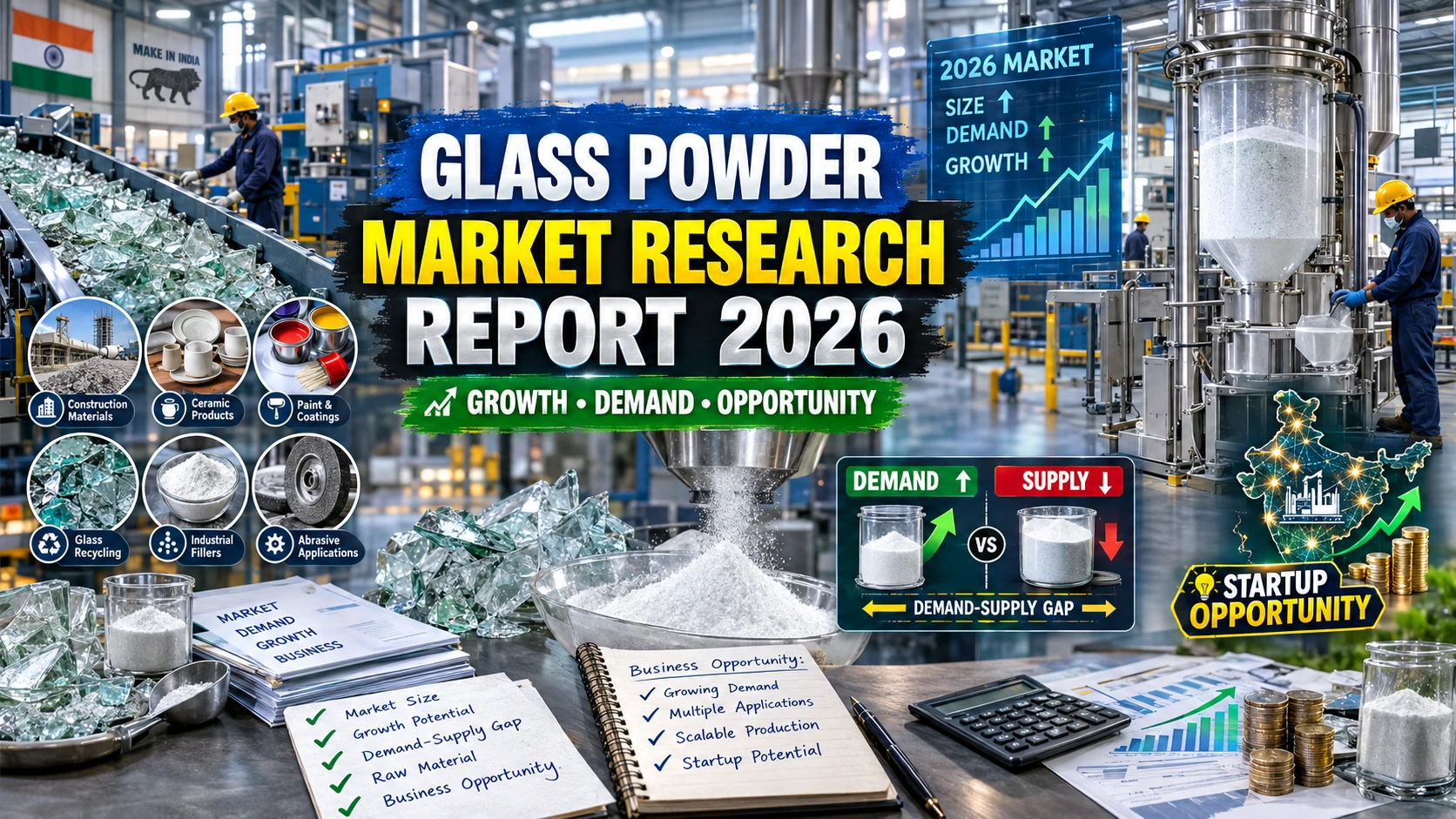
Glass Powder Manufacturing Business
The glass powder market in India is showing a significant growth, as the cement industry, which uses the powder to substitute sand and stone, is also expanding. The glass powder market in India is experiencing a substantial rise, alongside the expansion of the cement industry, which intends to replace sand and stone with glass powder.
About 3 million tonnes of glass is discarded annually in India and only about a third to a little under half of it is formally recycled. The raw material sitting in landfills rather than a processing facility is exactly the kind of business opportunity an entrepreneur should pursue to tap into one of the least talked-about circular-economy manufacturing opportunities in the construction materials sector of India: recycled glass powder, a real alternative to a significant portion of the cement used in making concrete.
What Is Glass Powder?
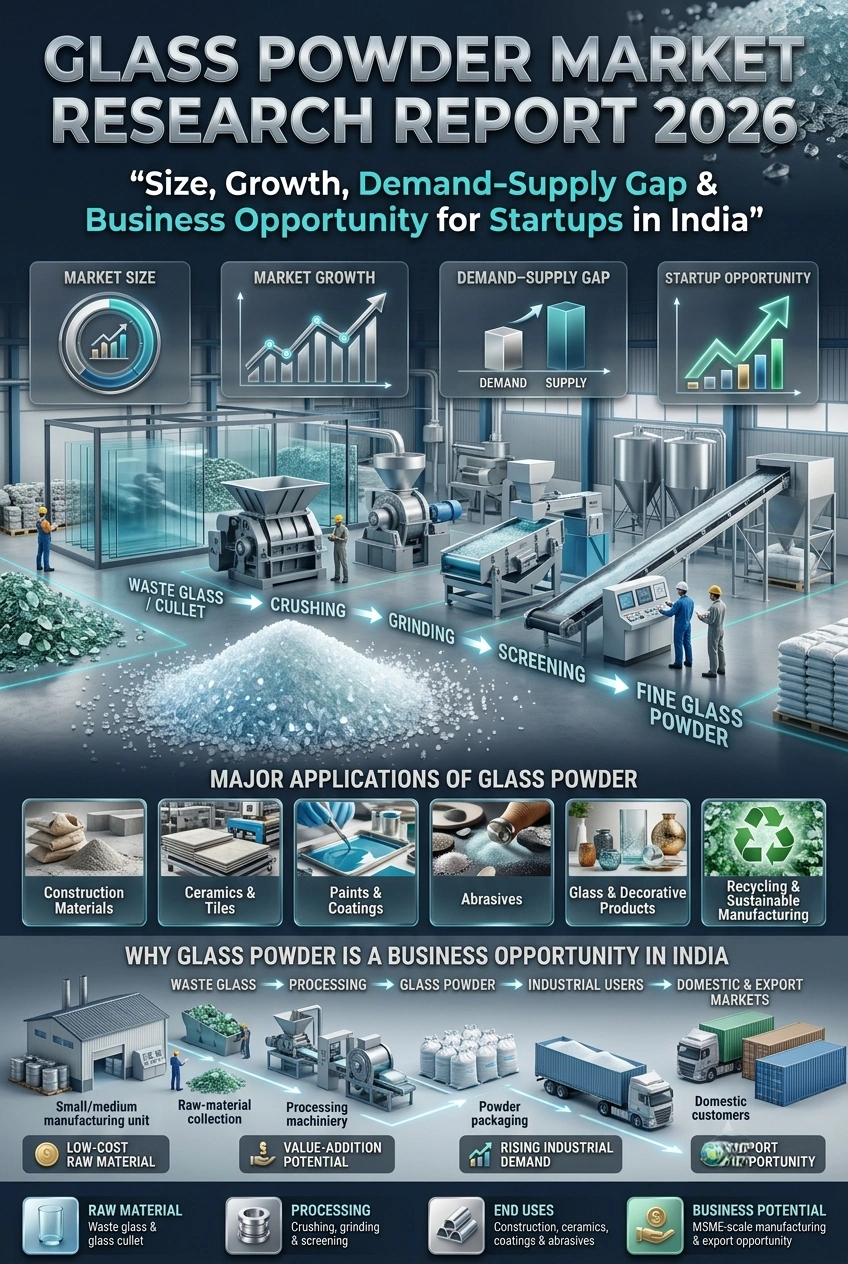
Glass powder is finely ground glass, in the form of waste or virgin glass, typically ground to less than 75 microns and finer if required for high performing pozzolanic applications, and subsequently cleaned, sorted and crushed. It can have two quite different uses, depending on the fineness and the type of glass used.
- Very fine glass powder (below 45 microns) is chemically bonded with the lime byproduct from cement hydration to create extra calcium silicate hydrate (CSH)—the compound that provides strength to concrete, making it a pozzolanic supplementary cementitious material (SCM). This enables the incorporation of up to 10–30% glass powder in concrete mix designs, similar to the well-known admixtures such as fly ash and silica fume, and also lowers the expenses as well as the carbon footprint of cement production, which is responsible for approximately 8% of the total CO₂ emissions worldwide.
- As a filler, abrasive, or aggregate: Coarser glass powder and crushed glass are employed as filler in paints and coatings, plastics and sealants, and as aggregate replacement in concrete and road base materials and sand in water treatment and swimming pool filtration media.
Glass powder production is one of the cleanest circular economy manufacturing opportunities for an entrepreneur because glass can be recycled 100% with no loss in quality as is the case with plastic, which deteriorates with each recycling.
Check Out This Recommended Book: The Complete Book on Glass and Ceramics Technology
Global and India Glass Powder Market Size and Growth
In 2025, the global consumption of glass powder was more than 4.2 million metric tons, of which the construction industry accounted for the highest share of nearly 34% of total consumption. Standalone market value estimates for the glass powder category range from about USD 1.6 billion (2024) to USD 2.8 billion (2033), with a similar wider scope for the recycled glass market (including pozzolanic and industrial-grade product across all applications) estimated considerably higher – one industry estimate is that recycled glass powder value will be close to USD 2.2 billion in 2025.
The Indian recycled glass market, comprising glass powder as a significant sub-segment, is expected to expand at a compound annual growth rate (CAGR) of around 7.5% until 2031, outpacing the global market, by adoption by the construction industry, regulatory measures for waste disposal, and the benefit of recycled glass compared to virgin raw materials.
Note on figures: Glass powder is often included in larger studies of “recycled glass” (in addition to cullet and crushed glass) and is thus not always available as a stand-alone category, which is why the scope and figures of this category will differ across studies. NPCS can provide an investor-ready glass powder techno-economic feasibility study for a range of glass powder applications – pozzolanic SCM or filler/abrasive.
India’s Waste Glass Opportunity
There is an estimated 3 million tonnes of waste glass generated in India each year which is formally recycled with the rest of the waste glass being an environmental burden and an unutilized raw material for glass manufacturing. Indian research has specifically shown the technical potential of this opportunity: the study of the incorporation of finely ground Indian consumer-waste glass powder into M30 and M40 grades of concrete indicated that 30% replacement of cement (by value) with glass powder yielded the optimum engineering properties for conventional and paver-block concrete applications, where the workability, compressive strength and durability indicators all improved with increasing glass powder content.
View Full Project Details: Glass Manufacturing Business: Complete Project Report
Policy Tailwinds
- Extended Producer Responsibility (EPR) regulations – EPR regulations in India are gradually shifting the burden of end-of-life collection and recycling of glass packaging to the producers of glass packaging, resulting in a structured supply of feed materials for glass powder producers.
- Green building certification standards: IGBC (Indian Green Building Council), GRIHA, and LEED-India certifications increasingly recognise recycled supplementary cementitious materials, including glass powder, as contributing to sustainability credits — creating specifier-level demand pull.
- Waste management and landfill diversion policies: Municipal solid waste policies and waste management policies at the state level are beginning to focus on diversion of glass waste from landfill, complementing the glass powder manufacturing process.
- Manufacturing incentives for MSMEs: Glass powder production is a low-tech, labour-intensive grinding and processing operation which is suitable for MSME investment limits and corresponding subsidies.
India Demand-Supply Gap: Glass Powder
| Parameter | Current Position |
| Annual waste glass generation in India | ~3 million tonnes |
| Formal recycling rate | Only ~35–45% — leaving roughly 1.65–1.95 million tonnes of waste glass annually outside the formal recycling stream |
| Domestic manufacturing base | Small and fragmented — dominated by regional processors and small-scale suppliers (largely IndiaMART/TradeIndia-listed local manufacturers) rather than large branded players |
| Nature of the gap | A feedstock recovery and processing capacity gap — India has more waste glass available than current recycling infrastructure can absorb, unlike categories where raw material itself is scarce |
| Technical validation | Indian-specific research confirms 30% cement replacement using local waste glass powder is technically viable in standard concrete grades, removing a key adoption barrier |
| Opportunity for new entrants | Significant — both in expanding formal collection/processing capacity and in serving the construction industry’s growing demand for certified sustainable cement-replacement materials |
Reading the gap: Unlike categories constrained by scarce raw material, glass powder in India faces the opposite problem — an abundance of unrecovered waste glass sitting in landfills because formal processing capacity hasn’t kept pace with generation. That combination (surplus feedstock + underdeveloped processing infrastructure + validated technical performance + rising green-building demand) is close to an ideal entry profile for a new manufacturing venture: the market isn’t waiting on unproven technology or scarce inputs, it’s waiting on more processing capacity.
Major Indian Glass Powder / Recycled Glass Manufacturers
| Company | Base/Region | Focus Area | Notes |
| JB Glass Crushers | India | Recycled glass powder, crushing and micronising | Recognised Indian manufacturer supplying industrial-grade glass powder with consistent particle size and high silica content across multiple states |
| Bipl Bheemeshvari | India | Glass powder (solvent extraction, high purity) | Regional manufacturer supplying industrial and specialty-grade glass powder |
| G3S Impax | Delhi | Glass powder trading and supply | Regional distributor/manufacturer supplying wholesale glass powder to bulk buyers |
| Triveni Glass Ltd. | India | Glass manufacturing and recycled glass products | Established Indian glass sector company recognised among recycled glass market participants |
| Numerous regional MSME-scale processors | Kolkata, Navi Mumbai, Kanpur, Surat, Delhi, Hyderabad, Chennai, Mumbai, Bengaluru, Pune and other cities | Local glass crushing, grinding, and powder production | The largest segment of India’s glass powder supply base by count — small-to-mid-scale regional operations serving local construction and industrial demand, representative of the primary MSME entry opportunity |
Major International Glass Recycling / Glass Powder Players
| Company | Country | Notes |
| Sibelco (with Strategic Materials Inc.) | Belgium (global) | Global leader in glass recycling following its 2024 acquisition of Strategic Materials (North America’s largest glass recycler); combined operations span 60+ facilities processing over 10 million tonnes of cullet annually |
| Vitro Minerals Inc. | United States | Specialist manufacturer of glass powder pozzolans (VCAS, ACAS product lines); helped establish ASTM C1866, the first dedicated standard for glass powder pozzolans in concrete |
| Owens-Illinois (O-I Glass) | United States | Major global glass container manufacturer with significant recycled glass sourcing and processing operations |
| Ardagh Group S.A. | Luxembourg/Ireland | Major global glass and metal packaging group with substantial glass recycling operations |
| Vetropack Holding Ltd. | Switzerland | European glass packaging manufacturer with integrated recycling operations across multiple countries |
| Momentum Recycling LLC | United States | Specialised glass and green-waste recycling services provider |
| Strategic Materials, Inc. | United States | North America’s largest glass recycler prior to Sibelco acquisition; historically processed roughly 2 million tonnes of cullet annually |
| Saint-Gobain | France | Major global glass and construction materials group with recycling and sustainability-linked glass initiatives |
Market Segmentation
By Product Type
- Recycled/post-consumer glass powder (dominant segment, driven by circular economy adoption)
- Virgin glass powder (smaller segment, typically for specialty/high-purity applications)
By Application
- Construction (cement replacement/pozzolanic SCM, concrete aggregate, paver blocks) — largest application segment
- Abrasives and blasting media
- Paints, coatings, and plastics fillers
- Water treatment and filtration media (silica sand substitute)
- Fiberglass and insulation manufacturing feedstock
- Decorative and architectural applications (countertops, flooring, terrazzo)
By Fineness/Particle Size
- Ultra-fine (below 45 microns) — pozzolanic/cement-replacement grade
- Fine (45–150 microns) — filler and specialty applications
- Coarse (crushed glass/cullet range) — aggregate and abrasive applications
By End-Use Industry
- Construction and infrastructure
- Paints, coatings, and polymer manufacturing
- Water treatment
- Glass container and fiberglass manufacturing (as furnace-ready cullet feedstock)
Key Growth Drivers
- Pressure from the cement industry to decarbonise. Glass powder is a low-carbon partial cement replacement and is directly seeing traction from builders and infrastructure projects aiming for sustainability targets with cement production accounting for approximately 8% of global CO₂ emissions.
- Demand for green building certification. There is a greater number of specifiers driven demand for use of recycled supplementary cementitious materials as more and more buildings are being certified by these frameworks such as IGBC, GRIHA and LEED-India which now consider them as an incentive.
- Increasing diversion and EPR regulations. The more the Extended Producer Responsibility (EPR) scheme for glass packaging is implemented in India, the more the glass packaging manufacturers are being pushed to take the initiative in funding and facilitating its end-of-life collection — thereby indirectly establishing the feedstock supply chain that glass powder manufacturers rely on.
- Lower cost than virgin raw materials. Adoption of glass powder does not only benefit the environment, but is also an economic choice, since it is cheaper than virgin silica sand for filtration and abrasive applications and is also cheaper than a part of the cement for concrete applications.
- Validated technical performance. Peer reviewed research work on using Indian waste glass sources has proven their good engineering performance, at reasonable rates of cement replacement, which eliminates much of the technical uncertainties that can delay the use of new construction materials.
- Global need for sustainable SCMs growing. Glass powder is expected to become a significant alternative source of supplementary cementitious material (SCM) as the major traditional sources such as fly ash (a byproduct of coal power plants) are projected to become scarce in the future, in light of coal power phase-outs.
Related Article: Best Manufacturing Business Ideas Under ₹50 Lakh in India
Challenges and Restraints
- Inadequate and irregular collection system. India currently has a formal recycling rate of 35 to 45 percent; a lot of waste glass does not even reach the processor: building-effective waste collection networks is often as critical as processing capacity for a new processor.
- Processing difficulty. Glass is intrinsically hard (Mohs 5.5-7) and shatters into sharp edges and needs strong, specially designed grinding machines, especially for grinding to ultra-fine pozzolanic powder grades, which call for specialised ball mill and air classifier systems.
- Colour & contamination sort. Compared to simpler stream of aggregate, sorting investment is added and needed for consistent high-quality output from glass streams which are mixed-color and contaminated.
- Failure of smaller construction companies to be aware. While proven performance, many smaller builders and contractors don’t know about glass powder as a cement-replacement material and need to be educated about the market as well as about production.
- Volatile raw material prices and supplies. The availability of feedstock depends on the quality of glass waste collected by municipalities and industry, which is often inconsistent in less-developed glass waste collection markets.
Competitive Landscape
India’s glass powder industry is one dominated by small to mid-scale regional processors and is unconsolidated unlike the recycled glass industry in the rest of the world with only a few big players (Sibelco/Strategic Materials, Vetro pack, Owens-Illinois, Ardagh) dominating the global market with about 50% of the market share. The lack of a consolidated supply chain in India compared with what is in place in the rest of the world indicates there is actual scope for an India-based player with good capital to develop a non-economy of scale, quality consistent regional or national glass powder brand which is lacking in the market today.
Glass Powder Manufacturing: Business Opportunity for Startups and MSMEs
- Regional waste glass collection and processing unit. With only 35–45% of waste glass being formally collected in India, a model that integrates waste collection with processing through a partnership between a municipal waste management system, bottling companies and glass packaging manufacturers under an EPR model is defensible and vertically-integrated.
- is the pozzolanic-grade (ultra-fine) glass powder. The biggest expenditure will be in fine grinding technology (ball mill with air classifier) to target the cement-replacement/SCM application, which is the highest-value, fastest-growing application, but will also provide premium positioning in relation to green-building certification.
- Glass powder for industrial use (filler & abrasive). A lower technical barrier entrance system for paints, coatings, plastics and abrasive blasting media markets that are not as strict as the pozzolanic-grade products.
- Processing contracts for glass container manufacturers/bottlers. By directly working with the beverage and glass packaging companies that are required to comply with EPR, they can ensure a consistent and contracted feedstock and demand situation for the post-industrial glass waste they process into powder or cullet.
- Integrated manufacture of aggregate/paver blocks. This is because the glass powder production and downstream paver block or precast concrete manufacturing (after the validated research for 30% glass powder replacement) can generate more value.
Assumption flag of investment and margin in glass powder manufacturing: They have significant variations depending on the target fineness size (coarse aggregate vs ultra fine pozzolanic powder) and whether it has its own collection system. NPCS creates Project Reports with grinding technology specification, feedstock sourcing strategy, construction industry market assessment in detail, specific to your target application and capacity, bankable project reports.
Turn your budget into a successful business plan
How NPCS Supports Entrepreneurs Entering This Space
A well-designed, detailed project report (DPR) is the first step on the path to any entrepreneur considering glass powder plant investment — the DPR considers the capacity of the plant, the technology for grinding and classification, the collection strategy for feedstock, the manpower required for the plant, project cost, and financial viability for the intended application and market.
About NPCS (Niir Project Consultancy Services)
NPCS, a New Delhi based Industrial consultancy founded in 1994 and a certified ISO 9001:2015 organisation, has more than 30 years of experience in techno-economic & project consultancy. Within the last 30 years, NPCS has provided over 15,000 project reports and profiles in 85 countries that cover the vast majority of manufacturing and process industries, such as recycled materials, waste-to-value manufacturing and construction materials.
There are three integrated platforms on which NPCS operates:
- niir.org — the primary repository of industry-specific Detailed Project Reports, business plans, and techno-economic feasibility studies
- entrepreneurindia.co — market research, project profiles, and manufacturing business opportunity content aimed at entrepreneurs and MSMEs
- npcsblog.com — industry insight, trend analysis, and manufacturing sector commentary
Key products/services that NPCS brings to the table for a glass powder project are:
- A list of Detailed Project Reports (DPRs) including plant capacity, machine specifications and layouts
- Techno-economic feasibility studies, with feedstock collection strategy guidance
- Financial modelling is conducted to determine the cost and profitability of a project, return on investment and break-even analysis.
- Assessment of raw material and markets in Indian region – specific to waste glass
- Support documents relating to MSME loan applications, subsidy schemes and bank funding requirement etc.
Entrepreneurs evaluating this sector can access relevant glass powder and recycled materials manufacturing profiles directly on niir.org and entrepreneurindia.co, or request a custom feasibility study scoped to a specific application and region.
Government and Institutional Reference Links
- Ministry of Environment, Forest and Climate Change (MoEFCC)
- Central Pollution Control Board (CPCB) — Waste Management Rules
- Ministry of Micro, Small and Medium Enterprises (MSME)
- Development Commissioner, MSME (DCMSME)
- Bureau of Indian Standards (BIS)
- Ministry of Housing & Urban Affairs (Swachh Bharat Mission)
- Press Information Bureau (PIB), Government of India
- Startup India
- Invest India (National Investment Promotion and Facilitation Agency)
- Make in India
Entrepreneurs are advised to verify the latest Extended Producer Responsibility (EPR) norms for glass packaging, Solid Waste Management Rules, and MSME subsidy guidelines directly on these portals, as regulatory provisions are periodically revised.
Conclusion
Glass powder has an unusual opportunity profile in Indian circular economy manufacturing: There is a large number of raw materials that are currently under-recovered in India – in the order of about 1.65-1.95 million tonnes of waste glass, which is currently not getting recycled in the country; technically proven performance in Indian concrete applications; a growing demand for building green and a domestic manufacturing base which is still largely in the hands of small players from across the country. This is a completely underdeveloped category for an entrepreneur willing to invest in collection relationships, and fine-grinding processing technology, with a simple growth thesis.
Glass powder presents an intriguing opportunity for entrepreneurs and MSMEs looking at sustainable materials manufacturing investments that come with several properties: it is a material which has plenty of local feedstocks, proved technical success, and is gaining traction in areas of regulations and green buildings, yet has none of the constraints of other materials when it comes to dependency on imports or capital.


