





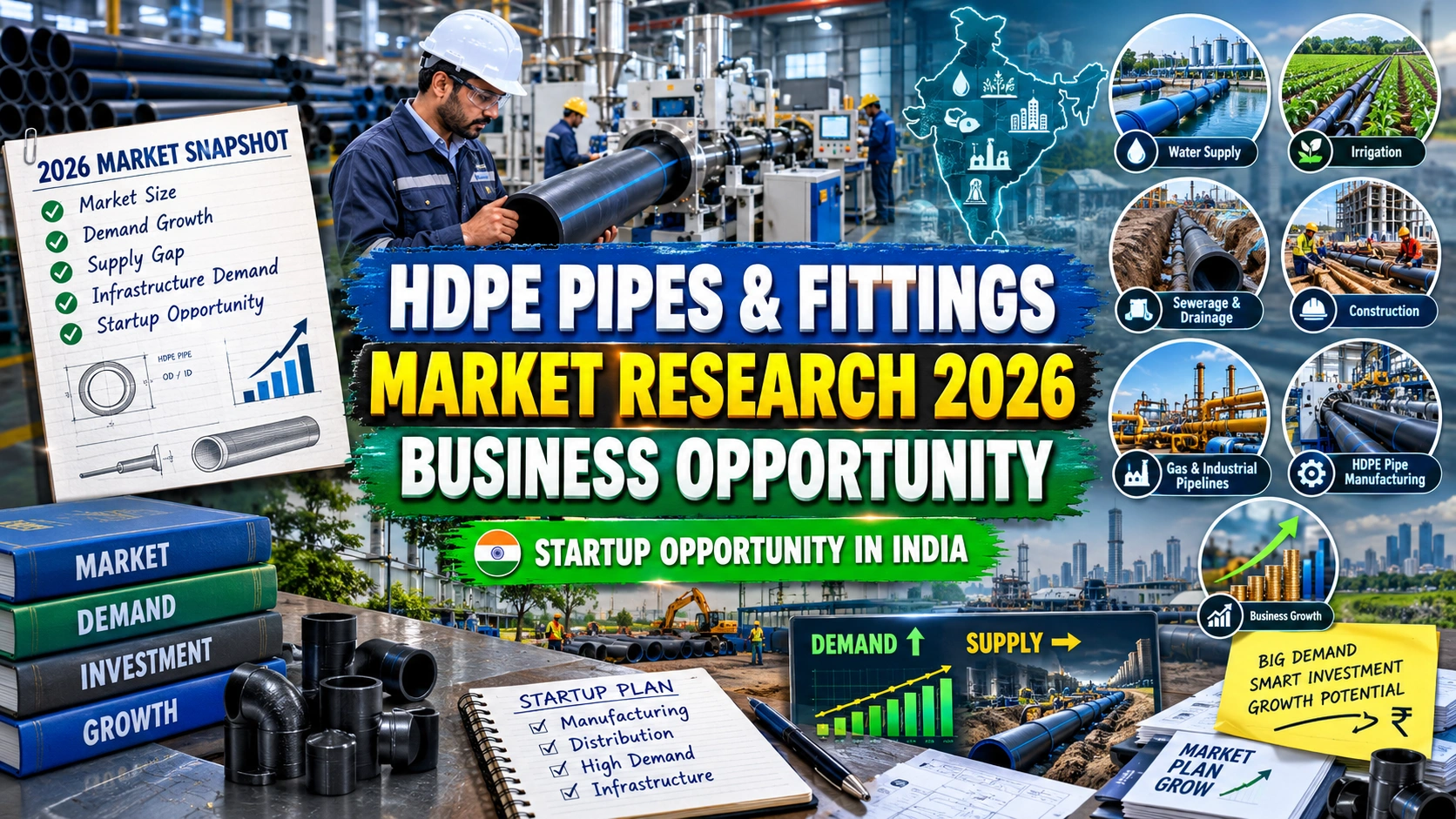
HDPE Pipes & Fittings Market
The Jal Jeevan Mission alone, is a ₹3.60 lakh crore investment in rural water connectivity with HDPE being the compulsory material for filling the millions of house connections it has been constructing. Even after all these years of Jan Samiksha Bharat under Jal Jeevan Mission, the plastic pipe consumption per capita in India still remains at about 3 kg per year, as compared to 8-10 kg per year in developed countries. For an entrepreneur, the three defining characteristics of HDPE pipes and fittings are that it is a stipulated government specification, there is a real multi-year order book, and the market is still quite a long way from the long run consumption ceiling.
What Are HDPE Pipes & Fittings?
Plastic pipes, extruded pipes with high-density polyethylene resin, which are well-known for their corrosion resistance, flexibility, leak-proof heat-fused joints, chemical resistance, and service life of more than 50 years, are called HDPE (High-Density Polyethylene) pipes. Manufactured to Indian Standard IS 4984:2016 (water supply) and IS 14333 (sewerage), and are graded as follows:
- Material grade (PE rating) – PE63, PE80 and PE100, representing minimum strength requirement; for Government infrastructure projects like the Jal Jeevan Mission distribution mains, PE100 is becoming the standard grade;
- Pressure rating (PN/SDR series) – from SDR6 (PN25, highest pressure) to SDR26 (PN6), which includes all possible pressure ratings for application
- The range of diameters includes: small diameter service connections (16mm); large diameter transmission mains (630mm and above).
Fittings – elbows, tees, reducers, couplers, valves and specialised connectors – are the final components of the installation system and are usually made using injection moulding or fabrication to the pipe specification.
Their main applications are water supply (potable water transmission and distribution — the biggest segment), sewerage and drainage, agricultural irrigation (especially for micro irrigation/drip irrigation systems), gas distribution, Telecom/fibre optic cable protection (in micro duct, under RDSS, BharatNet) and Power cable conduits (under RDSS).
Explore This Book: The Complete Technology Book on Plastic Films, HDPE and Thermoset Plastics
Global and India HDPE Pipes Market Size and Growth
The global HDPE pipes market is estimated to be valued at approximately USD 22.0 billion during 2025, rising to USD 30.9 billion by 2034 at a CAGR of around 3.88% with Asia Pacific accounting for more than 44% of the market, mainly bolstered by the infrastructure investment plans of India and China.
The India HDPE pipes market is estimated to be valued at USD 690-720 million in 2024-2025, which is expected to reach USD 990 million to USD 1.03 billion in 2033-2034 with an estimated CAGR of approximately 3.9-4.1%. This represents a small share of India’s total pipe market (all materials) worth around USD 16.0 billion in 2025 and expected to more than double by 2035, at a much higher CAGR of about 11.2%, reflecting the overall trend towards increase in plastic piping for all applications.
Note on figures: Figures for the HDPE market are subject to change depending on whether wider-based “plastic pipes” figures are being referred to (which also include PVC and CPVC). For all the numbers of investors, NPCS can carry out a techno-economic feasibility study, which can be customized to your diameter range, PE grade, and application (water, sewerage, irrigation, and telecom).
The Structural Headroom: India’s Low Per-Capita Consumption
The most visible sign of India’s growth potential is that India consumes approximately 3kg of plastic piping per person per year while the consumption in developed countries is 8-10kg per person per year. The current infrastructure boom is not just filling a gap, it’s closing a gap, after years of pipe-laying under the Jal Jeevan Mission banner, India is still a fraction of the consumption intensity of a mature market.
Policy Tailwinds
- Jal Jeevan Mission (JJM) — the single largest demand driver: With a budget allocation of approximately ₹3.60 lakh crore for rural water connectivity, and the mission timeline extended to 2028 with an additional ~USD 4.8 billion allocation, JJM alone generates an annual pipeline of roughly ₹60,000-70,000 crore of pipe-related work, mandating HDPE as the primary substrate for millions of household tap connections. As of recent tracking, over 51.99% of India’s rural families had already benefited from JJM connections.
- Mandatory BIS certification requirement: IS 4984:2016 BIS-certified HDPE pressure pipes are a mandatory specification requirement for every rural piped water scheme under JJM — this single specification requirement has reshaped India’s entire HDPE manufacturing landscape toward BIS-compliant, high-quality production.
- AMRUT 2.0 urban water and sewerage infrastructure: A parallel government programme focused on urban water supply and comprehensive sewage management, driving additional large-diameter HDPE demand in cities.
- Pradhan Mantri Krishi Sinchayee Yojana (PMKSY): Government promotion of micro-irrigation (drip and sprinkler systems) mandates extensive procurement of specialised agricultural-grade HDPE piping.
- BharatNet and RDSS infrastructure convergence: HDPE micro-ducts for BharatNet’s national optical fibre rollout and power cabling for the Revamped Distribution Sector Scheme (RDSS) are increasingly being installed alongside JJM water infrastructure in combined “smart village” rural connectivity projects, creating cross-sector demand for the same manufacturers.
- Ministry of Jal Shakti’s USD 240 billion water sector investment commitment: A broader multi-year national commitment to water security, including the world’s largest dam rehabilitation programme, underpinning long-term sector demand well beyond JJM’s current timeline.
Get Detailed Project Report (DPR): HDPE Pipes Manufacturing Project Report
India Demand-Supply Gap: HDPE Pipes & Fittings
| Parameter | Current Position |
| Per-capita consumption | ~3 kg annually vs. 8-10 kg in developed countries — a structural, multi-year growth gap rather than a cyclical one |
| JJM investment scale | ₹3.60 lakh crore budget allocation, with the mission timeline extended to 2028 and an additional ~USD 4.8 billion allocated |
| JJM annual order book | Roughly ₹60,000-70,000 crore of pipe-related work annually across PVC, HDPE/MDPE, GI, and DI segments |
| Domestic manufacturing base | A large, fragmented mix of major national brands (Jain Irrigation, Astral Pipes, Finolex, Supreme Industries) and hundreds of regional/MSME manufacturers, concentrated in Gujarat and Maharashtra with secondary hubs in Tamil Nadu, Uttar Pradesh, and Rajasthan |
| Nature of the gap | A structural consumption-intensity gap combined with active government-mandated demand — India isn’t import-dependent on HDPE resin production at scale, but domestic pipe-manufacturing and installation capacity has not yet caught up to either the current JJM/AMRUT order book or India’s long-run per-capita consumption potential |
| Post-JJM risk | Industry analysts note a “programme completion risk” — as JJM approaches its (extended) completion, temporary demand softening is possible before the ongoing operations & maintenance replacement cycle and other schemes (AMRUT 2.0, PMKSY, BharatNet/RDSS convergence) sustain volumes |
| Opportunity for new entrants | Strong for BIS-certified regional manufacturers positioned near active JJM/AMRUT project clusters, and increasingly for manufacturers serving the converging telecom/power-cabling infrastructure segment alongside traditional water applications |
Reading the gap: Unlike categories facing raw material scarcity, HDPE pipes in India face a manufacturing and distribution capacity gap relative to both current government-mandated demand and the country’s long-run consumption potential. With per-capita usage still a third of developed-market levels, this is a genuinely multi-decade growth runway, not simply a JJM-driven spike — though entrepreneurs should factor in the near-term “programme completion” transition risk that industry analysts flag as JJM approaches its extended 2028 deadline.
Major Indian HDPE Pipes & Fittings Manufacturers
| Company | Base/Region | Notes |
| Jain Irrigation Systems Ltd. | Jalgaon, Maharashtra | Major Indian pipes and irrigation systems manufacturer, with significant HDPE capacity serving both water supply and micro-irrigation segments |
| Astral Pipes (Astral Limited) | Gujarat/Ahmedabad | Major Indian plumbing and piping systems brand, actively expanding capacity, including a planned USD 47 million investment in new South India facilities (Chennai and Hyderabad) |
| Finolex Industries Ltd. | Pune, Maharashtra | Leading Indian PVC and HDPE pipe manufacturer with backward integration into resin production |
| Supreme Industries Ltd. | Mumbai, Maharashtra | Major diversified Indian plastic products company with substantial HDPE/plastic piping capacity; undertaking multiple capacity expansions and a new greenfield plant |
| Prince Pipes and Fittings Ltd. | Mumbai, Maharashtra | Established Indian pipes and fittings manufacturer serving plumbing, water supply, and agricultural segments |
| Apollo Pipes Ltd. | Delhi/NCR | Recognised Indian pipes and fittings manufacturer |
| Dutron Group | Gujarat | Established regional HDPE and PVC pipe manufacturer |
| Gark Polyplast | India | BIS-certified HDPE pipe manufacturer producing PE63, PE80, and PE100 grades across the full SDR series, actively supplying JJM, AMRUT, and PMKSY projects |
| SHK Polymers Industries | India | Regular supplier of PPR-C and HDPE pipes/fittings for Jal Jeevan Mission schemes across UP, MP, Rajasthan, Karnataka, and Bihar |
| JTL Industries Limited | India | Established government infrastructure pipe supplier, recently secured a USD 3 million JJM order from Jammu’s Public Health Engineering Department |
| Nagarjuna Polymers, Miraj Pipes & Fittings, Gamson India, Mangalam Pipes | Various regional locations | Representative of the MSME-scale regional manufacturing tier serving local JJM/state tenders |
Major International HDPE Pipe Industry Context
Unlike globally-traded specialty chemicals, HDPE pipe manufacturing is inherently local/regional — transport economics for a bulky, low-value-density product favour domestic production over cross-border trade almost everywhere. Rather than direct India-competing exporters, the relevant international context is comparable large-market industry structures:
| Region/Country | Notes |
| China | The world’s largest HDPE pipe market by volume, having added over 450,000 km of HDPE pipe networks between 2022 and 2024 under its National New-Type Urbanization Plan; production is almost entirely domestic |
| United States | A mature, replacement-driven market where HDPE now accounts for over 70% of new potable water project installations |
| Africa (e.g., Kenya) | Rapidly deploying HDPE for urban water network expansion — Nairobi’s recent 1,200 km water network expansion used 90% HDPE materials, illustrating the material’s role in emerging-market infrastructure build-out globally |
| Global HDPE resin suppliers | Companies like Borealis, LyondellBasell, and Reliance Industries (a major Indian domestic HDPE resin producer) supply the polyethylene resin feedstock that regional/national pipe manufacturers convert into finished pipe |
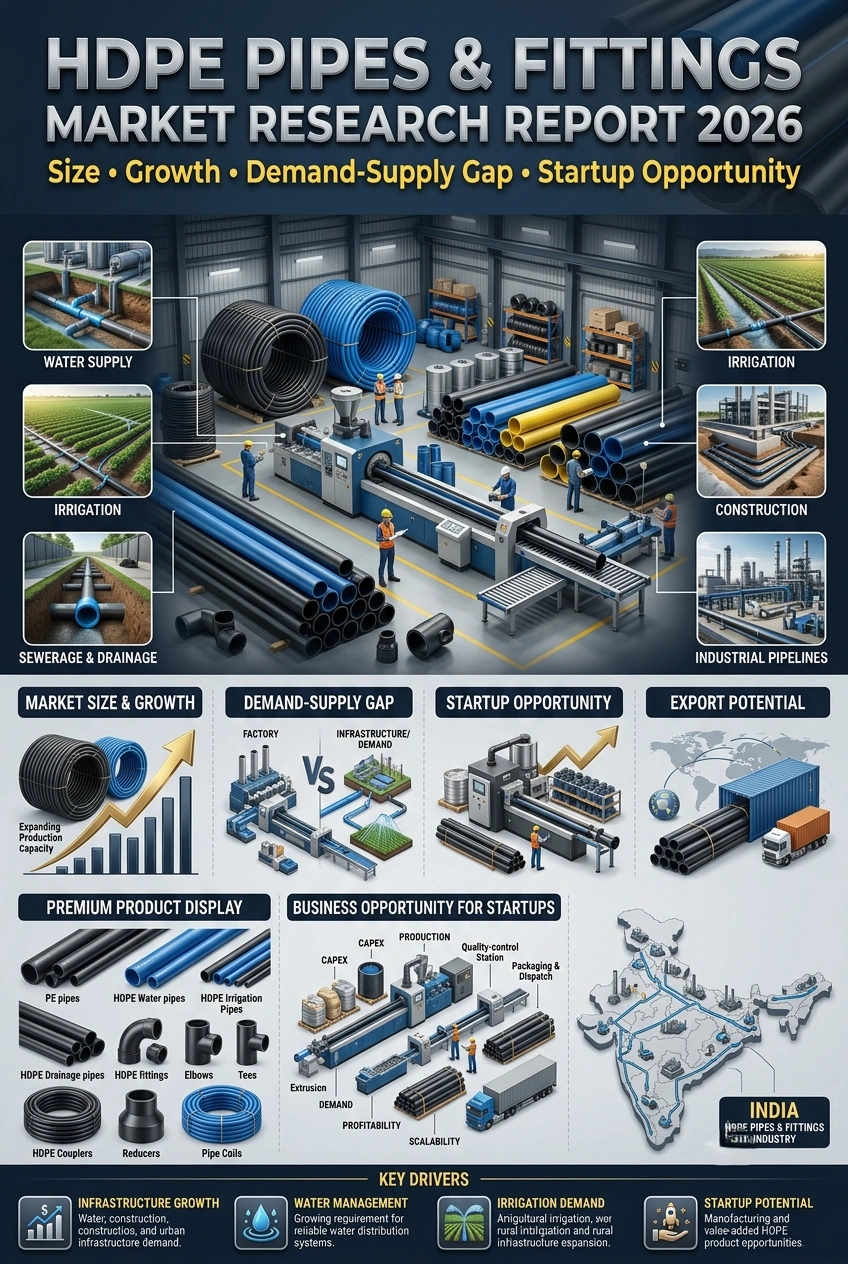
Market Segmentation
By Grade
- PE63 — commands a dominant ~45% market share in India, heavily driven by agricultural irrigation applications
- PE80
- PE100 — increasingly the standard specification for Jal Jeevan Mission distribution mains, given its higher strength rating
By Application
- Potable water supply (transmission and distribution) — largest volume segment
- Sewerage and drainage
- Agricultural irrigation (including micro-irrigation) — accounts for roughly 35% of India’s total HDPE application landscape
- Gas distribution
- Telecom (micro-ducts for fibre optic cable protection under BharatNet)
- Power cabling conduits (under RDSS)
- Industrial fluid transport
By Diameter/Pressure Rating
- Small-diameter service connections and household plumbing
- Medium-diameter distribution mains
- Large-diameter transmission mains (up to 630mm and above)
- SDR series from SDR 6 (PN25) through SDR 26 (PN6)
By Region (India)
- North India — largest regional consumption share (~33%), anchored by states like Uttar Pradesh’s massive rural household connection initiative
- South India — fastest regional growth (~12% CAGR), driven by significant manufacturing investment and greenfield capacity additions
Related Article: HDPE/PP Woven Sack Manufacturing: Fertilizer & Cement Packaging Demand in India
Key Growth Drivers
- The long order book of Jal Jeevan Mission that is guaranteed by the government. There is a strong medium-term outlook for HDPE demand as the mission time is extended through 2028 and new funding is provided for rural water connectivity.
- Under-consumption structurally as compared to developed markets. India’s plastic piping usage is about 3kg per capita, compared to 8-10kg consumed per capita in the rest of the world; therefore, even if a single government scheme does not get completed, there is still multi-year headroom for India.
- Convergent infrastructure rollout. Combined projects for rural connectivity are increasingly being deployed across multiple sectors like BharatNet (telecom), RDSS (power), JJM (water) and are driving a need for manufacturers who can cater to multiple specification demands.
- Metal and concrete replacement of materials. With its corrosion resistance, lightweight attributes and ability to be installed trench-less (horizontal directional drilling and pipe bursting), HDPE is continuing to replace ductile iron and concrete pipe in new water and sewerage projects.
- Urban Infrastructure expansion under 5AMRUT 2.0 and 6. Smart Cities. Large-diameter HDPE demand remains outside of the influence of the rural JJM cycle, as long as urban water supply, sewerage and stormwater management investment continue.
- Micro-irrigation expansion under PMKSY. Government promotion of water-efficient drip and sprinkler irrigation directly drives agricultural-grade HDPE pipe procurement, a segment already accounting for over a third of India’s application landscape.
Challenges and Restraints
- Post-JJM demand transition risk. As the Jal Jeevan Mission approaches its extended 2028 completion, industry analysts flag a potential temporary demand gap before operations & maintenance replacement cycles and other schemes fully offset the initial installation boom.
- Raw material price volatility. HDPE resin, derived from crude oil and natural gas feedstock (ethylene/polyethylene), exposes manufacturers to global petrochemical price swings that directly affect margins.
- Intensifying regional competition. The fragmented competitive landscape — large national brands alongside a growing number of regional players — creates pricing pressure, particularly in the MSME-scale segment.
- BIS compliance and quality documentation burden. Mandatory certification (IS 4984:2016) and batch traceability requirements for government tenders raise the compliance bar for new entrants, though this also protects established compliant manufacturers from lower-quality informal competition.
- Government tender-cycle and payment dependency. A significant share of demand flows through public tenders (state PHEDs, municipal corporations, irrigation departments), making tender-cycle timing and payment reliability important commercial factors.
Competitive Landscape
India’s HDPE pipes and fittings industry combines a handful of large, diversified national players (Jain Irrigation, Astral, Finolex, Supreme Industries, Prince Pipes) with a substantial and growing tier of regional/MSME manufacturers (Gark Polyplast, SHK Polymers, JTL Industries, and numerous smaller producers) that specifically target JJM, AMRUT, and state PWD/irrigation department tenders. Given the sheer scale of the government-mandated order book — tens of thousands of crores annually — even the largest national players capture only a fraction of total demand, leaving genuine room for well-positioned, BIS-certified regional manufacturers, particularly those close to active project clusters where logistics cost favours local supply.
HDPE Pipes & Fittings Manufacturing: Business Opportunity for Startups and MSMEs
- Regional BIS-certified manufacturing unit near active JJM/AMRUT project clusters. Given the government tender ecosystem’s scale and the logistics-cost advantage of local supply, a regionally-positioned, quality-compliant manufacturer can capture consistent government tender volume without needing to compete nationally against established brands.
- Fittings-focused manufacturing. Complementing pipe production (or as a standalone specialisation) with injection-moulded fittings — elbows, tees, couplers, valves — serves an essential, continuously-demanded complementary product line to every pipe installation project.
- Micro-duct and telecom-infrastructure-focused production. Given the convergence of BharatNet fibre rollout with JJM/RDSS infrastructure in combined rural connectivity projects, specialising in HDPE micro-ducts represents a growing, less crowded niche than traditional water-supply pipe.
- Agricultural/micro-irrigation-grade HDPE production. With PMKSY driving roughly 35% of India’s HDPE application demand toward irrigation, a manufacturer focused on this segment can build direct relationships with agricultural cooperatives and irrigation departments distinct from the broader municipal water tender ecosystem.
- Diversified capability across PVC, HDPE, and CPVC. Following the model of larger diversified players, a manufacturer capable of serving multiple pipe material segments (not HDPE alone) can better weather the post-JJM demand transition by shifting capacity toward whichever segment (plumbing, agriculture, sewerage) shows strongest near-term demand.
Assumption flag: Investment, capacity, and margin figures for HDPE pipe manufacturing vary substantially by diameter range, PE grade, and extrusion line technology. NPCS prepares detailed, bankable Project Reports with machinery specifications, BIS/IS 4984:2016 compliance guidance, and location-specific financial projections tailored to your target diameter range and application segment.
How NPCS Supports Entrepreneurs Entering This Space
For any entrepreneur evaluating an HDPE pipes and fittings manufacturing venture, the starting point is a properly structured Detailed Project Report (DPR) — one that addresses plant capacity, extrusion technology selection, BIS certification pathway, raw material sourcing, manpower planning, project cost, and financial viability specific to the chosen diameter range and target government/private customer base.
About NPCS (Niir Project Consultancy Services)
NPCS is a New Delhi-based industrial consultancy, established in 1994, and an ISO 9001:2015 certified organisation with over 30 years of experience in techno-economic and project consultancy. Over three decades, NPCS has delivered more than 150,000 project reports and profiles across 85 countries, covering virtually every manufacturing and process industry, including plastic pipes, polymer processing, and infrastructure-linked manufacturing.
NPCS operates across three integrated platforms:
- niir.org — the primary repository of industry-specific Detailed Project Reports, business plans, and techno-economic feasibility studies
- entrepreneurindia.co — market research, project profiles, and manufacturing business opportunity content aimed at entrepreneurs and MSMEs
- npcsblog.com — industry insight, trend analysis, and manufacturing sector commentary
NPCS’s core deliverables relevant to an HDPE pipes venture include:
- Detailed Project Reports (DPRs) with plant capacity, machinery specifications, and layout
- Techno-economic feasibility studies, including BIS/IS 4984:2016 compliance guidance
- Financial modelling — project cost, profitability analysis, ROI, and break-even calculations
- Raw material and market assessment specific to Indian regional government project pipelines
- Support documentation for MSME loan applications, subsidy schemes, and bank funding requirements
Entrepreneurs evaluating this sector can access relevant HDPE pipes and fittings manufacturing profiles directly on niir.org and entrepreneurindia.co, or request a custom feasibility study scoped to a specific diameter range and region.
Identify high-growth industries before others do
Government and Institutional Reference Links
- Jal Shakti Ministry / Jal Jeevan Mission
- Ministry of Housing & Urban Affairs (AMRUT)
- Ministry of Jal Shakti — Department of Water Resources, PMKSY
- Bureau of Indian Standards (BIS)
- Ministry of Micro, Small and Medium Enterprises (MSME)
- Development Commissioner, MSME (DCMSME)
- BharatNet — Bharat Broadband Network Limited
- Press Information Bureau (PIB), Government of India
- Startup India
- Invest India (National Investment Promotion and Facilitation Agency)
Entrepreneurs are advised to verify the latest JJM/AMRUT scheme guidelines, IS 4984:2016 specification updates, and MSME subsidy norms directly on these portals, as programme funding and technical standards are periodically revised.
Conclusion
HDPE pipes and fittings occupy a genuinely favourable position in India’s manufacturing landscape: a mandated government specification backed by one of the largest rural infrastructure programmes in the world, a market still consuming a fraction of developed-country per-capita levels, and multiple converging government schemes (JJM, AMRUT, PMKSY, BharatNet, RDSS) sustaining demand well beyond any single programme’s timeline. For entrepreneurs prepared to invest in BIS certification and position near active project clusters, this is a manufacturing category with genuine, multi-year demand visibility.
For entrepreneurs and MSMEs evaluating plastic pipe manufacturing investments, HDPE pipes and fittings offer a rare combination of government-mandated specification, structural per-capita growth headroom, and a fragmented competitive landscape that leaves real room for regional entrants.


