




Agrochemical Intermediates Market
The chemical industry of India stands as one of the largest industrial sectors in the nation because it provides essential support to agricultural operations and pharmaceutical development and textile production and plastic manufacturing. Within this huge sector, agrochemicals occupy a special place as they have direct impacts on agricultural productivity and food security. Even though pesticides constitute only around 2.1 per cent of India’s total chemical production, this product has a lot more relevance for the Indian economy and for its agricultural sector.
Over the past decade, India has become one of the most important suppliers of crop protection chemicals in the world. The agrochemical market in India was worth in the order of US$10.3 billion in FY 2023-24 and will reach around US$14.5 billion in FY 2027-28, an annual growth rate of about 9 per cent. The country currently needs to import most of its chemical intermediates which are necessary for producing agrochemicals. The existing gap between market demand and domestic production capacity offers entrepreneurs and chemical manufacturing companies multiple chances to expand their business operations.
Table of Contents
ToggleRead More: Handbook On Chemical Industries (Alcohol Based)
Importance of Chemical Intermediates in Agrochemicals
The production of agrochemicals requires several chemical reactions which create intermediate products through its manufacturing procedure. The intermediate substances function as essential components which lead to the development of active pesticide ingredients and herbicide components and fungicide materials. Without a constant supply of these chemicals, agrochemical manufacturers cannot operate on a large scale.
Some of the most used agrochemical intermediates are:
- Organophosphorus Compounds – used in Insecticides
- Halogenated aromatic chemicals for use in herbicides
- Nitriles and amines for use in various crop protection formulations
- Heterocyclic molecules in advanced pesticides
- Fluorinated chemical intermediates used to make modern herbicides
Many of these intermediates are still imported by Indian manufacturers, primarily from China and other chemical centres worldwide. Developing domestic capacity in this segment would build India’s entire agrochemical value chain.(Agrochemical Intermediates Market)
Read More: Modern Technology of Industrial Chemicals
Growth Drivers of Agrochemicals Market in India
The Indian agrochemical industry is growing on account of a number of structural and economic factors. Agriculture still employs a large proportion of the population and crop yields need to be improved in order to meet the country’s expanding need for food. Farmers are slowly embracing crop protection chemicals due to the reduction in loss by pests, weeds and diseases.(Agrochemical Intermediates Market)
One key indicator of future growth is the low pesticide consumption in India. The country consumes around 0.6 kilograms of pesticides per hectare which is considerably less compared to the Asian average of around 3.6 kilograms per hectare. This implies that the domestic demand for agrochemicals is likely to rise in coming years.
Export demand is also another key growth driving factor. Indian companies have made a name for themselves in the global markets as reliable suppliers of generic agrochemical molecules. Over the last few years, the exports of agrochemicals have been on a steady rise and some of the key markets for agrochemicals are Brazil, the US, and a number of European countries.
Another important factor that supports the industry is the expiration of patents on several agrochemical molecules that are widely used. When these patents expire, the Indian companies can produce generic versions of these chemicals at competitive prices, which enhances their competitiveness in the international market.(Agrochemical Intermediates Market)
India's Reliance on Imported Intermediaries
Despite the strong growth of finished agrochemical products, India is still heavily relying on imports of many chemical intermediates. The value of these imports is estimated to be between US$1.2 billion and US$1.8 billion every year.(Agrochemical Intermediates Market)
There are several reasons for such a dependence.
First, India has limited production of yellow phosphorus which is an important raw material for the production of organophosphorus intermediates. Since not enough is available in the domestic supply, the companies have to depend on imports.
Second, many Indian chemical plants are multipurpose manufacturing units rather than large scale dedicated units. Whilst this offers flexibility in production, this often means higher costs when compared to the large integrated chemical complexes found in countries such as China.(Agrochemical Intermediates Market)
Third, some advanced intermediates have complicated manufacturing processes and stringent environmental controls. Developing such capabilities requires a lot of investment in technology and infrastructure.
Another factor is the present policy environment. Agrochemicals are not part of the Production Linked Incentive (PLI) scheme, which has been introduced for a number of other manufacturing sectors. Without financial incentives, the investments in the intermediate production have been slower than expected.(Agrochemical Intermediates Market)
Major Companies of India's Agrochemical Sector
There are some large companies in the agrochemical sector in India, who are investing heavily in specialty chemicals and intermediates.(Agrochemical Intermediates Market)
UPL Limited
UPL Limited is the largest agrochemical company in India and one of the leading Crop Protection Company in the world. The company has operations in a number of segments, including seeds, crop protection products, BioSolutions, and specialty chemicals.(Agrochemical Intermediates Market)
UPL has dedicated its efforts to expand its specialty chemicals division through its recent business operations. Its main effort involved establishing a joint business partnership with Aarti Industries to manufacture specialized chemical ingredients which include amine derivatives used in agricultural products and paint materials. The collaboration brings together UPL’s expertise in agricultural protection and Aarti Industries’ strong chemical manufacturing capabilities.
PI Industries
PI Industries operates as a major industry player because of its specialization in custom synthesis and manufacturing processes. The company collaborates with the world’s leaders in agrochemical innovation and exports a significant portion of its production.
PI Industries has gradually build up its portfolio of agrochemicals molecules and has invested a lot in research and development. The company is also diversifying into the field of pharmaceutical intermediates while retaining its leadership in agrochemical custom manufacturing.(Agrochemical Intermediates Market)
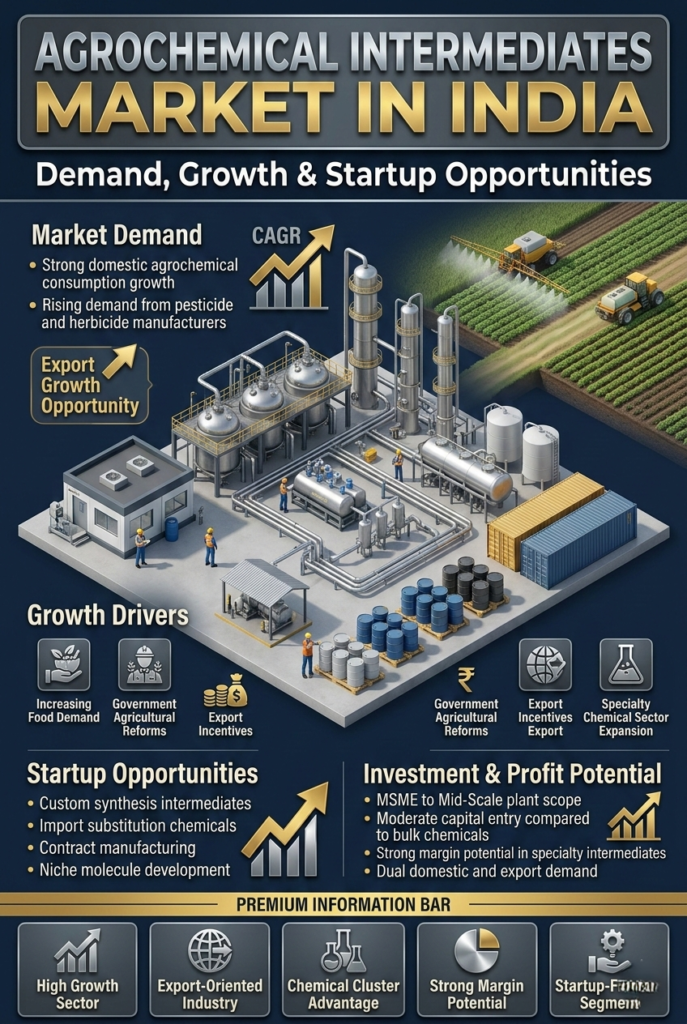
Business Opportunities for MSMEs and Startups
The increasing demand for agrochemical intermediates offers attractive opportunities to smaller chemical manufacturers. Entrepreneurs who are able to develop special production capabilities may find great demand from large agrochemical companies.(Agrochemical Intermediates Market)
Some of the promising areas to invest in are:
- Organophosphate Intermediates (used as widely in insecticides and herbicides).
- Pyridine and picoline derivatives – important substances found in modern pesticides.
- Fluorinated intermediates, used in advanced herbicide formulations.
- Amines and chlorinated aromatic chemicals (essential building components of crop protection chemicals).
By concentrating on niche intermediates and offering high quality standards, MSMEs can likewise become suppliers of major agrochemical manufacturers over time.(Agrochemical Intermediates Market)
Investment and Operational Considerations
Starting a chemical intermediate manufacturing facility requires careful planning and investment. The capital needed depends on the size of the production, level of complexity of the chemical processes involved and environmental compliance levels that may be needed.(Agrochemical Intermediates Market)
Typical investment requirements may be:
- Small speciality intermediate plant: 50-60 crore
- Medium scale intermediate level manufacturing facility-100-150 crore
- Large organophosphorus intermediate plant: Rupees 200-250 crore
The manufacturing process requires businesses to invest money while they also need to establish safe operational procedures and waste disposal systems and follow all necessary legal requirements. The chemical manufacturing process operates as a dangerous industry because it uses dangerous substances and conducts high-heat chemical processes, which requires businesses to implement rigorous safety procedures.(Agrochemical Intermediates Market)
Future Perspective of Agrochemical Intermediates in India
The future of the agrochemical industry of India will be reliant not only on the manufacturing of end products of pesticides but also on the development of a good domestic ecosystem for chemical intermediates. Reducing the reliance on imports can have a substantial impact on strengthening the supply chain and cost competitiveness.(Agrochemical Intermediates Market)
As global agrochemical demand continues to grow, as well as the diversification of international companies sourcing strategies, India has been given the chance of becoming a leading international centre for agrochemical products, as well as intermediates. Increased investment in research, advanced manufacturing technologies and specialty chemicals will play a key role in achieving this goal.
For entrepreneurs and investors, agrochemical intermediates are a promising industry with long-term growth potential and good demand both in local and international markets.(Agrochemical Intermediates Market)
Commonly Asked Questions (FAQs)
What are agrochemical intermediates?
Agrochemical intermediates are chemical compounds that are used as building blocks in the production of pesticides, herbicides, and fungicides.
Why does India import agro chemical intermediates?
India imports many intermediates due to limited capacity of domestic production of specialized chemicals and due to the fact that some of the key raw materials are not widely produced in the country.
Who are the major players in agrochemical industry in India?
Leading companies include UPL Limited, PI Industries, Aarti Industries, Bayer CropScience and Sumitomo Chemical India.
Is agrochemicals intermediate manufacture profitable?
Yes, the sector has a good potential in terms of profit because of the rising demand, export opportunities and also, the possibility to replace the imported intermediate products with domestic production.
How much investment to make to start chemical intermediate plant?
Investment requirements typically are in the range of Rs. 50 crores – Rs. 250 crores, depending on the size of the plant, technology implemented and level of environmental compliance.


