





Introduction: Chemical Manufacturing Clusters
Starting a chemical manufacturing business is much more than just setting up reactors, pumps and production equipment. While first-time entrepreneurs may be concerned with only technological and plant design choices, the success of manufacturing in the real world is also heavily dependent on the industrial ecosystem that surrounds the factory.
In India, grid challenges like unreliable utilities, logistics delays, regulatory complexity and inconsistent access to raw materials is about many standalone chemical plants. These problems can greatly affect the operational costs and lower profitability, even if the production process itself is technically sound.(Chemical Manufacturing Clusters)
For this reason, cluster-based chemical manufacturing parks are becoming the location of choice for new industrial startups. These parks gather together several companies in a common infrastructure environment geared towards industrial operations.
India’s chemical industry is already one of the biggest contributors to the manufacturing economy. As per the department of chemicals and petrochemicals, Ministry of chemicals and fertilizer’s industry has crossed 15 lakh crore in output’s value and still growing over 11% annually. With growing demands from sectors like packaging, pharmaceuticals, construction, agriculture and automotive manufacturing, new opportunities in chemical manufacture are growing exponentially.(Chemical Manufacturing Clusters)
However, along with the market’s growth, competition and complexity of operations also rise. Choosing the right location ecosystem can be an important determinant of the success of a new manufacturing venture. This is where cluster-based industrial parks offer good advantage.
Table of Contents
ToggleRead More: Handbook On Chemical Industries (Alcohol Based)
Understanding the Real Cost Structure of Chemical Manufacturing
When the industrial consultants are evaluating the feasibility of a chemical manufacturing project, they usually split the cost into two categories:
- Visible costs
- Invisible costs
Understanding the distinction between these two is very important for new entrepreneurs.
Visible Costs
Visible costs are the costs that are commonly included in the initial project planning by entrepreneurs. These are fairly easy to estimate and budget.(Chemical Manufacturing Clusters)
Typical visible costs are:
- Land acquisition
- Civil construction
- Plant and machinery
- Utility systems within the factory
- Installation and commissioning
- Safety infrastructure
As these costs are predictable, most project reports pay due attention to them.
Invisible Costs
Invisible costs are operational problems that occur after the production process starts. These costs are frequently under-estimated at the planning stage, and can have a significant effect on profitability.(Chemical Manufacturing Clusters)
Examples include:
- Disruptions to supplies of raw materials
- Transportation delays
- Utility failures
- Environmental compliance issues
- Shortage of skilled technical manpower
- Lack of nearby vendors or maintenance services
Standalone factories have to develop and manage all these systems on their own which brings risk to operations.
Cluster-based industrial parks on the other hand transform many of these risks into more structured systems of support, making operations more stable and predictable.(Chemical Manufacturing Clusters)
Read More: Modern Technology of Industrial Chemicals
Large chemical manufacturing clusters of India: PCPIR Regions
In order to build the chemical industry, the Government of India has been promoting large industrial ecosystems through Petroleum, Chemical and Petrochemical Investment Regions (PCPIRs). These regions are planned as integrated industrial areas with large scale infrastructure for chemical and petrochemical industries.
Dahej PCPIR, Gujarat
One of the most successful examples is that of Dahej PCPIR, Gujarat. This region is home to thousands of chemical units and it has attracted investments of more than 1.2 lakh crore.(Chemical Manufacturing Clusters)
Major benefits of Dahej cluster are:
- Strong port connectivity
- Integrated chemical supply chains
- Established vendor ecosystem
- Availability of skilled industrial manpower
Because of the densely industrial ecosystem, companies have easy access to suppliers, service providers and logistics networks.(Chemical Manufacturing Clusters)
Visakhapatnam to Kakinada PCPIR, Andhra Pradesh
Another significant cluster of chemicals lies along the Visakhapatnam – Kakinada corridor. Its location close to major ports makes it an ideal destination for companies engaged in international trade, particularly those that import raw materials or export chemical products.(Chemical Manufacturing Clusters)
The region is also blessed with good connectivity to industry corridors and big manufacturing centers.
Paradeep PCPIR, Odisha
The Paradeep PCPIR is building up as a major petrochemical centre on the basis of large anchor investments. Large-scale exercises provide downstream opportunities for smaller manufacturers producing intermediate chemicals and specialty materials.(Chemical Manufacturing Clusters)
These PCPIR regions serve to prove that industrial clusters are not just industrial land allocations. They are integrated ecosystems in which infrastructure, supply chains, utilities and environmental systems develop together.
Plastic Parks: Infrastructure Cluster for Manufacturers of MSMEs
While PCPIR regions are used to develop large-scale chemical industries, the Government of India has also developed Plastic Parks to develop small and medium enterprises (MSMEs).
Plastic parks with a focus on development of downstream plastics processing industries by making industrial infrastructure ready.(Chemical Manufacturing Clusters)
Under this initiative, the government provides financial support up to 50% of the cost of projects with the maximum grant of Rs 40 crores for park development.
Plastic parks have been approved in a number of states including:
- Madhya Pradesh
- Odisha
- Tamil Nadu
- Assam
- Jharkhand
- Karnataka
- Uttarakhand
- Uttar Pradesh
These parks offer startup manufacturers the following:
- Pre developed industrial plots
- Internal roads and infrastructure
- Utility connections
- Shared service facilities
- Cluster based vendor networks
For entrepreneurs to get into plastics manufacturing, this is a very favorable environment that greatly reduces the complexity of starting a new industrial unit.(Chemical Manufacturing Clusters0
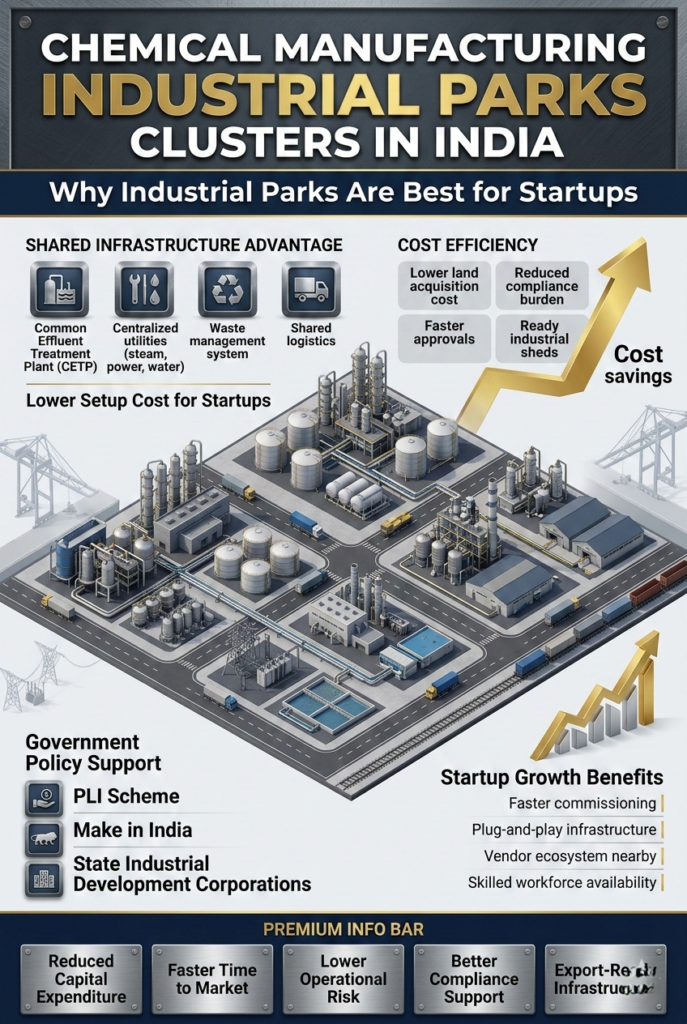
Why Manufacturing Parks Based on Clusters Are Perfect for Startups
Cluster-based industrial parks have a number of advantages which make them highly suitable for new manufacturing ventures.
1. Reduced Effective Capital Investment
Chemical manufacturing requires extensive infrastructure development which exceeds its requirements for production equipment.
Essential systems include:
- Industrial drainage network is
- Fire safety systems
- Utility pipelines
- Waste treatment facilities
- Chemical storage infrastructure
Cluster parks provide their member companies with shared facilities which reduce the need for each business to make their own capital investments.
This gives startups more resources to focus on production technology and products development.(Chemical Manufacturing Clusters)
2. Accelerated Plant Setup and Commissioning
Standalone industrial projects tend to suffer delays because of:
- Utility connection approbations
- Contractor shortages
- Delays in infrastructure construction
- Complex regulatory approvals
Cluster parks typically have pre-approved industrial frameworks that make it easier for companies to set up operations fast.
The time from startup to production and the time required to reach market availability both decrease for startups.(Chemical Manufacturing Clusters)
3. Simpler Environmental Compliance
Environmental regulations in the chemical industry are stringent and constantly changing.
Manufacturers are required to comply with requirements concerning:
- Effluent treatment
- Hazardous waste management
- Chemical storage safety
- Air emission controls
Cluster parks often comprise of centralised environmental infrastructure, e.g. common effluent treatment plants (CETPs). This in turn helps companies conform to regulatory requirements without spending on costly individual systems.(Chemical Manufacturing Clusters)
4. Thriving Supply Chain Ecosystems
Industrial clusters are natural magnets for suppliers, logistics providers and technical service companies.
This results in a thick vendor ecosystem, which in turn is good for startups for a number of reasons:
- Better access to raw materials (faster access)
- Reduced transportation costs
- Fast maintenance and technical support
- Increased efficiency in procurement
For chemical manufacturers, supply chain reliability is a critical issue for maintaining consistency in production.(Chemical Manufacturing Clusters)
Manufacturing Opportunities in Cluster Ecosystems
Cluster environments also open a number of interesting business prospects for new entrepreneurs.
Polymer Compounding and Masterbatch Making
Polymer compounding involves the modification of base polymers in order to improve properties such as:
- UV resistance
- Flame retardancy
- Impact strength
- Colour and appearance
Once a compound formulation has been approved by a customer, manufacturers obtain repeat orders often for longer time periods creating stable revenue streams.(Chemical Manufacturing Clusters)
Flexible Packaging Films
Flexible packaging materials have a wide range of applications throughout industries, including food processing, logistics, agriculture, and pharmaceutical.
The specialized films which industrial and agricultural sectors use in their operations achieve higher profit margins compared to regular plastic products.
Cluster parks provide easy access to polymer raw material and processing equipment vendors, making them a suitable location for such businesses.(Chemical Manufacturing Clusters)
Industrial Moulded Products
Manufacturing centres need large quantities of industrial pallets, crates, containers, and storage bins used in the handling of materials.
These products have constant demand from factories, warehouses and logistics companies that operate in industrial clusters.
Recycling and Reprocessing of Polymers
Industrial clusters produce concentrated flows of plastic and polymer waste. Recycling these materials into reusable raw materials is an opportunity that is being explored more as the years pass.
The increasing focus on sustainable practices together with circular economy methods has made polymer recycling businesses highly appealing within industrial manufacturing systems.(Chemical Manufacturing Clusters)
Strategic Lessons of India's Industrial Suitors
Many of India’s top industrial groups have grown large businesses not only focused on manufacturing but also in the development of strong industrial ecosystems.
Entrepreneurs such as
- Mukesh Ambani
- Gautam Adani
- Kumar Mangalam Birla
- Karsanbhai Patel
have increased their businesses through creating integrated supply chains, infrastructure networks and downstream markets.
For MSME entrepreneurs, learning is not how to do it on their scale but to start thinking like the same ecosystem.
Selecting the correct industrial environment can change dramatically the odds of long-term success.
Conclusion
Cluster based chemical manufacturing parks are changing the way of new industrial businesses to start the business in India. By offering shared infrastructure, dependable utilities, fixed supply chains and structured regulatory environments, these parks ease the burden of many of the operational risks involved in running stand-alone factories.
As the chemical and plastics industries continue to grow in India, startups that can position themselves in strong industrial ecosystems will be better positioned for efficient scaling and will be able to compete in global markets.
For entrepreneurs looking to get into the manufacturing business, the selection of a cluster-based industrial park is not merely a matter of location, but a strategic choice for the long-term success of the business.(Chemical Manufacturing Clusters0
FAQ
What is a Cluster based Chemical Manufacturing Park?
A cluster-based manufacturing park is an industrial zone in which a number of manufacturing units are located in conjunction with each other but with common facilities relating to utilities, logistics facilities and environmental management systems.
Why are cluster parks good for startups?
They lower operational risks as they offer pre-existing infrastructure, vendor networks and easier regulatory compliance.
Are cluster-based parks beneficial for small manufacturers?
Yes. A number of industrial clusters, particularly plastic parks, are aimed at providing support to small and medium size enterprises.
Do cluster parks reduce startup costs?
Cluster parks often reduce infrastructure costs and improves operational efficiency, which helps improves overall project feasibility.
Which industries can be successful inside cluster parks?
Industries such as plastics processing, packaging manufacturing, polymer compounding, recycling and specialty chemicals lend themselves to cluster ecosystems.


