



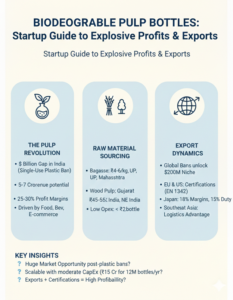
First-time industrialists scanning for scalable ventures often overlook packaging, yet Biodegradable Pulp Bottles stand out as a rare intersection of regulatory tailwinds, consumer shifts, and raw material abundance. The single-use plastic prohibitions in India have opened up a billion-dollar gap, the only real option being the use of molded pulp packaging, estimated to be over USD 250 million and increasing at an alarming rate of about 10 percent a year, driven by food, beverage, and e-commerce needs.
This is not propaganda it is based on the tidal wave of substitutes such as wood pulp or bagasse that break down naturally without leaving behind microplastic pollution. The high entry barriers are an unattractive factor to MSME planners, whose modest plant with a 5 million bottles per year throughput can reap a figure of Rs. 5-7 crore revenue with 25-30% margins due to the low cost of pulp at Rs. 40-60 per kg.
According to the Annual Report 2024-25 of the Ministry of New and Renewable Energy, there is an equal promotion of biomass-based materials, which indirectly encourages the use of agro-wastes to produce pulp. Savvy founders see beyond domestic sales—export markets in Europe and Southeast Asia crave certified biodegradable options, turning a local hustle into a global exporter of Biodegradable Pulp Bottles.
Read Our Books: India Sugarcane Bagasse Biodegradable Disposable Tableware Market
Raw Material Sourcing: Bagasse and Pulp at Rock-Bottom Prices
The crucial step in the operation of fueling a pulp bottle is mastering agro-waste wherein bagasse of sugar mills is the most cheapest and reliable input at Rs. 4-6 per kg delivered. The two provinces of Uttar Pradesh and Maharashtra alone produce 150 million tonnes of cane trash annually much of which is burned or discarded- entrepreneurs fill this gap by establishing collection radii within 100km, and conclude bulk deals with cooperatives at levels that guarantee 90% capacity utilization.
Wood pulp dominates at 85% market share due to its renewability, sourced from eucalyptus plantations in Gujarat at Rs. 50/kg, but blending 30% non-wood like bamboo slashes costs further while boosting biodegradability claims—an important differentiator for Biodegradable Pulp Bottles manufacturers.
| Raw Material | Annual Availability (Million Tonnes) | Cost per kg (Rs.) | Key Sourcing Regions | Biodegradability Timeline |
| Bagasse | 150 | 4-6 | UP, Maharashtra | 90 days |
| Wood Pulp | 10 (processed) | 50-60 | Gujarat, Andhra | 120 days |
| Bamboo Pulp | 5 | 45-55 | Northeast, Karnataka | 60 days |
| Recycled Paper | 8 | 30-40 | Pan-India | 45 days |
Read Also: Top Biodegradable Products Business Ideas
This disaggregation demonstrates the power of diversification: startups that average these inputs achieve opex of less than 2 per (Rs. 2) per bottle, and quality control is achieved by burst strength testers. The Hindsight of the founder of Ekocart, Rohan Gupta, resonates well with his successes of growing a molded pulp business in Delhi, where he locked seasonal bagasse to fixed prices avoiding 20 percent price volatility that amateurs face. New ventures should invest Rs. 10-15 lakh in drying yards early, transforming waste arbitrage into a profitability moat for Biodegradable Pulp Bottles production.
CapEx Breakdown: Launch a 1 Million Bottle/Month Plant for Rs. 15 Crore
The experts in the industrial consulting industry drive the point that CapEx discipline is a distinction between the survivor and the casualty, and pulp bottle plants are a perfect example of lean scalability. Mid-sized structure moulding 12 million units per year requires Rs. 12-15 crore: molding machines (40%), pulp slurry systems (25%), and civils (20). Chinese semi-automated lines at 3 crore each of 500000 bottle line: Finance 70 per cent by SIDBI at 9 per cent – payback time 4-5 years at 15-20 per bottle prices will provide 20-25 per cent IRR. Hybrids with coating for liquids add Rs. 2 crore but unlock beverage premiums, strengthening positioning in the fast-growing Biodegradable Pulp Bottles segment.
There is a looming risk of water usage (200 liters per tonne pulp) that will be countered by zero-liquid discharge that comes at an additional cost of Rs. 50 lakh. Promoter Naveen Galia of Ballarpur industries has developed resiliency by developing modular expansions by starting small to test FSSAI nods, where the start ups have the same type of expansion by testing 200,000 bottles per month first then increasing by 85 percent after 12 months. The e-commerce giants have their private labels, which are levers of profit since 30 percent of EBITDA is guaranteed by volumes.
Import-Export Dynamics: Ride Global Bans to Premium Dollars
Domestic prohibitions are pocket money; the riches are on exports, where the single-use directives of EU and the compostable stipulations of the US provide Indian bottles of pulp with a niche of 200 million dollars. Variants of bagasse are sold at $0.10-0.15 per unit FOB Chennai, and the packaging shift of 500,000 tonnes targets the Japanese market- Japan has a 18% margins in 10 million units shipment at 15% duty under RoDTEP. Scalability explodes with PE-free coatings meeting EN 13432 standards, positioning MSMEs as global suppliers of Biodegradable Pulp Bottles to brands like Nestle and Unilever abroad.
JK Paper JK Paper Bharat Jain had mastered this when he turned pivoting the coastal mills to Southeast Asia, cutting logistics by a quarter through his Tuticorin rationalization of certification-first opened $100 crore orders. SEZ structures mitigate freight risk by startups, combining half 60 percent domestic (BigBasket, Amazon) and 40 percent export revenues.
Scalable Project Ideas for Pulp Bottle Startups
Bagasse Water Bottle Line with E-Commerce Focus
PET underserved target hydration markets which are manufactured by converting UP cane waste to 10 million 500ml bottles annually. Rs. 10 crore setup will have net of Rs. 4 crore at Rs. 18 wholesale; under the Gupta model of aggregation, the feedstock is assured and FSSAI is arranging the B2B deals. Scale through variants of juices, reaching 28 percent margins.
Bamboo Pulp Beverage Bottles for Premium Brands
Use Northeast farms as source of food-grade pulp, make 8 million 250ml units of craft beers. Rs. 12 crore CapEx, Rs. 22/bottle prices export premiums; include PLA lining to shelf-life. The quality pivot taught by Jain is merciless leak tests.
Recycled Pulp Multi-Use Containers for FMCG
Blend 15 million bottles of waste paper, and sell HUL at Rs. 15/unit. Low entry, 22% IRR through volume, Rs. 8 crore; risk-hedge using multi-cavity molds. The modularity of Galia provides the possibility of 50 percent of annual capacity ramps.
Coated Pulp Bottles for Edible Oils
5 million liter-equivalent packs engineer barrier tech, to export to Middle East. Rs. 14 crore, where extruders, $0.12 FOB edges import; domestic oils boom is an upside. Financials here are de-risked by NPCS DPRs.
Read Project Details: Market Research Report on Edible Oils in India
Hybrid Pulp Jars for Cosmetics and Pharma
Wood mixes 3million 100ml units, FDA export compliant. Rs. 9 crore lean factory, 25% profit on boutique brands; the fastness of bamboo responds to seasonal spikes.
Niir Project Consultancy Services is an expert consultant in terms of preparation of Market Survey cum Detailed Techno-Economic Feasibility Reports (DPRs) to establish new industries or businesses. Our reports contain elaborate manufacturing procedures, market study and requirement analysis, process flow chart, product mix and capacity planning, machinery and raw material specifications and the entire project financials along with profitability analysis. We are aimed to make entrepreneurs consider feasibility, profitability, and scalability in the long-term and invest.
Tycoon Lessons for Pulp Pioneers
Rohan Gupta of Ekocart made bagasse bans his treasure trove, choosing the quantities of e-commerce to retail-Rohan Gupta of Ekocart announces his 40 percent yearly growth and calls upon startups to pursue hyperscalers first. In JK Paper, Bharat Jain leveraged certifications to sell more exports when other peers refused to go international, demonstrating compliance leads to premiums. Naveen Galia of Ballarpur was a betor on the volatility of pulp, in the form of modularity, achieving 95 percent utilization which is essential to bootstrappers. Their wisdom in common: grow locally, certify globally, expand incrementally.
FAQ:
What is the minimum size of plant to be viable?
5-10 million bottles/year; smaller risks 15% higher costs- begin with Rs. 8 crore pilots.
What to do to overcome plastic price competition?
2-3/bottle parity through bagasse; point out biodegradability on 20% premiums.
Certifications to be used as an exporter?
EN 13432, ASTM D6400-budgets Rs. 20 lakh, partner labs early.
Prime locations?
Up-maharashtra to bagasse, coastal to exports- less than 100 km mills.
Break-even period?
3-4 years at 80 percent PLF; coatings are a 10 percent increase in revenue.


